
What Are You Actually Listing? Issuance Structures
The question this chapter answers: is the user buying a share, a debt instrument, a tracker certificate or a derivative contract? And should you skip tokens altogether and list stock perps instead? Each of these choices determines how the product description and the risk disclosures have to be written.
At 17:00 UTC on November 16, 2026, during the US session, our monitoring recorded six “TSLA”s on-chain at the same moment. The deepest was Ondo’s TSLAon on Ethereum, with about $8.34 million in liquidity. Next came xStocks’ TSLAx on Solana at about $2.68 million, TSLAB, issued by a Binance affiliate, at about $1.19 million, and the Tesla token on Robinhood Chain at about $1.04 million. Their prices were within 1% of one another.
The prices were that close, yet legally these are four different things. The xStocks and Robinhood tokens are debt securities issued by Jersey companies. Ondo’s token is issued by a British Virgin Islands company and is also a debt security. TSLAB is an Abu Dhabi certificate representing a beneficial interest in shares. None of them makes the holder a Tesla shareholder.
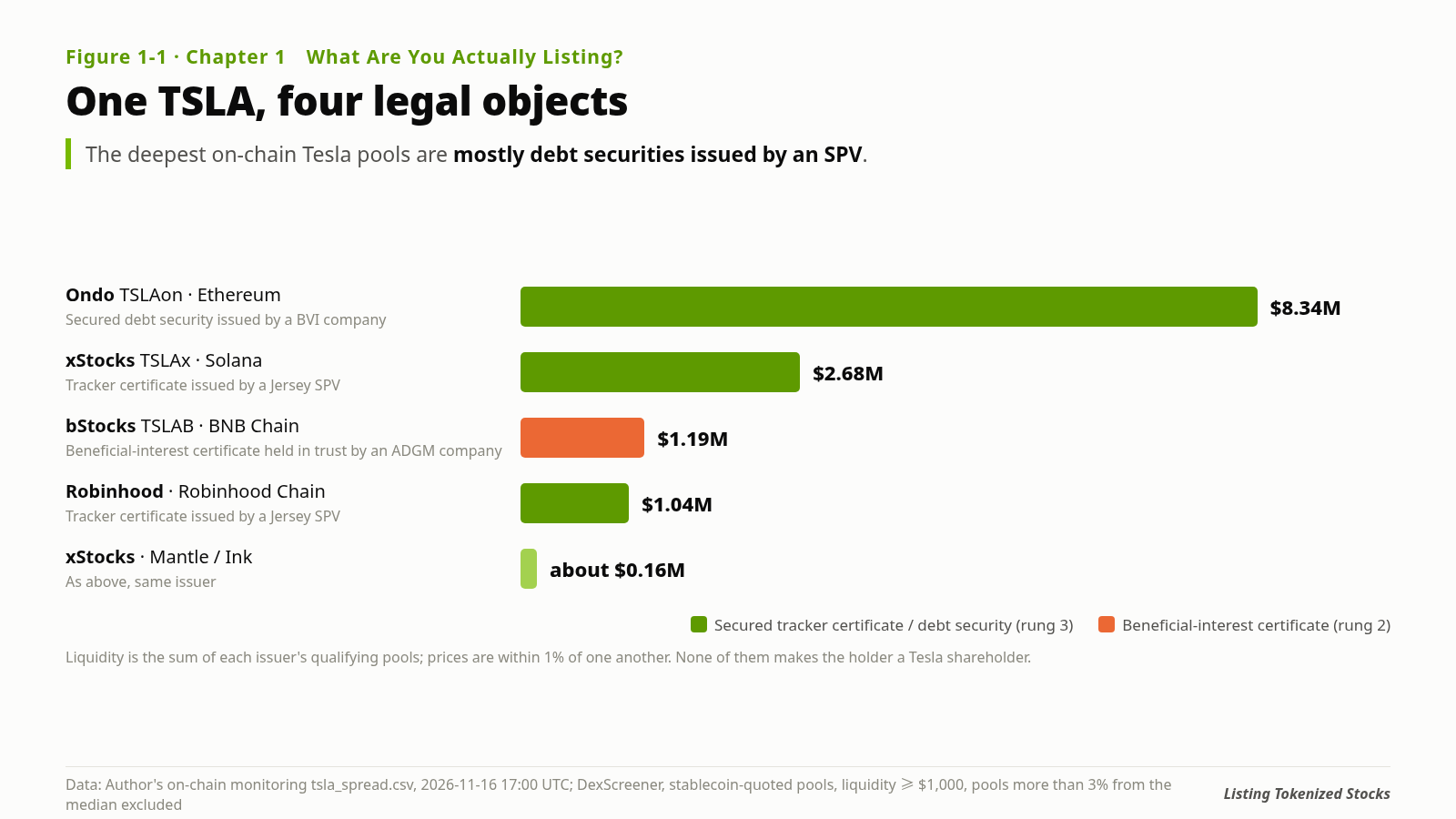
So before you list, you have to make this chapter’s decision: what kind of legal object is the “TSLA” on your platform? There are two layers. First, choose between listing the token and listing a stock perp (second half of this chapter). If you choose the token, then choose which rung of the ladder. That choice runs through everything that follows: how your product page is written, what your risk disclosures say, and who you can sell to. It also determines the question Chapter 6 takes up: what users are left holding if the issuer fails.
Ask three things first: a claim on whom, secured by what, and how do you exit
For any tokenized stock, start with three questions:
- A claim on whom? Is your user a Tesla shareholder, a beneficiary of a custodian, or a creditor of a special purpose vehicle (SPV)?
- Secured by what? If it is a debt claim, does the debtor hold the corresponding shares? Are those shares pledged to an independent security agent?
- How do you exit? Can the user swap back into real shares, only into cash, or only sell on the secondary market?
Sorted by the answers to these three questions, the products on the market today form a four-rung “ownership ladder.” The higher the rung, the closer the holder is to “really owning the stock”; the lower the rung, the more the holder depends on one particular company keeping its word.
- Rung 1: the share itself. A company records its own SEC-registered shares directly on-chain. The token is the share, and the holder is on the shareholder register. The example is Superstate’s Opening Bell.
- Rung 2: custodial entitlement. A third party buys real shares and holds them for the holder in trust or as a security entitlement (under Article 8 of the US Uniform Commercial Code). The holder owns a beneficial interest in those shares, not a general claim on the third party. Examples are Securitize Stocks, Coinbase’s certificates issued in Abu Dhabi, and Binance’s bStocks.
- Rung 3: secured tracker certificate. An SPV issues its own debt securities whose return tracks the share price. It buys the shares as pledged assets and pledges them to an independent security agent. The holder is a secured creditor of the SPV. Examples are xStocks, Ondo Global Markets and Robinhood’s on-chain stock tokens.
- Rung 4: contractual claim. A company signs a contract with the user and settles by reference to the share price. No assets are separately pledged for holders, or the user’s only claim is on the company itself. Examples are Dinari’s dShares and the “Classic” stock tokens inside Robinhood’s EU app. The stock tokens on FTX in 2021–2022 were also on this rung (Chapter 6).
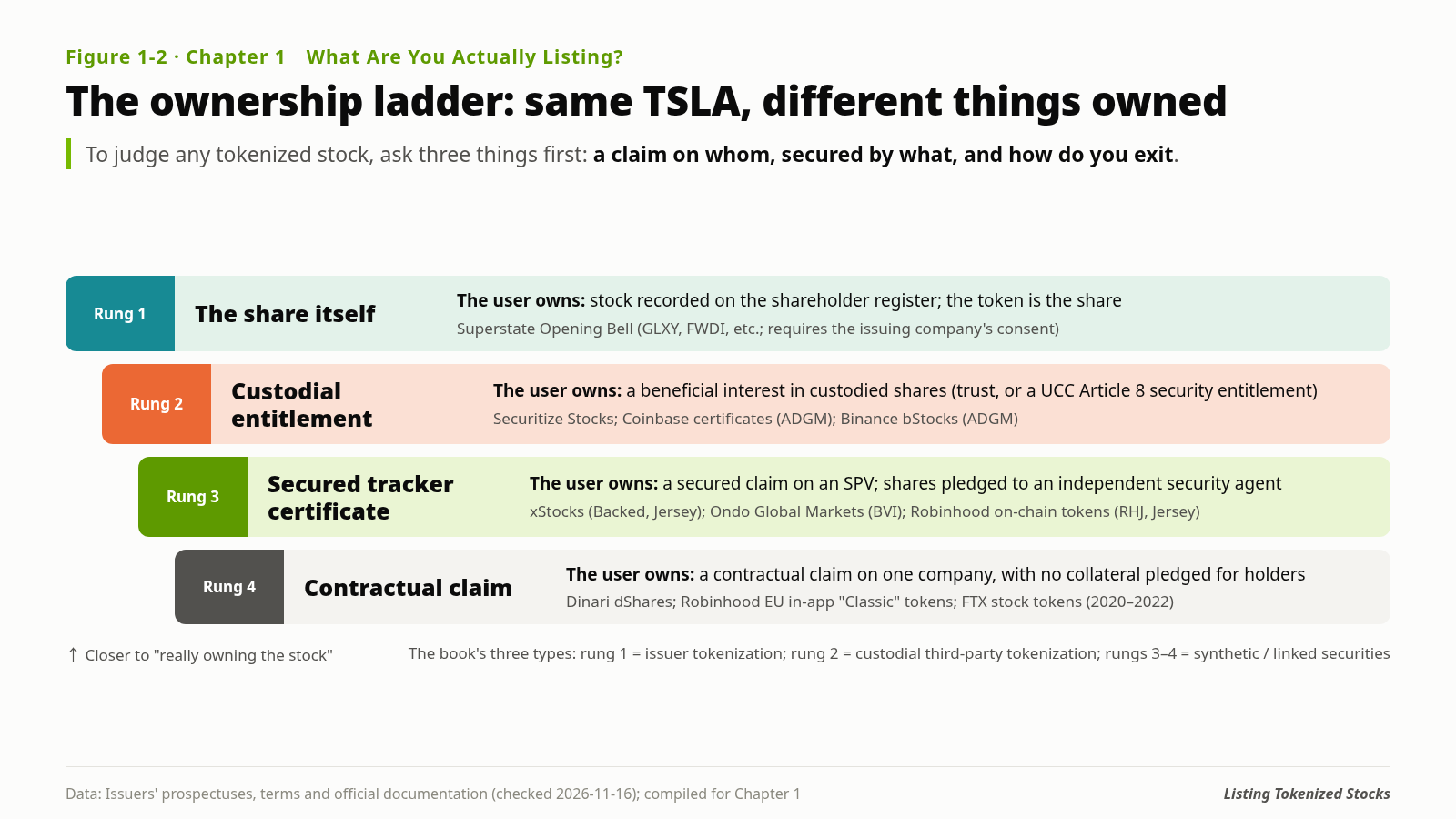
This ladder uses the same classification as the “three types of tokenized stock” used throughout the book, just cut more finely. The three types come from the US Securities and Exchange Commission’s Statement on Tokenized Securities of January 28, 2026. It first separates issuer tokenization from third-party tokenization, and then splits third-party tokenization into custodial and synthetic (the synthetic type includes “linked securities” and “security-based swaps”). The mapping is: rung 1 is issuer tokenization; rung 2 is custodial third-party tokenization; rungs 3 and 4 together are synthetic / linked securities, that is, the issuer’s own debt instruments or contracts. This book splits that type into two rungs. The dividing line between them is the security agent and the segregated custody account. As Chapter 6 explains, in a bankruptcy that line decides whether users get back the proceeds from selling the pledged assets, or an ordinary unsecured claim.
Rung 3: where on-chain liquidity is concentrated
Of the four TSLAs at the start of this chapter, three are on rung 3. The three issuers on this rung all use secured tracker certificates, with almost identical structures.
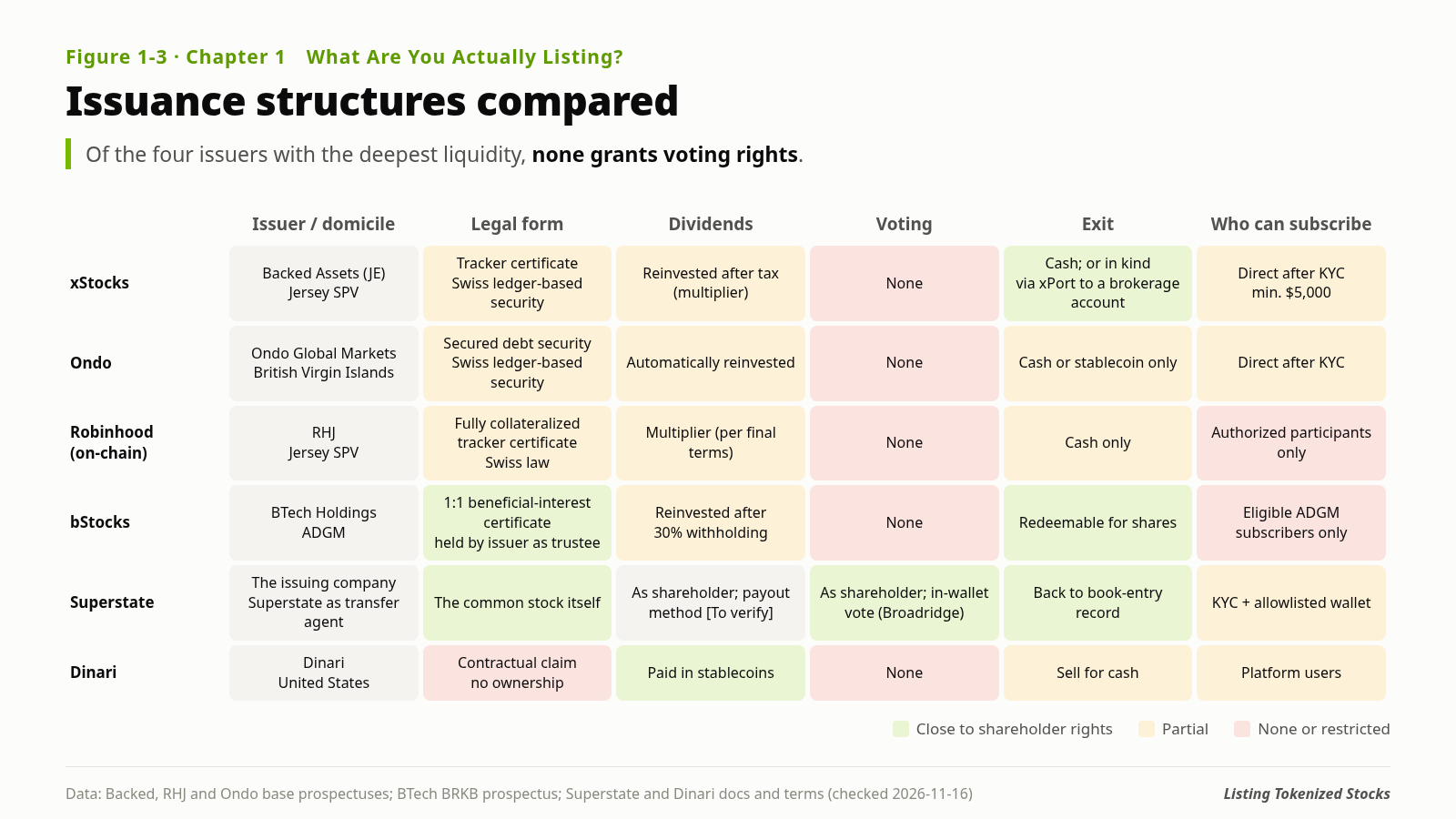
xStocks. The issuer is Backed Assets (JE) Limited, a Jersey SPV that its official documentation describes as “dedicated to the issuance and redemption of xStocks.” It is registered with the Jersey Financial Services Commission (JFSC) and has consent to issue, but the prospectus states that this consent “does not confer ‘regulated’ status on the issuer,” and that the issuer will not be supervised by any regulator as a result of the issuance. In Switzerland, the product is not approved by the Swiss Financial Market Supervisory Authority (FINMA) and can be sold only to professional investors. The EU base prospectus is approved by Liechtenstein’s Financial Market Authority (FMA) and passported to other countries in the European Economic Area (the latest version is dated May 8, 2026). The legal form is a bearer debt instrument, classified as a tracker certificate, and it constitutes a ledger-based security under Article 973d et seq. of the Swiss Code of Obligations: the token itself is the certificate. The prospectus is blunt: the product “does not represent any claim on the underlying” and “does not grant investors voting rights, nor any right to receive distributions.” Dividends, net of tax, are used to buy more of the same stock, and this shows up through the multiplier (Chapter 2).
Backed is now owned by Kraken. Kraken announced its acquisition of Backed Finance AG on December 2, 2025. The prospectus states that around January 5, 2026, Payward Europe Limited bought all of its shares, and also that Payward does not guarantee the issuer’s obligations. The parent company is now an exchange, but the user’s debtor is still that Jersey SPV.
Robinhood’s on-chain stock tokens. The issuer is Robinhood Assets (Jersey) Limited (RHJ), Jersey registration number 162428. Its prospectus is also approved by Liechtenstein’s FMA, with the programme established on June 25, 2026. It describes the product as “debt securities securitized in the form of crypto tokens,” each one “a fully collateralized tracker certificate,” governed by Swiss law. Like Backed, it carries no voting rights. The differences: redemption is cash only, with no physical delivery; and the prospectus says outright in its FAQ that the issuer “is not authorized or regulated by the JFSC, the FMA or any other competent authority.” Jersey’s consent to issue is not a licence. Third-party data sites that describe these two issuers as “regulated by the JFSC/FMA” are wrong. The contract-level pause and burn powers are covered in Chapter 6.
Ondo Global Markets. The issuer is Ondo Global Markets (BVI) Limited, a British Virgin Islands company. According to Ondo’s documentation, 90.01% is held by Flux Finance, a wholly owned subsidiary of the Ondo Foundation (the prospectus says 90.1%; the two do not match). The FMA approved its base prospectus on November 11, 2025, in the category “debt securities with a denomination of less than EUR 100,000.” Ondo’s documentation calls the product “structured notes,” while the prospectus likewise uses the form of a ledger-based security under Swiss law. Holders have no voting rights and no shareholder information rights, and dividends are automatically reinvested. The prospectus limits all of the holder’s rights to “an indirect, pro rata economic claim on the net realization proceeds, exercisable only through the security agent.” Redemption is only into cash or stablecoins. Ondo launched on September 3, 2025 with more than 100 US stocks and ETFs; by its letter to the SEC of April 13, 2026, it offered more than 260 products.
Put the three side by side. Two are domiciled in Jersey and one in the British Virgin Islands. All three use ledger-based securities under Swiss law. Two have EU prospectuses approved in Liechtenstein. Backed and RHJ use the same security agent (Security Agent Services AG, Zug) and even share a registered address in Jersey (the office of the same administrator, Cavendish Fiduciary). The deepest tokenized-stock pools on-chain are almost all the same legal product: a tracker certificate issued by an SPV and secured by shares. For platforms this is good news: the assessment method can be reused. The bad news is that users on this rung are not shareholders under any circumstances, and any wording in a product description that suggests “you hold the stock” cannot stand.
Rung 2: a beneficial interest, but not a shareholder
Products on rung 2 are legally closer to the stock, but the details contain hurdles.
bStocks. The issuer, BTech Holdings Ltd, is registered in the Abu Dhabi Global Market (ADGM) under number 36283; Binance calls it “a Binance Group affiliate.” Each stock has its own prospectus, approved by the ADGM Financial Services Regulatory Authority (FSRA). Binance announced the first batch on June 12, 2026, including TSLAB, NVDAB, CRCLB and others. The certificates represent “a 1:1 beneficial interest in the underlying.” The shares sit in a segregated account opened in the issuer’s name with the custodian Alpaca, and the issuer holds them as trustee for the certificate holders. Holders can redeem certificates for the corresponding shares but have no shareholder voting rights; dividends are reinvested after deduction of the 30% US withholding tax, not paid in cash.
The hurdle is subscription. Only “eligible ADGM subscribers,” who have completed Binance KYC, are located within ADGM and are not US persons, can mint. Anyone outside ADGM can only buy on the secondary market. Restricted jurisdictions are written into the transfer restrictions of the certificate’s smart contract, and certificates that end up in the hands of people in those jurisdictions can be frozen or cancelled (Chapter 8). There is one more point risk teams should note: taking the BRKB prospectus as an example, the shares behind the first certificates were borrowed from Alpaca by Binance’s clearing firm, not bought on the open market. That is a question of “how clean the pledged assets are,” covered in detail in Chapter 6.
Coinbase’s certificates. Coinbase Onchain SPV Ltd is also registered in ADGM. Taking its UMAC prospectus of October 22, 2026 as an example, the product is a “certificate representing a beneficial interest in common stock.” The issuer holds the shares under a trust deed, in a segregated account at Alpaca. It divides holders into two classes. “Vested holders,” who have completed KYC, wallet verification and bank-account linking, are entered on the statutory register and can redeem for shares and give voting instructions. “Unvested holders,” who bought on the secondary market and have not completed those steps, are owed only the duties of a bare trustee. The same token can carry a different legal status in two different wallets.
Securitize Stocks. Launched 12 stocks (including TSLA) on October 8, 2026, and expanded to 25 on November 2. Each token is a security entitlement under Article 8 of the Uniform Commercial Code, held through Securitize Markets (an SEC-registered broker-dealer). Securitize says holders retain dividend rights, retain voting rights where the underlying stock carries them, and can convert into registered shares if the issuing company adopts issuer tokenization. Note that the issuing companies themselves are not involved in this product.
Rung 1: real shares, but almost no float
Superstate’s Opening Bell takes a different route. Superstate Services LLC is an SEC-registered transfer agent. An issuing company signs a digital transfer agency agreement with it; once shareholders move their shares into book-entry records under Superstate, they can mint them as tokens into allowlisted wallets. Burning a token returns it to the book-entry record, with no payment involved. In an exhibit to its 8-K of September 3, 2025, Galaxy Digital wrote: “This is not a derivative or a representation; they are Galaxy Digital’s Class A common stock, with all the rights that come with it.”
This is the only structure in which the user really is a shareholder. It comes at two costs. Every stock needs the issuing company’s own consent; and even with consent, the on-chain amount is small. On November 16, Superstate’s asset page showed only 13,399 GLXY shares on Solana, and no SBET shares on-chain at all. Tesla, NVIDIA and the other stocks platforms most want to list have not taken this route. Voting has one arrangement in place: the proxy materials for Galaxy’s 2026 annual meeting opened in-wallet voting to holders of on-chain GLXY, through Broadridge’s ProxyVote embedded in the wallet. There is no public data on how many holders actually voted this way. How dividends reach token holders is not described in Superstate’s or Galaxy’s public documentation; you need to ask directly [To verify].
There is another example that is easy to confuse. In 2021 Exodus issued “tokenized common stock” through Securitize, but the offering circular stated that the common stock tokens “are not shares of Class A common stock, but a digital representation of the number of shares purchased and held by a stockholder.” Even a token issued by the company itself is not necessarily the share itself. Read the documents, not the name.
Rung 4: only a contract
Dinari’s dShares. Dinari Securities was approved as a US registered broker-dealer on June 20, 2025. But the dShares token terms (version of December 26, 2025) are clear: holders “have no rights to or ownership of the underlying assets, but have a claim on the value of those assets”; the buyback is “a contractual right to sell,” and “ownership of the underlying assets and all rights incidental to ownership remain with the company.” Dividends are paid to the wallet in stablecoins, and voting rights are retained by Dinari or the custodian. The terms also state that the underlying assets are held in a Bermuda segregated accounts company, managed by an independent representative if Dinari runs into trouble. That is a layer of separation, but holders have no proprietary rights in those assets and no security agent to enforce on their behalf.
Robinhood’s two tokens. The same brand has two products in the EU. The one that circulates on-chain is the RHJ tracker certificate on rung 3 above. The “Classic” stock tokens inside the app are provided by Robinhood Europe UAB, supervised by the Bank of Lithuania. According to its key information document, they are OTC derivatives under MiFID II. They cannot be transferred to an external wallet, Robinhood Europe is the sole counterparty, they are not covered by investor compensation or deposit insurance, and they carry a risk rating of 7 on a 7-point scale. Both are called “Robinhood stock tokens,” but one is on rung 3 and the other on rung 4. If your platform sources “Robinhood’s tokens” from elsewhere, the first thing to confirm is which one you are connecting to.
Beyond the ladder: list the token, or list the stock perp?
At 19:37 UTC the same day, the TSLA perpetual on Hyperliquid deployed by trade.xyz had about $39.5 million in open interest and about $31.3 million in 24-hour volume; open interest across the deployment’s 145 markets totalled about $4 billion. The five Tesla token routes from the start of the chapter had combined reported liquidity of about $13.4 million. The two numbers measure different things, one exposure and the other money sitting in pools, so they cannot be used to compare total capital on each side. What can be said is this: the open interest of a single perp market was close to three times the combined reported liquidity of all five token routes. For now, the main venue for on-chain exposure to Tesla’s price is perps (in this sample).
So the first alternative a platform faces is not switching to a different issuer, but not listing a token at all and listing a stock perp instead. On the trading page the two look identical: both are called TSLA, and both move with Tesla. But users’ rights, the platform’s risk, off-hours pricing and corporate-action rules are all different.
What the user gets
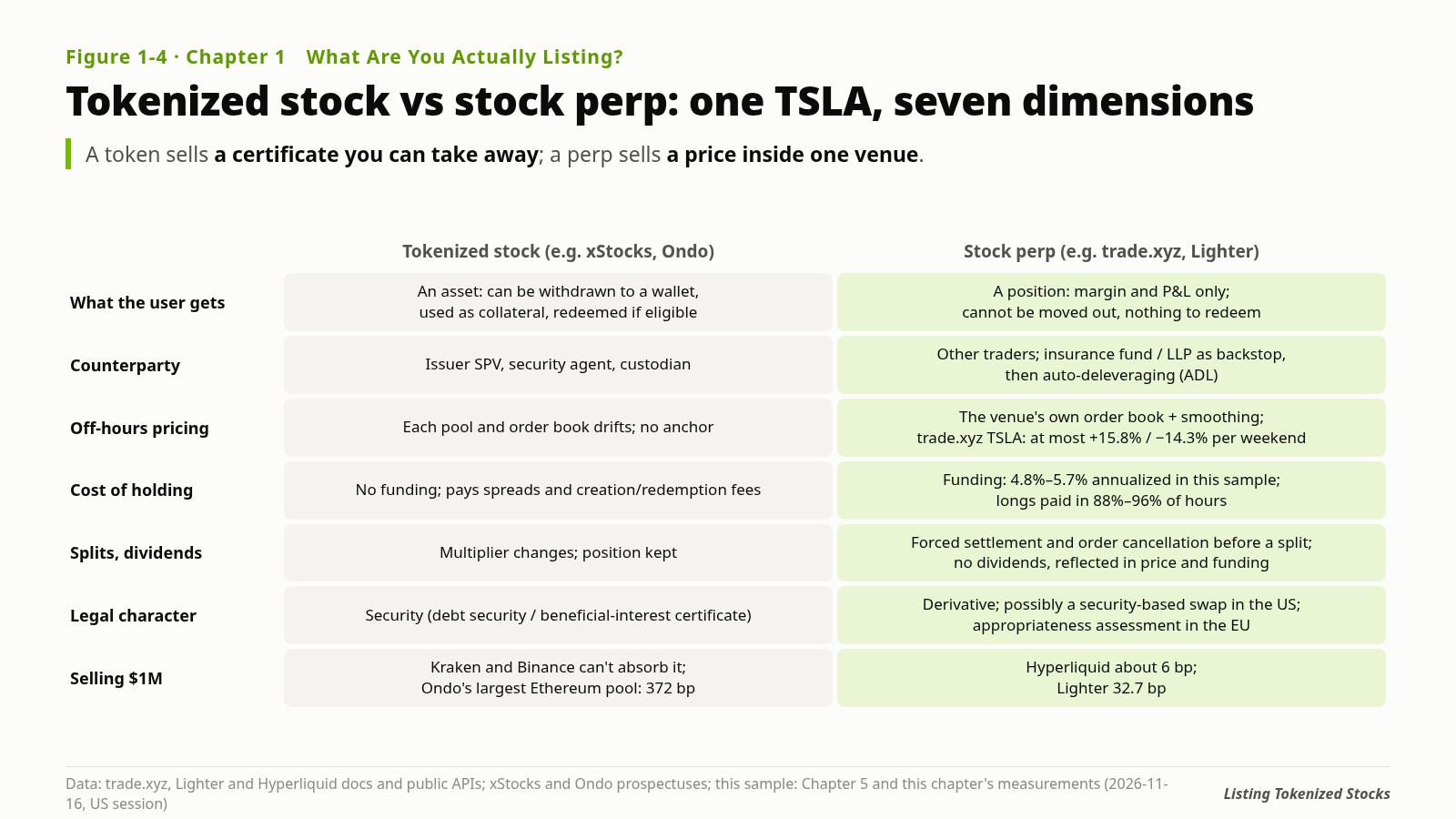
A tokenized stock is an asset. Whatever rung it sits on, it can be moved into the user’s own wallet, posted as collateral in a lending protocol (Chapter 7), and created or redeemed by eligible parties (Chapter 3). Splits and dividends are reflected through the multiplier (Chapter 2). It has no leverage, does not expire and charges no holding fee.
A stock perp is only a position. What the user deposits is margin (USDC, USDT or USDG), in exchange for a contract that settles profit and loss against the price. The position cannot be withdrawn to a wallet, cannot be used as collateral elsewhere, and there is nothing to create or redeem. trade.xyz’s risk disclosure puts it plainly: perpetual contracts provide synthetic price exposure and give the holder no ownership of the underlying asset or the issuer, and no voting, dividend, distribution, information, redemption, conversion, delivery or any other rights. The bottom rung of the ladder is a contractual claim on a company; a perp does not even have that IOU. The user’s profits are paid by the counterparty’s losses.
Corporate actions show the difference most clearly. When a token goes through a stock split, the multiplier changes and the user’s holding remains (Chapter 2). When a perp goes through a split, positions are force-closed. Lighter’s rule is to delist the market before the split takes effect and settle at the mark price, with “settlement time not announced in advance,” and all open orders cancelled. For Sandisk’s 8-for-1 split on November 19, 2026, trade.xyz announced that all positions would be settled at that day’s Nasdaq close and the market reopened the next day on the post-split basis; users have to reopen positions themselves. Dividends are not paid either: trade.xyz states that the economic effect of dividends is reflected through price and funding.
(Terminology in this book: “pledged assets” refers only to the shares pledged behind an issued certificate; “collateral” refers only to tokens accepted by a lending protocol; money in a perp account is “margin.” Do not mix the three, including on product pages.)
What risk the platform takes on
There are three ways to offer perps, and the risk lands in different places.
- Run matching and liquidation yourself. Binance, Bybit and Robinhood Europe all do this. Binance launched the TSLAUSDT stock perp on January 28, 2026, and Bybit also has TSLAUSDT. Robinhood Europe UAB (supervised by the Bank of Lithuania) offers perps on two ETFs, QQQ and EWY, plus commodities and FX in the EU. Here the platform is the central counterparty: margin rules, liquidation engine, insurance fund, auto-deleveraging (ADL), index price and mark price are all yours.
- Route users to an on-chain venue. On July 1, 2026, Robinhood Wallet integrated Lighter, routing trades to a separate Lighter instance deployed on Robinhood Chain. Robinhood’s position is that users execute trades directly through a self-custodial wallet, subject to Lighter’s contracts and terms, that the Robinhood entity providing the wallet “does not offer perpetual futures trading,” and that it is not affiliated with Lighter. Legally the risk sits with the venue; but when users lose money inside your interface, the reputational damage is yours.
-
Deploy your own markets. Hyperliquid’s HIP-3 lets anyone stake 500,000 HYPE, maintained for at least 183 days after deployment, to deploy their own perp markets. The deployer defines the contracts, runs the oracle, sets the leverage cap, and can use
haltTradingto cancel all open orders and settle all positions at the current mark price. trade.xyz’sxyzwas deployed this way. The deployer’s stake can be slashed by validator vote, up to 100%, but slashed stake is burned, not paid to harmed users. That stake protects the network, not your users.
Whichever route you take, users face the same liquidation chain. Lighter’s sequence is: partial liquidation; once an account falls below the close-out threshold, LLP (Lighter’s liquidity pool, which doubles as its insurance fund) takes over the position; whatever LLP cannot absorb is auto-deleveraged. trade.xyz’s sequence is: market liquidation; in cross-margin mode, an on-chain backstop liquidator takes over; if that is not enough, ADL, ranked by “profit multiple × leverage,” so the most profitable, most leveraged traders are force-closed first at the previous mark price. Its disclosure contains a sentence platforms should copy verbatim onto product pages: even if you are right about direction, the expected profit is not guaranteed. Tokenized stocks do not have this layer; a token’s counterparty risk lies with the issuer and the custodian (Chapter 6), not with other traders.
Oracle risk is the most practical item in this layer. At 23:01 UTC on July 27, 2026, the mark price of trade.xyz’s SK Hynix perp dropped in one step from $1,127.90 to $917.25, down 18.7%. The cause was a real trade on Korea’s NXT pre-market, relayed into the oracle by several data vendors. trade.xyz said the oracle “worked as specified,” and then announced compensation for users liquidated as a result: calculated trade by trade against a reference price of $1,115.5, with amounts under $10,000 credited in full, and for larger amounts $9,999 paid first and the rest subject to enhanced due diligence. The total compensation was not disclosed. Media and on-chain analysts estimated the liquidated positions at about $57 million to $80 million, often reported as “$60 million”; that is the size of the liquidations, not the compensation. trade.xyz stressed that this was “a one-time discretionary decision” with no guarantee of the same treatment in future. Under the rules, when an oracle ingests a real but absurd trade, users bear the loss; compensation depends on the deployer’s goodwill. If you route your users to someone else’s perp market, write down in advance who is responsible to your users in a case like this.
Who sets the price when the market is closed
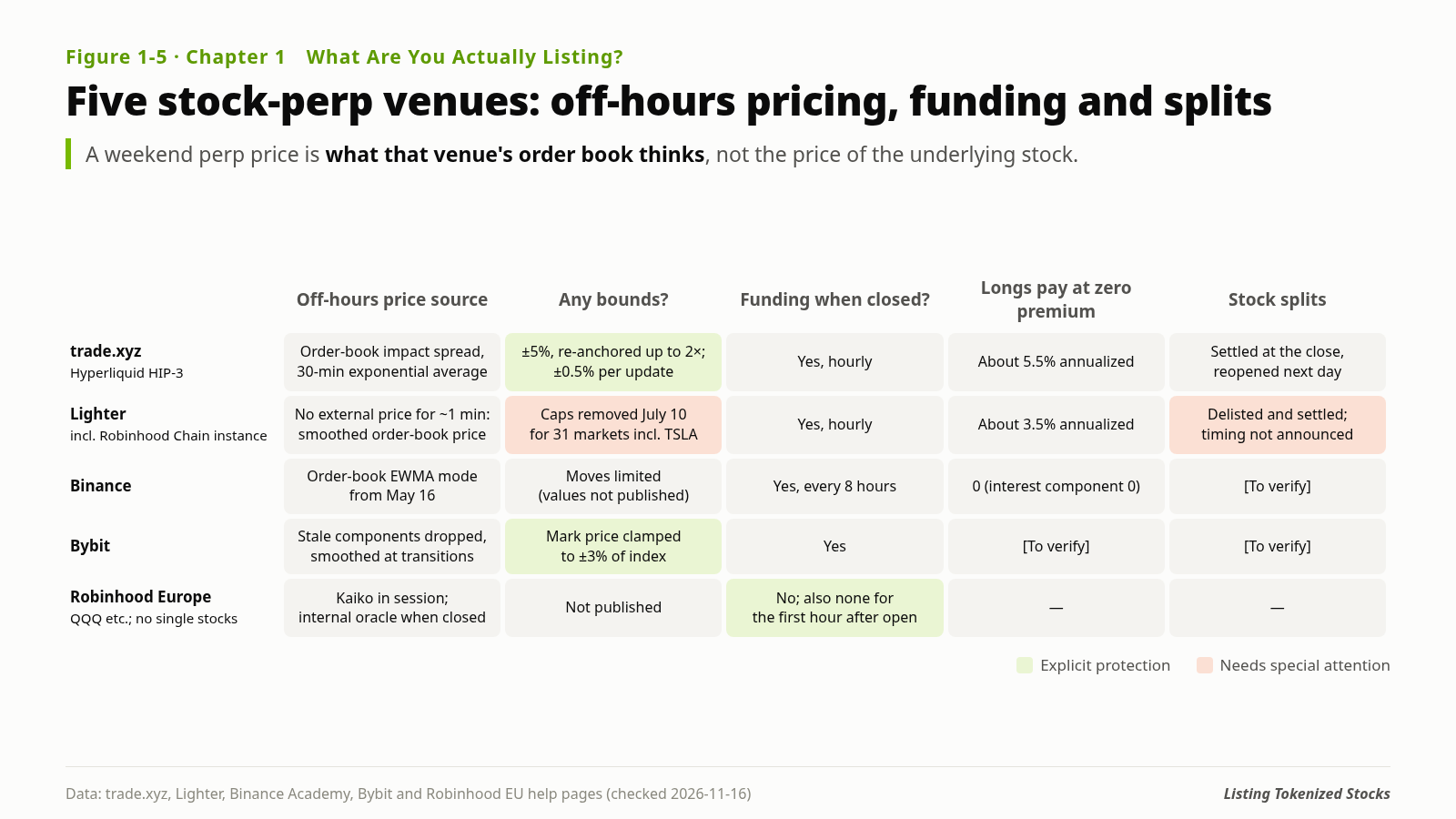
Over the weekend, tokenized stocks lack the creation/redemption anchor, and prices are quoted independently by each pool and order book (Chapter 4). Perps keep trading through the weekend, with mark and index prices generated by each venue’s own rules, and those rules vary widely:
- trade.xyz (TSLA). The external pricing session runs from 20:05 Sunday to 20:00 Friday (US Eastern), including the overnight session; from 20:00 Friday to 20:05 Sunday it switches to internal pricing. Internal pricing starts from the last external price and applies a 30-minute time-constant exponential average to the order-book impact spread. The mark price is the median of three components, and each update can move it by at most ±0.5%. TSLA’s “discovery bound” is ±5% (derived from the 20x maximum leverage) and can be re-anchored twice, so within one weekend the price can go at most +15.8% or −14.3% from Friday’s close. At the limit it is capped until the external price returns. Positions whose liquidation price falls outside the current bound will not be liquidated while the bound is in force.
- Lighter. External prices come from Pyth, Chainlink, RedStone, Stork and others. If there is no update for about 1 minute, it switches to the internal price, again a 30-minute exponential average of the order-book impact price. The difference is that from July 10, 2026, 31 markets including TSLA, NVDA and SPY removed the upper and lower caps relative to the last oracle price, keeping only risk checks against other trading venues, and the documentation says the thresholds of those checks are adjusted at discretion.
- Binance. Early on, the index price was frozen at its last value while the market was closed. According to Binance Academy (updated April 23, 2026), from May 16, 2026, stock perps switched to an “order-book EWMA mode,” smoothing with the order-book impact mid-price and limiting the size of moves, to avoid price jumps at the open.
- Bybit. The mark price is clamped to within ±3% of the index price; when the market is closed, stale component prices are dropped, and the switch at the open and close is smoothed.
- Robinhood Europe (QQQ and others). It uses a Kaiko index during trading hours and an internal oracle when the market is closed; no funding is charged while the market is closed, nor during the first hour after the open.
The conclusion is simple: a weekend perp price is what that venue’s order book thinks the price is, not the price of the underlying stock. The venues’ bounds differ, so in the same weekend the same stock can be held within ±5% at one venue and have no cap at another. The 24/7 stock price sources discussed in Chapter 4 are synthesized from exactly this kind of perp price. If you use them to set weekend prices for tokens, you inherit these rules.
Funding
A perp has no expiry; it relies on funding to pull the contract price towards the index price. When the contract trades above the index, longs pay shorts; otherwise shorts pay longs. The structure of this payment determines the cost of “holding long term.”
trade.xyz settles hourly. Its formula includes an interest component, currently 0.01% per 8 hours, multiplied by a funding multiplier of 0.5. At zero premium, longs pay 0.000625% per hour, about 5.5% annualized. For Lighter’s TSLA market on Robinhood Chain, the base interest rate in the API parameters is 0.0032% per 8 hours, a floor of about 3.5% annualized at zero premium. Binance’s stock perps settle every 8 hours, with an interest component of 0 and a cap of ±2% per settlement.
In this sample (20:00 UTC on October 17 to 19:00 UTC on November 16, 2026; 720 hours):
| Annualized average | Share of hours at the floor | Share of hours longs paid | |
|---|---|---|---|
| trade.xyz TSLA | 5.69% | 67.5% | 88.6% |
| Lighter (Robinhood Chain) TSLA | 4.77% | 86.0% | 96.0% |
This means that a user who just wants to “hold Tesla,” going long through a perp for a year, would have paid about 5% in funding in this sample, the equivalent of interest on a loan. Token holders pay no funding, but they pay bid-ask spreads and creation/redemption fees, and bear issuer credit risk (Chapters 2, 3 and 6). Users who treat a perp as “a cheaper tokenized stock” get exactly this item wrong.
Regulatory character
On the issuer side, a tokenized stock is a security: xStocks, RHJ and Ondo go through EU prospectuses, bStocks and the Coinbase certificates through ADGM prospectuses, and selling restrictions follow the issuer’s documents (Chapter 8).
A stock perp is a derivative, and a different set of rules applies:
- United States. The Statement on Tokenized Securities issued by three SEC divisions on January 28, 2026 says that an instrument giving synthetic exposure to a security without granting the holder any shareholder rights may constitute a “security-based swap.” Offering such instruments to non-eligible contract participants requires an effective registration statement, and trading must take place on a national securities exchange. A perp on a single US stock falls near this category in economic substance [To verify: whether it constitutes a security-based swap or a security future requires a US legal opinion]. The perps Robinhood launched for US users on September 29, 2026 cover only 8 crypto assets such as BTC and ETH, offered by Robinhood Derivatives, a CFTC-registered futures commission merchant. trade.xyz and Lighter both exclude the US in their terms.
- European Union. Perps are complex derivatives, and selling them to retail requires an appropriateness assessment. Robinhood Europe uses an entry test: if you fail, you wait 24, 48 and then 72 hours, and after that two weeks. In the EU it has listed perps on ETFs, commodities and FX, but not on single stocks.
- Elsewhere. Lighter’s terms exclude the US, Canada, the UK, China and sanctioned regions; when Robinhood Wallet integrated Lighter, it excluded the US, the UK, Canada, Switzerland, the UAE and Singapore. That list overlaps heavily with the restricted regions for tokenized stocks: RHJ excludes the US, Canada, the UK and Switzerland. Switching to perps does not widen access; what it adds is the appropriateness obligations of derivatives.
Depth and cost
On execution cost alone, perps are clearly cheaper. In this sample, during the US session on November 16, the cost of selling Tesla exposure (relative to the best price, excluding taker fees):
| Route | $100,000 | $1,000,000 | Time (UTC) |
|---|---|---|---|
| Hyperliquid trade.xyz TSLA perp | about 0.7 bp | about 6 bp | 19:37 |
| Lighter (Robinhood Chain) TSLA perp | 1.3 bp | 32.7 bp | 17:51–18:06 |
| Kraken TSLAx/USD spot | 6.6 bp | cannot absorb | 17:57 |
| Binance TSLAB/USDT spot | 6.2 bp | cannot absorb | 17:57 |
| Ondo’s largest Ethereum pool (2%) | 217 bp | 372 bp | same period |
(The Hyperliquid $1 million tier is estimated from $0.1 aggregated price levels, with an error of about ±3 bp. A re-test of Lighter at 19:37 gave 32.8 bp for $1 million, consistent with the Chapter 5 round. Fees are extra: Lighter’s standard accounts on Robinhood Chain pay 0, and trade.xyz’s TSLA market has “growth mode” enabled, with a base taker fee of 0.009%. Spot data for each row is in Chapter 5.)
But this table has to be read alongside the first subsection. Perp depth buys price exposure and delivers no tokens. If a user wants to withdraw, or post the token as collateral, or you need to sell a liquidated token on behalf of a lending protocol, perp depth is of no use whatsoever. What it can do is let a liquidator hedge first and then sell the tokens gradually (Chapter 7).
How to choose, and how to keep them apart if you list both
Decide by your platform’s business, not by which is deeper:
- Wallets, broker-style apps and users who hold long term, where withdrawal or on-chain use must be supported: list the token. Users want something they can take with them.
- Derivatives exchanges that already have perp matching, margin, liquidation and insurance-fund systems, and whose users want leverage and shorting: list the perp, provided your jurisdiction allows you to sell single-stock derivatives to your users and you are willing to design off-hours pricing yourself.
- Lending protocols: tokens only. Perp positions cannot be transferred and cannot be used as collateral.
- List both: Binance has both TSLAB spot and the TSLAUSDT perp; Bybit has both TSLAX spot and the TSLAUSDT perp; Robinhood Wallet offers both tokenized stocks and Lighter perps. This is the norm for large platforms, and the hard part is the product page.
If you list both, the product pages should at minimum do the following:
- Separate names and entry points. Label the token “TSLAx (tracker certificate issued by xStocks)” and the perp “TSLA perpetual contract”; put them in separate spot and derivatives sections, mark the type in search results, and never share a single “TSLA” entry point.
- Separate first-screen fields. The token page lists the issuer, legal form, treatment of dividends and splits, and redemption channel (next section of this chapter). The perp page lists the settlement asset, maximum leverage, current and trailing 30-day annualized funding, off-hours pricing rules and bounds, liquidation and ADL rules, and how splits are settled.
- Don’t mix prices. Do not present the perp’s mark price as the token’s “reference price,” or vice versa, especially over the weekend. Charts must label which price is being used and where it comes from.
- Separate risk acknowledgements. The perp requires an appropriateness assessment; the token is subject to the issuer’s geographic and eligibility restrictions. One acknowledgement cannot cover both products.
- Don’t sell the perp as “the leveraged version of the tokenized stock.” The two have different counterparties, pricing rules and corporate-action treatment; cross-promotion needs its own compliance review.
A tokenized stock sells a certificate you can take away; a stock perp sells a price inside one venue. Work out which one your users want first, then talk about issuers and depth.
The trading page must state the issuer, the rights and the exit
The rung on the ladder directly determines what you can say to users.
First, product names and descriptions must not present the token as stock. For rungs 2 through 4, you cannot write “buy Tesla stock” or “become a shareholder.” The accurate wording is “a [tracker certificate / beneficial-interest certificate / contract] issued by [issuer’s full legal name] that tracks Tesla’s share price.” The issuer’s full legal name must appear on the trading page, not just behind a terms link. The tokenized companies themselves will speak up: at the end of June 2025 Robinhood distributed OpenAI tokens to users in the EU, and on July 2 OpenAI publicly stated that these tokens “are not OpenAI equity,” that it had not partnered with Robinhood and had not approved any transfer of equity. According to the offering documents, that statement is correct. Your product page must not imply the opposite.
Second, spell out dividends and voting item by item. The three rung-3 issuers all turn dividends into the multiplier, pay no cash and give no vote. bStocks and the Coinbase certificates likewise pay no cash dividends. Dinari pays dividends in stablecoins. Securitize Stocks says dividend and voting rights are retained. On your page, “how dividends arrive” and “voting rights or not” should be two separate fields, with values copied from the issuer’s documents, not merged into one line saying “enjoys economic rights.”
Third, state who the redemption channel is open to. Backed can pay out cash, or deliver in kind via xPort to a brokerage account at Alpaca. RHJ and Ondo pay cash only. bStocks can be redeemed for shares, but subscription is open only to eligible ADGM subscribers. Your users most likely cannot get through this door (Chapter 3), so the page should say plainly, “You can only sell on this platform or on other secondary markets,” rather than imply that the token can be swapped for stock at any time.
Fourth, the first item of the risk disclosure is the counterparty, not price volatility. On rung 3 the risk is SPV default and insufficient pledged assets; on rung 2 it is the trustee and the custodian; on rung 4 it is the credit of the issuing company itself. The first sentence users should see is “Your rights depend on whether [issuer] performs,” not “the share price may fall.”
Fifth, geographic restrictions must match the issuer’s. All of them exclude US persons. RHJ also excludes Canada, the UK and Switzerland. Backed is open in the UK only to certain professional clients. In the European Economic Area and the UK, Ondo is open only to professional or qualified investors, except for products covered by its prospectus. If your access rules are looser than the issuer’s, the liability is yours (Chapter 8).
The US is a separate matter. The innovation exemption the SEC issued on September 17, 2026 allows only tokenized stocks that provide “the same rights and treatment as the underlying” to trade on qualifying venues. By that standard, rung 3 and rung 4 products cannot get through the US door (Chapter 8). The issuance structure you choose also determines which regions’ users you can serve.
Ten questions to ask the issuer before integrating a tokenized stock
- What is the issuer’s full legal name, place of incorporation and registration number? Is it licensed itself, or does it only have consent to issue or an approved prospectus?
- What is the product’s legal form: a share, a trust beneficial interest, a security entitlement, a secured debt security, or a contract? Which country’s law governs it?
- Against whom does the holder have a claim? Which sentence in the prospectus or terms defines that claim?
- Are there pledged assets set aside for each product and an independent security agent? Who is the security agent?
- How are dividends handled: reinvested via the multiplier, paid in stablecoins, or not handled? On what tax basis?
- Do holders have voting rights or the right to give voting instructions? If so, how are they exercised?
- Does redemption pay cash or shares? Who is eligible to redeem directly, what is the minimum amount, and when is it open?
- Do holders who bought on the secondary market have the same legal status as those who subscribed directly (for example, vested versus unvested holders of the Coinbase certificates)?
- Does the same brand have another product with a different legal structure? Which one does the contract address you are integrating correspond to?
- What is the issuer’s list of geographic restrictions? What exactly does it say for US persons, UK persons and EU retail investors?
Seven questions to ask the venue (or yourself) before listing stock perps
- Do you run matching and liquidation yourself, route users to an on-chain venue, or deploy your own markets? Correspondingly, who is the user’s counterparty, and whose insurance fund absorbs losses first?
- What is the liquidation sequence: under what conditions do partial liquidation, takeover by a backstop liquidator or insurance fund, and auto-deleveraging each kick in? How is ADL ranked, and where can users see their own position in the queue?
- Which data sources feed the index and mark prices? Can a single abnormal trade move the mark price directly (as with SK Hynix)? Is compensation after an incident a rule or a discretionary decision, and who is responsible to your users?
- Where does the price come from when the market is closed: what are the smoothing parameters of internal pricing, the cap on each update, and the maximum range over a whole weekend? How are liquidations outside the range handled?
- How is funding calculated: settlement frequency, interest component, per-settlement cap, and whether it is charged while the market is closed? What was the annualized rate over the past 30 days, and can the product page show it in real time?
- How are splits, dividends and mergers handled: by adjusting positions or by forced settlement? How far in advance are the settlement time and settlement price announced?
- Does your users’ jurisdiction allow them to buy single-stock derivatives? How is the appropriateness assessment done, and what is blocked if a user fails? Do you exclude the same regions the venue’s terms exclude?
Conclusion
The deepest tokenized stocks on-chain are almost all tracker certificates issued by an SPV and secured by shares. What the user buys is not Tesla; it is an IOU secured by Tesla. Your product page, risk disclosures and access rules should all be written starting from that sentence. How much that IOU is worth if the issuer fails is the question for Chapter 6. A stock perp does not even have the IOU; what it sells is a price inside one venue and a set of liquidation rules. A platform can list tokens, list perps, or list both, but it must never let users who come through a single “TSLA” entry point be unsure which one they have bought.
Sources for this chapter
All checked on 2026-11-16.
- Opening liquidity figures: author’s on-chain monitoring
tsla_spread.csv, snapshot at 2026-11-16 17:00 UTC; basis is DexScreener pool liquidity, counting only stablecoin-quoted pools with liquidity of $1,000 or more, excluding pools deviating more than 3% from the liquidity-weighted median, aggregated by issuer. - xStocks: Backed Assets (JE) Limited base prospectus (2026-05-08, approved by the FMA; reproduced by the MFSA) https://www.mfsa.mt/wp-content/uploads/2026/05/Backed-Assets-JE-Limited-Base-Prospectus-Document-dated-08-May-2026.pdf ; product legal overview https://docs.xstocks.fi/docs/product-legal-overview ; dividends and stock splits https://docs.xstocks.fi/docs/dividends-and-stock-splits ; in-kind redemption via xPort https://docs.xstocks.fi/docs/issuance-and-redemption/in-kind-flow-xport ; service providers https://assets.backed.fi/legal-documentation/service-providers
- Kraken’s acquisition of Backed: Kraken blog (2025-12-02) https://blog.kraken.com/news/backed-acquisition ; Payward press release (see the sources for Chapter 9 of Three Questions on M&A); prospectus §3.1.1.5 (Payward Europe acquired all shares around 2026-01-05).
- RHJ: base prospectus (2026-06-25) https://cdn.robinhood.com/assets/robinhood/legal/rhj_base_prospectus.pdf ; https://docs.robinhood.com/rhj ; https://docs.robinhood.com/chain/stock-tokens
- Robinhood Europe “Classic” stock tokens: key information document (2026-07-01) https://cdn.robinhood.com/assets/robinhood/legal/stock_tokens_kid_eu.pdf ; FAQ https://robinhood.com/eu/en/support/articles/stock-tokens-faq
- Ondo Global Markets: FMA certificate of approval (document dated 2025-11-12, approved 11-11) https://www.mfsa.mt/wp-content/uploads/2025/12/Ondo-Global-Markets-BVI-Limited-Certificate-of-Approval-of-a-Base-Prospectus-dated-12-November-2025.pdf ; base prospectus (reproduced by Romania’s ASF) https://www.asfromania.ro/uploads/articole/attachments/6915d7b484340864128566.pdf ; legal and regulatory https://docs.ondo.finance/ondo-stocks/legal-and-regulatory ; launch blog (2025-09-03) https://ondo.finance/blog/global-markets-is-live ; Ondo letter to the SEC Crypto Task Force (2026-04-13) https://www.sec.gov/files/ctf-written-input-ondo-finance-041326.pdf
- bStocks: BTech Holdings BRKB prospectus (2026-10-20, approved by the FSRA) https://www.adgm.com/globalassets/market-disclosure/content/prospectus/btech-holdings-prospectus—20-october—berkshire_hathaway-bstocks_10_20_2026_15-40-34.pdf ; Binance launch press release (2026-06-12) https://www.newswire.ca/news-releases/binance-exchange-launches-bstocks-tokenized-securities-1-1-backing-and-24-7-trading-837269532.html
- Coinbase Onchain SPV: UMAC prospectus (2026-10-22) https://www.adgm.com/globalassets/market-disclosure/content/prospectus/coinbase-onchain-spv-ltd—prospectus-umacc—22oct2026_10_22_2026_12-56-28.pdf
- Securitize Stocks: launch press release (2026-10-08) https://www.prnewswire.com/news-releases/securitize-launches-global-onchain-trading-of-us-stocks-with-security-entitlements-302902107.html ; expansion press release (2026-11-02) https://www.prnewswire.com/news-releases/securitize-expands-onchain-us-stock-offering-to-25-equities-302925970.html
- Superstate: SEC EDGAR (Superstate Services LLC, CIK 2054806); Galaxy 8-K exhibit (2025-09-03) https://www.sec.gov/Archives/edgar/data/1859392/000185939225000052/galaxyxsuperstateoblaunchf.htm ; asset page https://superstate.com/assets/glxy (on-chain share count as read on 11-16; it changes); documentation https://docs.superstate.com/issuers/opening-bell
- Exodus: Reg A+ offering circular https://www.sec.gov/Archives/edgar/data/1821534/000114036121012255/nt10013846x18_253g2.htm
- Dinari: FINRA BrokerCheck (CRD 329672) https://api.brokercheck.finra.org/search/firm/329672 ; token terms (2025-12-26) https://www.dinari.com/terms
- SEC: Statement on Tokenized Securities (2026-01-28; Division of Corporation Finance, Division of Investment Management, Division of Trading and Markets) https://www.sec.gov/newsroom/speeches-statements/corp-fin-statement-tokenized-securities-012826 (including the restriction on offering “security-based swaps” to non-eligible contract participants); innovation exemption (2026-09-17, Release 34-106402) https://www.sec.gov/newsroom/press-releases/2026-90-sec-issues-innovation-exemption-facilitate-trading-tokenized-nms-stock-request-comment
- OpenAI statement: OpenAI Newsroom post on X (2025-07-02), stating that the “OpenAI tokens” distributed by Robinhood are not OpenAI equity, that there was no partnership, and that no equity transfer was approved [check the original post’s wording again before quoting].
Stock perps section (checked 2026-11-16):
- Hyperliquid HIP-3 rules (stake of 500,000 HYPE, maintained for 183 days, deployer runs the oracle,
haltTradingsettles at mark price, slashing ratio and burning): https://hyperliquid.gitbook.io/hyperliquid-docs/hyperliquid-improvement-proposals-hips/hip-3-builder-deployed-perpetuals - trade.xyz documentation: relationship to Hyperliquid https://docs.trade.xyz/overview/relationship-to-hyperliquid ; oracle price https://docs.trade.xyz/perpetuals/mechanics/oracle-price ; mark price (median of three components, ±50 bp per update) https://docs.trade.xyz/perpetuals/mechanics/mark-price ; discovery bounds https://docs.trade.xyz/perpetuals/mechanics/discovery-bounds ; funding (hourly, interest component 0.01%/8 hours, multiplier 0.5) https://docs.trade.xyz/perpetuals/mechanics/funding ; fees https://docs.trade.xyz/perpetuals/mechanics/fees ; US equities external session https://docs.trade.xyz/perpetuals/markets/stocks/us ; specification index (TSLA 20x, ±5%, 2 re-anchors, external 24/5, internal Friday 20:00 to Sunday 20:05) https://docs.trade.xyz/perpetuals/specifications-and-schedules/specification-index ; internal session hours change (2026-08-13) https://docs.trade.xyz/perpetuals/changelog/equities-internal-session-hours ; auto-deleveraging https://docs.trade.xyz/perpetuals/risk-and-margining/auto-deleveraging ; corporate actions and the Sandisk split notice https://docs.trade.xyz/perpetuals/corporate-actions , https://docs.trade.xyz/perpetuals/corporate-actions/2026-11-19-sandisk-stock-split ; risk disclosures https://docs.trade.xyz/legal-and-disclaimers/perpetuals-risks-and-disclaimers ; general disclaimer (excludes US persons) https://docs.trade.xyz/legal-and-disclaimers/general-disclaimer
- Hyperliquid public API
api.hyperliquid.xyz/info:metaAndAssetCtxs(dex=xyz, 2026-11-16 19:37 UTC; TSLA open interest 104,691.7 shares × oracle price $377.21, 24-hour volume $31.28 million; open interest across 145 markets at oracle prices totalling about $4.04 billion);l2Book(xyz:TSLA, nSigFigs=5 and 4, same time);fundingHistory(xyz:TSLA, 2026-10-17 20:00 to 11-16 19:00 UTC, 720 records). - SK Hynix incident: CoinDesk (2026-07-29) https://www.coindesk.com/markets/2026/07/29/company-behind-ai-trade-that-caused-usd60-million-crypto-liquidations-to-cover-all-losses , relaying trade.xyz’s statement on X (mark price $1,127.90 → $917.25, 23:01 UTC, one-time discretionary compensation); trade.xyz’s original post x.com/tradexyz/status/2082260930751082821 (2026-07-29) and compensation-method post x.com/tradexyz/status/2083350061984170027 (2026-08-01, reference price $1,115.5); range of liquidation size from Galaxy Research, “hyperliquid-tradexyz-oracle-liquidations.”
- Lighter documentation: Robinhood Chain separate instance (contract
0x94bA…ff9d, USDG margin, zero fees for standard accounts) https://docs.lighter.xyz/developers/robinhood-chain/overview ; RWA markets https://docs.lighter.xyz/trading/real-world-assets-rwas ; mark price and risk checks https://docs.lighter.xyz/trading/fair-price-marking ; internal pricing and the 2026-07-10 list of markets with caps removed https://docs.lighter.xyz/trading/internal-pricing-mechanism ; liquidations, LLP and ADL https://docs.lighter.xyz/trading/liquidations-and-llp-insurance-fund ; corporate actions https://docs.lighter.xyz/trading/real-world-assets-rwas/corporate-actions ; terms (restricted regions) https://lighter.xyz/terms - Lighter Robinhood instance API
api.rh.lighter.xyz/api/v1/:orderBookDetails(TSLA market_id 16, minimum initial margin 5%, maintenance 3%, zero fees, open interest 8,746.2 shares, 24-hour volume $16.77 million, base_interest_rate 0.0032, 2026-11-16 19:37 UTC);orderBookOrders(250 levels on each side, same time);fundings(market_id 16, 1 hour, 2026-10-17 20:00 to 11-16 19:00 UTC; the rate field is a percentage per hour, direction is the paying side). The 17:51–18:06 UTC depth round is in Chapter 5. - Robinhood: press release (2026-07-01; Wallet integrates Lighter, RHNC does not offer perpetual futures trading, restricted regions, EU expansion to ETF/commodity/FX perps) https://robinhood.com/newsroom/robinhood-accelerates-global-expansion-robinhood-chain-mainnet-stock-tokens-agentic-trading ; EU perpetual futures page (list of underlyings, Kaiko index and internal oracle when closed, no funding when closed, entry-test cooling-off periods) https://robinhood.com/eu/en/support/articles/about-perpetual-futures ; US perps (2026-09-29, 8 crypto assets, Robinhood Derivatives): Robinhood’s announcement on X and coverage by The Defiant.
- Binance: TSLAUSDT stock perp launch announcement (2026-01-28 14:30 UTC, maximum 5x, funding every 4 hours) https://www.binance.com/en/square/post/35602336273633 ; Binance Academy, “How to Trade Stock Perpetual Contracts on Binance” (updated 2026-04-23: maximum 10x, every 8 hours, ±2%, interest component 0, order-book EWMA mode from 2026-05-16) https://www.binance.com/en/academy/articles/how-to-trade-stock-perpetual-contracts-on-binance
- Bybit: TradFi perps explainer https://www.bybit.com/en/learn/bybit-tradfi/trade-tradfi-perpetuals-bybit ; mark price ±3% clamp https://www.bybit.com/en/learn/trading/last-price-vs-mark-price-in-futures ; stock perps https://www.bybit.com/en/learn/bybit-tradfi/stock-tradfi-perpetuals-bybit
- Selling cost on spot routes: Chapter 5 measurements (2026-11-16 17:51–18:06 UTC).
[To verify]
- How Superstate Opening Bell dividends reach token holders: not described in public documentation (voting already has an in-wallet Broadridge ProxyVote arrangement).
- Ondo issuer ownership percentage: the documentation says 90.01%, the prospectus says 90.1%; which is correct needs confirmation from the issuer.
- Exact wording of the innovation exemption’s “same rights and treatment”: this chapter summarizes the SEC press release; check against the full text of the order before quoting the original sentence.
- Characterization of single US stock perps in the US (security-based swap or security future): this chapter cites only the SEC statement’s classification; a US legal opinion is needed.
- Bybit stock perps’ launch date and the maximum leverage on TSLAUSDT: Bybit’s own tutorial pages say 50x in one place and 10x in another; the original contract specification page was not found.
- Binance stock perps’ current maximum leverage and funding interval: the launch announcement says 5x and every 4 hours, the Academy article says 10x and every 8 hours; the live contract-page parameters take precedence.
- Robinhood’s OTC counterparty for EU perps (the “partner trading venue”): the help page does not name it.
- Total compensation in the SK Hynix incident (trade.xyz published only the method, not the total).