
Chapter 1: What You Can Hold Onchain: An Asset Map
If you are about to put money on Robinhood Chain, this chapter answers the most basic question first: what can you actually hold on the chain, where is the money really sitting, and for each kind of asset, where does the return come from, what are the risks, and how fast can you get out?
The Money Is Not Where You Think It Is
Mention Robinhood Chain and most people think of stock tokens: a U.S. broker putting Apple, Nvidia, and the S&P 500 onchain so that anyone, in any country, can trade them around the clock.
The chain’s own ledger paints a different picture. On November 2, 2026, the chain’s total value locked (TVL) was about $1.083 billion, and stablecoins on the chain totaled about $1.045 billion. Within those numbers, the single largest use was stablecoin lending. Lending markets on Morpho held about $620 million, of which about $520 million came from one vault. Robinhood disclosed in its 10-Q that, as of September 30, the fair value of all the public stock tokens it had issued was only $185 million.
In other words, this chain is famous for stock tokens, but most of its money is dollars, not stocks.
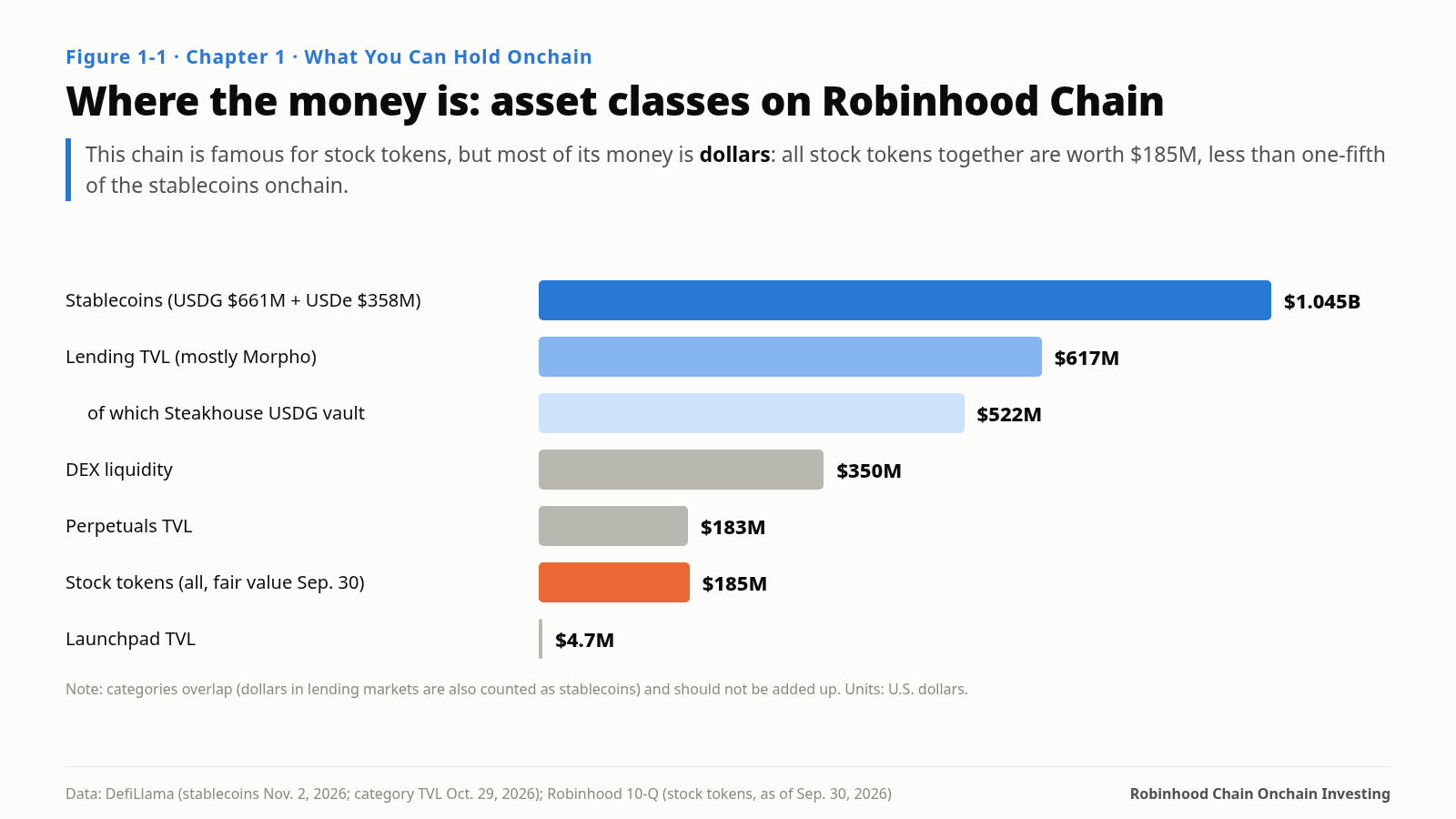
That comparison sets the focus of this book. What an investor can do on this chain falls roughly into eight categories. We first lay them out on one map, then explain what kind of money each one earns.
Eight Asset Classes
1. Stablecoins: USDG and USDe
Stablecoins on the chain total about $1.045 billion, and two of them account for nearly all of it:
- USDG (Global Dollar, issued by Paxos), about $661 million, is the chain’s settlement dollar. Swaps in Robinhood Wallet, margin for Lighter perpetuals, and the main trading pairs for stock tokens are all priced in it.
- USDe (Ethena’s synthetic dollar), about $358 million, has almost only one use on this chain: about $352 million is posted as collateral in Morpho’s USDe/USDG market, 98% of all USDe on the chain.
Stablecoins pay no interest on their own. USDG holders do not receive Paxos’s reserve income, which is shared with partner institutions through the Global Dollar Network rather than with onchain holders. The USDe on this chain is not the yield-bearing sUSDe either. Every dollar of return from holding stablecoins comes only after you lend them out, post them as collateral, or put them into a pool.
2. Lending Receipts and Vault Shares
Deposit USDG into a lending market and you receive a receipt: shares in a Morpho vault (such as steakUSDG), Spark’s spUSDG, or a LayerBank deposit token. The share price rises with interest, and on redemption you get back more USDG.
This is the largest asset class on the chain. The USDG vault curated by Steakhouse (steakUSDG), at about $522 million, is the vault behind Robinhood Earn and the bulk of Morpho on this chain. Where its yield comes from is the subject of Chapter 5.
3. Yield-Bearing Dollars: syrupUSDG, spUSDG, mGLO
Another group of dollar assets carries its own yield, because real lending or investment sits behind it:
- syrupUSDG (Maple): funds are lent to institutions against overcollateralized loans, and the interest goes to holders.
- spUSDG (Spark): the USDG version of Spark’s savings product, currently yielding about 3.8%.
- mGLO (Midas Fasanara Global Open): a fund-share token issued by Midas, with an onchain supply of about 52.7 million tokens.
What they share is that their yield does not depend on subsidies, but they carry credit or fund risk. They are also collateral for looped borrowing on Morpho, which comes up again and again in Chapter 5.
4. Stock Tokens
There are about 200 of them, by Robinhood’s own count, worth $185 million in total at fair value on September 30. Legally, they are debt instruments issued by Robinhood’s European entity that track the economic performance of a stock and carry no voting rights. (The legal structure is covered in Chapter 8 of Robinhood Goes Onchain and is not repeated here.)
For investors, stock tokens differ from shares held at a broker in three economic ways:
- They trade 24/7. When U.S. markets are closed, they keep being priced onchain.
- Dividends are reinvested. Stock tokens do not pay cash. Instead, a multiplier is raised, so each token slowly comes to represent more shares. (Chapter 6 uses this to solve a price-gap puzzle.)
- They are composable. They can go into AMM pools, serve as lending collateral, and be hedged with perpetual contracts.
Their risks come from the same features. When the market is closed, only onchain traders are discovering the price. The contracts can be paused, and an administrator can burn holdings (Chapter 11).
5. LP Shares
Put two assets into a DEX pool to make a market and you receive LP shares. DEX TVL on the chain is about $350 million, mostly on Uniswap V4 and V3.
This chain has a kind of pool rarely seen elsewhere: stock against stock. In Uniswap pools such as SPY/NVDA, SPY/QQQ, and SPY/GOOGL, both sides are stock tokens, and the LP’s risk is the relative price of two stocks rather than exposure to the dollar. Chapter 7 takes these pools apart.
6. Perpetuals and Leverage
Perpetuals on the chain have about $183 million of TVL. Lighter runs a separate instance on this chain. On November 2 it showed 63 perpetual markets, $616 million of 24-hour volume, and about $188 million of open interest. The most-traded market was not bitcoin but the SPY perpetual ($84.9 million in 24 hours), followed by the QQQ perpetual ($67 million). On its Q3 earnings call, Robinhood said onchain perpetual volume had exceeded $1 billion a day in recent weeks.
Investors can use perpetuals in two ways: to add leverage directly, or to pair them with spot tokens in a basis trade (Chapter 8).
7. Ecosystem and Launchpad Tokens
Launchpad platform tokens, meme coins, and protocol governance tokens. Their prices are the most volatile and their return distributions the most extreme (Chapter 9). The business model of the launchpad sector is covered in the companion book The Coin Factory. This book treats these tokens only as a high-volatility asset class and discusses position sizing.
8. The Beginnings of Fixed Income and Prediction Markets
These are still very small, but the names are worth knowing: Pendle (about $340,000), Arcus’s pTokens (about $400,000), maturity-dated tokens on stock tokens (such as pSPY-DEC27 and pPFE-DEC27), and the Meridian prediction market (about $1.03 million). They are the first rate and event products built on stock tokens (Chapter 8).
One Map: What Each Asset Class Earns
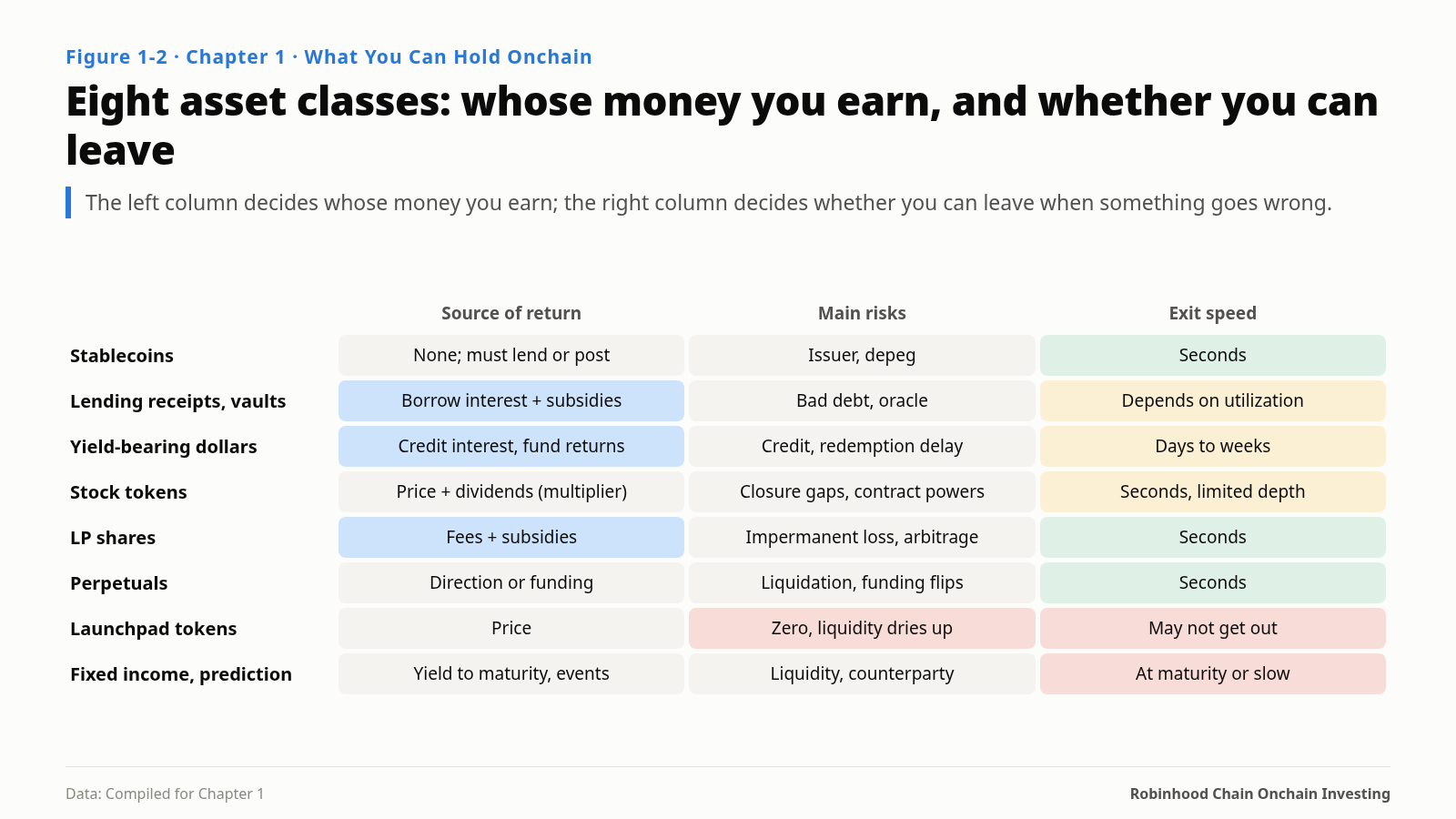
Put the eight classes side by side and a clear dividing line appears:
| Class | Source of return | Main risks | Exit speed |
|---|---|---|---|
| Stablecoins | None (must be lent or posted) | Issuer, depeg | Seconds |
| Lending receipts and vaults | Borrowing interest + subsidies | Borrower default, oracle, bad debt | Depends on utilization |
| Yield-bearing dollars | Credit interest, fund returns | Credit, redemption delays | Days to weeks |
| Stock tokens | Price moves + dividends (multiplier) | Stock price, gaps across market closures, contract permissions | Seconds during market hours, limited depth |
| LP shares | Trading fees + subsidies | Impermanent loss, being arbitraged while markets are closed | Seconds |
| Perpetuals | Directional gains or funding | Liquidation, funding reversal | Seconds |
| Launchpad tokens | Price | Going to zero, liquidity drying up | You may not get out |
| Fixed income and prediction markets | Yield to maturity, event outcomes | Liquidity, counterparty | At maturity, or slowly |
The left-hand column decides whose money you are earning. The right-hand column decides whether you can get out when something goes wrong. Together, those two columns are the two questions every later chapter answers.
The Size Changes, the Structure Does Not
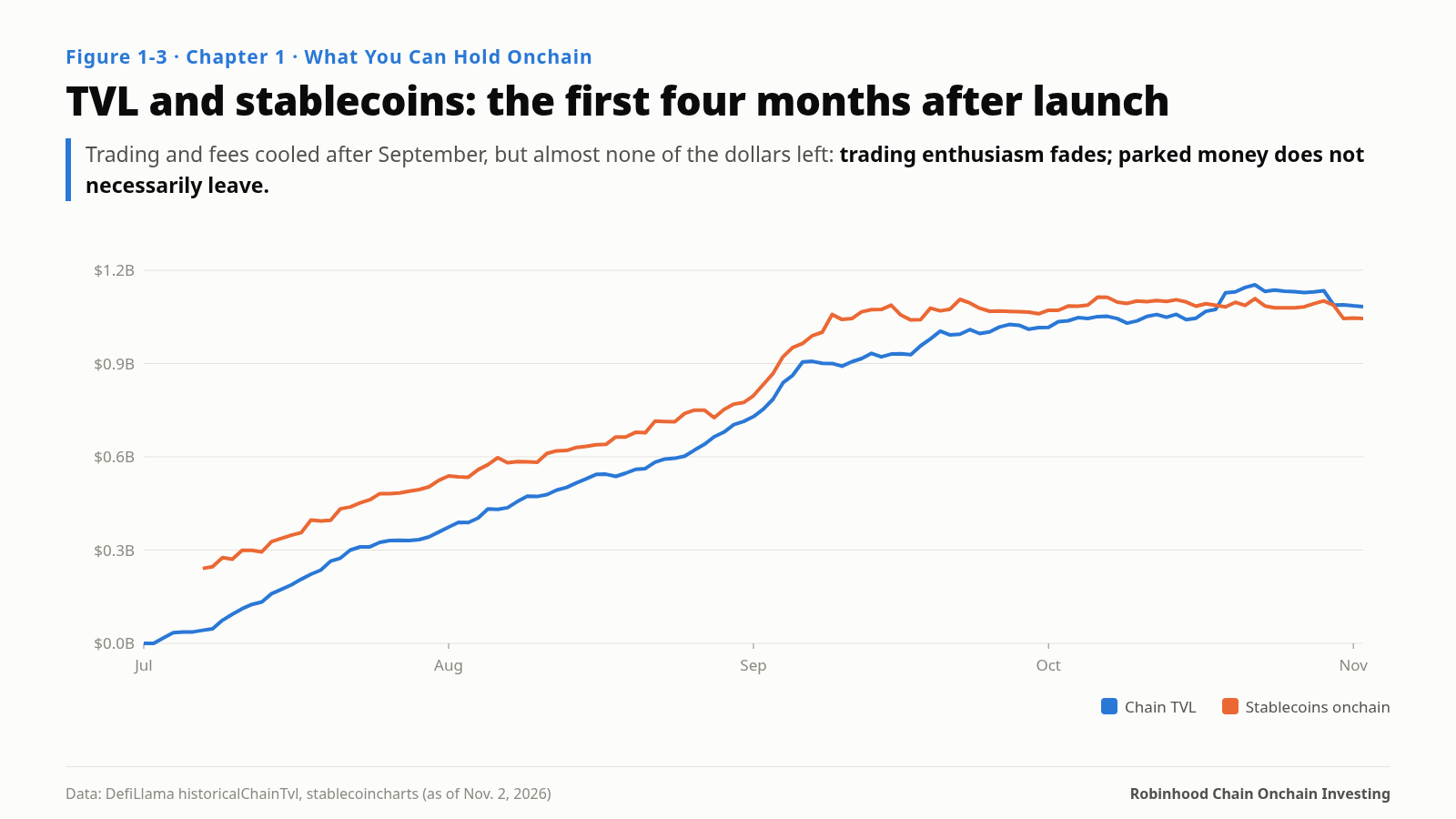
Mainnet launched on July 1. TVL was about $125 million in mid-July, passed $1 billion in mid-September, peaked at about $1.153 billion on October 21, and then eased to $1.083 billion on November 2. The stablecoin supply rose from about $240 million in early July to about $1.09 billion in mid-September and has moved sideways between $1.05 billion and $1.10 billion since.
DEX volume followed a different path. After peaking in early September at a weekly average of about $2.7 billion a day, it fell back to $700–800 million a day by late October.
The two curves say one thing: trading enthusiasm fades, but money that has been parked does not necessarily leave. After September, trading and fees cooled noticeably, yet almost none of the dollars on the chain left. Most of the billion dollars that stayed is earning interest. To understand this chain, you first have to understand where that interest comes from.
If You Are About to Put Money Here
- Decide which kind of return you want. Price returns (stock tokens, launchpad tokens), interest (lending, yield-bearing dollars), fees (LP positions), and funding (basis trades) carry completely different risks. Do not evaluate them together just because they live on the same chain.
- Size is information. An asset class worth only a few hundred thousand dollars usually means your trades will move the price. One worth hundreds of millions usually means someone is subsidizing it or there is real demand. Chapter 4 shows you how to tell the two apart.
- Remember that stablecoins pay no interest. Every dollar of onchain dollar yield comes from handing your dollars to someone else to use. Whoever you hand them to is your risk.
This chain is best known for stocks, but holds mostly dollars; its most visible activity is trading, but its most stable is interest.
Sources for This Chapter
- DefiLlama: chain-level TVL (historicalChainTvl, November 2, 2026), stablecoin totals and breakdown by coin (stablecoins API, November 2, 2026), protocol and category TVL (protocols API, October 29, 2026), DEX volume (overview/dexs)
- Robinhood Form 10-Q (filed October 28, 2026, for the period ended September 30, 2026): fair value of public stock-token liabilities of $185 million
- Robinhood Q3 2026 earnings call: remarks on onchain perpetual volume
- Morpho GraphQL API: collateral and borrowing in the USDe/USDG market (November 2, 2026)
- Lighter Robinhood instance API
api.rh.lighter.xyz: number of perpetual markets, 24-hour volume, open interest (November 2, 2026) - smarts: mGLO supply (block 26,328,375)