
Chapter 3: Round-Trip Costs and Access: What It Costs to Move Money Onchain and Back
If you are comparing “buying stocks at a broker,” “holding dollars in the Robinhood app,” and “running your own strategy onchain,” this chapter works out two things: the full cost of moving money onchain and back off again, and which assets your region actually lets you touch.
Gas Is Not the Expensive Part
When people think about onchain costs, their first thought is gas. On Robinhood Chain, it is the last thing to worry about.
On November 2, the chain’s base fee was about 0.02 gwei. An ordinary swap uses about 200,000 gas; with ETH at about $2,270, that comes to less than one cent. On top of that, swaps inside Robinhood Wallet are gas-free until December 31, 2026 (the waiver was originally due to expire on September 29 and was extended).
The real costs hide in three other places: bridging, slippage, and spreads. They are charged in proportion to the amount, so the more money you move and the more often you move it, the bigger the difference.
Leg One: Getting Onchain
There are three ways to get money onto Robinhood Chain:
- Inside the Robinhood app. Eligible U.S. users buy USDG in the app and deposit it into Earn. The funds go into a self-custody wallet built into the app. Users barely notice this path.
- Robinhood Wallet. In supported countries and regions, users can transfer crypto assets into Wallet and then swap onchain.
- Bridges. Stablecoins are bridged over from Ethereum, Base, Arbitrum, and other chains.
The cost of the third path can be measured precisely. Using Relay’s public quote API, we requested quotes for four amounts on November 2:
| Route | $1,000 | $10,000 | $100,000 | $1 million | Arrival time |
|---|---|---|---|---|---|
| Base USDC → USDG onchain | ~6 bp | ~6 bp | ~6 bp | Quote refused | ~1 second |
| Ethereum USDC → USDG onchain | ~6 bp | ~6 bp | ~6 bp | Quote refused | ~1–24 seconds |
| Arbitrum USDC → USDG onchain | ~6 bp | ~6 bp | ~6 bp | Quote refused | ~1 second |
| USDG onchain → Base USDC | ~6 bp | ~6 bp | ~6 bp | ~10 bp | ~2 seconds |
(bp means basis points; 1 bp = 0.01%. Cost = 1 − (amount received ÷ amount paid), including a relay fee of about 2.2 bp and the price loss on the USDC/USDG swap.)
Two details stand out:
- Deposits are capped. Relay refuses to quote any single deposit above $500,000, so large amounts must be split or sent through another channel. In the withdrawal direction, $1 million can be quoted, at a cost of about 10 bp.
- Bridges do not touch stock tokens. Requests to swap USDG for SPY, NVDA, or TSLA all came back “unsupported currency.” Stock tokens can only be traded on the chain’s DEXs, the Lighter order book, or the Arcus request-for-quote system.
Leg Two: Swapping Into the Asset You Want
If what you want is USDG itself, to deposit in Earn or lend out, the trip ends once you are onchain. If you want stock tokens or a perpetual position, you pay a cost again.
There are three places on this chain to buy stock exposure, and their depth differs enormously. On November 2 we read the Lighter order books and calculated the average cost, relative to the best price, of taking liquidity in one go up to a given amount:
| Venue | $10,000 | $100,000 | $1 million | Bid-ask spread |
|---|---|---|---|---|
| Lighter SPY perpetual | 0.4 bp | 0.7 bp | 12.4 bp | 0.9 bp |
| Lighter QQQ perpetual | 0.5 bp | 0.9 bp | 17.5 bp | 1.4 bp |
| Lighter NVDA perpetual | 1.1 bp | 2.1 bp | 25.6 bp | 1.0 bp |
| Lighter SPY spot | 1.9 bp | 29.1 bp | Cannot fill | 0.8 bp |
| Lighter NVDA spot | 0 | 14.2 bp | Cannot fill | 6.3 bp |
| Lighter AAPL spot | 0.8 bp | 530 bp | Cannot fill | 10.0 bp |
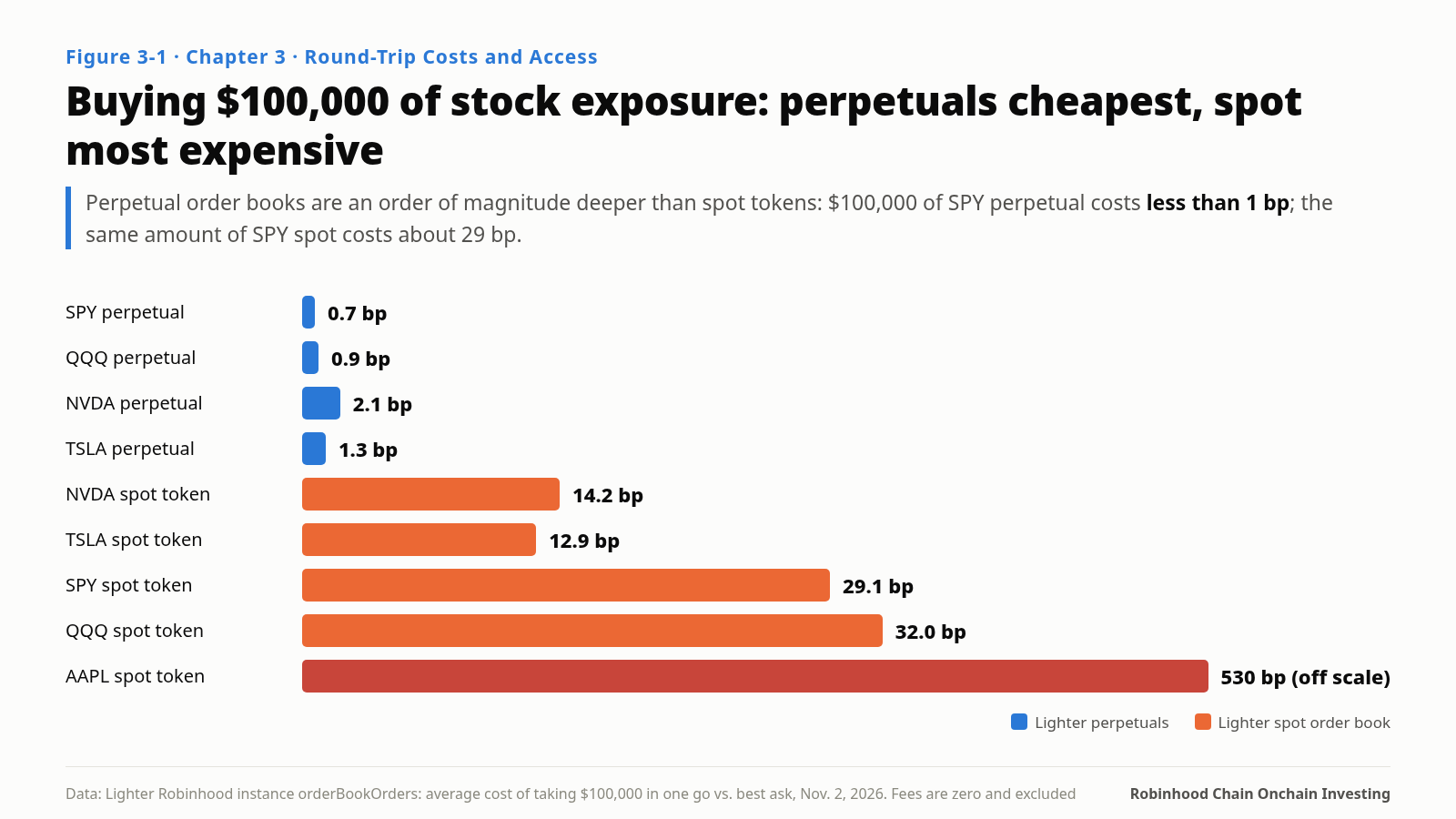
Perpetual order books are more than an order of magnitude deeper than spot tokens. Taking $100,000 of SPY perpetual costs less than 1 basis point. The same amount of the SPY spot token costs about 29 basis points, and $100,000 of the AAPL spot token pushes the price up by more than 5%. On top of that, Lighter charges no fees on either side on this chain (maker and taker fees are zero across all 63 perpetual markets).
DEX pools are thinner still. In the main stock-token pools tracked by GeckoTerminal (SPY, NVDA, TSLA, QQQ, and GOOGL against USDG), the median of the last 300 trades ranged from $107 to $735, and the largest trade was about $12,000. These pools charge fees from 0.05% to 0.3%, so buying also costs one pool fee (5–30 bp) up front.
The conclusion: on this chain, retail-sized amounts (a few thousand dollars) can trade anywhere. Stock exposure of a few hundred thousand dollars or more can be absorbed almost only by the perpetual order books.
Leg Three: The Price Gap, or Are You Paying Fair Value?
Stock tokens carry one more hidden cost: the price you trade at may itself deviate from the underlying stock. Chapter 6 analyzes this in detail; here are just the conclusions (medians, after correcting for the token multiplier):
- During U.S. trading hours, the main stock tokens deviate from the shares by only 3–6 bp (about 13–14 bp for TSLA and MU).
- On weekends, tokens are on average 10–38 bp more expensive, and at certain hours more than 100 bp.
In other words, if you buy on the weekend and sell on Monday, you are very likely paying for the privilege of trading on weekends. Conversely, if you must rebalance on a weekend, that premium is the price you pay for 24/7 liquidity.
Adding Up the Three Legs: A Round-Trip Cost Table
Add the three legs together, getting onchain, swapping, and getting off, and you have the cost of one full round trip. The table below assumes $10,000, bridged in and out yourself. (It excludes conversions inside the app, which may carry their own fees; go by what the app shows.)
| Strategy | On | Swap (buy + sell) | Price gap | Off | Round trip |
|---|---|---|---|---|---|
| Deposit USDG for interest | 6 bp | 0 | 0 | 6 bp | ~12 bp |
| Buy SPY spot token (DEX, trading hours) | 6 bp | ~60 bp (0.3% pool, twice) | ~6 bp | 6 bp | ~80 bp |
| Buy SPY spot token (Lighter order book) | 6 bp | ~4 bp | ~6 bp | 6 bp | ~20 bp |
| SPY perpetual (Lighter) | 6 bp | ~1 bp | 0 | 6 bp | ~13 bp + funding |
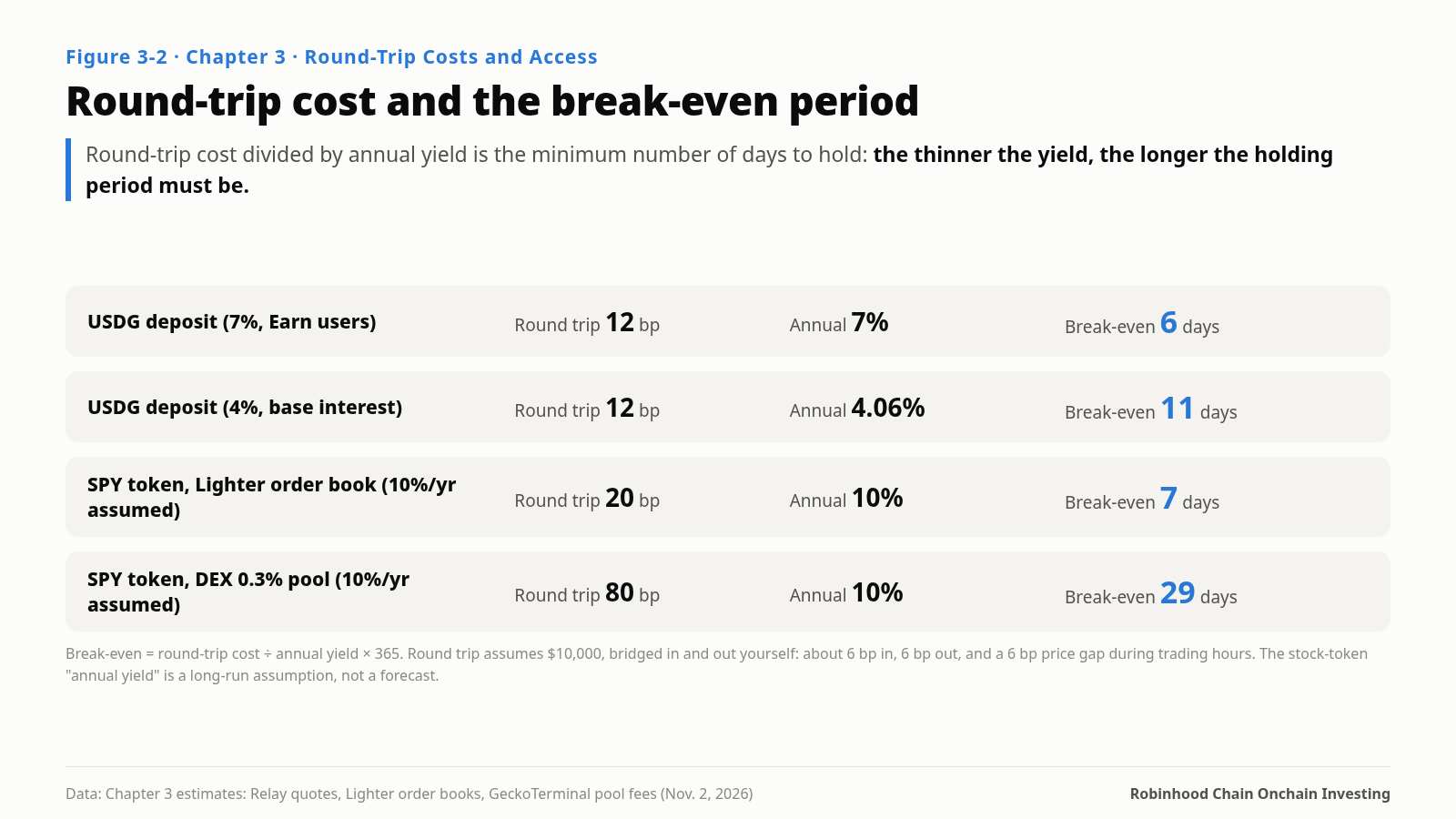
Divide a strategy’s round-trip cost by its annual yield and you get the break-even period: how long you must hold before the return covers the cost of getting in and out.
- Depositing USDG for interest: base interest of about 4%, a 12 bp round trip, break-even in about 11 days. For a Robinhood user earning 7%, about 6 days.
- Going long SPY with a perpetual: there is no interest income; instead you pay funding (an annualized 4.5–5.7%, Chapter 8), so the longer you hold, the more it costs.
- Buying a spot token on a DEX: a round trip of about 80 bp, roughly one month of SPY’s average gain (assuming a long-run annual return of about 10%).
Rule: for any strategy yielding less than 5% a year, think of the holding period in months at least. Any route with a round-trip cost above 50 bp suits only holding periods of a quarter or longer.
Access: No One Gets Everything
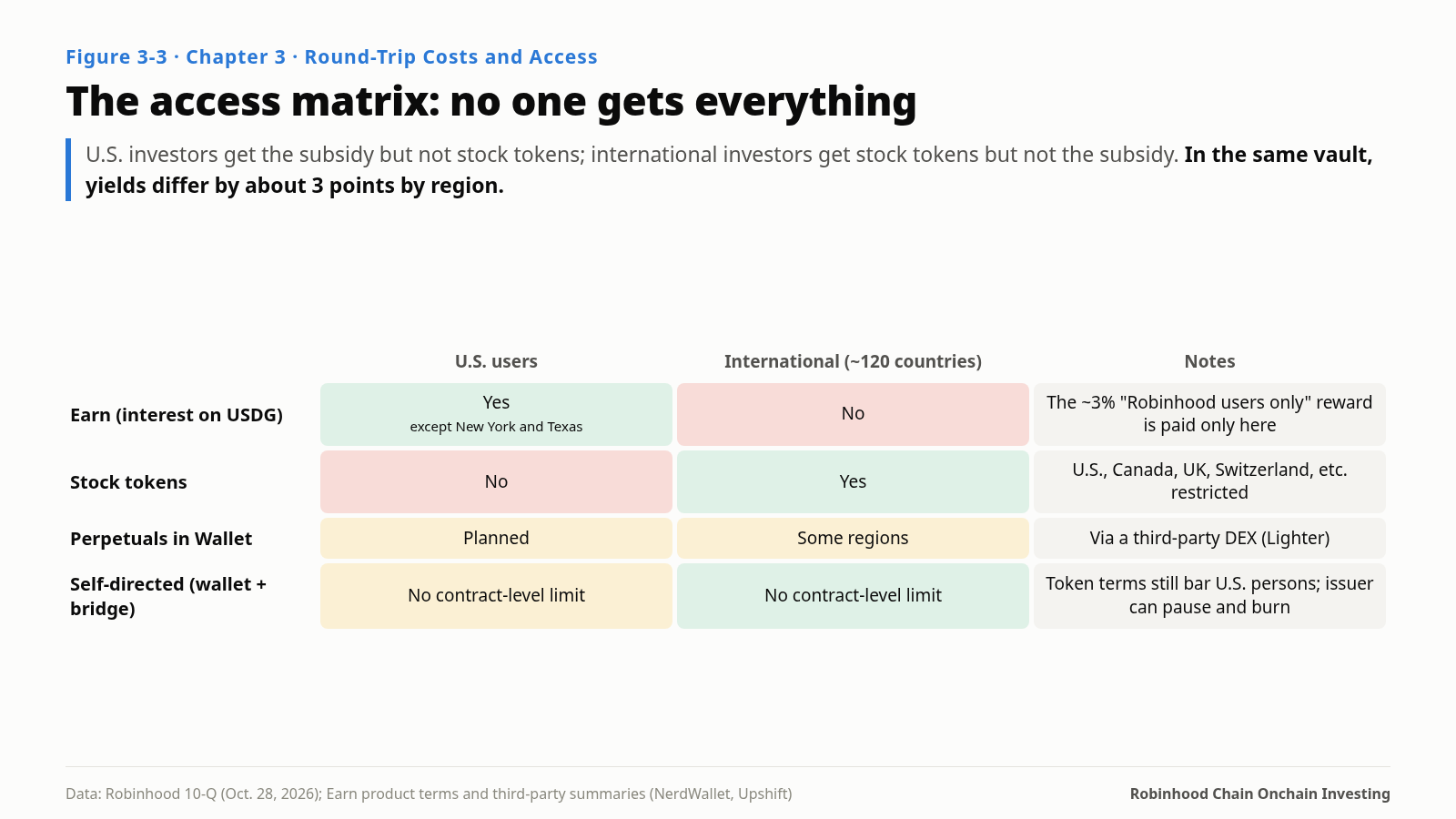
Costs can be calculated. Access cannot be negotiated. Robinhood’s onchain products are carved up by region, and the pieces barely overlap:
| Product | U.S. users | International users outside the EU and UK | Notes |
|---|---|---|---|
| Robinhood Earn (interest on USDG) | Yes (except New York and Texas) | No | The 3% “Robinhood users only” reward is paid only through Earn |
| Stock tokens | No | Yes (about 120 countries) | The 10-Q lists the U.S., Canada, the UK, Switzerland, and others as restricted |
| Perpetuals in Wallet (Lighter) | Planned | Available in some regions | 10-Q: eligible users in selected jurisdictions |
| Going onchain yourself (wallet + bridge) | No restriction at the contract level | No restriction at the contract level | But the stock-token terms still bar U.S. persons from holding them |
Some consequences:
- U.S. investors get the subsidy but cannot touch stock tokens. They are the only beneficiaries of Earn’s 3% reward, but under the terms they cannot hold onchain stock tokens.
- International investors can touch stock tokens but do not get the subsidy. Depositing into the same Steakhouse vault on their own, they get only the base interest of about 4%.
- The contracts do not check nationality; the terms do. The stock-token contracts have no address whitelist, but Robinhood holds the power to pause them and to burn holdings as administrator (Chapter 11). For holders in regions the terms do not permit, the risk is not technical but legal and a matter of contract permissions.
Access is not a compliance footnote. It directly changes the return table: in the same vault, people in different regions earn yields 3 percentage points apart.
If You Are Planning Your Own Entries and Exits
- Check access before you calculate returns. An asset your region cannot hold is irrelevant to you, however high its yield. A subsidy you can get is your most certain excess return.
- Move large amounts through order books, not pools. For stock exposure above $100,000, use Lighter perpetuals or the order book. Split any single deposit above $500,000 in advance.
- Avoid rebalancing on weekends. Unless weekend liquidity is exactly what you came for, buying and selling stock tokens during U.S. trading hours saves you 10–30 bp of premium.
- Screen strategies by break-even period. Divide round-trip cost by annual yield to get the number of days you must hold. A strategy works only if that is shorter than your planned holding period.
On this chain, gas is almost free. The real cost is how you move: where you come in, where you swap, and when you leave.
Sources for This Chapter
- Robinhood Chain RPC
eth_feeHistory(base fee, November 2, 2026) - Relay quote API
api.relay.link/quote(7 routes × 4 amounts, November 2, 2026) - Lighter Robinhood instance
orderBookOrdersandorderBookDetails(order-book depth and fees, November 2, 2026) - GeckoTerminal pool trade records (last 300 trades, November 2, 2026)
- Robinhood Form 10-Q (October 28, 2026): restricted regions for stock tokens; availability of stock tokens and perpetuals in Wallet
- Robinhood Earn product terms and third-party summaries (NerdWallet, July 29, 2026; Upshift): Earn is open only to eligible U.S. users, excluding New York and Texas
- Wallet gas waiver extended to December 31, 2026: CoinDesk (as relayed by crypto.news)