
Contents (8)

·
From Broker to Exchange: Take Back Your Core Before Someone Else Owns It
2015–2018 Coinbase Exchange, GDAX and the two-tier price structure
On January 20, 2015, Coinbase announced a $75 million Series C, the largest venture round in the bitcoin industry to date.
DFJ Growth led it. What made the news travel was a few names on the list of co-investors: the New York Stock Exchange (NYSE), the Spanish banking giant BBVA, USAA, the insurer and financial services provider for the US military, and the Japanese telecom carrier NTT Docomo.
A year earlier, Mt. Gox had just gone bankrupt and “bitcoin is dead” headlines were everywhere. A year later, America’s oldest stock exchange was a shareholder in a bitcoin company.
Six days later, on January 26, Coinbase launched its own exchange, Coinbase Exchange, billed as “the first regulated bitcoin exchange in the United States.”
From that moment, Coinbase went from being a “counter that sells bitcoin” to being a “marketplace for bitcoin.” It looked like a natural step, but behind it was a problem that stops many companies cold: cannibalizing yourself.
1. The trouble with a counter business
Before 2015, Coinbase was essentially a broker, a counter.
A user placed an order to buy bitcoin, Coinbase quoted a price, took a fee and put the bitcoin in the user’s wallet. Where Coinbase’s own bitcoin came from, users didn’t need to know and didn’t care.
In fact, much of it came from other exchanges. Coinbase bought coins in other people’s markets and resold them to its own users.
Early on this model made sense: simple, asset-light, earning money from convenience. But the collapse of Mt. Gox exposed its weakness: your supply is in someone else’s hands.
If an upstream exchange got into trouble, Coinbase’s pricing and supply would suffer. More fundamentally, bitcoin’s price was being set in other markets; Coinbase was only a price-taker. In a future with tighter regulation and more institutions, a company that wanted to be “bitcoin infrastructure” could not leave its most important function, price discovery, to an exchange overseas.
Ehrsam’s Wall Street background mattered here. A former trader, Ehrsam understood that real power in financial markets sits with exchanges: whoever owns the order book owns the liquidity; whoever owns the liquidity owns pricing; and institutional clients go only where liquidity is deepest and regulation clearest.
So Coinbase had to have its own exchange.
2. “The first regulated bitcoin exchange in the US”
In late January 2015, Coinbase Exchange went live. By Coinbase’s account at the time, it was open to users in 24 US states.
That “regulated” label was the payoff from the years described in Chapter 2. Two-plus years of grinding through state licenses had become an entry ticket others couldn’t get anytime soon.
The Series C investor list now had a clearer meaning:
- NYSE investing amounted to a traditional exchange endorsing the business of a bitcoin exchange;
- BBVA and USAA, a bank and a financial institution, investing amounted to saying: we are willing to deal with this company;
- And they chose to invest exactly as Coinbase was moving from counter to exchange.
For regulators and traditional finance, a regulated US exchange was easier to understand and easier to work with than an exchange in Japan or Slovenia.
But Coinbase was not the only company to see this.
In 2015, itBit in New York obtained a New York trust charter. That October, the Winklevoss twins, famous for their dispute with Facebook, launched their own exchange, Gemini, also under New York regulation and with even stricter standards. Kraken had been operating since 2013 and was known for security and compliance.
What really made the trading volume rankings look lopsided, though, was on the other side of the Pacific.
In 2016, most of the world’s bitcoin trading happened in China. Huobi, OKCoin and BTC China charged zero trading fees and offered margin trading, and their volumes kept climbing. By several media counts, Chinese exchanges at one point accounted for more than 90 percent of global bitcoin volume. On those rankings, fee-charging Coinbase was nearly invisible.
The turn came suddenly. In January 2017, the People’s Bank of China began on-site inspections of the major exchanges, saying their zero-fee trading fueled speculation and went beyond their lawful business scope. From January 24, the exchanges began charging a uniform 0.2 percent fee and suspended margin lending. According to reports at the time, the three exchanges’ volume fell by roughly 90 percent within a very short period.
Volume propped up by zero fees evaporated as soon as fees appeared. It taught the industry a lesson: volume rankings and real user demand are two different things. Coinbase’s counter fees were not low, but its users were ordinary people coming in with real money through verified bank accounts, and that demand didn’t vanish because of a fee notice.
“Regulated” soon stopped being Coinbase’s unique selling point. Its real advantage was something else that was hard to copy: the hundreds of thousands, then millions, of ordinary users who had already bought bitcoin at its counter.
3. The two-tier price structure
Once the exchange was live, Coinbase was in an awkward position.
On its main product, the app for ordinary people, buying bitcoin cost a fee of about 1.49 percent plus some spread. On its own exchange, the same trade cost far less: an introductory fee-free period at launch, then a flat 0.25 percent that fell as volume rose. Later the exchange switched to separate maker and taker fees.
Same company, same bitcoin, two prices, several times apart.
That meant any slightly savvy user could save a lot simply by clicking over from the Coinbase app to the Coinbase exchange. Soon the internet was full of guides with nearly identical titles, “How to avoid Coinbase’s high fees,” and the answer was almost always “use GDAX.”
This was open self-cannibalization. The high-fee counter was Coinbase’s most profitable business, and the low-fee exchange was teaching users how to bypass it.
Many companies would hesitate here. Hide the exchange? Put up barriers to it? Not build it at all?
Coinbase chose to accept it. Its logic: users willing to place their own orders on an exchange will sooner or later go to someone else’s exchange. Better to keep them on our own platform than let them leave. And most ordinary users don’t care about makers and takers; they are willing to pay a bit more for convenience and peace of mind.
So a business structure took shape that would run through Coinbase’s history:
- A “simple mode” for ordinary people: high fees, a minimal experience, earning money from convenience and contributing most of the revenue;
- A “pro mode” for professionals and institutions: low fees, complex features, earning from liquidity and scale and supplying prices and depth to the whole platform.
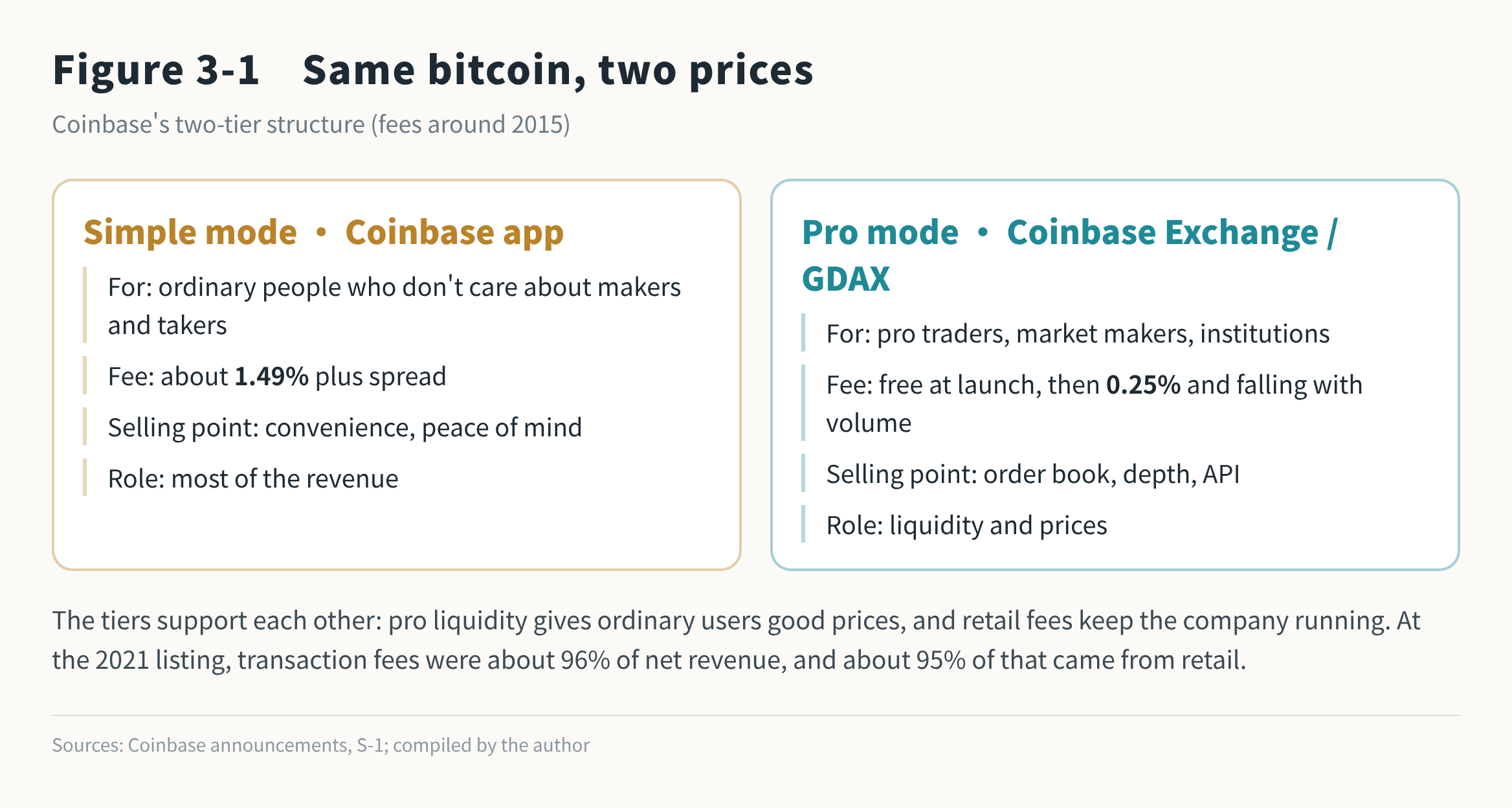
The two tiers supported each other: liquidity from professional users let ordinary users get good prices, and the high fees ordinary users paid kept the whole company running.
This structure drew plenty of criticism. For a long time Coinbase was seen as one of the most expensive exchanges. But as a business it worked very well: at its 2021 listing, transaction fees made up about 96 percent of Coinbase’s net revenue, and about 95 percent of transaction revenue came from retail users.
4. GDAX: more than a new name
In May 2016, Coinbase Exchange was renamed GDAX, short for Global Digital Asset Exchange.
The rename sent two signals.
First, the word “bitcoin” disappeared. In 2015 Ethereum had launched, a new blockchain that could run smart contracts. Coinbase realized that the exchange of the future would not trade only bitcoin. Alongside the rename, GDAX began offering ether trading on May 24, among the first regulated US exchanges to do so.
Second, the exchange and the retail brand were separated. Coinbase was the brand for ordinary people; GDAX was the brand for professional traders. Two kinds of users, two experiences, two price schedules, separated by two names.
That same year, the competitive landscape delivered a reminder. In August 2016, the offshore exchange Bitfinex was hacked and 119,756 bitcoin were stolen, worth roughly $65 million to $72 million at the time; bitcoin’s price fell about 20 percent. Once again, users were reminded that an exchange’s security and regulation were not just marketing slogans.
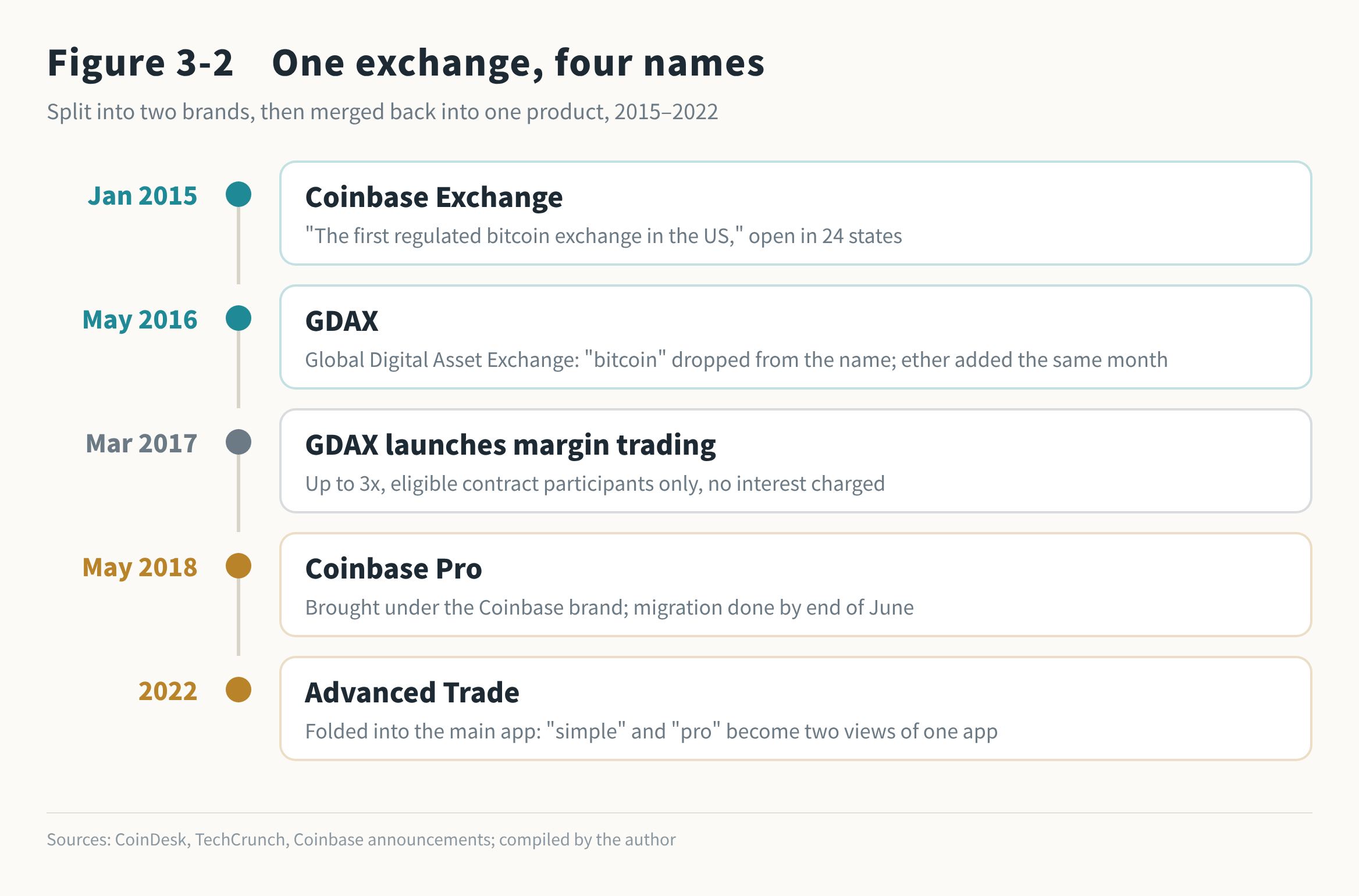
In May 2018, GDAX was renamed again, to Coinbase Pro, with the migration completed by the end of June. The matching engine underneath didn’t change; the brand strategy did. After the 2017 bull market, the name Coinbase was known everywhere, and it made more sense to bring everything under Coinbase than to maintain two brands.
In 2022, Coinbase Pro was folded into the main app and renamed Advanced Trade. “Simple” and “pro” became two interfaces in one app.
From 2015 to 2022, Coinbase spent seven years going in a circle: from one product split into two brands, then merged back into one. Each step matched the market of its time: early on it needed to separate users and protect the high fees; later it needed one brand, less churn and lower maintenance costs.
5. A “secret” plan made public
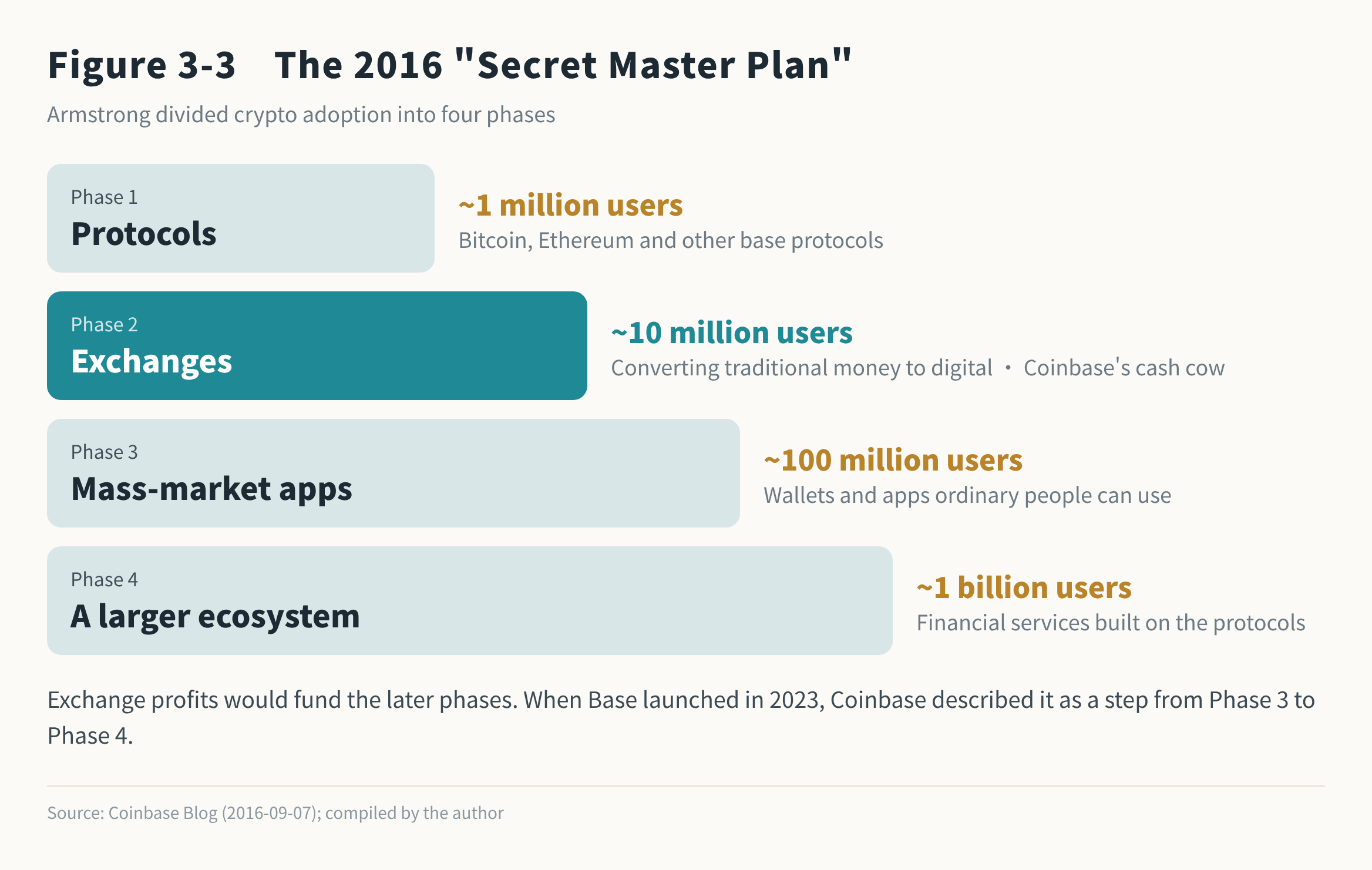
Why did the exchange matter so much? On September 7, 2016, Armstrong published a post on the company blog with a slightly playful title: “The Coinbase Secret Master Plan.”
The post divided the spread of cryptocurrency into four phases, comparing them to the development of the internet:
- Phase 1, protocols: base protocols such as Bitcoin and Ethereum are invented; about 1 million users;
- Phase 2, exchanges: people need a place to convert traditional money into digital currency; about 10 million users;
- Phase 3, mass-market apps: wallets and app interfaces that ordinary people can use easily; about 100 million users;
- Phase 4, a larger ecosystem: all kinds of financial services built on these protocols; about 1 billion users.
In this roadmap, the exchange was Coinbase’s cash cow: the money it earned would fund the later phases. That explains why Coinbase was willing to accept self-cannibalization to build the exchange. The exchange was not just a business; it was the fuel for everything that came after.
The plan would be quoted again and again over the next decade. When Coinbase launched the Base blockchain in 2023, it was described as a step from Phase 3 to Phase 4.
A few months after writing the plan, Coinbase lost its other founder.
On January 18, 2017, Fred Ehrsam announced at an internal meeting a plan to step back from day-to-day management at the end of the month and stay on the board. The reasons given were undramatic: revenue had grown more than 2.5 times in 2016, the management team had been strengthened, and it felt like a comfortable time to leave; the industry as a whole had also reached an inflection point where it was “feasible for the first time” to build other ideas. A little over a year later, Ehrsam co-founded the crypto investment firm Paradigm.
The man who came off a Goldman trading desk convinced that “the exchange is the center of power” left once the exchange was firmly established. The judgment Ehrsam left behind was about to face a real flood of traffic.
Two months after Ehrsam left, GDAX launched margin trading, with up to 3x leverage on bitcoin, ether and litecoin. But it was open only to “eligible contract participants,” such as institutions with more than $10 million in total assets, and Coinbase charged no interest or fees, because lending to consumers would require specific licenses.
This was another cost of standing on the side of the rules: a leveraged product other exchanges could launch on a whim, Coinbase first had to check which license it required and whether it had one.
6. Looking back: judgment or luck?
The judgment: Building its own exchange was the key step in Coinbase turning from “a bitcoin app” into “financial infrastructure.” Without its own order book there would have been no institutional business, no custody business, and none of its later role as the main custodian for spot bitcoin ETFs. Ehrsam’s view that “the exchange is the center of power” was borne out repeatedly over the next decade.
The courage: Accepting self-cannibalization. Many companies at similar moments protect their existing high-margin business and end up being disrupted from below by rivals. Coinbase gave users a cheaper option itself. It gave up some retail profit, but it kept professional users on its own platform.
The shortcomings: The two-tier structure cut both ways. It made Coinbase money, but it also left it at a long-term price disadvantage. When Binance stormed into the market after 2017 with very low fees and a huge range of coins, Coinbase’s high fees became an obvious weakness. In global volume rankings it trailed far behind for many years.
The exchange itself also left a stain. In March 2021, the US Commodity Futures Trading Commission (CFTC) fined Coinbase $6.5 million, finding that from January 2015 to September 2018 it had made false or misleading reports of trading data on GDAX, and that a former employee had engaged in wash trading over six weeks in August and September 2016. An exchange selling itself on being “regulated” had not kept its own order book spotless.
What if Coinbase had never built an exchange?
It would probably have become something like a PayPal for buying bitcoin: lots of users, a good brand, but always downstream in the industry chain. Prices and liquidity would be in someone else’s hands, and every upstream problem would hurt it too. More importantly, when institutional money really arrived a few years later, it would look for an exchange with an order book, custody and licenses, and by then Coinbase might have been too late.
The lesson of this chapter: when your core capability is in someone else’s hands, take it back as early as you can, even if building it yourself hurts your existing business.
Decision Card
- Situation: 2015: Coinbase was a bitcoin “counter,” dependent on other exchanges for prices and supply
- Options: A: stay a broker and focus on the retail experience B: build its own regulated exchange and accept that low fees would eat into retail
- Choice: B, creating a two-tier structure of “high retail fees plus low professional fees”
- Outcome: Gained its own liquidity and pricing power, laying the foundation for institutional and custody businesses; but high fees became a weakness in later price wars
- Lesson: When your core capability is in someone else’s hands, take it back early, even if it hurts your existing business
Key line: Whoever owns the order book owns the price. Better to let users save money in your own house than in someone else’s.
Sources
- Series C and investors: Fortune, 2015-01-20; CoinDesk; Cointelegraph
- Coinbase Exchange launch: Retail TouchPoints; SiliconANGLE, 2015-01
- GDAX and Coinbase Pro renaming: CoinDesk, 2018-05-23; The Next Web; Finance Magnates; Koinly
- Fee structure: Coinbase Blog: Improving our Fee Schedule; Boxmining; IBTimes
- Exchange launch date, 24 states and fees: FinTech Futures; CoinDesk
- GDAX launching ether: CoinDesk, 2016-05-19
- Bitfinex hack: Wikipedia: Bitfinex; Boston Globe
- Retail share of revenue: The Motley Fool
- “The Coinbase Secret Master Plan”: Coinbase Blog, 2016-09-07; Base and Phase 4: The Daily Hodl, 2019-08-01; Milk Road
- Ehrsam’s departure: CoinDesk, 2017-01-18; Fortune, 2017-01-21
- GDAX margin trading: TechCrunch, 2017-03-21; CoinDesk, 2017-03-20; Finance Magnates
- Chinese exchanges’ zero fees, January 2017 inspections and new fees: CoinDesk, 2017-01-23; Brave New Coin; Finance Magnates
- CFTC $6.5 million penalty: CFTC press release, 2021-03-19
From my new book Coinbase: On the Side of the Rules: https://pickful.ai/books/tqn4
Repost this post?
Share with your followers.
Reply