
目錄(13 節)

·
TORCH: Live Product, Unproven Value Capture — A Robinhood Chain Deep Dive
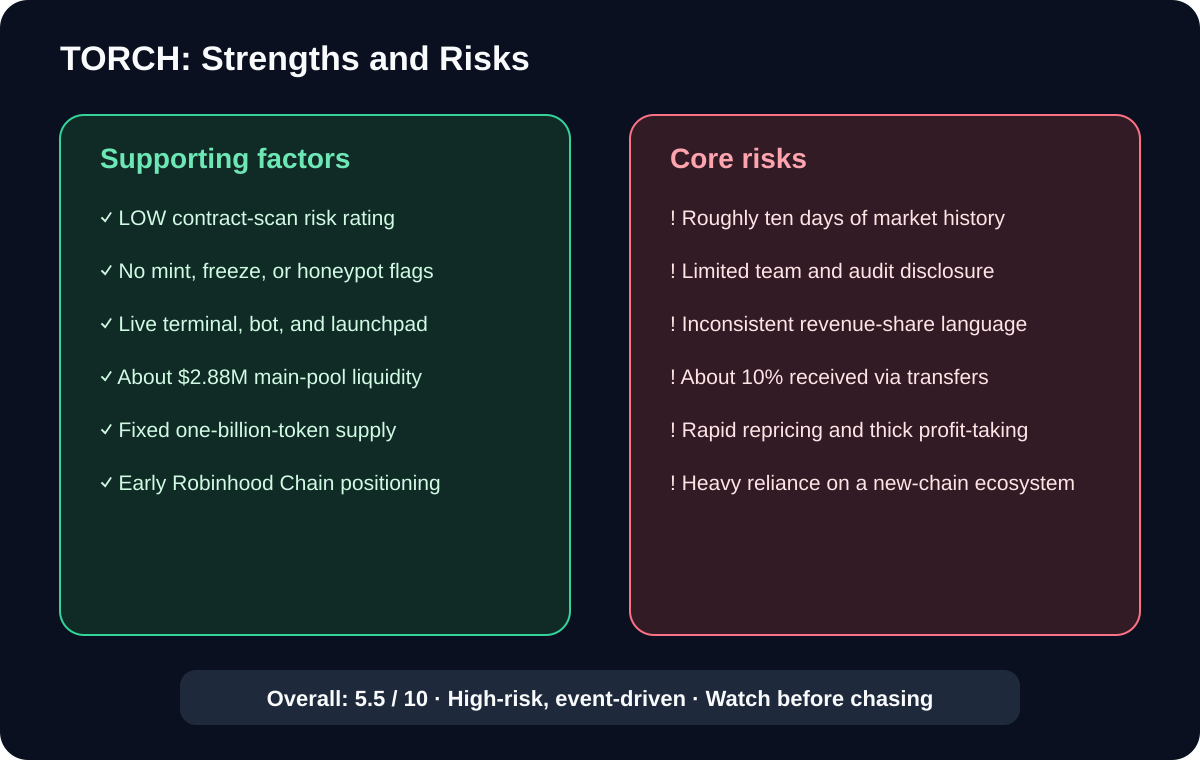
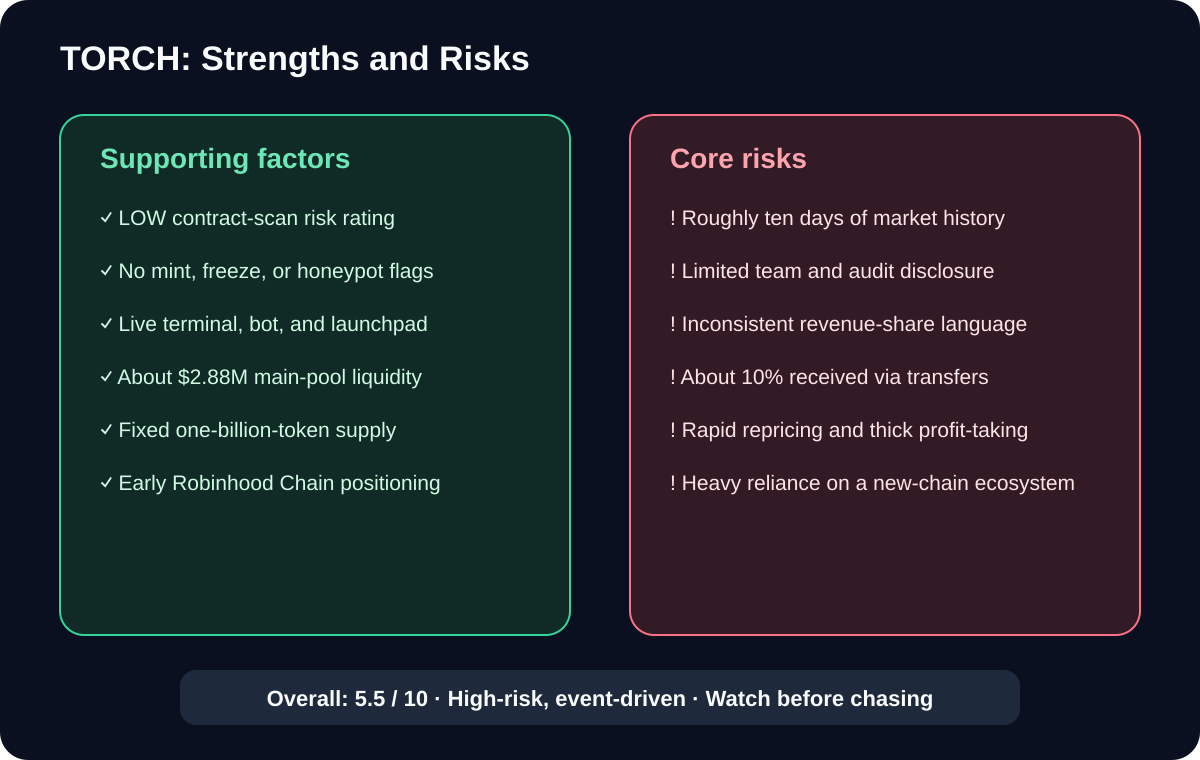
TORCH has a live terminal, bot, and launchpad, plus a relatively clean contract scan. But its short history, inconsistent revenue-allocation language, limited team disclosure, and transferred supply make it a high-risk, event-driven asset.
Data snapshot: October 20, 2026, approximately 15:30–16:00 UTC
This report is for research purposes only and is not financial advice.
1. Asset Identification
- Project: Torch
- Token: TORCH
- Network: Robinhood Chain mainnet
- Chain ID:
4663 - Contract:
0x000050e18ffa3f8f7ad170eb9cef160eb3ed1111 - Research entry: Fomo Family
2. Executive Summary
TORCH is more than a standalone meme token. It is tied to an early-stage trading terminal, Telegram bot, launchpad, and cross-chain trading product. Its token contract also produced a relatively clean automated security result. However, the project is extremely young, team transparency is limited, public descriptions of revenue allocation are not fully consistent, and a meaningful portion of the supply has previously been distributed by direct wallet transfers.
At a valuation of roughly $16 million, the market is primarily pricing in the growth of a new Robinhood Chain ecosystem—not a proven stream of protocol cash flow. TORCH should therefore be treated as a high-risk, event-driven asset rather than a core holding.
Overall rating: 5.5/10. Watch before chasing.
3. Market Snapshot
The deepest tracked market is the Uniswap V4 TORCH/ETH pool.
| Metric | Snapshot |
|---|---|
| Price | About $0.0163
|
| Market cap / FDV | About $15.8M–$16.4M
|
| 24-hour change | About +72%
|
| 6-hour change | About -7%
|
| 24-hour volume | About $4.11M
|
| Main-pool liquidity | About $2.88M
|
| 24-hour buys / sells | 5,450 / 3,953 |
| Total supply | 1 billion TORCH |
| TORCH in main pool | About 99.39 million |
| Main pool created | October 10, 2026 |
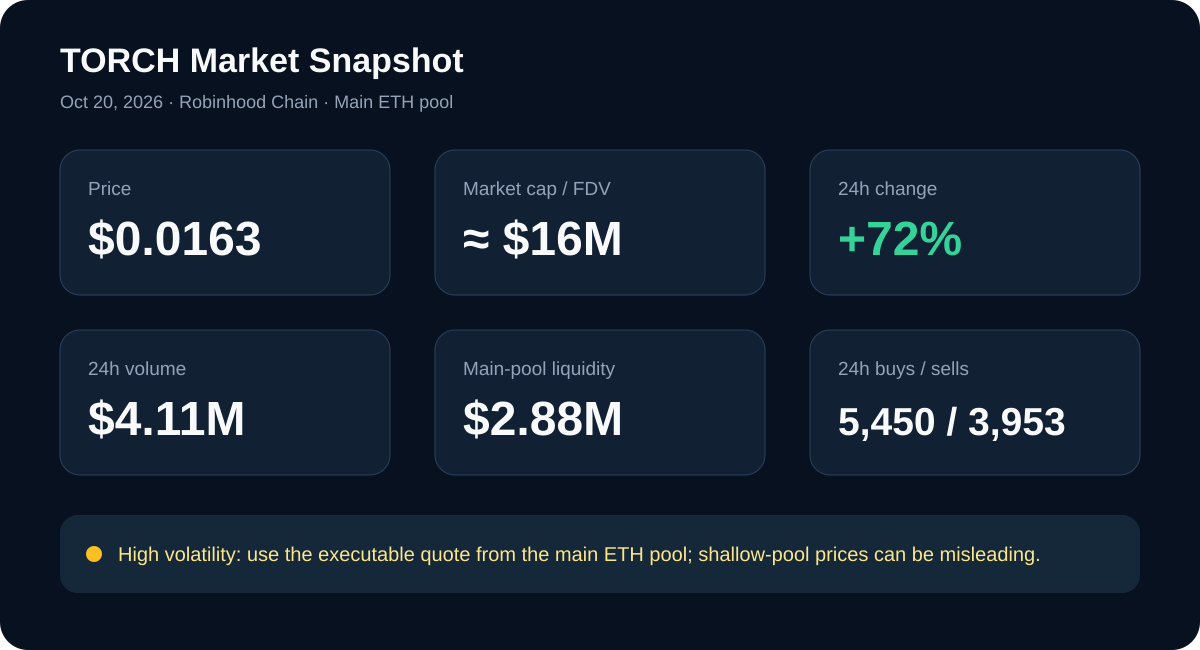
Sources: DEX Screener main pool and DexBrief.
Market-structure observations
- Liquidity was approximately 18% of valuation, a respectable ratio for a newly launched small-cap token.
- Twenty-four-hour volume was roughly 1.4 times main-pool liquidity, indicating active trading as well as clear new-token speculation.
- Twenty-four-hour buy count exceeded sell count, although the most recent one-hour window had at times shifted toward more sells, suggesting cooling short-term momentum.
- Several shallow USDG, V3, and Metric pools displayed materially divergent prices. The executable quote from the main ETH pool is the more useful reference.
- With nearly the full one-billion supply included in circulating valuation, each
$0.001change in price moves nominal valuation by roughly$1 million.
TORCH has appeared in MEXC Meme+, Gate Trenches, WEEX, and Bitrue Alpha. These are primarily early-discovery or meme-token venues and should not be interpreted as full due-diligence endorsements. The MEXC listing announcement confirms the network and exact contract address.
4. Product and Project
Torch aims to provide one account and one balance for trading across multiple chains. Its product set includes:
- A web trading terminal
- A Telegram trading bot
- Cross-chain purchases and automatic bridging
- Take-profit, stop-loss, limit, and DCA orders
- Wallet tracking and copy trading
- A Robinhood Chain token launchpad
- Holder rewards, cashback, and referral sharing
Torch states that wallets are managed using Turnkey secure hardware or trusted execution infrastructure. Users can export their private keys; small trades can sign automatically below a user-defined limit, while larger transactions, withdrawals, and key exports require password confirmation. See the official Torch documentation.
What supports the product thesis
- Robinhood Chain is a live, EVM-compatible Arbitrum L2 with mainnet chain ID 4663. See Robinhood’s official network documentation.
- A newly launched chain does need trading aggregation, bots, and token-launch infrastructure.
- TORCH is already used as the quote asset for some Torch Launchpad tokens, which could create ecosystem-level demand.
- Trading, launch, and bridging fees offer more potential value capture than a pure meme token.
What limits the thesis
Telegram bots, cross-chain aggregators, launchpads, and copy-trading terminals are crowded categories. A durable moat would have to come from real volume, execution quality, user retention, and liquidity network effects. The project’s history is not yet long enough to demonstrate those advantages.
5. Token Mechanics and Value Capture
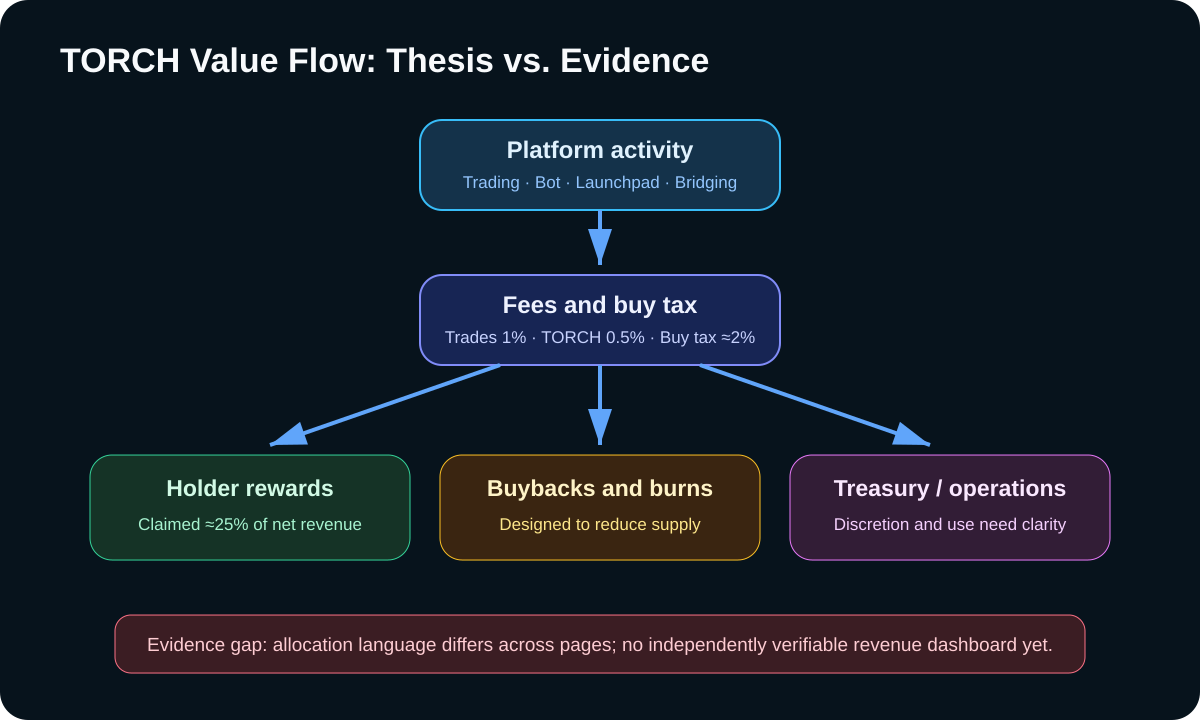
The project describes two principal sources of value capture:
- Fees from TORCH trading, partly allocated to holders and partly to buybacks or burns.
- Platform revenue, with approximately 25% of net revenue from the bot, terminal, and launchpad reportedly distributed pro rata to TORCH holders.
Other published claims include:
- A 0.5% platform fee on TORCH trades.
- A 1% platform fee on ordinary token trades.
- An approximately 2% TORCH buy tax and 0% sell tax.
- A fixed one-billion-token supply with no mint function.
- Fee-funded buybacks and burns.
Critical issue: public allocation descriptions do not fully align
- The marketing site says 70% of TORCH’s own 1% fee goes to holders and 30% is burned.
- The fee documentation says the 0.5% TORCH trading fee goes to the burn wallet and treasury.
- The site separately states that holders receive approximately 25% of platform net revenue.
- There is not yet a comprehensive, independently verifiable dashboard for revenue, buybacks, burns, and holder distributions.
Holder revenue should therefore be treated as a project claim and an item requiring verification—not as a mature dividend stream that can be valued directly. See the Torch website and official fee documentation.
6. Contract Security
An automated security scan of the exact contract returned the following:
| Check | Result |
|---|---|
| Overall risk level | LOW |
| Honeypot | No |
| Simulated sale | Sellable |
| Buy tax | 2% |
| Sell tax | 0% |
| Mintable | No |
| Freeze authority | No |
| Blocking history | No |
| Source code | Verified/open source |
| Ownership retained | No |
| Fake liquidity | Not triggered |
| Wash trading | Not triggered |
| Known rug-linked funding | Not triggered |
| Liquidity removal | Not triggered |
This makes TORCH unlike a typical honeypot, arbitrarily mintable token, or admin-freezable asset.
However, a LOW scan result only means that no known contract-risk labels were triggered. It does not mean low price risk, nor does it verify the team, platform revenue, or related-wallet behavior.
The project also says launchpad liquidity is permanently held by the factory contract with no withdrawal route. Without an independent audit and full manual code review, that remains principally a project assertion. See the launchpad mechanics.
7. Holder Concentration and Supply Risk
This is one of the most important areas of concern.
An independent on-chain scan previously found:
- The top ten real circulating holders controlled approximately 27.4%.
- The largest single holder controlled approximately 6.8% of circulating supply.
- Six wallets collectively received roughly 10% of circulating supply by transfer rather than through ordinary purchases.
- If these wallets sold into the main pool together, the model estimated price impact of approximately 45%.
- The deployer itself was not among the largest holders.
- No obvious same-block wallet pack or first-30-second sniper cluster was detected.
Source: Trenchscan.
An older snapshot showed a 46.9% top-ten balance share, but it also recorded only 481 holders, compared with roughly 1,448 in a later explorer snapshot. The difference may reflect subsequent distribution or methodological differences in excluding pools, contracts, and burn addresses.
Interpretation
- Concentration was not so extreme that malicious control could be assumed immediately.
- The wallets that received approximately 10% by transfer deserve continued monitoring.
- “100% of initial supply entered the pool” does not mean the team has no tokens; related parties could acquire supply through a launch-time developer buy or later purchases.
- Holder-address growth does not necessarily equal independent-user growth.
8. Team, Community, and Credibility
Public team transparency remains limited:
- The project primarily uses identities such as
torchandmlog, without clear public professional histories. - No complete legal-entity, investor, or financing disclosure was identified.
- The Telegram community had approximately 1,400 members.
- Project and team accounts still had relatively small visible followings.
- Most domain, documentation, token, and product activity dated from October 2026, giving the project a very short history.
- No compelling independent smart-contract audit report was identified.
- The project’s terms exclude users in the United States, Canada, the United Kingdom, China, and sanctioned regions, indicating meaningful legal concerns.
On the positive side, the documentation is relatively detailed and does not hide volatility, failed-stop-loss, bridge, or key-management risks. Good documentation, however, is not a substitute for identifiable leadership, independent audits, and verifiable revenue.
TORCH being deployed on Robinhood Chain does not imply endorsement by Robinhood Markets, ownership in Robinhood, or any official corporate rights.
9. Bull Case
- Robinhood Chain is in an early infrastructure land-grab phase.
- Torch has an operational early product rather than only a roadmap.
- TORCH’s use as a launchpad quote asset could create ecosystem demand.
- Fixed supply, buy tax, possible buybacks, burns, and revenue sharing create a theoretical value-capture loop.
For that thesis to hold, the project must demonstrate:
- Sustained real-user growth beyond launch-week traffic.
- Organic trading volume rather than wash activity or incentive loops.
- On-chain revenue distributions supported by verifiable data.
- Continued growth in TORCH-denominated trading pairs.
- No concealed concentration across team-controlled wallets.
- Continued user and asset growth on Robinhood Chain itself.
10. Principal Risks
In order of importance:
- Extremely short operating history: approximately ten days of market history cannot demonstrate durable growth.
-
Rapid repricing: the move from roughly
$0.003to above$0.016created substantial unrealized profits. - Transferred supply: approximately 10% of circulating supply was received via transfers, creating possible concentrated sell pressure.
- Unverified revenue mechanics: the claimed 25% net-revenue allocation and exact burn split require on-chain proof.
- Limited team transparency: public identity, legal entity, financing, and audit disclosures remain weak.
- Ecosystem dependency: TORCH relies heavily on Robinhood Chain, itself a new ecosystem.
- Composability risk: a simple token contract does not eliminate risk in the launchpad, automated signing, bridges, routers, or rewards contracts.
- Regulatory risk: pro-rata distributions of platform net revenue may raise securities or yield-product questions in some jurisdictions.
- Immature indexing: material differences across data providers mean traders should verify the executable main-pool quote before acting.
11. Scorecard
| Dimension | Assessment |
|---|---|
| Basic contract security | Relatively strong |
| Liquidity | Good for a small, new token |
| Product delivery | Early product exists |
| Token value capture | Coherent thesis, insufficient verification |
| Team transparency | Weak |
| Supply structure | Medium-to-high risk |
| Project maturity | Extremely low |
| Current valuation appeal | Moderate; substantial optimism priced in |
| Overall risk | High |
12. Final Assessment
TORCH has more substance than a typical newly issued meme token: an early product suite, an emerging role as an ecosystem quote asset, and a plausible value-capture narrative. It is not yet mature enough to value as an established protocol.
Before treating it as a high-conviction long-term investment, investors should require:
- Verifiable daily and monthly active users and retention;
- Real platform fee revenue;
- Cumulative TORCH buyback, burn, and holder-distribution data;
- Independent audits of critical contracts;
- Continued monitoring of transfer-funded large holders; and
- Better disclosure of the team and legal entity.
Any participation should be sized as a high-volatility early-stage position. Avoid treating a one-day rally as proof of product-market fit, and monitor main-pool liquidity, platform revenue, and transfers from large wallets to liquidity pools or exchanges.
A LOW automated security rating does not mean low investment risk and is not a recommendation to buy.
13. Principal Sources
轉發此貼文?
與您的關注者分享。
回覆