
Contents (8)

·
Five Gatekeepers: Most of What Shapes Robinhood Chain's Launchpad Market Isn't Up to the Launchpads
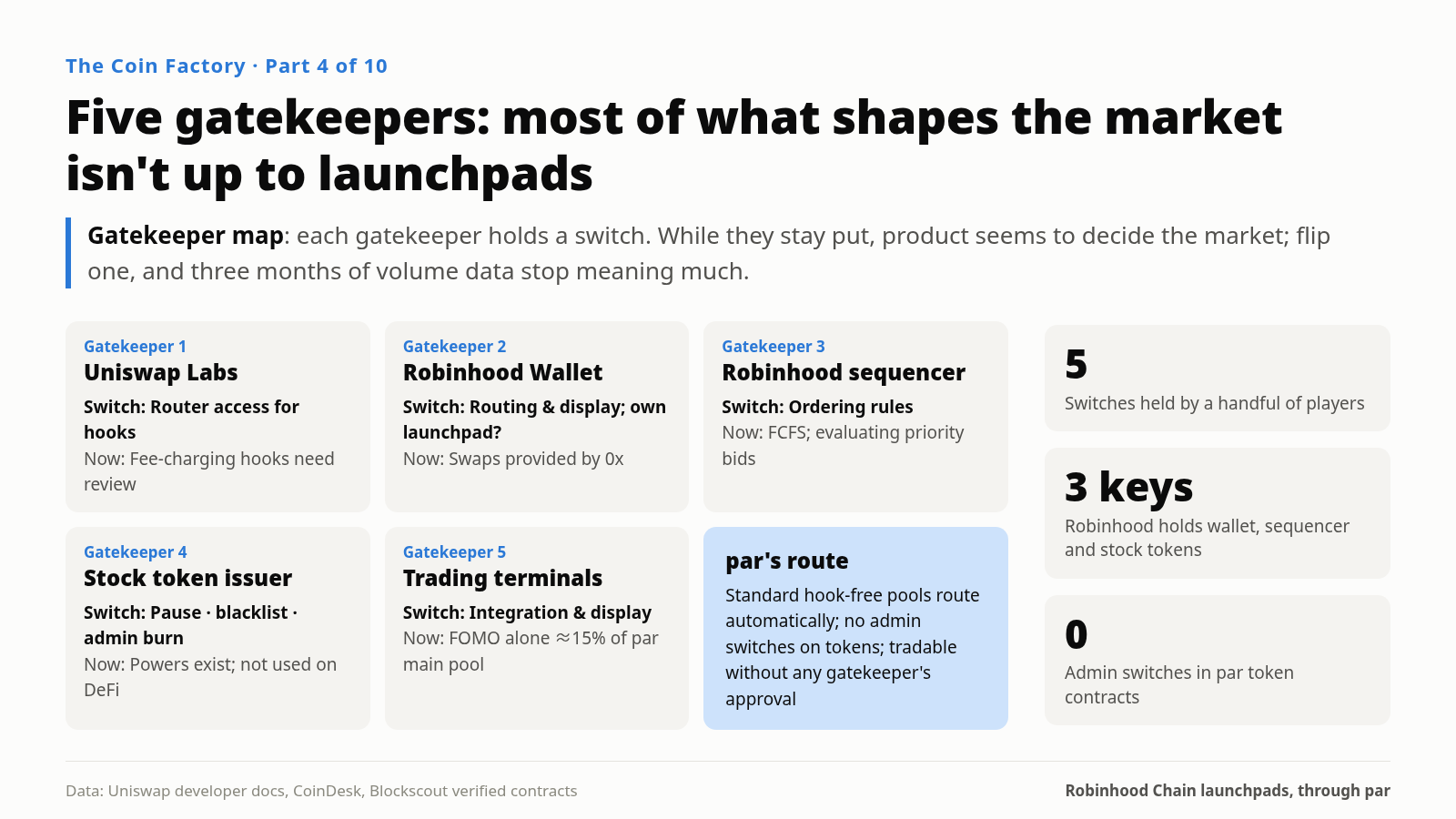
Five technical switches held by a handful of players — Uniswap's hook router access, Robinhood Wallet routing, sequencing rules, stock token issuer powers and trading terminals — can reshuffle Robinhood Chain's launchpad market faster than any product launch.
If you’re trying to judge what a new chain’s competitive landscape will look like in six months, or weighing a launchpad’s long-term risk, market data only tells you about the past. This piece lists five technical variables controlled by a handful of players. Change any one of them and the landscape reshuffles.
Start with a few things launchpads don’t get to decide:
- par wants to switch to collecting fees only in the quote asset. Its developer says that’s “waiting on hook approval,” so the timing depends on whoever approves it.
- Whether a memecoin quoted in a stock token can trade depends on whether the stock token’s issuer has paused the contract.
- How bad front-running gets depends on the rules the sequencer uses to order transactions.
- Whether a new token gets seen by lots of retail traders depends on whether wallets and terminals list it.
Gatekeeper map: each gatekeeper holds a switch. While the switches stay put, the landscape looks like it’s driven by product and operations. Flip one, and the landscape reshuffles fast.
1. Uniswap’s router access for hooks
Uniswap Labs states publicly that hooks with beforeSwapReturnsDelta, afterSwapReturnsDelta or dynamic-fee permissions must be submitted for review before they can be included in Uniswap’s routing. The review checks routing compatibility only; it isn’t a security audit. Uniswap Labs retains sole discretion to refuse or later remove them.
On v4, designs like “take a slice of the trade and collect only the quote asset” technically require returnsDelta permission. In other words, a launchpad that wants more powerful fee collection has to pass Uniswap’s review, and Uniswap runs its own launchpad, pools.trade. The gatekeeper is also a competitor.
par’s developer wrote on October 5 that V2 is waiting on hook approval. The developer didn’t name the approver; technically, the most likely candidate is Uniswap’s router access.
How wide is this door? It only governs order flow routed through Uniswap Labs. In the latest 2,000 trades in par’s platform token main pool, about 13.9% went through Uniswap’s UniversalRouter. Important, but not the only door.
2. Robinhood Wallet’s routing and display
0x has provided swap routing for Robinhood Wallet since 2023. About 39.4% of volume in par’s platform token main pool comes from 0x’s settlement contract on this chain, RobinHoodSettler. But that’s 0x’s general-purpose contract. Trace it trade by trade, and about 40% of it comes from the trading terminal FOMO (Relay calling 0x), and another ~37% from a group of 7702 wallets built on Alchemy’s account contract, source unconfirmed. Robinhood Wallet’s exact share can’t be separated out on-chain. The 90-day gas subsidy also only covered swaps initiated from Robinhood Wallet.
Whoever Robinhood picks as a partner gets that slice of traffic: swaps went to 0x, the main AMM to Uniswap, USDG yield to Morpho, perps to Lighter.
There’s no public information yet on whether 0x routes to pools with fee-charging hooks, or how the wallet displays memecoins.
The biggest unknown in this switch: Robinhood is the only party on the chain that owns the assets, the chain and the wallet, and it doesn’t currently run a launchpad. Uniswap has already shown the path from the rails layer up into the launchpad layer. If Robinhood launched official token creation or curation inside its wallet, every third-party launchpad would instantly face a competitor holding the biggest front door. Of the five variables, this one has the most impact and is the hardest to predict.
3. Sequencing rules
Robinhood alone runs the sequencer, and the rule is first-come, first-served; you can’t pay to jump the line. CoinDesk reported on October 9, citing people familiar with the matter, that Robinhood is evaluating Priority Gas Auctions, which Arbitrum launched on September 24 and which let a transaction pay more for priority. Neither side has said whether or when a decision will be made.
Sequencing rules decide what front-running competes on. Under first-come, first-served, it’s about who’s closest to the sequencer, so terminals start selling “latency” and some providers offer submission endpoints connected straight to the sequencer. Regular users don’t stand a chance. Under priority bidding, it’s about who’ll pay more: front-running costs become public, and part of the profit flows to the sequencer operator as gas.
If the rules change, anti-sniping designs have to be repriced. Atomic designs, where the creator buys first inside the launch transaction, are unaffected; protections that rely on “block windows” need to be reassessed. par’s dev buy is the former. Sequencing revenue would also become a new income stream for Robinhood at the chain layer.
4. Stock token issuer powers
Take the SPY stock token (0x117c…4C0C). In the verified Stock contract on Blockscout:
| Capability | Implementation |
|---|---|
| Pause all transfers |
transfer and transferFrom both check onlyNotPaused; TOKEN_PAUSER_ROLE can call pause()
|
| Blacklist addresses | Transfers check that sender, recipient and caller are all off the blacklist |
| Admin burn |
ADMIN_BURNER_ROLE can call adminBurn(from, amount) to burn from any address, bypassing pause and blacklist checks |
| Mint | MINTER_ROLE |
There’s no whitelist. Any address that isn’t blacklisted can hold and transfer, which is what lets it go into Uniswap pools and serve as a quote asset for memecoins.
These powers make sense for a regulated security token; they’re tools for carrying out legal orders. But a memecoin quoted in a stock token inherits them unchanged.
There’s a structural implication. Uniswap v4 is a singleton: assets for all pools sit in one PoolManager contract. Following the stock token contract’s logic, if the issuer blacklisted that one PoolManager address, every transfer of that stock token involving it would fail, and every v4 pool on the chain quoted in that stock token would stop trading at once. This isn’t a prediction, and it doesn’t say the issuer would do it. It just shows that memecoins quoted in stock tokens sit under a switch the issuer controls unilaterally.
5. Trading terminals and cross-chain intents
Terminals like GMGN, Axiom and FOMO are the interfaces most meme traders actually use. They decide what information a new token appears with and which path an order takes. par’s docs note that GMGN reads every token’s logo but only shows social links for launchpads it has integrated.
Cross-chain intents also open a new front-running window. FOMO users’ funds sit on Solana; when they buy tokens on Robinhood Chain, the cross-chain protocol Relay fills the order. How big is that path? Of trades in par’s platform token main pool from October 3 to 12, the ones traceable to FOMO make up about 15%, two orders of magnitude more than the 0.1% that comes through par’s own website. Bitquery recorded that from September 12 to 25, three groups of bots used the roughly 0.15-second gap between Relay recording an order and filling it to front-run 3,532 orders, costing users about $181,000.
The more concentrated terminals get, the more a launchpad’s relationship with them looks like a distribution contract. On day one, pools.trade was tradable on Uniswap’s web app, wallet and API, plus Bitget, Fomo, GMGN and OKX Wallet (Decrypt). That’s a brand owner’s advantage at the front-end layer.
The gatekeeper map
| Gatekeeper | Switch | Current state | If flipped, who gains | Who loses |
|---|---|---|---|---|
| Uniswap Labs | Router access for fee-charging hooks | Review required | Loosened: launchpads wanting to upgrade fee structures | Tightened: hook-fee models |
| Robinhood (wallet) | Routing and display; whether to run its own launchpad | Swaps via 0x; no official launchpad | Platforms that get priority routing or display | If it enters itself: every third-party launchpad |
| Robinhood (sequencer) | Ordering rules | First-come, first-served; evaluating priority bidding | Platforms with atomic anti-sniping; the sequencer operator | Platforms relying on block-window protection |
| Stock token issuer | Pause, blacklist, admin burn | Powers exist; no use against DeFi pools seen | Loosened: stock-token-quoted designs | Tightened: same |
| Trading terminals | Integration and display | A few terminals carry most traffic | Deeply integrated launchpads | Launchpads not yet deeply integrated |
Three takeaways.
Long-term profit at the launchpad layer depends on the relationship with gatekeepers, not just features. Pons is already deeply integrated with terminals and its hook fees are live. pools.trade has Uniswap behind it, which is itself a gatekeeper. par takes a different route: standard hook-free pools get into routing automatically, its token contracts have no admin switches at all, it needs no gatekeeper’s approval to be traded, and it has the most features. Its next steps are getting V2’s fee upgrade approved and deepening terminal integration.
The biggest single variable is Robinhood itself. It holds three keys: the wallet, the sequencer and the stock tokens. For now it has left the launchpad layer to third parties, but that choice could change any time. Any long-term view of this sector should treat “Robinhood enters directly” as its own scenario.
Market data lags the switches. The day a gatekeeper changes the rules, the last three months of volume data stop being a useful reference. On a chain that’s only a hundred days old, analyzing the rules says more about the future than volume does.
Fill in the gatekeeper table for any launchpad
Does its fee structure need Uniswap’s approval? Did it get it? How much of its volume comes from Robinhood Wallet? If Robinhood launched official token creation, what’s left of its differentiation? If sequencing rules change, does its anti-sniping still hold? How many of its tokens are quoted in stock tokens? How many major terminals have integrated it deeply?
The more answers that come back “depends on someone else,” the higher the long-term risk, no matter how good its volume looks today.
Closing
On a chain that just turned a hundred days old, the landscape isn’t just about who moves fastest.
When the five gatekeepers flip their switches matters more.
Volume data only records the stretch when the switches didn’t move.
Of these five switches, which do you think moves first?
— Excerpted from Chapter 4 of The Coin Factory, “Gatekeepers: Five Technical Variables That Decide the Landscape”
Repost this post?
Share with your followers.
Reply