
目录(6 节)

·
100x Only Happens in the First Month: Robinhood Chain's 175x and 96% Ebb (Why 100x Is Hard 2/4)
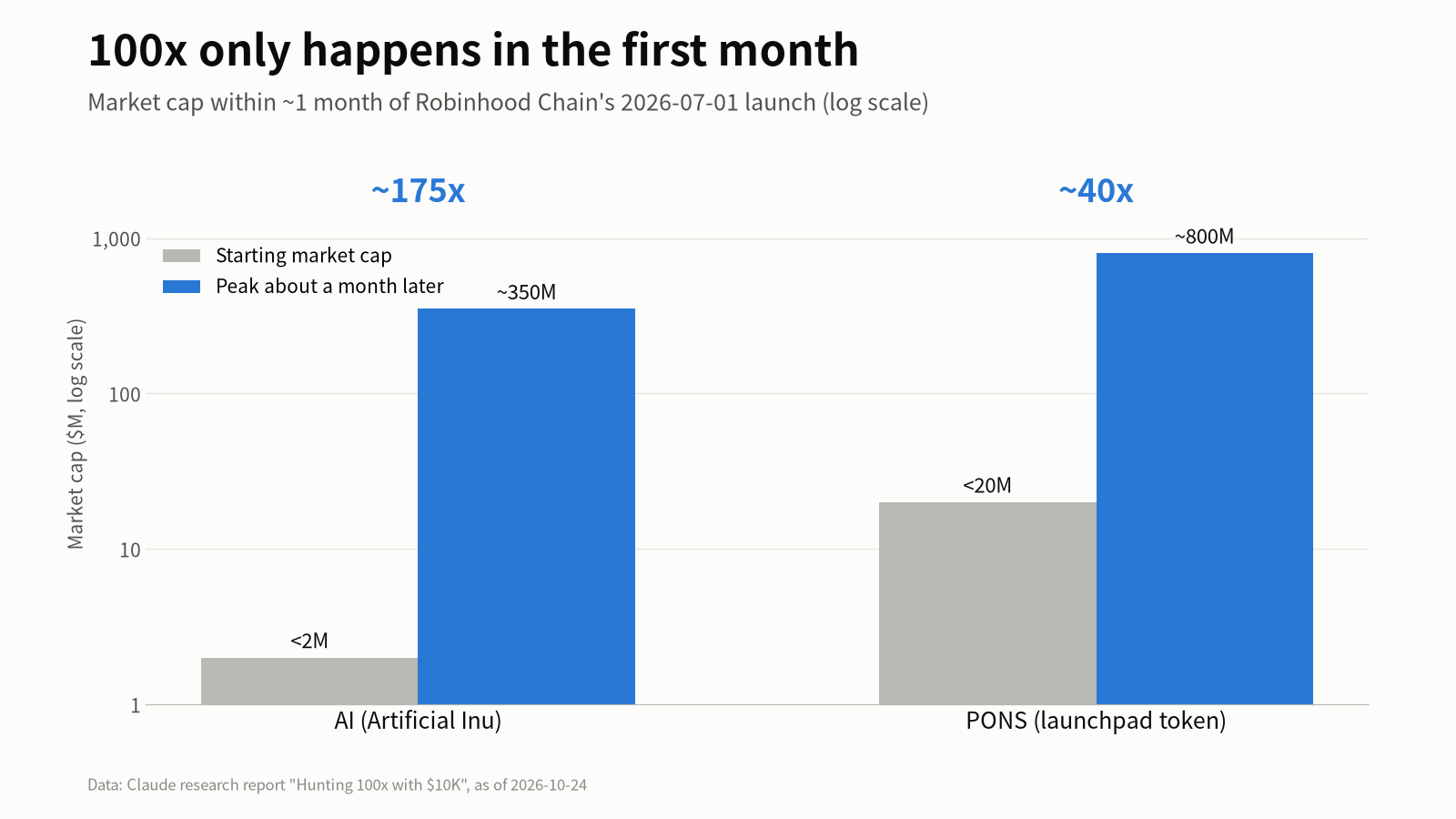
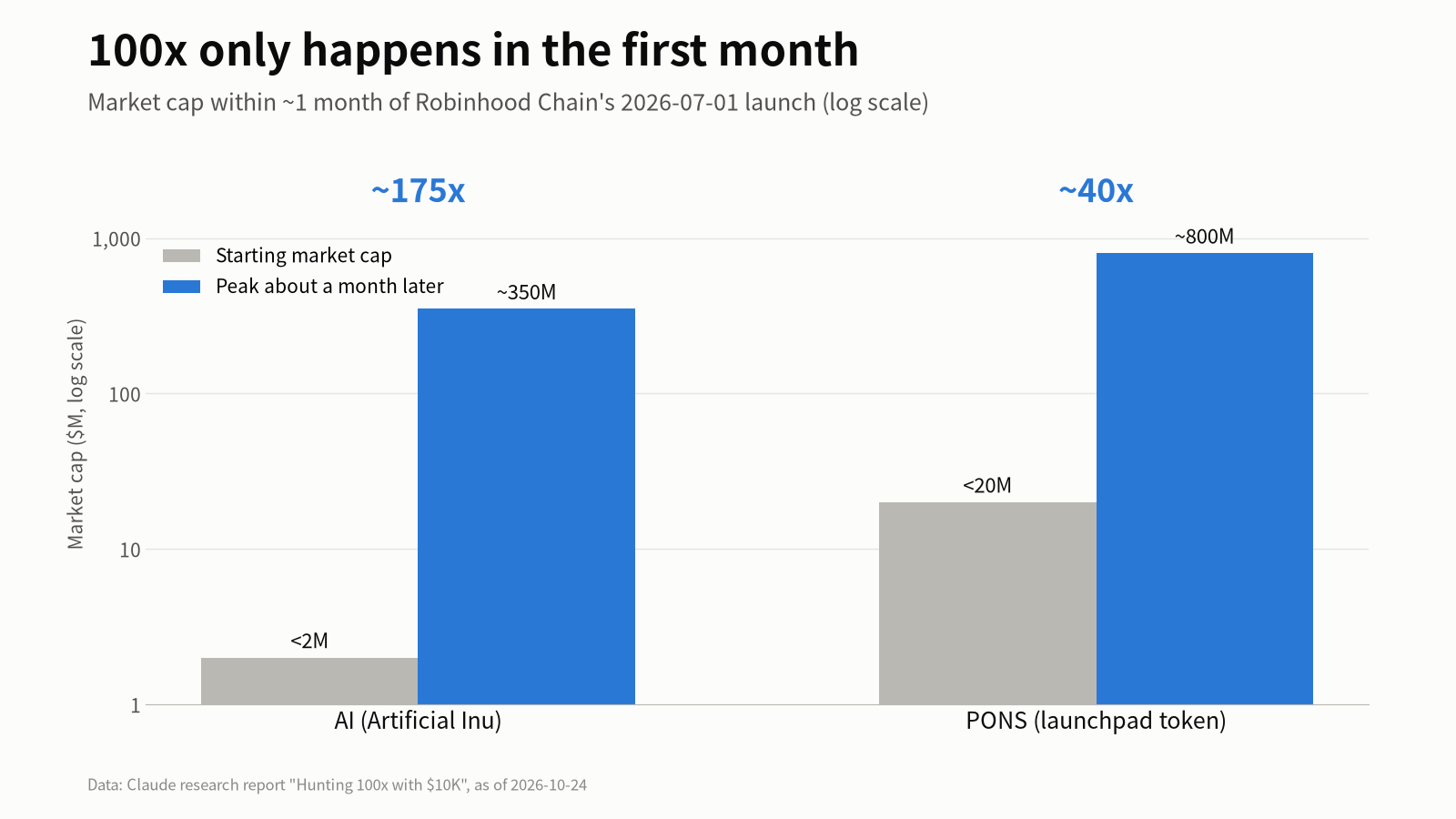
Within a month of Robinhood Chain's launch, one meme went about 175x and the launchpad token about 40x. Three months later, meme/stock-pair volume was down 96%. 100x moves cluster in a narrow First-Month Window.
If you are building a chain, a trading venue or a token-launch tool, or investing in companies that do, this case is about you. It answers an expensive question: how do 100x moves on new platforms actually happen, and why does almost nobody capture them?
The conclusion first:
100x moves are not spread across time. They cluster in a narrow window. Once it closes, the same trade turns from buying a lottery ticket into becoming someone’s exit liquidity.
I call it the First-Month Window.
Autopsy: a broker’s chain in its first 100 days
On July 1, 2026, Robinhood launched its own chain, Robinhood Chain. It was built for tokenized stocks and real-world assets. What filled it first was meme coins.
Over roughly the next month:
- A meme called AI (Artificial Inu), paired with the tokenized Nvidia share, went from under $2M in market cap to about $350M. Roughly 175x.
- The token of Pons, the chain’s largest launchpad, went from under $20M to about $800M. Roughly 40x. In its first month Pons launched about 290,000 tokens and cleared $2.5B in volume.
- PIPEDOG traded $65M in its first 16 hours and peaked near $74M in market cap.
- CASHCAT, a cat meme, was listed directly in the main Robinhood app on August 6 and rose about 78% around the announcement, peaking at $200M to $300M.
These were real 100x and multi-ten-x moves. Then the tide went out:
- Daily volume in meme/stock-token pairs on the chain fell 96% from $443M in early September.
- PIPEDOG fell from $74M to about $28M; CASHCAT to about $100M; another ecosystem meme, GOOD, sits 93.7% below its peak.
- An onchain analyst alleged that one crew pulled at least $18.43M out of 53 token launches between July 10 and September 21 by sniping its own launches and selling to latecomers. The Block confirmed the sniping pattern on 10 of them.
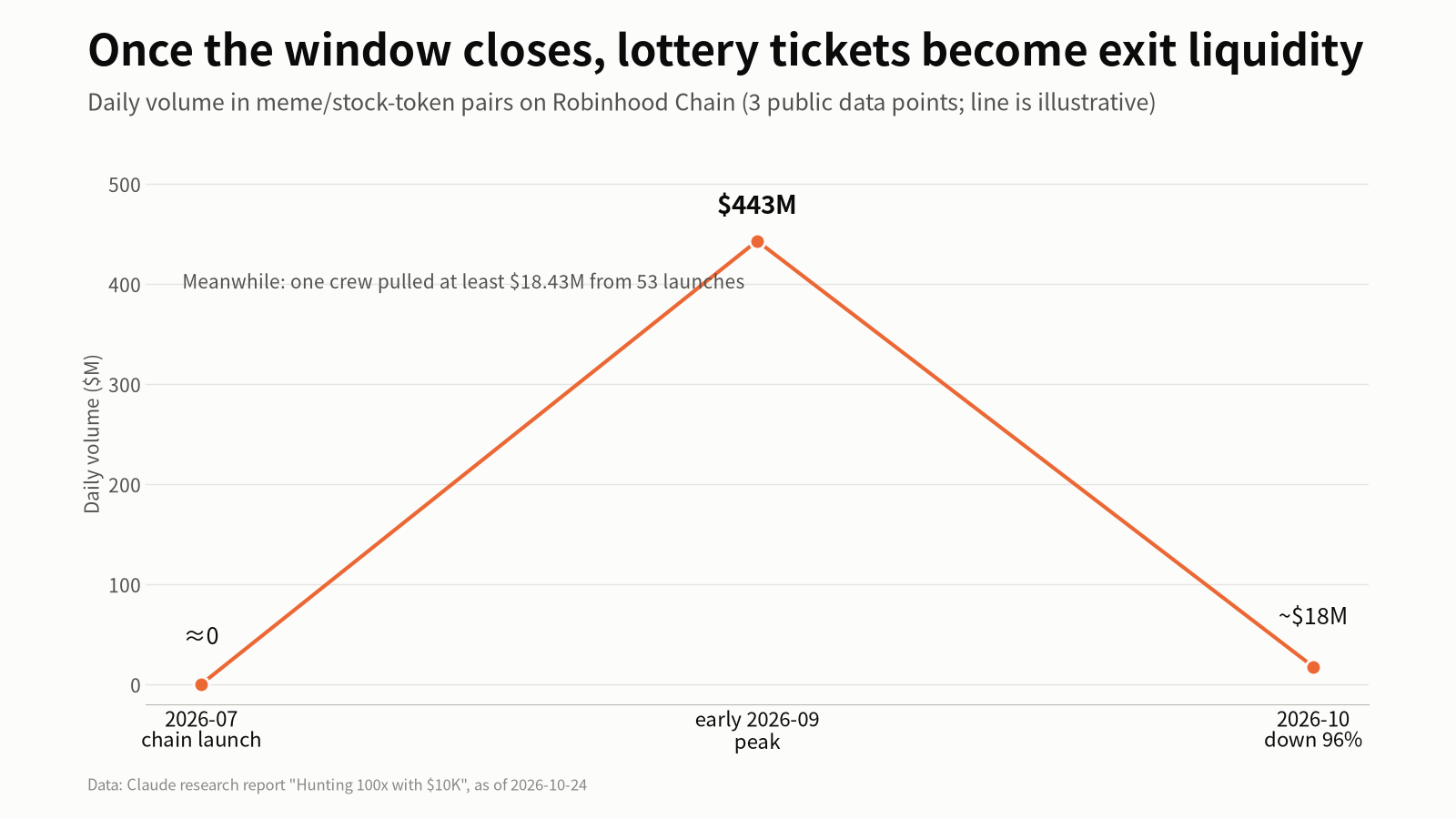
Line the timeline up and the main legs all sit between July and early August. By October the odds had flipped.
Why the window is so short
The First-Month Window needs three things at once:
- Mass retail distribution. Robinhood has 27.6 million funded accounts. A new chain launches with a ready-made user pool behind it.
- Frictionless token creation. Launchpads cut the cost of a new token to cents, so supply explodes within days.
- Attention not yet priced. In month one, nobody knows how big the chain will get, so early buyers are buying possibility.
Only the first is durable. Launch tools get used by everyone and supply floods in; attention gets priced and possibility turns into price. Once the second and third are gone, what remains is an increasingly crowded casino with more and more insiders.
So the essence of the window: distribution belongs to the platform; the dividend belongs to time. The platform stays. The dividend goes to whoever arrives first.
The failure rate is worse than you think
Do not let a few winners fool you. Zoom out to the whole launch market:
- Pump.fun, the largest meme launchpad, launches more than 280,000 tokens a week. Its “graduation rate”, the share of tokens that move from the launchpad’s bonding curve to a real trading pool, ranged from 0.2% to 2.7% across 2026 studies.
- One analysis claimed 98.6% of more than 7 million Pump.fun tokens were flagged as scams or fake volume (single source, treat with caution).
The few 100x stories get all the coverage; hundreds of thousands of dead tokens get none. That is survivorship bias.
One observable catalyst: the main-channel listing
One detail deserves its own section: CASHCAT rose about 78% around its listing in the main Robinhood app. A separate Messari study found tokens rise 91% on average in the five days after a Coinbase listing.
In a new platform’s life, the jump from onchain-only to the main distribution channel is a step change you can watch for. A token that moves from a chain explorer to the home screen of an app with tens of millions of users meets an entirely different number of buyers.
To be honest: a Robinhood app listing of an onchain meme has happened exactly once so far. Whether it repeats is unknown.
If you are building a platform
Blockworks, reviewing Robinhood Chain, made a sharp point: a new chain does not need to start with the applications that eventually justify it. Robinhood set out to bring traditional assets onchain, but memes brought the first users and liquidity, and that liquidity helped tokenized equity supply pass $150M in under three months.
For a platform, the First-Month Window is both a growth engine and a reputation risk: the same liquidity comes partly from genuine excitement and partly from crews farming new users. How you design anti-sniping rules on your launchpad decides whether month one leaves you with users or with scars.
One line
The platform gives the 100x; time gives the window. Miss the first month and you are not buying possibility anymore, you are buying someone else’s exit.
A question for you: if a new chain with tens of millions of users launched tomorrow, could you make a call within 72 hours? If not, what you would miss is not the opportunity, it is the preparation.
Sources
- AI ~175x, PONS ~40x, CASHCAT ~+78% around listing, 27.6M funded accounts, tokenized equity supply over $150M: Blockworks, “How to Launch a Chain”
- Pons ~290,000 tokens and $2.5B volume in month one; PIPEDOG $65M in 16 hours and $74M peak; CASHCAT peak and current value: CoinLaunch
- $443M daily meme/stock-pair volume, then down 96%: Fortune citing CryptoQuant, 2026-10-06
- $18.43M from 53 launches, 10 confirmed by The Block: Yahoo Finance / Cryptonews
- GOOD 93.7% below peak: CoinMarketCap
- Pump.fun graduation 0.2%–2.7%, 282,000 tokens a week: Blofin, Coinmonks
- 98.6% flagged as scams: X @nikshepsvn (single source)
- Coinbase listing +91% in 5 days: Cryptonews citing Messari
Why 100x Is Hard, part 2 of 4.
转发此帖子?
与您的关注者分享。
回复