
目錄(6 節)

·
How Robinhood Reaches 120-Plus Countries Without a Broker's License in Each
How Robinhood offers Stock Tokens in 120-plus countries without a broker's license in each: issuance from Jersey, a Cayman self-custody wallet and third-party trading venues. Plus the EU's two rulebooks, the U.K.'s 2027 crypto regime and the split between licensed home markets and offshore reach.
If you run a broker, a payments business, a wallet or a crypto firm outside the United States, one line from Robinhood’s July 1 launch deserves a close reading: next-generation Stock Tokens are open to eligible users in more than 120 countries.
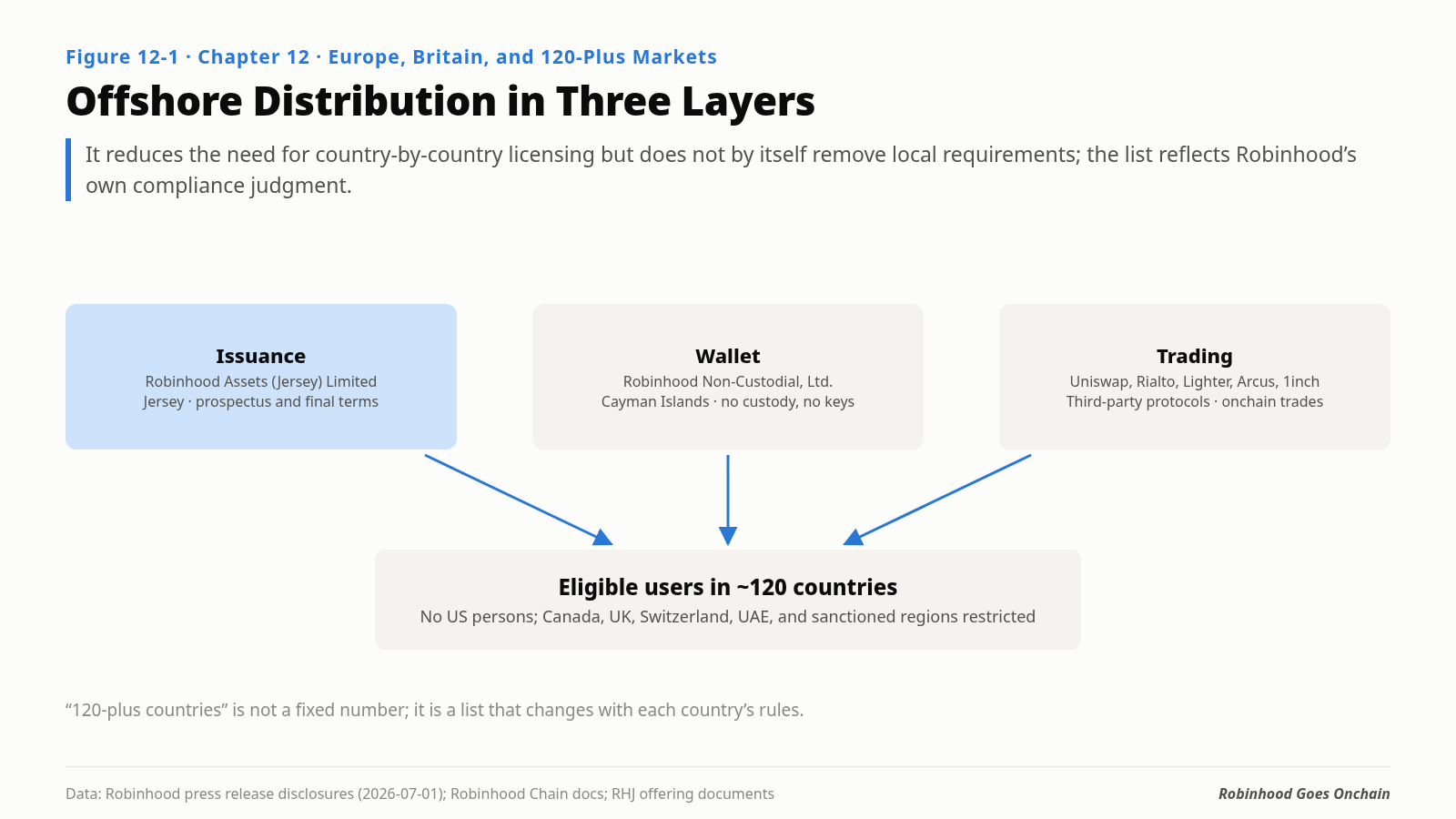
To do securities business in 120 countries the traditional way, a broker would need a stack of licenses. Robinhood instead splits one transaction into three layers, each held by a different entity in a different jurisdiction:
| Layer | Entity | Jurisdiction | What it does |
|---|---|---|---|
| Issuance | Robinhood Assets (Jersey) | Jersey | Issues tokenized debt securities under a prospectus and final terms |
| Wallet | Robinhood Non-Custodial | Cayman Islands | Provides a self-custody wallet; holds no assets and no keys |
| Trading | Uniswap, Rialto, Lighter, Arcus, 1inch and others | Independent | Third-party venues; users trade directly onchain |
Add a restricted list: U.S. persons cannot buy, and Canada, the U.K., Switzerland, the UAE and sanctioned locations are restricted.
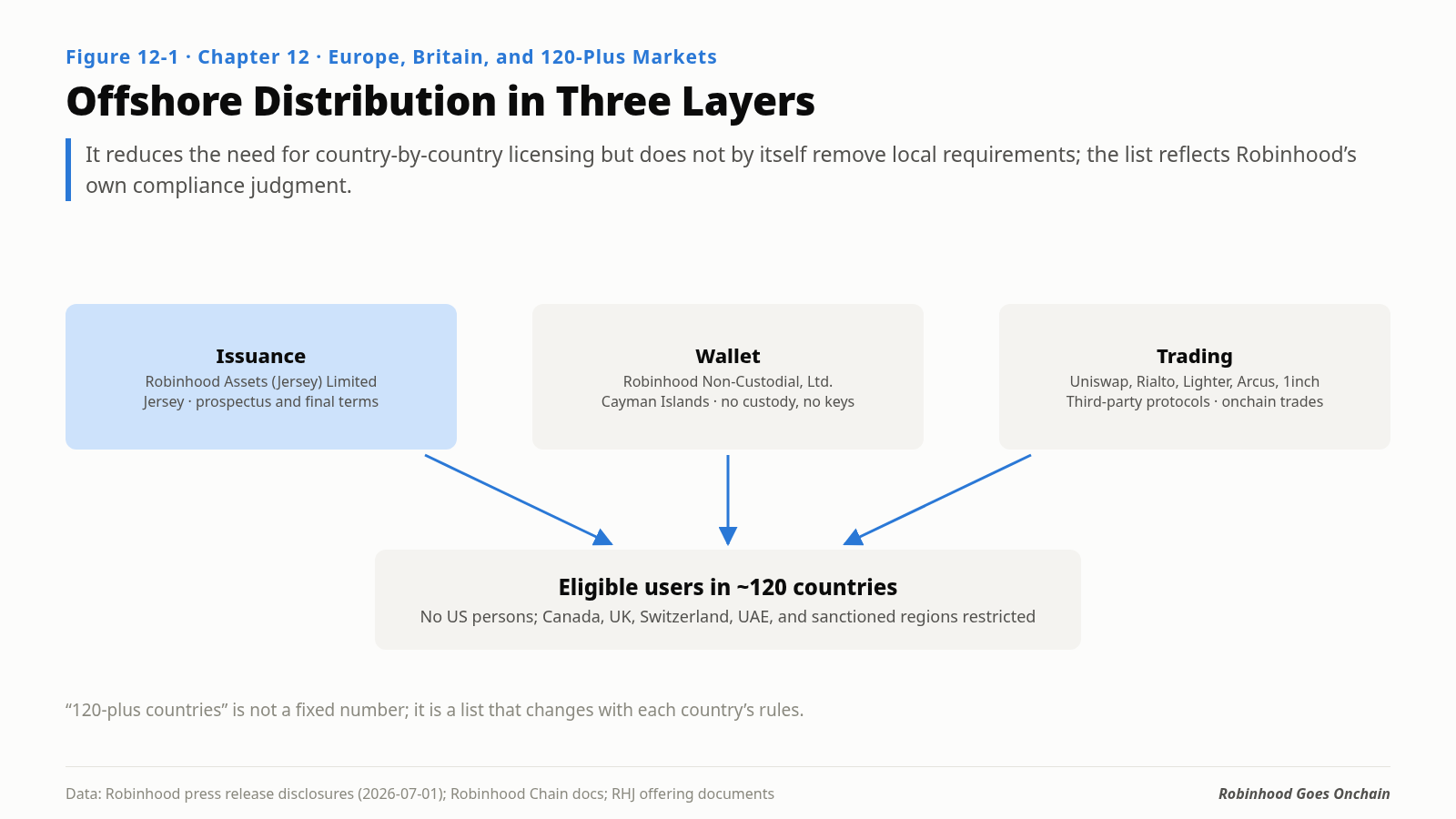
The Framework: Three-Layer Offshore Distribution
The issuer carries offering compliance, users control their own assets, and third-party protocols handle trading. I call this the three-layer offshore distribution model.
It reduces Robinhood’s need to set up a conventional brokerage country by country. It does not automatically remove local licensing rules for securities offerings, financial promotions, wallets, brokerage or trading facilities. “120-plus countries” should be read as the availability Robinhood has concluded its compliance allows, not as approvals from 120 regulators.
It also means the list will change. It depends on each country’s rules on distributing offshore securities to residents and on self-custody wallets. If one country tightens, it can drop off the list.
The EU: Two Generations, Two Rulebooks
Robinhood operates in the EU through Robinhood Europe, authorized by the Bank of Lithuania as a financial brokerage, a crypto-asset service provider and a payment institution.
What makes the EU distinctive is that crypto-assets and financial instruments sit under two separate rulebooks. MiCA governs crypto-assets and stablecoins; MiFID II governs shares, bonds, derivatives and other financial instruments. A stock token classified as a financial instrument falls outside MiCA’s core scope, and each product has to be classified case by case on its contractual rights, transferability and issuance structure.
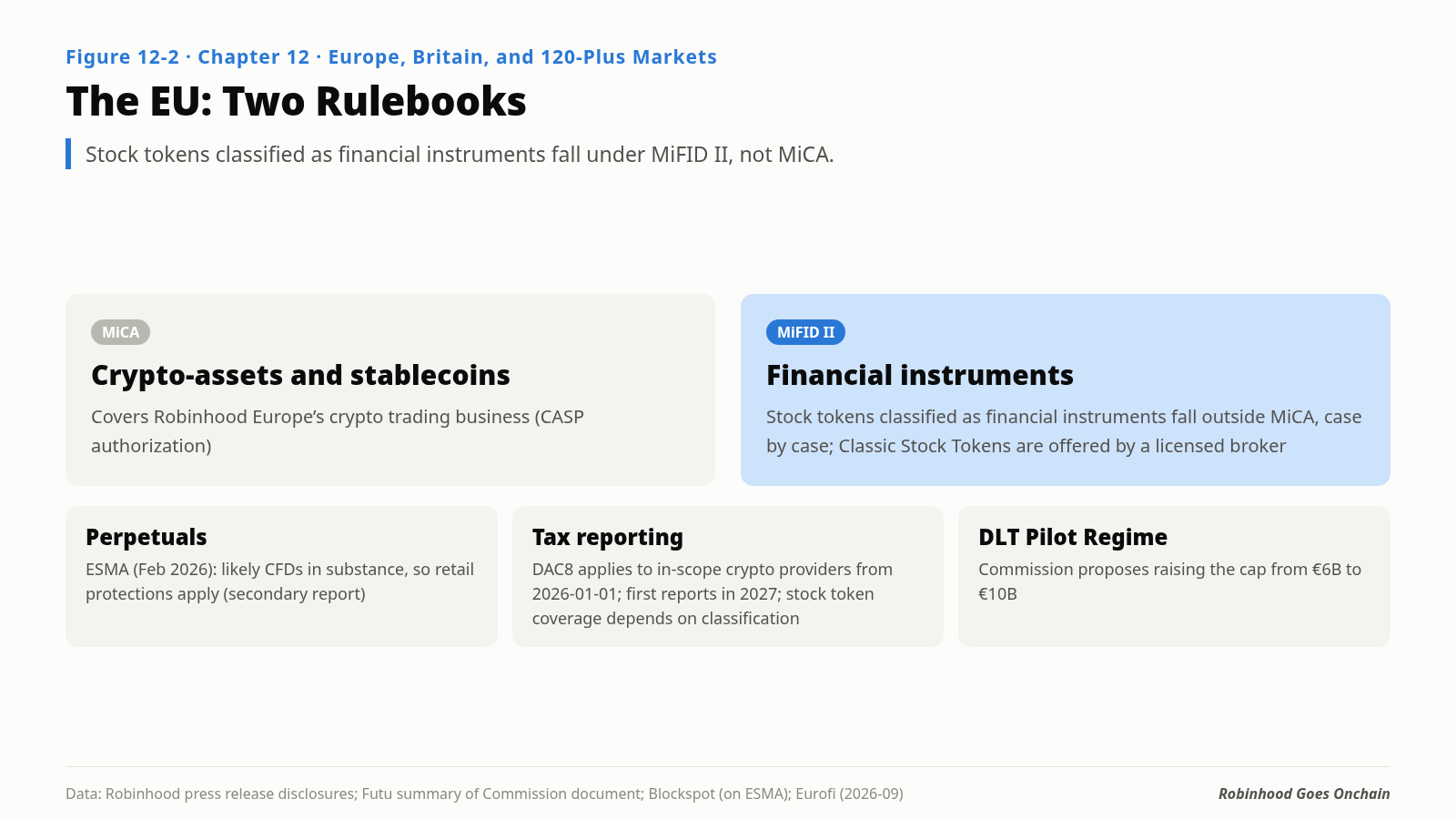
That explains the first-generation product: EU Classic Stock Tokens were built as derivative contracts between Robinhood’s European entity and its customers, offered by a licensed broker under MiFID II. The new tokens are issued as debt securities under their offering documents.
Two more rules touch Robinhood’s products directly. First, perpetuals: ESMA said in February that products called perpetual contracts are likely contracts for difference in substance, and retail protections apply when they meet the definition. Robinhood’s July EU perpetuals on commodities, ETFs and FX offer up to 10x leverage. Second, tax: DAC8 has applied to in-scope reporting crypto-asset service providers since January 1, 2026, with first-period data reported and exchanged in 2027. Whether a given stock-token trade is in scope depends on how the asset and the provider are classified.
The U.K.: A Path to Apply
Britain is an established Robinhood market, but Robinhood U.K. does not currently offer crypto trading or custody, and Stock Tokens are restricted there.
The new crypto regime’s timetable is set. The FCA’s authorization window opened on September 30, 2026 and closes on February 28, 2027; firms already operating that apply within the window get transitional treatment; the regime takes effect on October 25, 2027.
The regime gives Robinhood’s U.K. crypto business a path to apply, and Britain could become a growth market after 2027. Whether it is approved, whether the approval covers the planned products, and whether Stock Tokens fall under the new crypto rules or existing financial-instrument rules all depend on the application and classification. Whether Robinhood files within the window is a signal to watch.
Licensed Home Markets and Offshore Reach
Put the regions together and Robinhood’s international strategy runs in two modes:
- Licensed home markets: the U.S., EU, U.K., Canada and Singapore. Licensed locally, full service through the app; Stock Tokens are either restricted or offered as in-app derivatives.
- Offshore reach: the roughly 120 other countries. No local license; users are reached through a self-custody wallet and offshore-issued Stock Tokens.
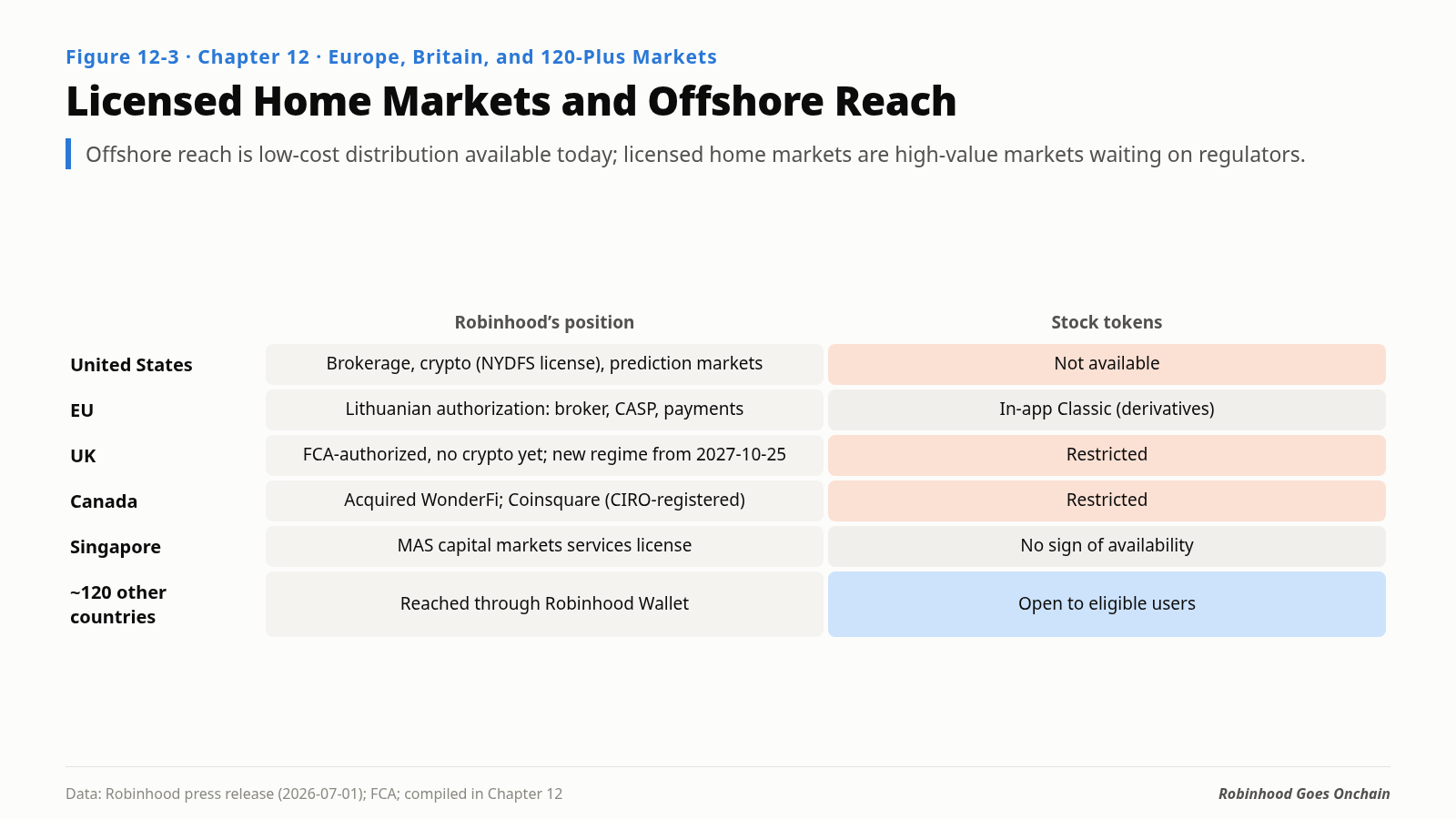
Offshore reach is low-cost distribution that works today. Licensed home markets are high-value markets waiting for regulators to open them. The chain is the lead actor in the first and an unexercised option in the second.
If You Work Outside the United States
- Local financial firms: offshore reach means local users can hold U.S. equity exposure without a local broker. That is competition, and also an opening: fiat on- and off-ramps, local tax services and investor education are things Robinhood will not build itself in 120 countries.
- EU firms: stock tokens are classified case by case on rights and structure. Those classified as financial instruments fall under MiFID II, which a MiCA license does not cover.
- U.K. firms: the application window closes on February 28, 2027, and transitional treatment only goes to applicants within it.
The Takeaway
Behind “120-plus countries” is a three-layer split: issuance in Jersey, a wallet in the Caymans, trading on third-party venues. It spares Robinhood a country-by-country brokerage buildout, and it leaves the list exposed to regulatory change anywhere. For local firms, the biggest opportunity lies exactly where this structure does not reach.
In your market, would you treat Robinhood’s offshore reach as a competitor or a partner?
— Adapted from Robinhood Goes Onchain: A Broker’s First Year, Chapter 12, “Europe, Britain, and 120-Plus Markets”
The full book (17 chapters, 48 figures, first 3 chapters free to read): https://pickful.ai/books/qx7q
轉發此貼文?
與您的關注者分享。
回覆