
目錄(4 節)

·
A market app showed par with an $80K USDG pool. Onchain, it isn't there.
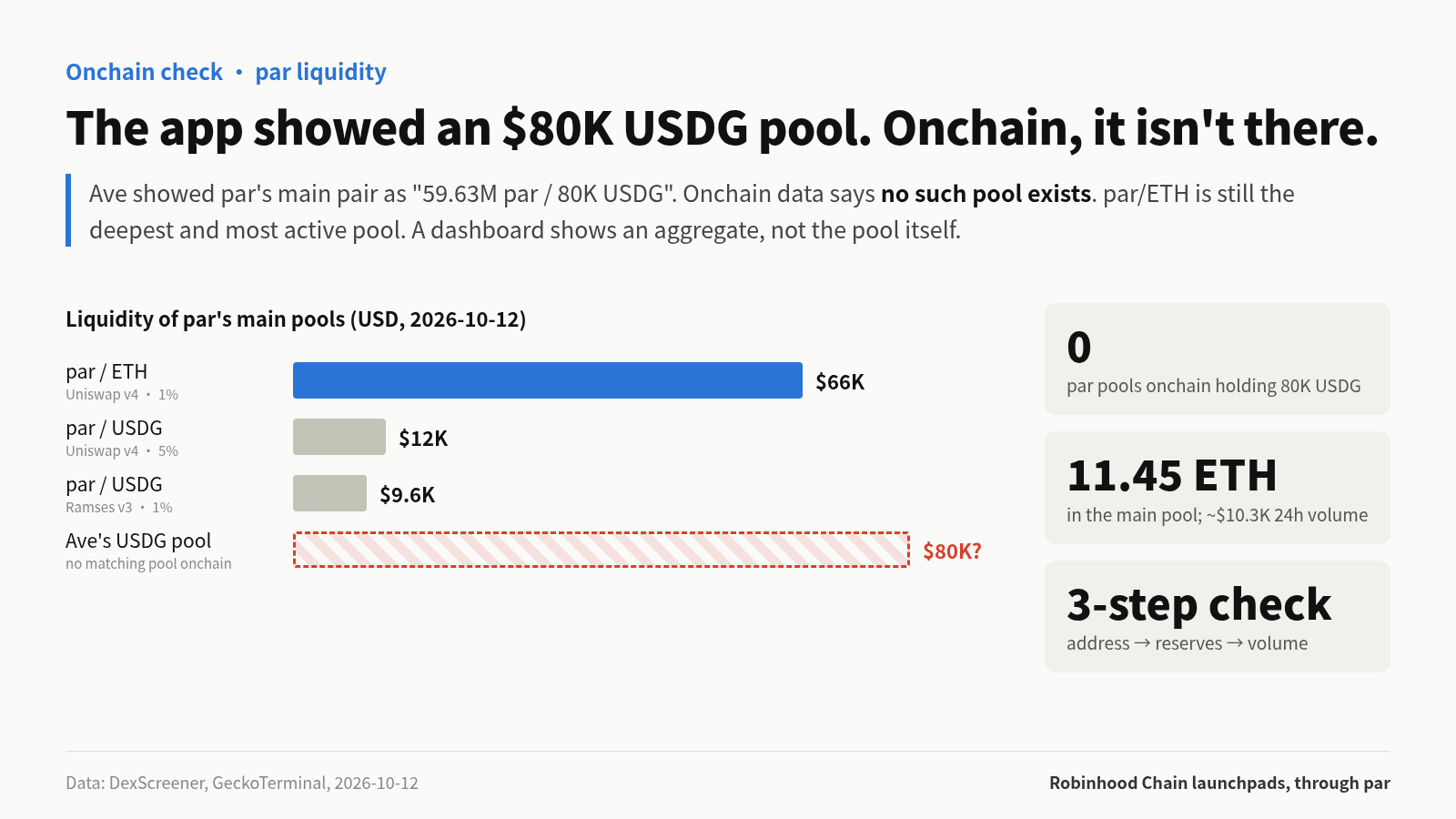
Ave displayed par's main pair as "59.63M par / 80K USDG". DexScreener and GeckoTerminal show no such pool: par/ETH is still the deepest and most active (11.45 ETH, ~$66K liquidity). Why Uniswap v4 makes dashboards easier to misread, and a three-step pool check: address, reserves, volume.
If you build launchpads or make markets on Robinhood Chain, or you just research onchain assets, start with this: the “liquidity” line in a market app is a conclusion the dashboard computed. It is not the raw onchain fact.
Here’s what prompted this. par has always traded mainly against ETH. Today Ave showed its main pair as “par 59.63M / USDG 80K”. First reaction: did someone just drop an $80K stablecoin pool in?
I checked onchain. No.
What’s actually onchain
DexScreener and GeckoTerminal agree (2026-10-12):
| Pool | Venue / fee | par | Counter side | Liquidity | 24h volume |
|---|---|---|---|---|---|
| par / ETH | Uniswap v4, 1% | 120.3M | 11.45 ETH | ~$66K | ~$10.3K |
| par / USDG | Uniswap v4, 5% | 23.39M | 5,134 USDG | ~$12K | ~$2.4K |
| par / USDG | Ramses v3, 1% | 16.25M | 4,636 USDG | ~$9.6K | ~$3.3K |
There are also a dozen or so pairs of par against newer tokens, each worth a few hundred to a couple of thousand dollars. They say one thing: plenty of new projects are willing to use par as a quote asset.
The deepest and most active pool is still par/ETH. The two USDG pools together hold 39.64M par and under 10K USDG. That is nowhere near Ave’s 59.63M par / 80K USDG, and it doesn’t match any single pool either.
The likely explanation: Ave switched its default pair to the stablecoin one, which reads more naturally in dollars, and the “80K” is its own aggregate. It sits close to the combined dollar liquidity of the top pools (about $88K across the top three), just labeled as USDG. Ave’s API needs a key, so I can’t verify that part directly. What I can verify is that no pool onchain holds 80K USDG of par liquidity.
Why v4 makes this easier to misread
A Uniswap v2 pool is its own contract. Check its balances and you have its reserves. Hard for a dashboard to get wrong.
v4 works differently. Every pool’s assets sit inside one PoolManager contract. A pool has no address of its own, only a PoolId. Liquidity is concentrated in price ranges, so “how much is in the pool” depends on how you count: all positions, or only those near the current price. Each dashboard also has its own rules for which pool is the main one and how to convert the quote asset. The same token showing different reserves on different dashboards is normal.
GeckoTerminal has a version of this too. It lists several par pairs with “$20K–30K reserves”, such as S/par, FLOOR/par and PARP/par, each with zero volume in 24 hours. Those reserves are the other token’s self-reported price times its balance. With no trades, nobody is testing that price.
The three-step pool check
When liquidity suddenly looks different, run this. It takes five minutes.
- Match the address. Get the pool address or PoolId from the dashboard and match it on DexScreener and GeckoTerminal, so you know everyone is talking about the same pool. par’s main pool is
0x78c5655c…5fab4(par/ETH). The two USDG pools are0xa4b3dd7c…ef521(v4) and0x5cDDCc8e…E4fC(Ramses). - Check reserves in tokens. Look at token amounts on both sides, not the dollar estimate. Dollars are multiplied; token amounts are what’s actually there.
- Check volume. A pool with reserves but no trades has an untested valuation. The pool that actually holds up the price is the one people trade in.
Bottom line
A dashboard is secondhand data. Reserves are the primary source. Volume is the test.
This was a display issue, not new money arriving. par’s liquidity is still concentrated in its ETH pool, with two stablecoin pools alongside it and depth on both Uniswap v4 and Ramses. For a chain this early, that is a healthy structure. Just don’t let a label in an app make the call for you.
Has your market app ever shown you a pool that doesn’t exist onchain?
轉發此貼文?
與您的關注者分享。
回覆