
目录(5 节)

·
Who Prices Nvidia on the Weekend? The Money in Onchain Stocks Isn't in the Venues
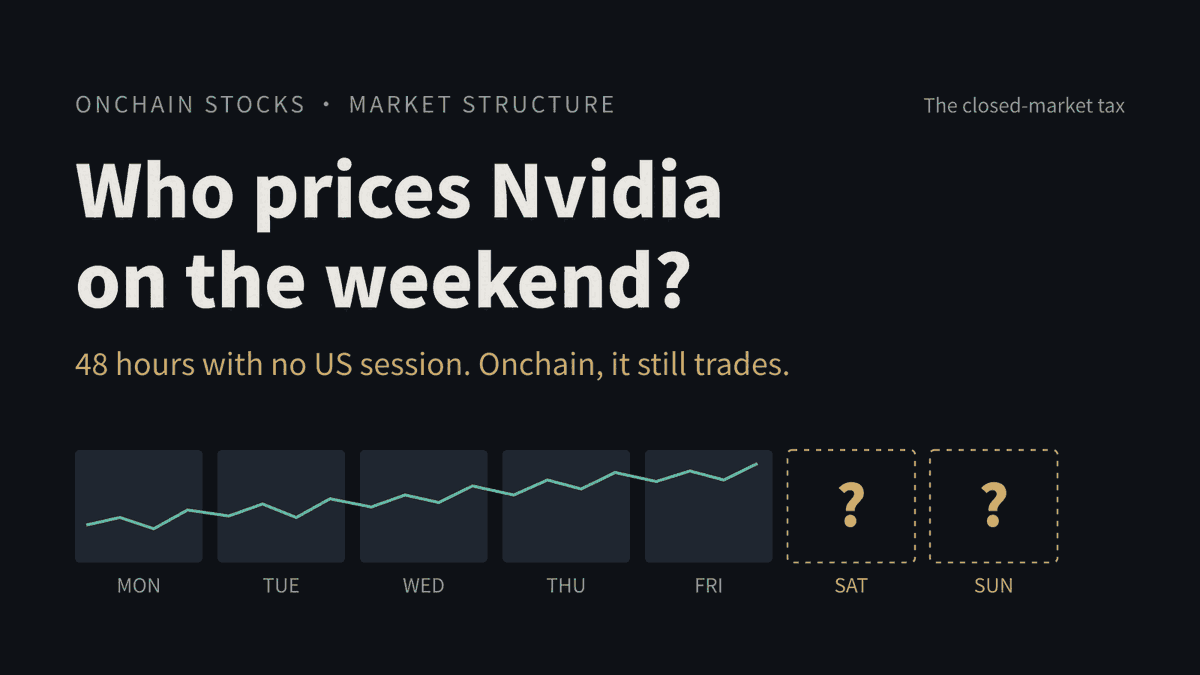
US markets are shut for 48 hours every weekend, but tokenized stocks keep trading onchain and passive LPs carry the risk. The SEC's new exemption fragments venues; the open seat is pricing while the market is closed.
If you work at a broker, an exchange or a trading desk, or you’re building anything that issues assets onchain, this one is for you.
It’s Saturday morning and tokenized Nvidia is trading onchain like any other day. The US market isn’t. After-hours ends at 8pm ET on Friday and the overnight session doesn’t reopen until 8pm Sunday. That’s 48 hours with no US session at all. So who sets the price in those 48 hours, and who eats the loss when it’s wrong?
Mostly the LPs sitting in Uniswap pools. They never signed up for it, but they’re the ones holding the risk.
Robinhood Chain went live on July 1. Uniswap says its pools have handled roughly 80% of Robinhood stock token volume, around $10B. A pool prices off a formula. It has no idea the world moved until someone trades against it. All weekend the pool price goes stale, and when the overnight session opens Sunday night, arbitrageurs pick off the old quotes at the new price. The difference comes out of LPs’ pockets.
I call this the closed-market tax: whenever the underlying market is shut, onchain liquidity providers pay for everyone else’s price discovery.
What the market is betting on
On September 17 the SEC issued its Innovation Exemption. Tokenized US stocks that carry full shareholder rights can now trade in permissioned AMM pools, for five years.
UNI ripped that week. Securitize stock was up 164% in September. The read was simple: venues, issuers and chains are about to make money.
Read the conditions and the venues look a lot more boxed in:
- A venue can list at most 75 large caps (S&P 500 type names), and each can trade no more than 0.25% of its prior-month average daily volume there.
- Venues can’t do any lending.
- Third-party tokenization needs 30 days’ notice to the listed company, and if the company objects, the stock is off.
- Caps are counted per venue, together with its affiliated venues, so the only way to scale is to open more of them.
So venues multiply and fragment, and none of them gets much pricing power. Issuers aren’t cheap either. Securitize was worth about $2.6B at the end of September on annualized revenue under $60M, which is 40-something times sales.
Three layers
| Layer | Where it stands |
|---|---|
| Issuance | Already priced in |
| Venues | Capped and fragmented |
| Pricing while the market is closed | Nobody owns it yet |
Why someone can take this on now
Two years ago you couldn’t. There was nothing to hedge with on a weekend.
Now there is. a16z counts about $101B of onchain RWA perp volume in August and $4.8B of open interest, and equities made up 48% of that volume. For the first time there’s a deep enough market to hedge a weekend Nvidia position.
Issuers have noticed. Ondo’s Ian De Bode said on Bankless in July that what they worry about most as an issuer is the liquidity mismatch between onchain and offchain.
Solana already ran this experiment
A little over a year ago SOL/USDC mostly traded in passive pools. Then proprietary AMMs showed up. Market makers put up their own inventory and update quotes constantly, so arbs can’t pick off stale prices and spreads get tighter. Aggregators route on price, and the flow moved over.
HumidiFi says prop AMMs now handle about 75% of Solana DEX volume, and it does more than $1B a day by itself. From under 10% to over 70% in roughly a year.
Passive pools lost because their quotes go stale. Stock token quotes go stale far worse: 48 hours, every single weekend.
What this means for you
- Issuers: secondary liquidity is going to end up with professional market makers, the weekend part most of all. Work out now who quotes your tokens.
- LPs: high volume doesn’t mean high returns. A good chunk of the volume in the first minutes after the Sunday night open is you paying the closed-market tax.
- Market makers and quant shops: this is open right now, but not for long. On Solana the structure was set within a year.
I could be wrong. By my rough math perp volume is already four to five times spot, and perps may simply eat the spot market. Distributors like Robinhood and Coinbase could make markets themselves and leave no room for anyone else. And the most practical risk of all: one big weekend headline, a gap at the Sunday open, and a year of profit is gone in a night.
Onchain venues will keep multiplying. Only a handful of firms will be able to quote weekend Nvidia accurately and survive doing it.
Who do you think ends up owning weekend pricing: market makers, issuers, or distributors like Robinhood that own the users?
转发此帖子?
与您的关注者分享。
回复