
Contents (8)

·
par's Toolbox: A Launchpad That Gives Fees Five Destinations, With $129K Already Paid to Holders
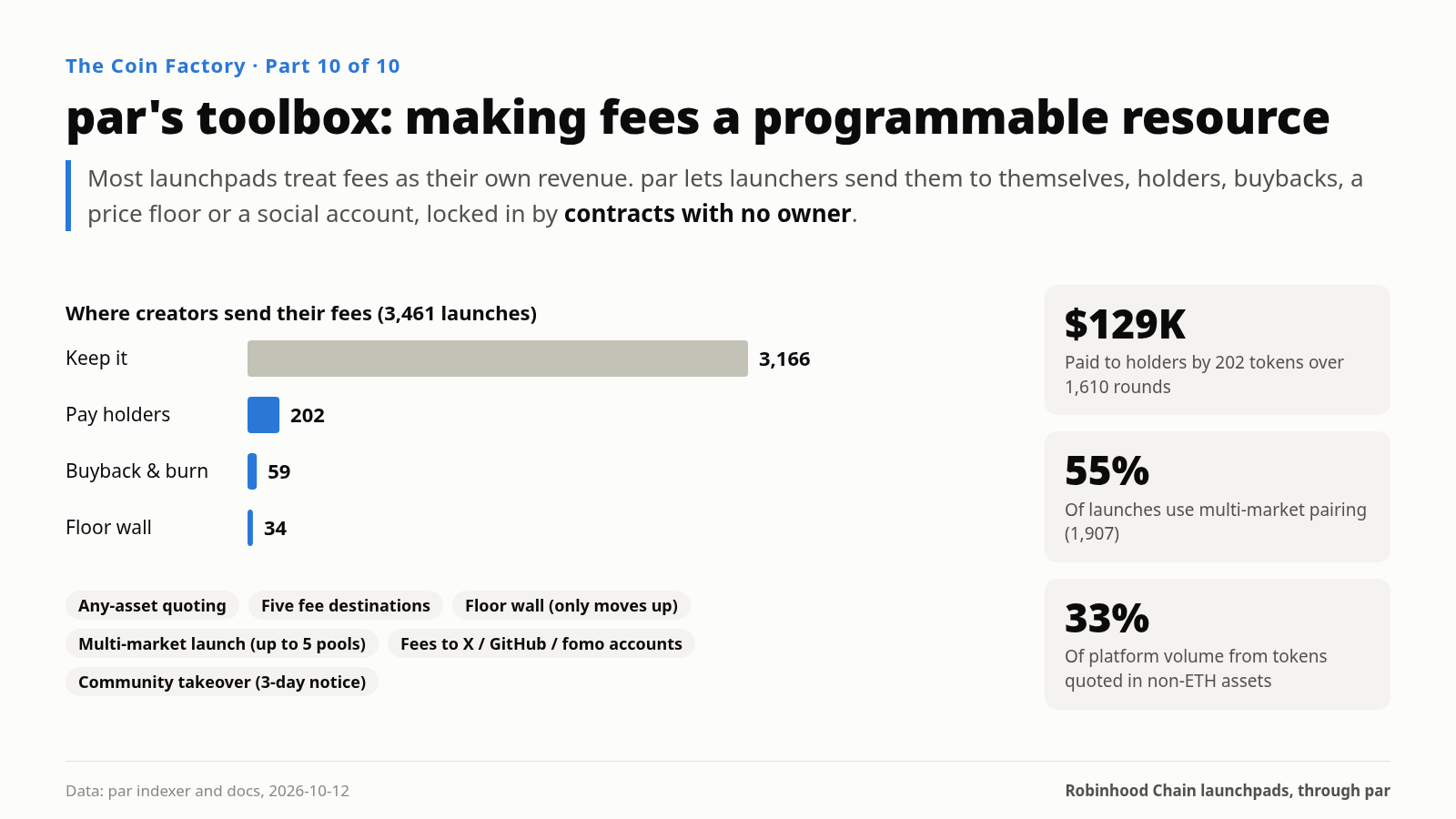
par.family treats fees as a programmable resource: five destinations (self, holders, buyback, floor wall, social account), multi-market launches used by 55% of tokens, and $129K already paid to holders. A walk through the toolbox and who it's for.
If you run a community, operate a project, or wonder what a launchpad can do besides launch tokens, this piece takes apart several features of par.family on Robinhood Chain. Earlier pieces mentioned them only in passing, but on-chain data shows they’re already in heavy use.
Start with some numbers (par’s official indexer, pulled October 12):
| Data | |
|---|---|
| Total launches | 3,461 |
| Launches opening 2–5 markets at once | 1,907, or 55% |
| Volume from tokens quoted in assets other than ETH | about 7,257 ETH, 33% of cumulative platform volume |
| Tokens that chose “fees to holders” | 202, having paid holders about $129,000 over 1,610 rounds |
| Tokens quoted in the par platform token | 411, with about 442 ETH cumulative volume |
| Cumulative fee income for other token creators (ETH equivalent) | about 146 ETH, roughly 2.6x protocol income over the same period (about 55 ETH) |
Behind these numbers is a way of thinking that’s a bit different from “launch → trade → collect fees”:
Fees aren’t just platform revenue. They’re a programmable resource. Whoever launches a token can decide whether fees go to themselves, to holders, into buybacks, into a price floor, or to a social account. What the launchpad provides is the tooling to lock those choices into irrevocable contracts.
1. Five fee destinations
On par, every trade pays a 1% base fee, half to the protocol and half to the creator, and the creator can add a tax of up to 10%. Where the creator’s share goes is chosen at launch, and the creator can choose not to keep it:
| Mode | How it works | Tokens using it |
|---|---|---|
| Keep it | Claimed by a regular wallet | 3,166 |
| Pay holders | Every hour, received fees are distributed pro rata to holders as-is (quote asset as quote asset, token as token), with no swap and no slippage | 202 |
| Buyback and burn | Every hour, the quote asset buys the token back in its own pool, and it’s burned along with the token portion | 59 |
| Floor wall | The token portion is burned; the quote asset portion builds a buy wall in the pool that only moves up | 34, with 23 walls currently active |
| Pay a social account | Sent to the contract address tied to an X, GitHub or fomo account | See below |
The last three have something in common: the recipient is a contract with no owner and no function that can pull the money back. Once chosen, it’s permanent. For holders, that’s far more reliable than a team’s promise.
“Pay holders” is the most popular. Of the 202 tokens, the top by volume, TEN, has paid out about $37,000, and MUTT about $34,000. Interestingly, their quote assets are all over the place: TEN is quoted in NET; MUTT opened five markets, mainly PONS; there’s even one quoted in the gold token GLD. Holders receive those assets themselves.
2. Floor walls: turning fees into a price floor that only moves up
The floor wall is where par’s engineering shows most. The rule: the token-denominated part of the creator share is burned in full; the quote-asset part goes back into the pool as a single-tick buy wall, positioned at the highest price at which the quote assets in the wall could buy every circulating token exactly.
That price is solved exactly, not estimated. The docs give the full equation and state a key property: sells burn tokens (less supply to absorb) and buys add quote assets (more money to absorb it), so the wall only moves up. Anyone can call rebalance to advance it a round, and the keeper calls it automatically whenever it collects fees. The pool itself doesn’t change, so every terminal and bot trades as usual.
For a memecoin, that turns trading activity directly into a public, verifiable price floor that only rises.
3. Multi-market launches and INDEX
A token doesn’t have to pick just one quote asset. A multi-market launch opens up to five Uniswap v4 pools for the same token in one transaction, each with a different quote asset, supply split evenly and the same opening price. Arbitrage keeps the pools’ prices in line, so a large order effectively taps the depth of all of them, and anyone holding any of the quote assets can buy or sell directly without swapping first.
The first multi-market token, INDEX, is quoted simultaneously in five stock tokens: Apple, Microsoft, Nvidia, Google and Tesla. It has done about 84 ETH in cumulative volume. In effect it’s an on-chain “basket” of US tech leaders in the form of a memecoin. As of October 12, the platform had 1,907 multi-market launches; more than half of all launches use the feature.
4. Launch a token for any account, and the account owner claims it
The creator fee recipient doesn’t have to be the launcher’s own wallet. Enter an X or GitHub account in the launch form, and the creator share goes to a contract address tied to that account. The address is derived from the account’s immutable user ID (not the transferable username) and is the same on every chain par supports.
The money doesn’t move until the account owner logs into par and links a wallet, and the launcher can’t touch it at any point. fomo accounts are even more direct: every fomo profile already has a trading wallet, and par periodically sends the income there as-is, no claim needed.
That makes “launch a token in honor of a developer, a KOL or an open-source project” something you can actually do: who gets the revenue is clear, and the launcher can’t skim it.
5. Community takeover
When a token’s original developer abandons it, the community can apply to take it over. par can change exactly one thing: who receives the creator share, which can be switched to a new wallet, a social account or any of the modes above. The token, pool, supply and fee rate don’t change, and no one, par included, can touch them.
The whole process is public. par reviews applications manually; if approved, the factory proposes the change on-chain, and it can only be executed after a three-day notice period, within a further three-day window, after which it expires. Money already sitting in the escrow contract still belongs to the original recipient. A takeover is a handover from that day forward, not a retroactive claim.
6. Where demand for the platform token comes from
Finally, back to the platform token itself. Beyond trading, the par platform token (call it the par token) has a real use: as a quote asset. 411 tokens are quoted in par, or use it as one of their markets, with about 442 ETH in cumulative volume. Buying any of those tokens in its par market means buying par first.
par’s docs also describe a further arrangement for the platform token’s own pool: the par token’s creator share is claimed daily and sent to the buyback wallet to buy back and burn; combined with direct burns on the protocol’s token side, 75% of fees collected in the par token pool get burned. As of October 12, no new claims under this flow had shown up on-chain (the creator share was last claimed on October 5). It will be one of the signals most worth tracking next.
Who these tools are for
Communities and projects: you can create child tokens and new uses for your own token, and turn fees into holder income, buybacks or a price floor, with those choices written into the contracts.
Creators and developers: you can accept tokens other people launch in your name, with the contracts guaranteeing who gets the revenue.
AI agents and developer tools: every feature can be called directly at the contract level, the code and SDK are open source under MIT, every launch automatically submits source verification to Blockscout and Sourcify, and all indexer data can be rebuilt from on-chain events.
Closing
Most launchpads treat fees as their own revenue.
par turned them into a resource that can be programmed and permanently committed.
Launching is just the starting point. Where the fees go decides how far a token can travel.
If you launched a token, which fee destination would you pick?
— Excerpted from Chapter 11 of The Coin Factory, “par’s Toolbox: Making Fees a Programmable Resource”
Repost this post?
Share with your followers.
Reply