
Contents (7)

·
Three Identities: Is your tokenized stock a share, a beneficial interest, or a debt?
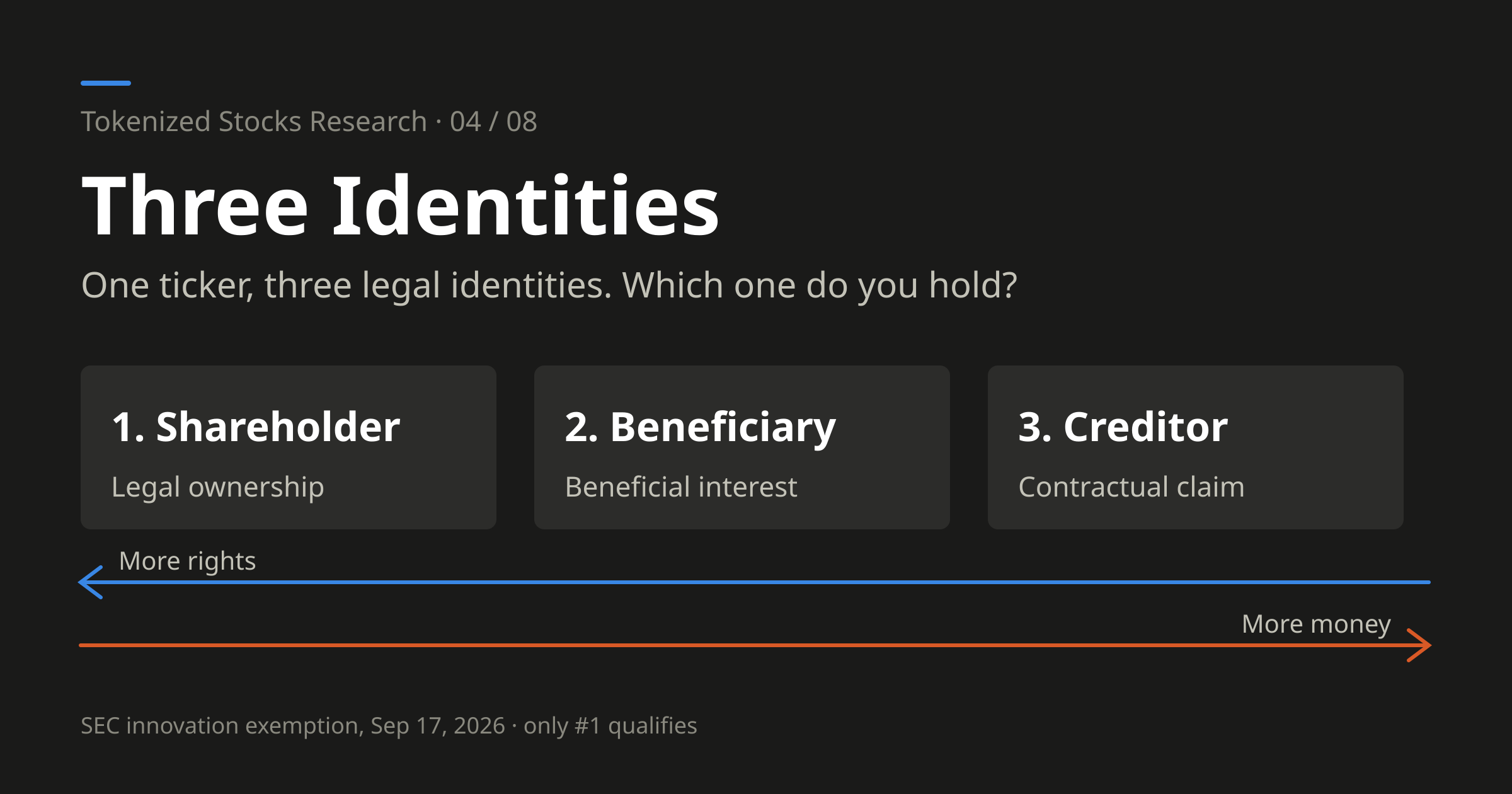
Same ticker, same price chart, three possible legal identities underneath: shareholder, beneficiary, or creditor. The category with the most money has the fewest rights, and the SEC's new innovation exemption only opens to the one with the most.
If you allocate tokenized assets for clients, or you hold any of xStocks, Ondo Stocks, bStocks or Robinhood Stock Tokens yourself, this is a legal checkup.
Same ticker, same price chart, same wallet interface. Underneath, there can be three completely different legal identities.
Three identities
1. Shareholder. The token is the security itself. A transfer agent keeps the legal register of shareholders onchain. You have a CUSIP, voting rights, dividend rights and legal ownership.
Examples: Superstate Opening Bell (Galaxy GLXY, SharpLink SBET, Forward FWDI), Securitize (Exodus EXOD, and Securitize’s own SECZ).
2. Beneficiary. A broker holds the shares, an SPV issues the tokens, and you hold a beneficial interest in a pool of deposited shares. Legal title sits with a trust, and whether you can exercise shareholder rights depends on the SPV’s terms.
Examples: Coinbase Tokenized Stocks (Coinbase Onchain SPV Ltd in Abu Dhabi’s ADGM), Dinari dShares.
3. Creditor. The token is a debt. You hold a contractual claim against an issuing entity, not the underlying shares.
Examples: xStocks (tracker notes from Backed Assets (JE) Limited in Jersey), Ondo Stocks, bStocks (Certificates under ADGM’s FSMR), Robinhood Stock Tokens (secured, limited-recourse notes from Robinhood Assets (Jersey) Limited).
In a joint staff statement on January 28, 2026, the SEC set out its own three categories: issuer-sponsored, third-party custodial, and third-party synthetic. Only holders in the first category are shareholders in the legal sense.
The rights, side by side
| Right | 1. Shareholder | 2. Beneficiary | 3. Creditor |
|---|---|---|---|
| Legal ownership | ✅ | ❌ beneficial interest | ❌ contractual claim |
| Voting | ✅ direct | ⚠️ depends on SPV terms | ❌ (some let you “express a preference”) |
| Dividends | ✅ cash | ⚠️ converted to value | ⚠️ rebase or reinvested |
| Redeem the underlying | ✅ | ⚠️ authorized participants only | ⚠️ qualified investors only, for a fee |
| Bankruptcy remoteness | ✅ the register is the evidence | ⚠️ claimed | ⚠️ depends on the issuer |
| 24/7 transfer | ⚠️ limited by the register | ✅ | ✅ |
| DeFi composability | ⚠️ whitelist only | ✅ | ✅ |
The most counterintuitive thing in the table is the order
The category with the most money has the fewest rights. The category with the fullest rights has the least money.
By market value, the large majority of tokenized stocks are category 3, debt. Category 1, the only one with real legal ownership and self-custody, is the smallest.
Two comparable numbers make the point. Securitize tokenized its own stock on the day it listed on the NYSE, July 2, 2026: about $295M, the largest single issuer-sponsored tokenization so far. Ondo Stocks alone has more than $1B in TVL.
A professional reader will say this isn’t user preference, it’s a supply constraint: category 1 has few names, launched late, is geographically restricted and illiquid, so users had no real choice. That’s fair. But for the holder, the result is the same: the market grew exactly where rights are weakest.
Be very careful with the word “voting”
On April 28, 2026, Ondo partnered with Broadridge and announced that token holders could take part in proxy voting and access regulatory filings. That sounds like category 1 treatment.
Read the disclaimer: it’s “the right to express a preference to the issuer of Ondo GM tokens.”
That’s not a shareholder right. You tell the issuer what you’d like, and the issuer decides how to vote.
Robinhood was more direct. In a September 9, 2026 CNBC interview, Tenev conceded that token holders don’t have voting rights and declined to say how Robinhood intends to vote the underlying shares, saying only that it “hasn’t really announced plans on the voting side.” Five days later, on September 14, he posted that “in-kind redemption and voting are coming.” As of this writing, that’s still a tweet with no technical spec.
Coinbase’s gap between marketing and legal text is also worth reading. Brian Armstrong said on CNBC, “You get the dividends, you get the shareholder rights.” Its own prospectus says the tokens represent a beneficial interest in a pool of deposited shares, legal title stays with the trust, and the exercise of shareholder rights is up to the SPV.
Three questions on rights
Before you allocate to any tokenized stock, ask three things. Each has a clear documentary answer. No guessing needed.
-
In which document am I named, and as what? Find the Base Prospectus or Final Terms and read the section on what you hold. “Note,” “certificate” or “limited recourse” means category 3. “Beneficial interest” means category 2. Only a legal shareholder register and a CUSIP mean category 1.
-
Can I redeem? Distinguish “authorized participants can redeem” from “I can redeem.” The first keeps the peg. Only the second is your exit. Products that let retail redeem are close to zero right now.
-
Where do I rank if the issuer goes bankrupt? “Bankruptcy-remote” is a claim, not a document. No major issuer has yet published the full text of a bankruptcy-remoteness legal opinion.
Why this matters more after September 2026
The SEC’s innovation exemption (September 17, 2026) made equal rights a legal condition of entry: tokens must carry the same legal, economic and governance rights as traditional shares, and standalone notes, swaps and SPV interests are excluded.
So within this innovation-exemption channel, category 3, today’s largest, is explicitly excluded. That isn’t a blanket ban on category 3, but it means category 3 doesn’t get this new US pass.
Category 1, the smallest and least liquid, is the only one that qualifies.
Three lines to close
One ticker can sit on top of three legal identities, and the price chart won’t tell you which.
In this market, money and rights sit at opposite ends: the money is with liquidity, the rights are on the other side.
And the regulator has just opened its new channel only to the rights side.
Check what you hold: does the prospectus say note, beneficial interest, or share?
Repost this post?
Share with your followers.
Reply