
目錄(5 節)

·
The 100x Ceiling: One Inequality Caps Your Odds of Turning $10K into $1M (Why 100x Is Hard 1/4)
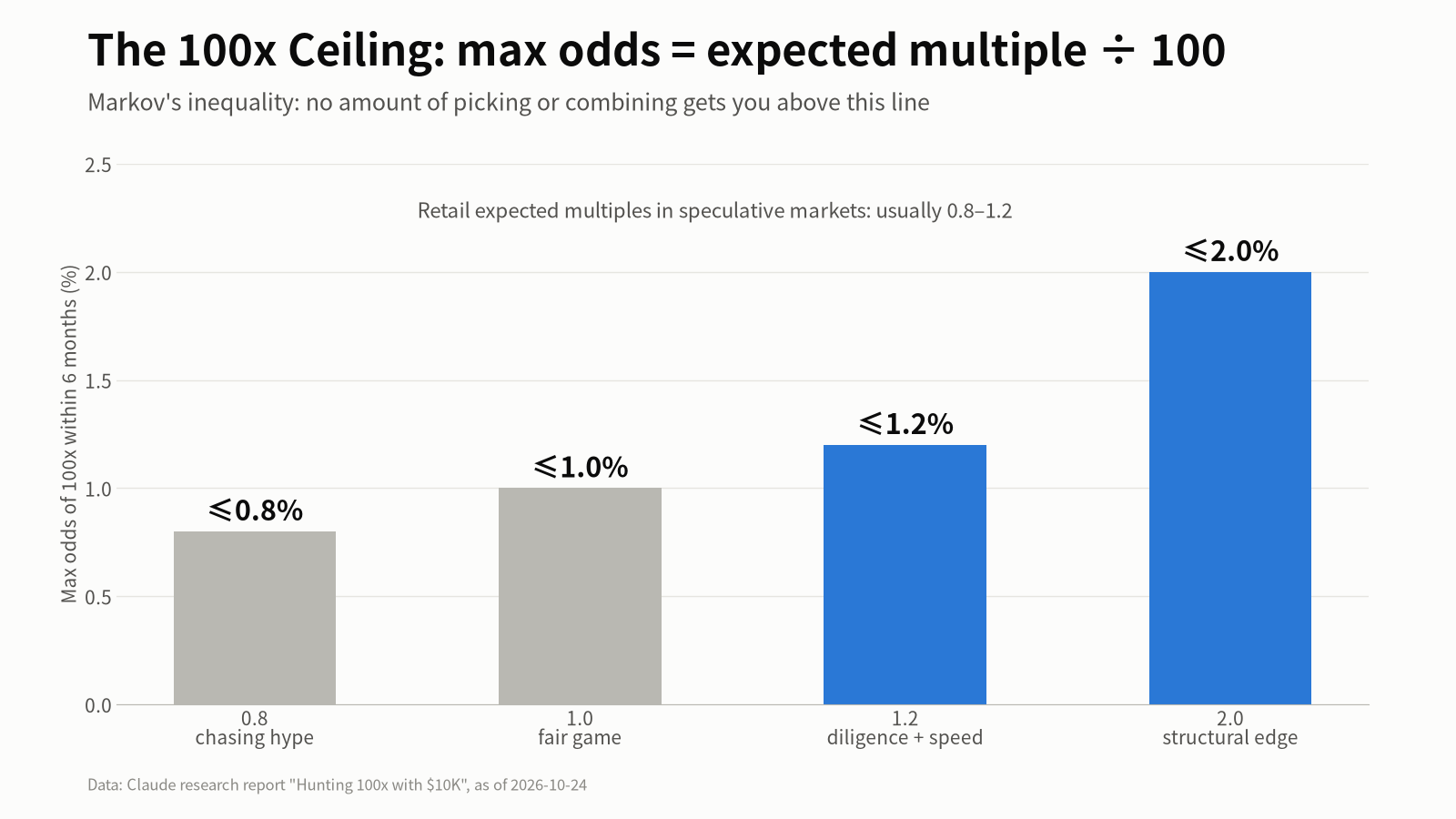
Your odds of a 100x can never exceed one hundredth of the bet's expected multiple. Retail in speculative markets sits at 0.8–1.2x, so the cap is about 1%. Simulations of four structures show high 100x odds and never going to zero cannot coexist.
If you are a founder, a portfolio manager, or the person at a family office who handles “alternatives,” you have heard this line: “Put a small amount into a 100x shot. If it goes to zero, who cares.”
The first half is fine. The second half hides an expensive misunderstanding: the belief that a 100x is mainly a matter of picking well, and that sharper picks push the odds up.
It works the other way around. The odds of a 100x are set by math first and by skill second. And the math fits on one line.
An inequality you cannot get around
Markov’s inequality says that for any return multiple X that cannot go below zero:
P(X ≥ 100) ≤ E[X] ÷ 100
In plain words: your chance of making 100x can never exceed one hundredth of the expected multiple of the bet.
The expected multiple is what each dollar turns into on average if you repeat the same bet many times. In speculative markets, fees, slippage, sniper bots and insiders all eat into it, so a retail participant’s expected multiple usually sits between 0.8 and 1.2.
Plug that in:
| Your true expected multiple | Ceiling on 100x odds |
|---|---|
| 0.8 (chasing hype, getting farmed) | 0.8% |
| 1.0 (a fair game) | 1.0% |
| 1.2 (real diligence and speed) | 1.2% |
| 2.0 (a genuine structural edge) | 2.0% |
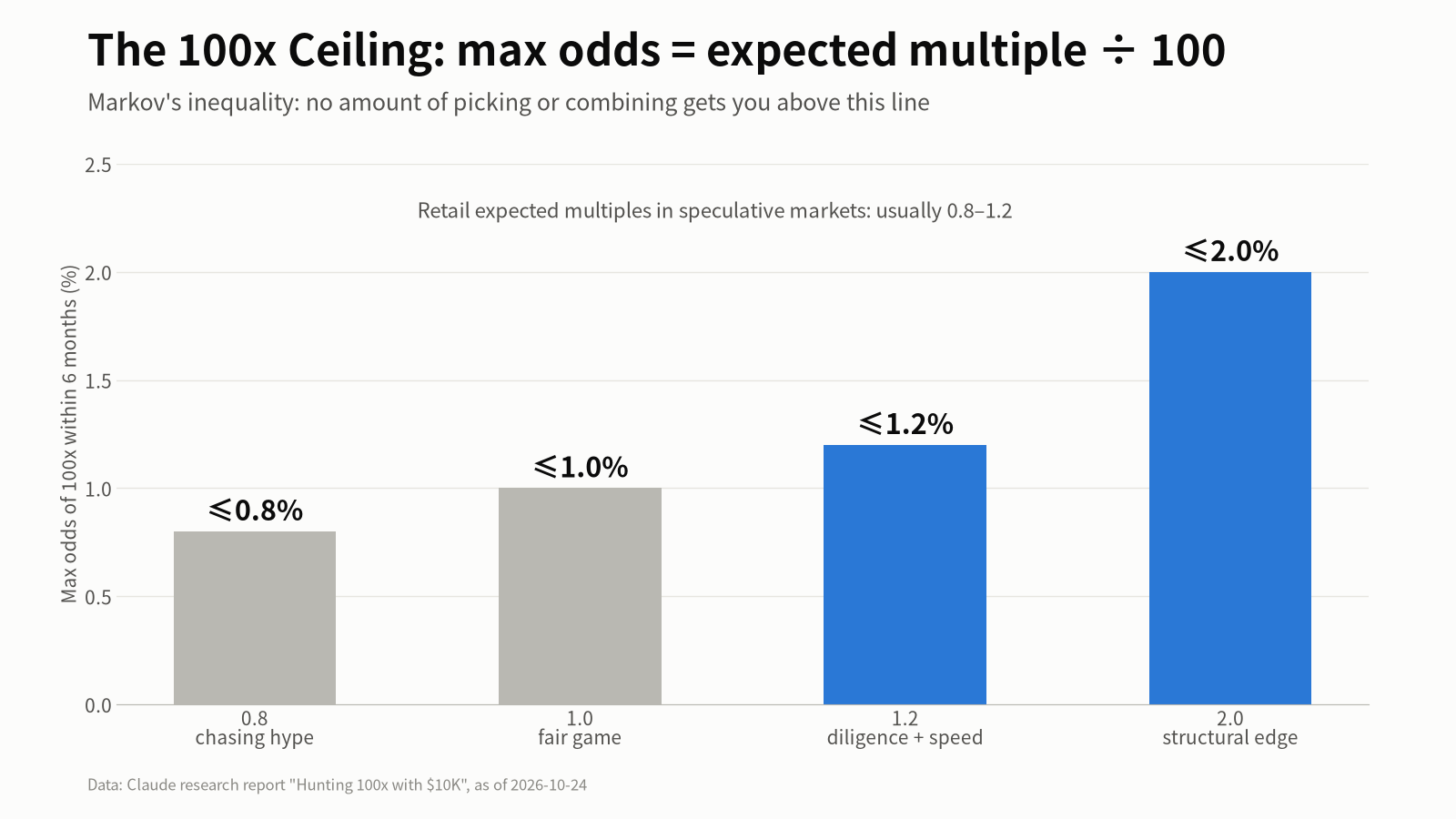
I call this the 100x Ceiling: in a roughly fair market, no amount of picking or combining gets your one-shot 100x odds much above 1%.
That is not pessimism. It is accounting.
Under the ceiling, structure decides how close you get
The ceiling is a cap. How much of it you actually reach depends on how you bet. I simulated four ways to deploy $10,000, each 200,000 to 300,000 times, using openly stated assumptions (listed at the end):
| Structure | Odds of 100x | The cost |
|---|---|---|
| All-in on one meme coin | ~0.29% | 85% chance of ending below $2,000 |
| Two all-in “10x shots” in a row | ~0.83% | 94% chance of being nearly wiped out |
| 40 lottery tickets of $250 each | ~0 | median outcome ~$6,900 |
| Barbell (small probes + airdrops + options + reserve) | ~0.03% | almost never wiped out; median ~$8,700 |
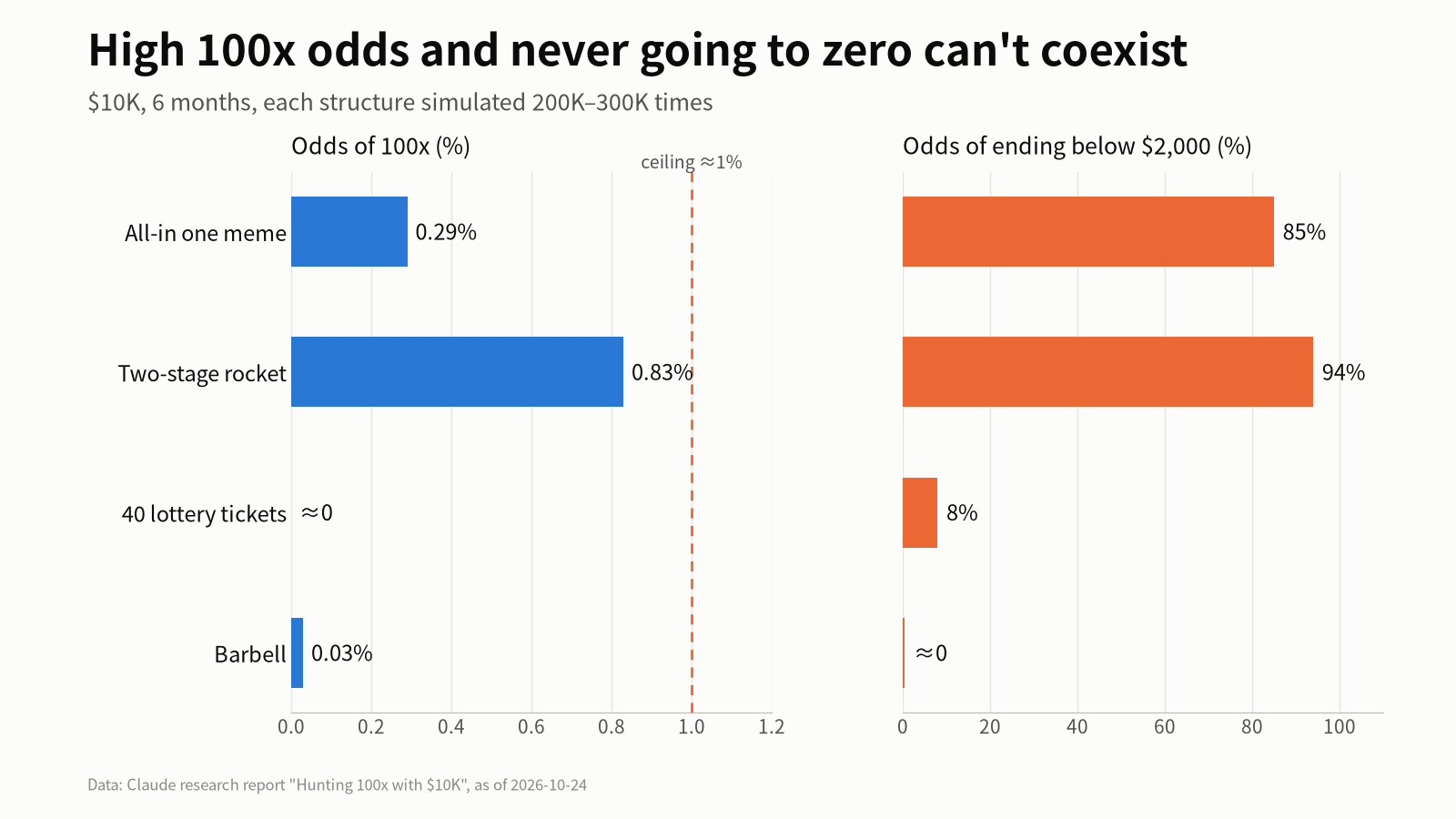
The structure that gets closest to the ceiling is the “two-stage rocket”: put everything into a bet with a 10% chance of 10x, and if it hits, put the whole $100,000 into the next one. 0.1 times 0.1 is 1%.
Its price is in the table too: a 94% chance you end up with almost nothing.
The counterintuitive part: diversification cannot rescue a 100x
The instinct says “buy more tickets, raise the odds.” That holds for hitting one ticket. It fails for the whole portfolio reaching 100x.
The reason is arithmetic. A $100 ticket that goes 300x is $30,000, still more than 30x short of $1M. The thinner you spread, the smaller each winner is in absolute terms, and the closer the portfolio drifts to the average. Diversification lowers the odds of ruin and erases the odds of 100x at the same time.
So there is a trade-off you have to face:
High 100x odds and “never going to zero” cannot coexist.
If you want odds near 1%, you accept a 90%-plus chance of ruin. If you want to avoid ruin, your 100x odds fall to a few in ten thousand. No structure delivers both. Anyone selling a “low-risk 100x” is either lying or has not done this math.
Is there any way to raise the ceiling itself?
Yes, and only one direction: raise the expected multiple. Better picking moves you around under the ceiling; lifting the ceiling requires a source where E[X] is above 1.
For small accounts, such sources are scarce. There are essentially three:
- Trading labor for tokens, meaning airdrops and points. You contribute real usage instead of buying at market price, so the expected return on capital can exceed 1.
- Showing up in the first weeks of a platform with mass distribution, when information and speed advantages are largest and latecomers are left holding the bag.
- Stretching the time horizon. The same structure run three to five times over 24 to 36 months turns many small, survivable losses into accumulated odds.
The next articles in this series take these apart one by one.
One line
A 100x is not picked, it is computed: expected value sets the ceiling, structure sets how close you get, time sets how many tries you have.
Before you size any “high-odds opportunity,” ask one question: is its expected multiple really above 1? If not, you are just buying a slightly pricier lottery ticket.
Notes on data
- Markov’s inequality is a standard result in probability theory.
- Simulation assumptions (assumptions, not measurements): the all-in meme bet has an expected multiple of about 0.96; each “10x shot” is 86% zero, 5% flat, 9% tenfold. Parameters for probes, airdrops, token sales and BTC options are listed in Appendix C of the full report. BTC options use Deribit quotes from 2026-10-24, priced risk-neutrally at roughly 42% implied volatility.
Why 100x Is Hard, part 1 of 4.
轉發此貼文?
與您的關注者分享。
回覆