
Contents (6)

·
One NVIDIA, Five Issuers, Six Tokens: Which One Do You Actually Hold?
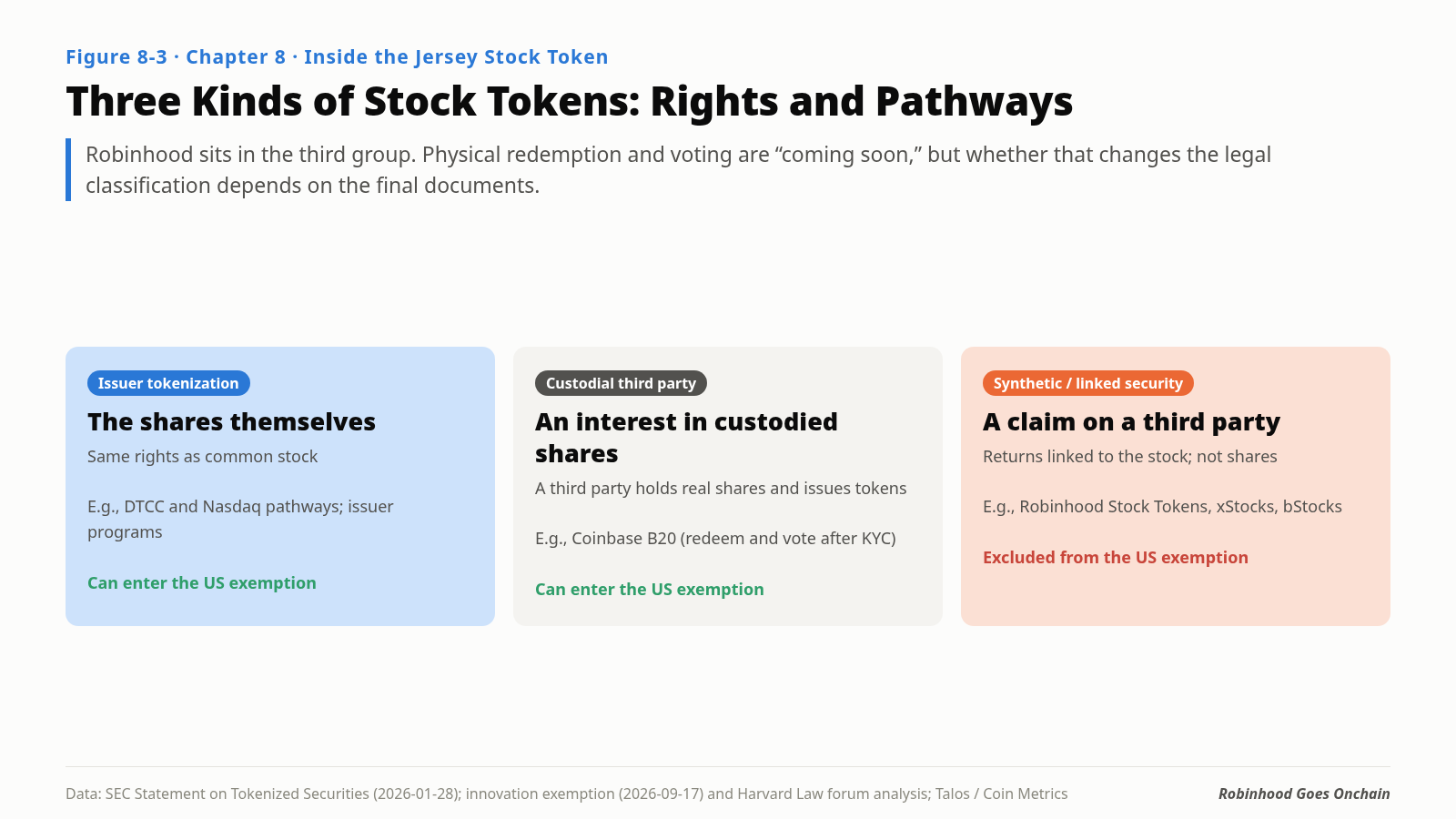
The same NVIDIA exists as six tokens from five issuers on five chains. A Robinhood Stock Token is a Jersey debt security backed by custodied shares, wrapped in an ERC-20 with freeze powers. Three types of stock token, issuer-sponsored, custody-backed and synthetic, decide where a token can go.
If you integrate stock tokens into an exchange, a wallet or a DeFi protocol, or you evaluate them from a compliance or custody seat, answer one question first: when you buy an NVIDIA Stock Token in Robinhood Wallet, what do you actually get?
A Bitquery investigation published October 13 put the question in plain view. The same NVIDIA exists as six tokens from five issuers on five chains: Robinhood on Robinhood Chain, Backed on Solana and Base, Ondo on Ethereum, Coinbase on Base, and Reality on Arbitrum.
From September 13 to October 13, Robinhood’s version traded about $656 million, Backed’s Solana version about $258 million and Ondo’s Ethereum version about $5.3 million. The rest barely traded. There are no bridges between them, yet prices stay close: the median daily gap between the Solana and Robinhood Chain versions was about 0.18%.
Prices converge because every version references the same real share and market makers arbitrage within each market. But for users and integrators, six versions mean six legal structures, six sets of contract permissions and six redemption paths.
The Three Layers of a Robinhood Stock Token
The legal layer. It is a tokenized debt security issued by RHJ, a Robinhood subsidiary registered in Jersey. It gives economic exposure to the underlying stock but no legal or beneficial rights in the stock or its issuer. You are not an NVIDIA shareholder. You are a creditor of RHJ, holding a claim whose value follows NVIDIA’s price.
The backing layer. Robinhood’s offering disclosures say the tokens are fully backed by shares held with a U.S. custodian, initially one share per token, with the number adjustable later through a multiplier. Only authorized participants that pass institutional due diligence can create and redeem with RHJ, and there was just one at issuance. Retail users trade only in secondary markets.
The contract layer. A standard ERC-20 with no allowlist and a Chainlink price feed for each token. Dividends and splits run through the multiplier: your balance stays the same while the number of shares each token represents changes. The contract also keeps powers to pause transfers, blacklist addresses and let an administrator burn tokens from any address.
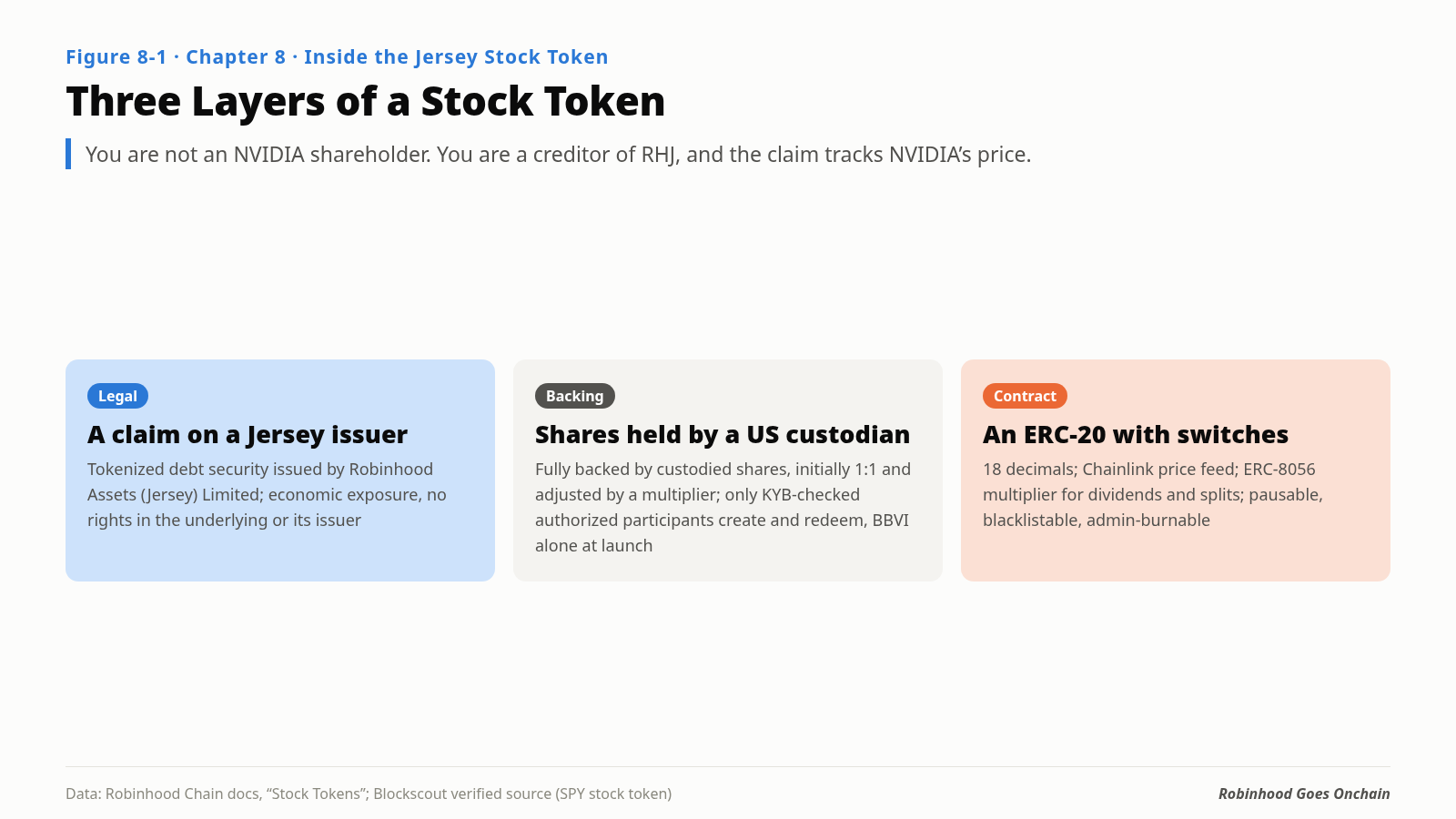
Open circulation plus retained freeze powers is the token’s central trade-off. Without an allowlist it can sit in Uniswap pools, serve as Morpho collateral and act as a launchpad quote asset. The freeze powers, in turn, are inherited unchanged by every DeFi protocol that uses it as a base asset.
Why a Jersey Debt Certificate?
Robinhood has not explained every reason behind the structure, but its logic follows from the constraints. It cannot publicly offer unregistered securities in the U.S., so the issuer sits outside the U.S. and does not sell to U.S. persons. It wants distribution in 120-plus countries, so it uses Jersey and a prospectus regime. It does not want users to become registered shareholders of U.S. public companies, so a debt security provides the exposure while a custodian holds the shares. It wants DeFi, so it uses a non-allowlisted ERC-20.
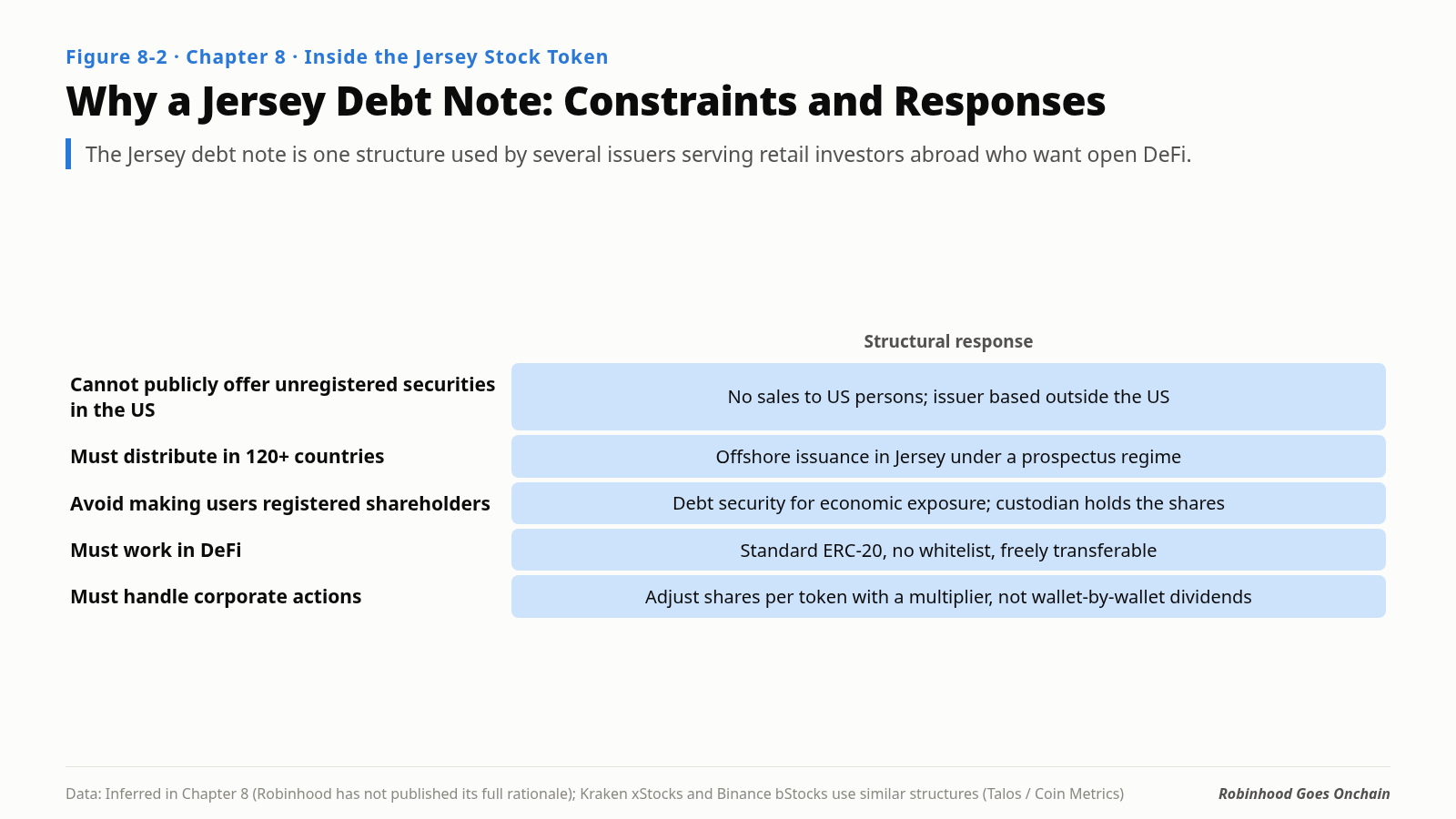
Robinhood did not invent this. Kraken’s xStocks are issued by a Jersey SPV affiliated with Backed, and Binance’s bStocks likewise carry financial rights without votes. The Jersey debt certificate is one structure used by several issuers who want offshore retail distribution and compatibility with open DeFi.
The Framework: Three Types of Stock Token
The SEC’s January 2026 Statement on Tokenized Securities splits the field in two: tokenization by the issuer (or its agent), and tokenization by an unaffiliated third party. For analysis I split the third-party group once more, by whether rights in the underlying share pass through. That gives three types of stock token. It is a simplification, not an official SEC taxonomy:
| Type | What the holder owns | Examples |
|---|---|---|
| Issuer-sponsored | The share itself, with ordinary shareholder rights | Tokenized shares on DTCC and Nasdaq paths |
| Custody-backed third party | An interest in shares held by a custodian | Coinbase says B20 directly represents shares, redeemable and votable after KYC |
| Synthetic or linked security | A claim against a third party, not the share | Robinhood Stock Tokens, xStocks, bStocks |
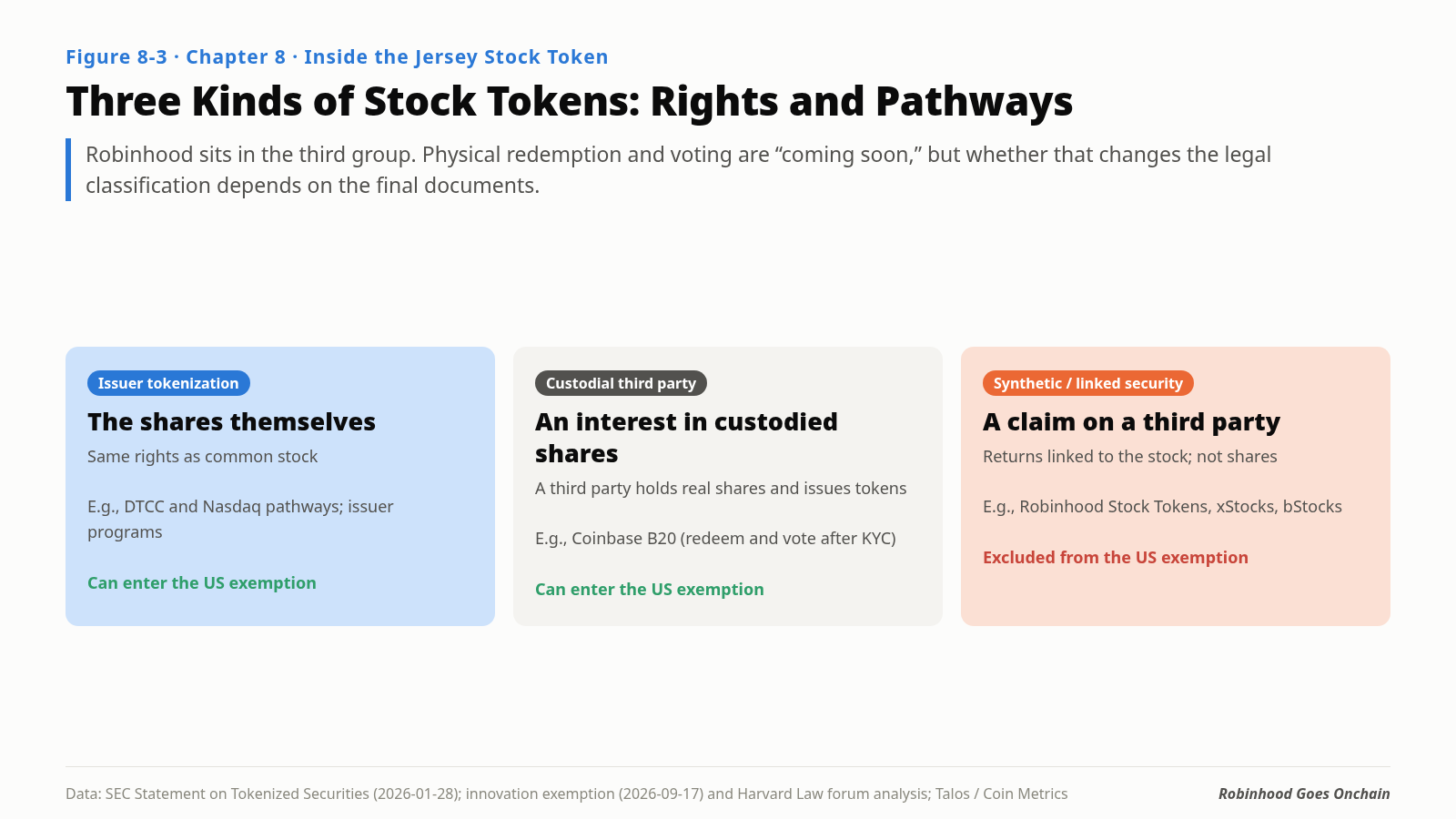
The type decides where a token can go. The SEC’s September 17 innovation exemption allows only the first two on qualifying venues and expressly excludes third-party securities offering synthetic exposure. Synthetic tokens are more flexible for offshore distribution, but the stock’s issuer can say, “That is not our stock.” Custody-backed and issuer-sponsored forms are closer to real shares, at the cost of heavier custody, transfer and register arrangements.
Robinhood sits in the third type today. On September 15, Tenev said in-kind redemption and voting were “coming soon.” That would narrow the rights gap. Whether it changes the legal classification of RHJ’s debt securities, or satisfies the U.S. exemption’s same-rights condition, depends on the final legal documents, not on a feature promise.
From Tokens in the App to Tokens in the Wallet
Look back a year and the structure was built in steps. The first-generation EU stock tokens launched at Cannes in June 2025 were derivative contracts between Robinhood’s European entity and its customers, tradable only inside the app and impossible to withdraw. The second generation became Jersey debt securities that can move into a wallet and into DeFi.
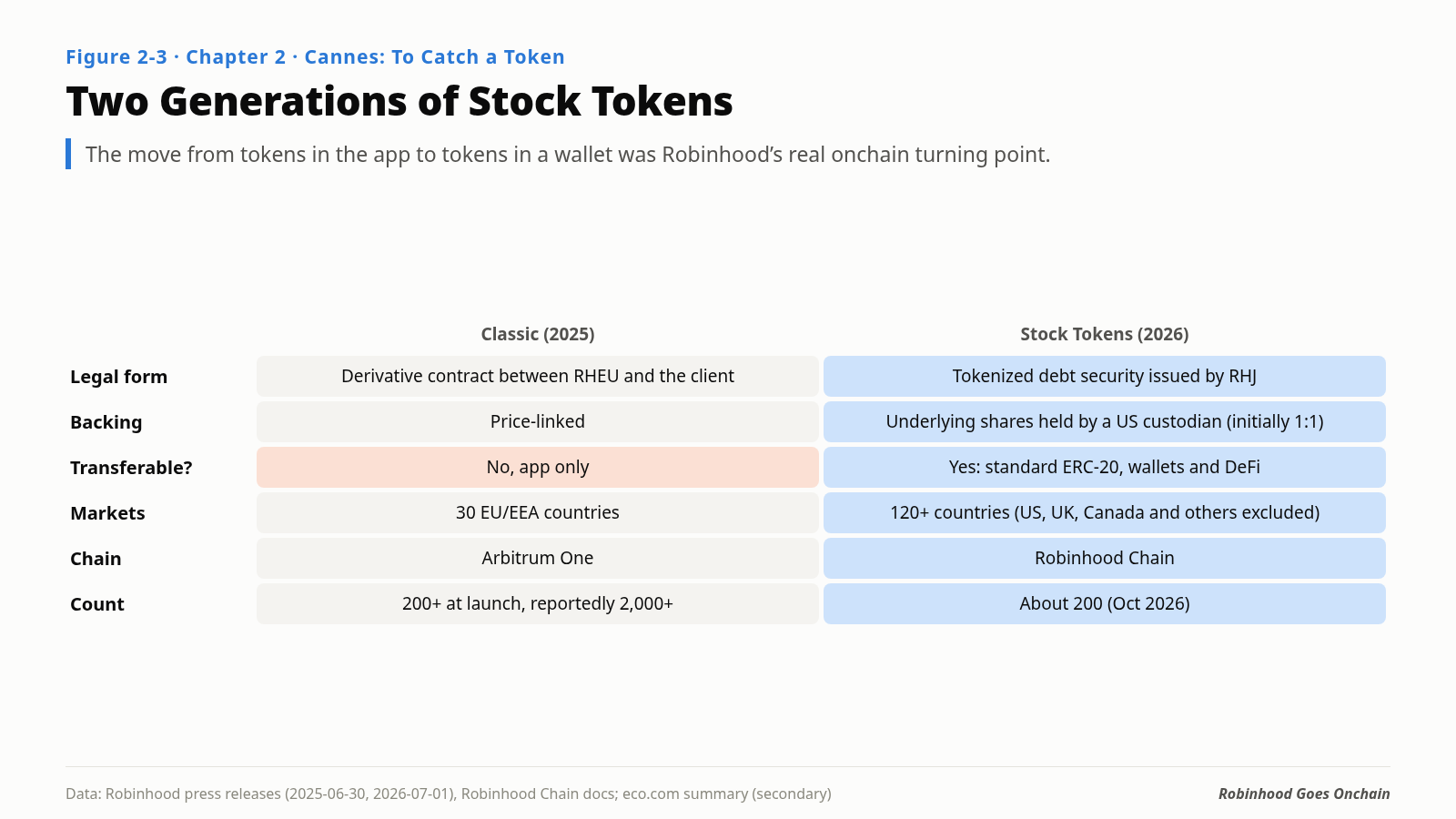
That move, from tokens in the app to tokens in the wallet, is the real watershed of Robinhood going onchain. The first was a new way of keeping the books. The second put stocks into an open environment Robinhood does not fully control, where memecoins, arbitrage, bots, compliance and objecting issuers all have to be faced.
If You Integrate or Evaluate Stock Tokens
- Read the legal structure before the contract. The same NVDA label can mean a share, an interest in custody, or a claim against a third party.
- Read the multiplier. An unchanged balance does not mean unchanged rights; collateral values, tax and accounting all need it.
- Assess issuer freeze powers. If you use stock tokens as quote assets or collateral, one paused or blacklisted address can hit your whole product.
- Count the authorized participants. With one, creation, redemption and price convergence all ride on a single firm.
The Takeaway
A Robinhood Stock Token is a Jersey-issued claim, shares held as backing by a custodian, and an ERC-20 with switches. Where it can go depends on which of the three types it belongs to. “Which NVIDIA do I hold?” will be a lasting question for tokenized equities.
When you integrate a stock token, what do you check first: the legal structure, the contract’s permissions, or liquidity?
— Adapted from Robinhood Goes Onchain: A Broker’s First Year, Chapter 2, “Cannes: To Catch a Token,” and Chapter 8, “Inside the Jersey Stock Token”
The full book (17 chapters, 48 figures, first 3 chapters free to read): https://pickful.ai/books/qx7q
Repost this post?
Share with your followers.
Reply