
目錄(8 節)

·
PAR Burned 1.06M Tokens in 5 Days, 11% of Supply So Far: Inside Its Three Burn Valves
A burn-by-burn on-chain breakdown of PAR from Oct 16 to 20: 1,058,880 tokens burned, split roughly evenly between buybacks and sell-fee burns, with supply down 11.04% since launch. The three-valve framework shows where burn fuel comes from and who holds it.
If you design token buyback-and-burn mechanisms, or evaluate how a protocol token captures value, don’t start with how much has been burned. Start with how each token got burned.
We traced every PAR burn on-chain from October 16 to 20, 2026 (UTC). Over those five days, 1,058,880 PAR were burned through two mechanisms: buybacks contributed 53% and automatic sell-fee burns 47%, roughly half each. Since launch, PAR’s total supply has shrunk by 11.04%.
There is plenty of room for more: the project address holds 20.22 ETH and 1.977M PAR. How fast PAR burns from here depends largely on how that fuel gets used.
1. The 5-day ledger: two kinds of burn, roughly half each
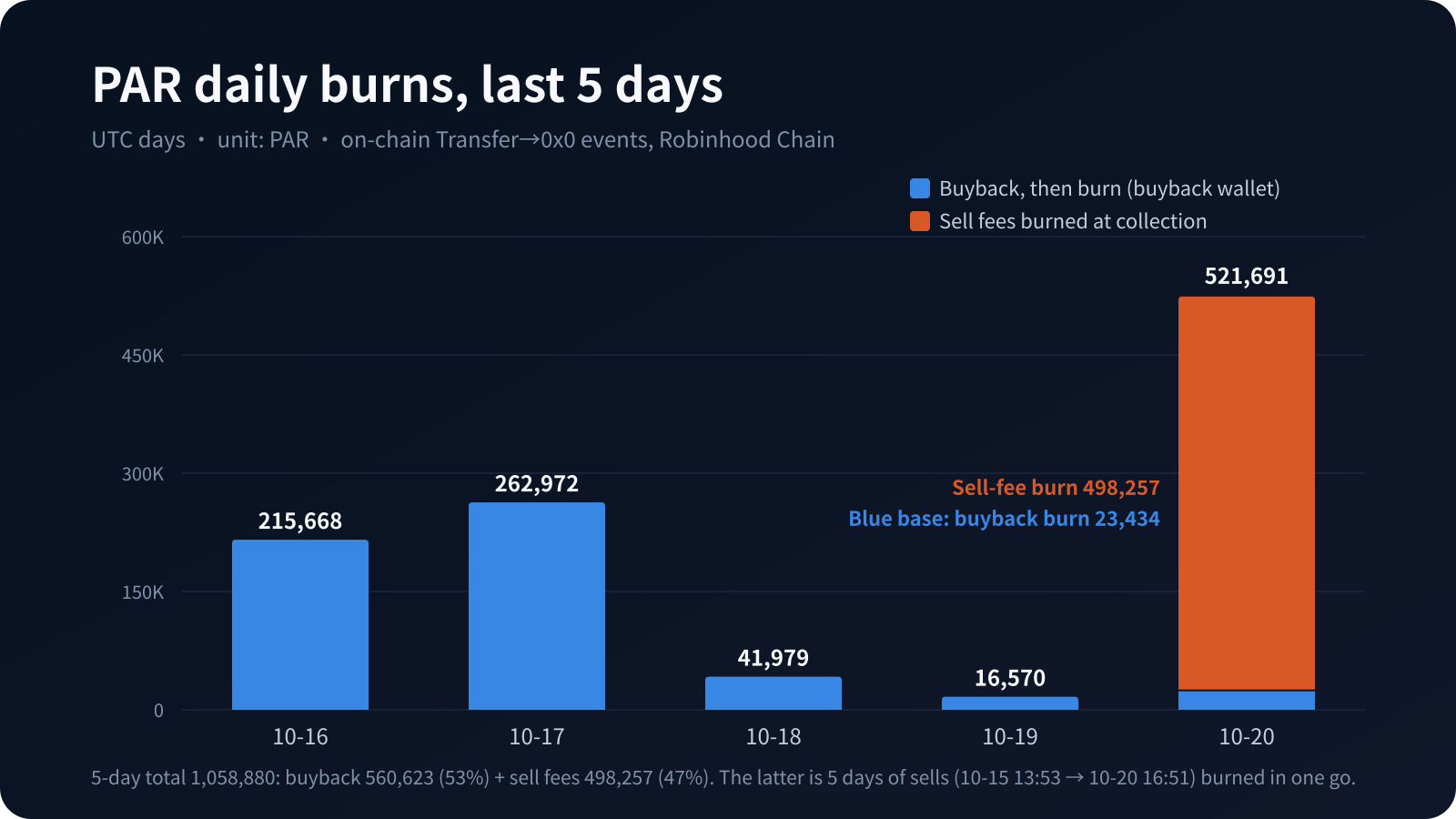
PAR burns by calling burn(), which reduces totalSupply directly and emits a Transfer(from, 0x0) event on-chain. We pulled every transfer to the zero address in the window. There were only two sources:
| Date (UTC) | Buyback burn | Sell-fee burn | Total |
|---|---|---|---|
| Oct 16 | 215,668 | 0 | 215,668 |
| Oct 17 | 262,972 | 0 | 262,972 |
| Oct 18 | 41,979 | 0 | 41,979 |
| Oct 19 | 16,570 | 0 | 16,570 |
| Oct 20 | 23,434 | 498,257 | 521,691 |
| Total | 560,623 | 498,257 | 1,058,880 |
-
Buyback burn: the buyback wallet
0x5ba4…8033buys PAR in the pool with ETH, then callsburn(). It did this 7 times in the window, each purchase split into 4 swaps, and every one matches the official/buybacksAPI record. -
Sell-fee burn: sells in the PAR pool pay their fee in PAR. When the Locker contract
0x8a6d…a231collects fees, it burns the protocol’s half on the spot.
Summing the ETH in each purchase transaction, the buyback wallet spent 0.0593 ETH (about $145) over the five days and bought back 571,172 PAR.
No PAR went to the dead address in the window, and no third party burned any. Current totalSupply is 889,557,587. Against the initial 1 billion, that is 110,442,413 PAR burned in total, or 11.04%, which matches the official API exactly.
2. Three valves: first ask where the fuel for a burn comes from
PAR’s five days break down into three burn valves. You can apply the same breakdown to any buyback-and-burn token:
- The automatic valve: a tax paid by sellers. More selling means more burning, and once fees are collected the contract burns them on the spot. Collection itself needs someone to trigger it, though; more on that in section 5. But it brings in no new buyers. It’s a tax on sellers, paid in the token.
- The buyback valve: spend money, buy back, burn. Real ETH flows into the pool while supply shrinks. It’s the only valve that creates buy-side demand, and its strength depends on how much ETH the buyback wallet has.
- The treasury valve: the project decides. When and how treasury tokens and ETH get used is up to whoever holds them. No on-chain rule binds it.
The most common misreading is crediting the automatic valve’s numbers to the buyback valve. October 20 shows 520K PAR burned in a single day, which looks like burns accelerating. In fact, 95% came from one fee collection; buybacks contributed only 23,434.
3. Sell fees: one fee, two destinations, 9 seconds
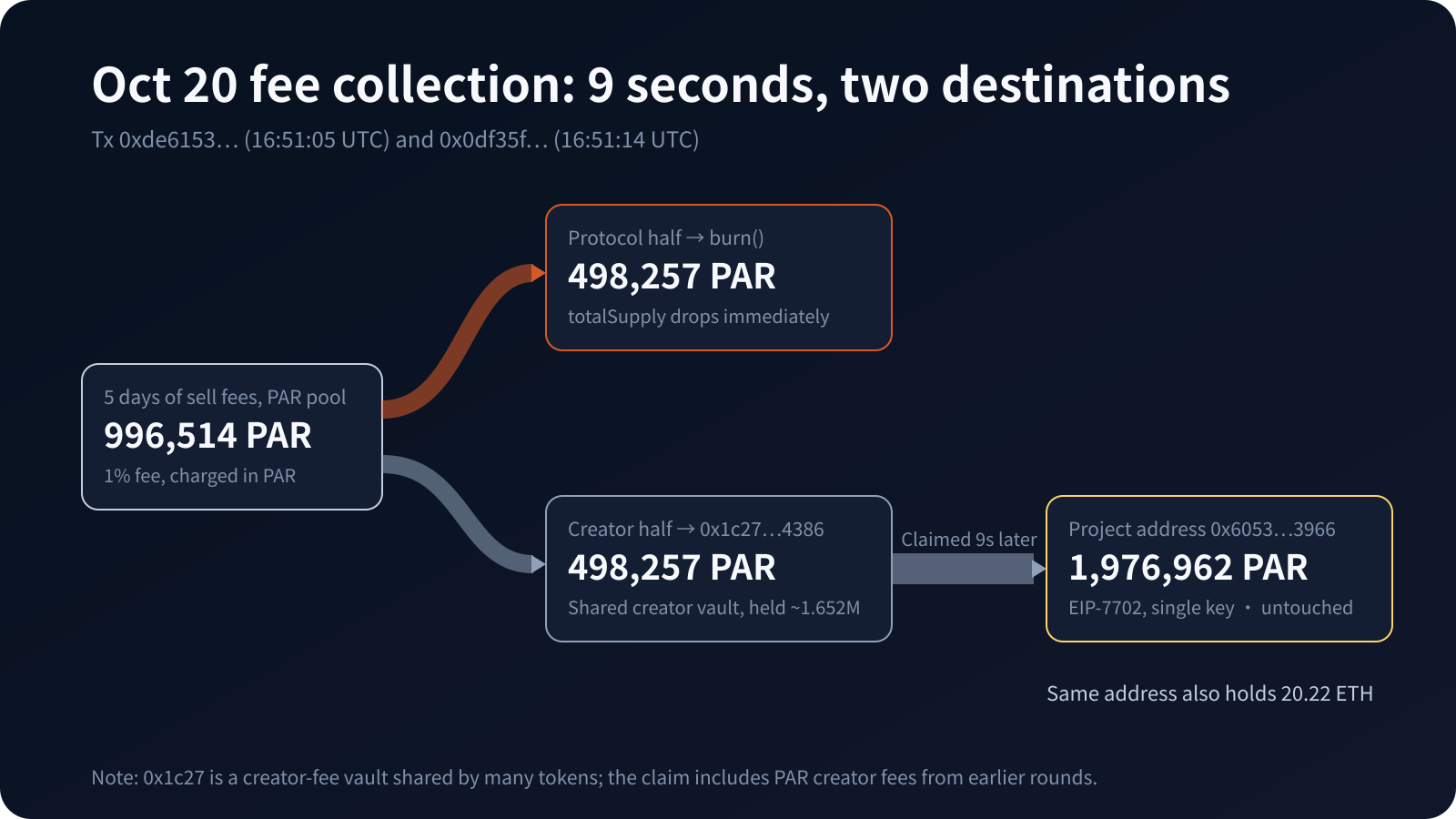
At 16:51:05 UTC on October 20, transaction 0xde6153…9ab0 pulled all the sell fees that had built up in the PAR pool: 996,514 PAR, covering every sell since the previous collection on October 15 at 13:53.
- The protocol half, 498,257 PAR, was burned on the spot with
burn(). - The creator half, 498,257 PAR, went to
0x1c27…4386, a creator-fee vault shared by many tokens on the platform.
Nine seconds later, at 16:51:14 UTC, transaction 0x0df35f…dddf: the project address 0x6053…3966 claimed 1,976,962 PAR from that vault in one go. Besides the 498K that had just arrived, the rest was PAR creator fees left over from earlier rounds.
Those tokens haven’t moved since. The PAR balance of 0x6053 is exactly 1,976,962, with no outgoing PAR transfers since.
Cross-check: between the two collections, the PAR pool traded 18.59 ETH. At a 1% fee rate that should yield about 0.186 ETH in fees. What was actually collected: 0.0909 ETH in the quote asset, plus 996,514 PAR worth about 0.097 ETH at the current price, for about 0.188 ETH in total. That’s within 2%.
So the full path of a sell fee is: half gets burned, half goes to the project address.
4. Who holds the fuel
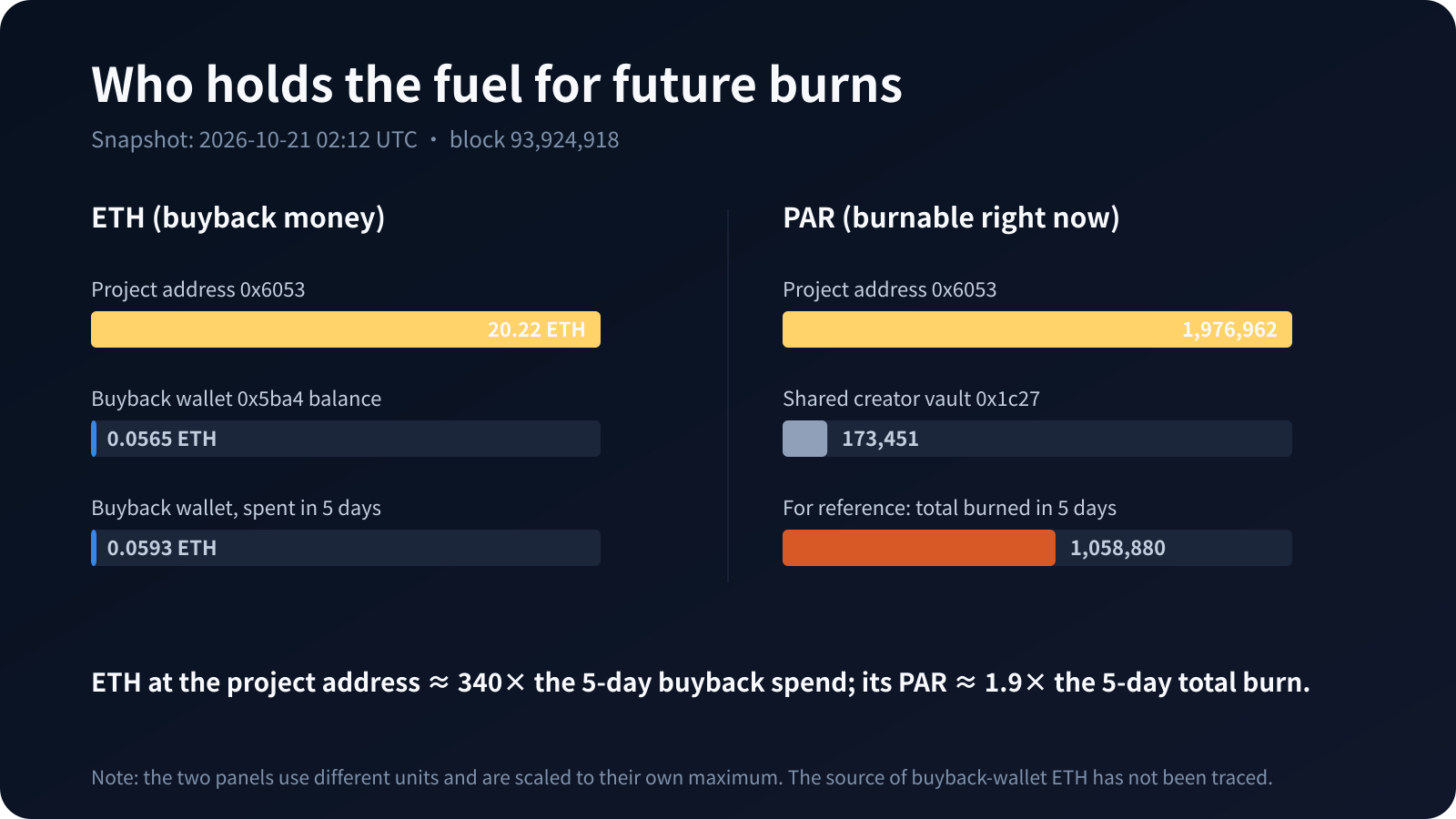
Snapshot taken October 21, 2026 at 02:12 UTC, block 93,924,918:
| Address | ETH | PAR | Role |
|---|---|---|---|
Project address 0x6053…3966
|
20.22 | 1,976,962 | Both protocol fee recipient and creator fee recipient for the PAR pool |
Buyback wallet 0x5ba4…8033
|
0.0565 | 0 | Runs buybacks and burns |
Shared creator vault 0x1c27…4386
|
0.24 | 173,451 | Shared across many tokens; balance not attributed |
Two ratios:
- The ETH at the project address is about 340× what the buyback wallet actually spent in five days (0.0593 ETH).
- The PAR at the project address is 1.9× the total burned in five days.
0x6053 is not a multisig. It’s an ordinary account delegated via EIP-7702 to MetaMask’s EIP7702StatelessDeleGator contract, controlled by a single private key. It is the protocol fee recipient and creator fee recipient for the PAR token itself. PAR was launched from the old factory 0x9d33…; tokens launched from the new factory send their protocol fees to a different recipient contract, 0x85a1…a4c1.
This is the part of PAR’s value capture that most needs to be understood: only the automatic half is fixed by rules. The fuel for buybacks, and the larger share sitting in the treasury, are both human decisions.
5. Zoom out: after October 5, the human half stopped
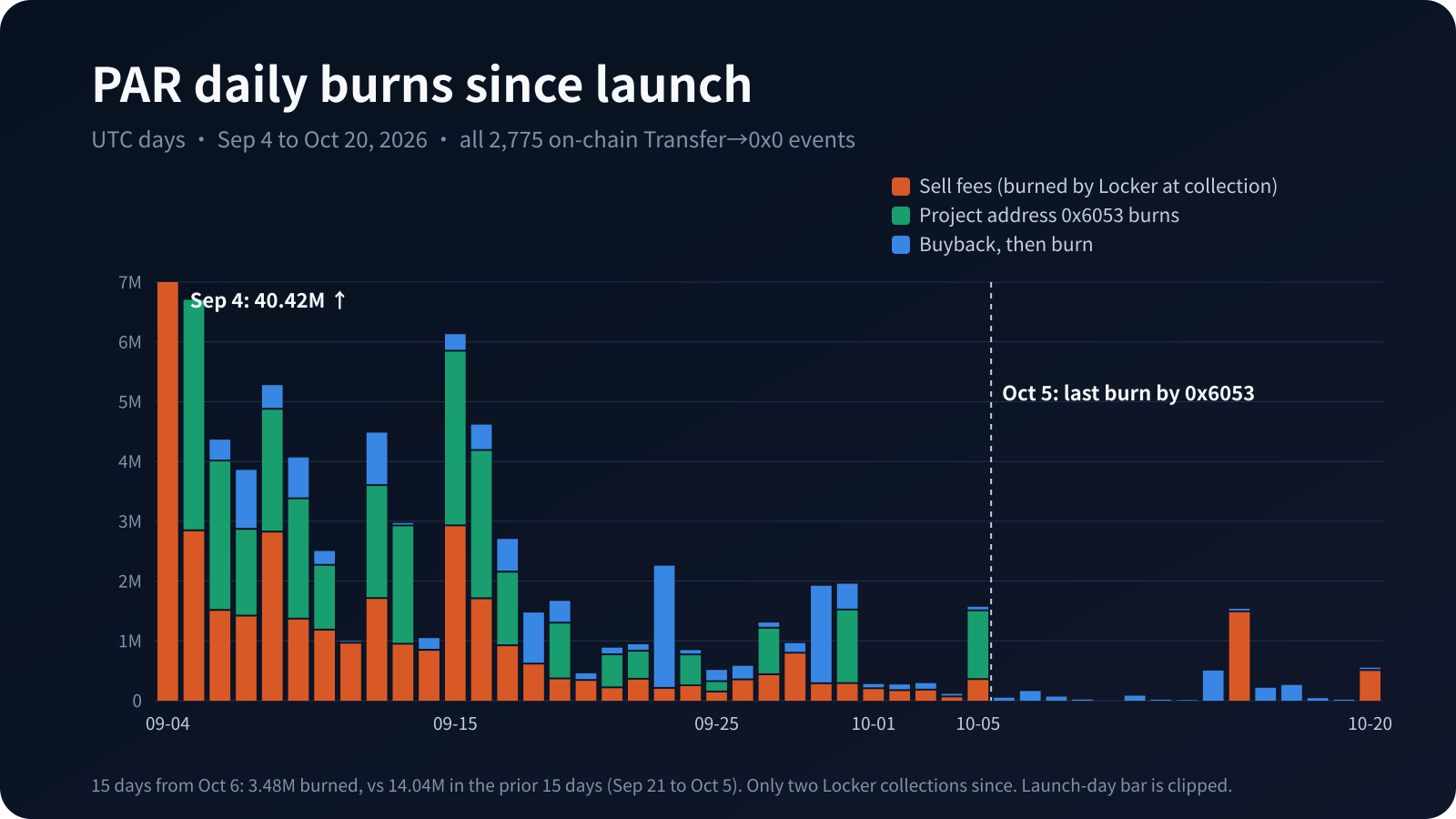
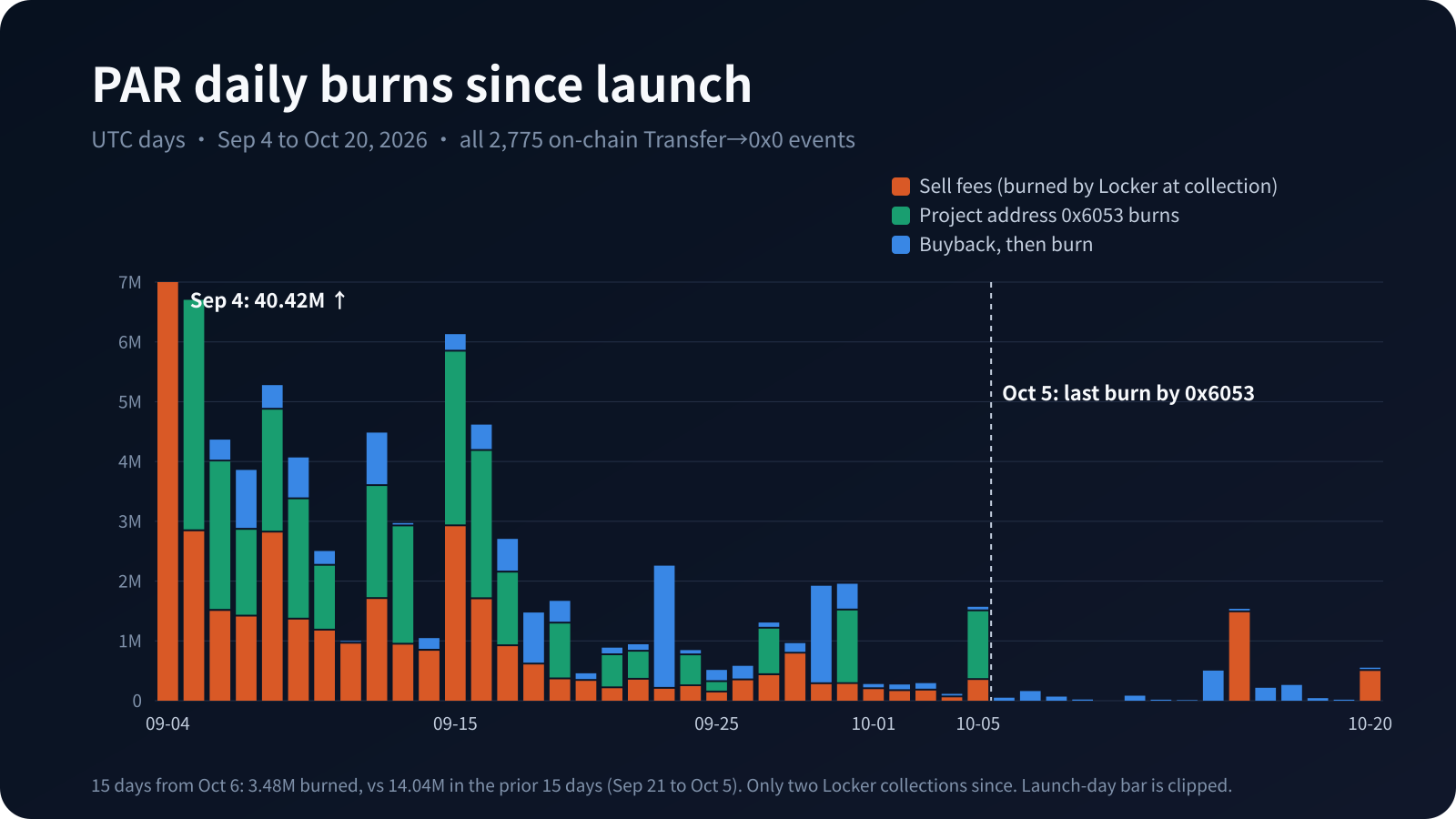
Lay all 2,775 burn events since launch out by day, and the change in structure is clear.
PAR’s biggest burn day was launch day, September 4, 2026 (UTC): 40,421,600 PAR, about 4.04% of initial supply. The largest single burn came that day at 20:46, when 0x6053 burned 11,435,806 PAR in one transaction. The biggest day in the last five, October 20, was 520K, roughly 1/77 of the peak.
Cumulatively, the three sources break down as follows:
| Source | Cumulative burn (PAR) | Share |
|---|---|---|
| Sell fees (burned by Locker at collection) | 49,305,734 | 44.6% |
Burns by project address 0x6053
|
48,297,286 | 43.7% |
| Buyback, then burn | 12,839,393 | 11.6% |
The project did burn most of its creator fees in the past, across 31 burns. But the last one was on October 5, for 1,119,100 PAR. There hasn’t been one since.
Something else changed at the same point. Before October 5, the Locker collected fees almost every day. Since October 6, it has collected only twice, on October 15 and October 20. Collection takes someone sending a transaction, and the October 20 one was sent by 0x6053. So the “automatic” valve has a manual switch too: fees burn automatically once collected, but a person decides when to collect.
Put the two together: in the 15 days from October 6 to 20, PAR burned 3.48M tokens, versus 14.04M in the previous 15 days (September 21 to October 5), a drop of about 75%.
Past burns show the project is willing, but that isn’t a commitment. No on-chain rule says when, or at what pace, this 1.977M PAR and 20 ETH will turn into burns.
6. Platform-wide fee revenue
Over the same five days, protocol fees collected across all tokens on the PAR platform came to about $618 (0.252 ETH), or about $124 a day:
| Date (UTC) | Protocol fees (USD) |
|---|---|
| Oct 16 | 167 |
| Oct 17 | 155 |
| Oct 18 | 36 |
| Oct 19 | 19 |
| Oct 20 | 241 |
For comparison, the official cumulative protocol fees stand at 95.19 ETH, and cumulative buyback spend at 7.62 ETH. Revenue today is clearly much smaller than in the weeks after launch.
7. If you design or evaluate a buyback-and-burn mechanism
- Report the three valves separately. A single “total burned” figure lets a tax on sellers pass for buyback performance.
- Read burns by collection cycle, not by calendar day. Fee collections happen at irregular times, so a single day’s number can be several days’ worth burned at once.
- Track the fuel, not just the result. The buyback wallet’s balance, the treasury’s balance, and who controls them say more about what comes next than cumulative burns do.
- Make control explicit. Whether the fee recipient is a multisig, a timelock, or a single key decides how much a burn “commitment” is worth.
A burn is only the result; whether it can keep going depends on where the fuel sits. The half of PAR’s burns that happen automatically is a tax paid by sellers. The bigger share of the fuel is still sitting at a single-key address.
When you evaluate a token’s buyback and burn, which valve do you check first?
Sources and methodology
-
Burn history: every
Transfer→0x0event since PAR’s creation block 54,535,851: 2,775 events totaling 110,442,413 PAR, exactly matching 1 billion minus currenttotalSupply. There are only three source addresses: the buyback wallet, the Locker, and0x6053. -
On-chain data: Robinhood Chain public RPC. We read PAR
Transfer→0x0events (from Oct 15),totalSupply(), address balances andeth_getCode, and transaction receipts. Snapshot taken Oct 21, 2026 at 02:12 UTC, block 93,924,918. -
PAR contract:
0x507B6F349a80114097A67b8b4677367acC15b220. -
Key transactions: fee collection
0xde61535862fe5de5b3b39f7abf5c65fa5fdc0fe105398c612a93db5627b99ab0; vault claim0x0df35fc5f97e24c817a63b4e30572abb6a0f733534e66a170bf8e641e4cddddf. -
Delegate contract:
0x63c0c19a282a1b52b07dd5a65b58948a07dae32b, verified on Sourcify asEIP7702StatelessDeleGator. -
Official API:
/stats,/buybacks,/fees,/candles, and/launchesonapi.par.family. Buyback records match on-chain burn events one for one, and the cumulative burn in/statsmatches on-chaintotalSupply. -
Buyback spend: sum of the ETH
valueof each purchase transaction from the buyback wallet. There were 28 purchases over the five days, buying 571,172 PAR, slightly more than the 560,623 burned in the same period because one purchase was burned the following day. The buyback wallet currently holds 0 PAR. - USD conversion: ETH at $2,453.87 (DexScreener, at snapshot time).
-
Platform fees: the protocol share of
/feescollection records. Non-ETH quote assets were converted at current DexScreener prices, not the price at the time of each trade, so the error is around ±20%. OUST had no price and was counted as 0; the amount is negligible. -
Not verified: where the buyback wallet’s ETH comes from (the node doesn’t expose traces, so it hasn’t been traced transaction by transaction); whether the “60% buyback, 40% operations” split in the official docs applies to PAR’s own pool (PAR launched from the old factory, and its fees go straight to
0x6053); and the 12.58M uncollected creator PAR shown by the/launchesAPI, which doesn’t match the balances of the on-chain vaults and is not used in this article.
This article covers on-chain accounting and token mechanics. It is not investment advice. Balances and supply will keep changing after publication.
轉發此貼文?
與您的關注者分享。
回覆