
Contents (7)

·
The Approval Sheet for Listing a Tokenized Stock: Ten Decisions, Each With a Failure Condition
Each of the previous nine pieces asked about one decision. This piece compresses those nine decisions into a single approval sheet, works through the economics, and adds the tenth decision: once you are live, which numbers you watch every day, every week and every quarter, and which number sends you to which level of halt.
Each of the previous nine pieces asked about one decision. This piece compresses those nine decisions into a single approval sheet, works through the economics, and adds the tenth decision: once you are live, which numbers you watch every day, every week and every quarter, and which number sends you to which level of halt.
The numbers from the opening piece can be closed out in one sentence: on Sunday, the Ondo reading closest to the Friday close came from a 2% pool that had stopped trading 19.5 hours before the snapshot; the creation/redemption door is genuinely being used, but in this sample only the upper edge of the arbitrage band has been confirmed. Reading the wrong price is more dangerous than the spread itself. On the approval sheet, my “one door, three prices” framework comes down to two things: what you compare (the underlying price, across issuers, across pools), and which price you read for each use (display, trading reference, liquidation).
1. The approval sheet: ten decisions, each with a failure condition
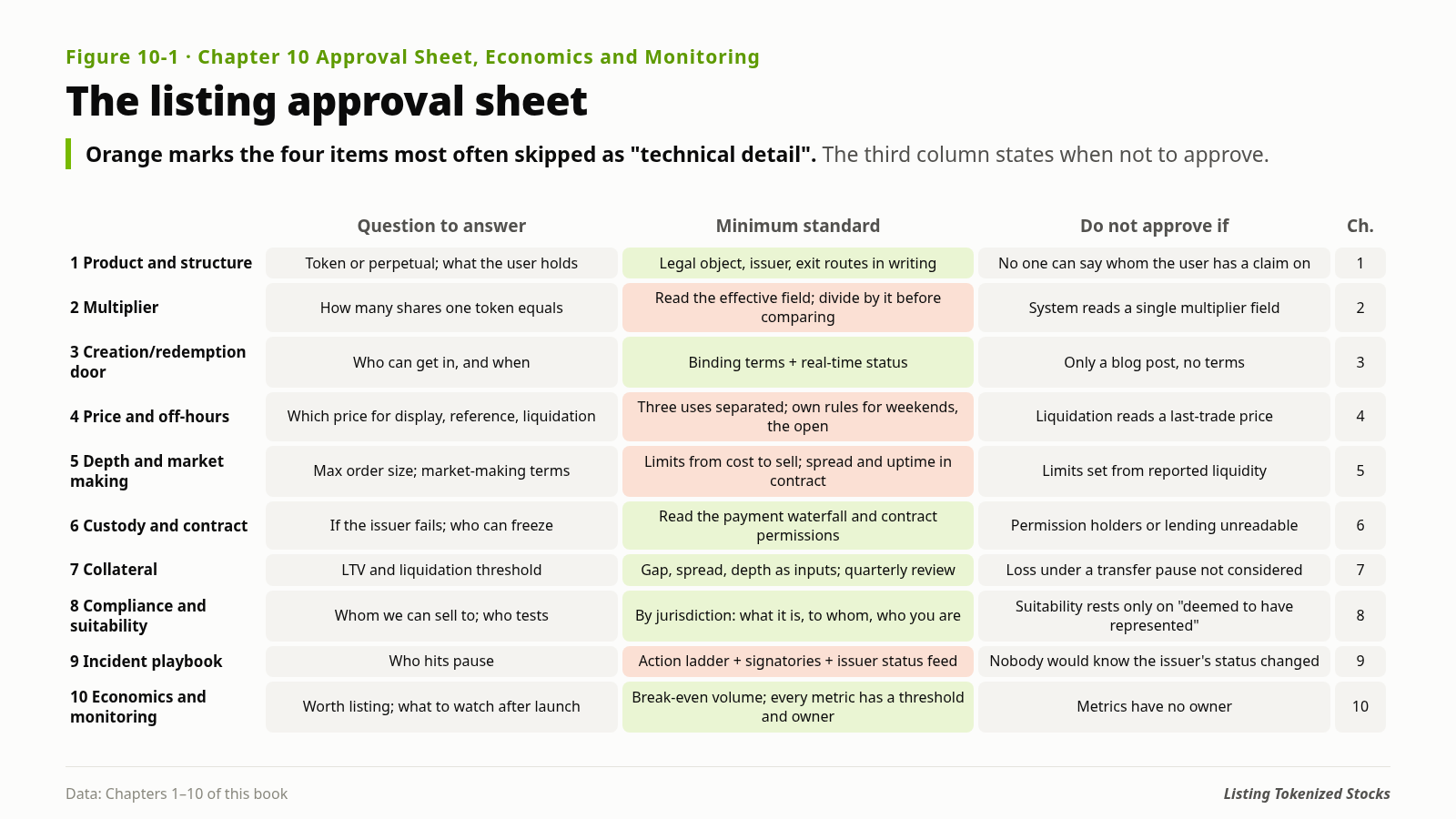
What separates this sheet from an ordinary due-diligence checklist is the “failure condition” column: every row states the situation in which the listing is not approved. An approval sheet without failure conditions ends up as nothing more than a signature page.
- 1 Product and structure: Question to answer: Token or perpetual; what the user holds; Minimum standard (evidence to keep): Product page states the legal object, issuer and exit routes; prospectus excerpts; Do not approve if: Nobody can say whom the user has a claim on, or what secures it; Signatory: Head of product + legal & compliance
- 2 Multiplier: Question to answer: How many shares one token equals; Minimum standard (evidence to keep): Read the effective field by issuer, underlying, chain and contract version; conversion basis written into system documentation; Do not approve if: The system reads a single multiplier field, or maintains one per ticker across the board; Signatory: Head of risk
- 3 Creation/redemption door: Question to answer: Who can get in, and when; Minimum standard (evidence to keep): Binding terms; how real-time status is read; the past week’s mint and burn records; Do not approve if: Only a blog post or product page says so, with no terms; Signatory: Head of product
- 4 Price and off-hours: Question to answer: Which price for display, reference and liquidation; Minimum standard (evidence to keep): Data source and staleness rule specified for each of the three uses; separate rules for weekends and the first 30 minutes after the open; Do not approve if: The liquidation price reads the last-trade price of a single pool; Signatory: Head of risk
- 5 Depth and market making: Question to answer: How large a single order can be; what the market-making contract says; Minimum standard (evidence to keep): Cost-to-sell curve on the venues actually routed to; market-making contract specifies quote size, spread, uptime and off-hours exceptions; Do not approve if: Limits set from reported liquidity; market-making contract has no off-hours clause; Signatory: Head of product
- 6 Custody and contract: Question to answer: What happens if the issuer fails; who can freeze; Minimum standard (evidence to keep): Payment waterfall; securities-lending terms; on-chain permission readings (holders, thresholds, timelocks); Do not approve if: Permission holders or lending status cannot be read, and the issuer will not answer in writing; Signatory: Head of risk + legal & compliance
- 7 Collateral: Question to answer: LTV, liquidation threshold, supply cap; Minimum standard (evidence to keep): Formula and data for the three inputs: gap, spread, slippage; list of liquidators; Do not approve if: No one has considered who bears the loss when the token’s transfers are paused; Signatory: Head of risk
- 8 Compliance and suitability: Question to answer: Whom we can sell to; who tests; Minimum standard (evidence to keep): By jurisdiction: what it is, whom it can be sold to, how far your licence reaches; suitability tests and blocking actions; Do not approve if: Suitability rests only on the user being “deemed to have represented”; Signatory: Legal & compliance
- 9 Incident playbook: Question to answer: Who hits pause when something goes wrong; Minimum standard (evidence to keep): Action ladder, signatories, restart conditions; subscription to or polling of the issuer’s status; Do not approve if: Nobody would know the issuer’s status had changed; Signatory: Head of risk
- 10 Economics and monitoring: Question to answer: Is it worth listing; what do we watch after launch; Minimum standard (evidence to keep): Break-even volume; every metric has a threshold, an owner and an action; Do not approve if: Metrics have no owner, or the economics show revenue but no costs; Signatory: Head of product + head of risk
The rows most easily skipped as technical detail are 2, 4, 5 and 9.
The trap in row 2 has actually happened. Netflix split 10-for-1 in November 2025. The multiplier field of xStocks’ NFLXx on Solana still reads 1 to this day; the field actually in effect is another one, newMultiplier, with a value of 10. A system that reads only the first field misprices this token by a factor of 10.
The trap in row 5 sits where the numbers look best. Ondo’s Ethereum route reports the most liquidity of any issuer, about $8.34 million, yet its largest pool charges a 2% fee: selling $1,000 costs 2% before anything else.
The trap in row 9 is that everyone assumes someone will tell them. Ondo’s status page recorded 3 incidents in the past 90 days, including about 6 hours 40 minutes of intermittent creation/redemption failures during the overnight session on October 21, and push notifications for status updates were switched off. If you don’t read it yourself, you won’t know the door was ever shut.
2. Ten decisions are not ten separate questions
When a listing goes wrong, it is rarely because one decision was wildly wrong. More often, an error in one decision travels down a chain. The four most common chains:
Multiplier → price → liquidation. Read the multiplier wrong and the price source is wrong; with the price source wrong, the liquidation threshold is wrong. The piece on multipliers described a subtler version: the oracle’s price already includes the multiplier and your system multiplies again. In normal times the error is too small to see; it surfaces all at once on an ex-dividend date or split date.
Custody and contract control → collateral parameters. The piece on custody and contract control found that several issuers’ terms allow the underlying shares to be lent out; all four token contracts we read can be paused, Ondo and Robinhood can pause all of their stock tokens in one go, and TSLAx on Solana already has a freeze authority and a “permanent delegate” switched on, while the prospectus says only that freezing “may be introduced in the future”. Whether the collateral behind the token can be lent out, and whether the token can be frozen, directly determine how much you recover in a liquidation and whether you can sell at all. So they belong in loan-to-value and supply caps, not just in the due-diligence sheet.
Compliance → liquidity → depth. Almost every issuer excludes U.S. persons, and creation/redemption eligibility mostly goes only to authorized participants or KYC-cleared clients. Whether your market maker can get through the door, and in which jurisdiction, determines whether anyone arbitrages the pools you integrate, and so determines the piece on depth’s cost curve and how tight a spread you can write into the market-making contract.
Product choice → everything. The first decision in the piece on issuance structures is whether to list a token or a perpetual. Choose the perpetual and most of the questions in the pieces on multipliers, creation and redemption and custody and contract control are replaced by another set: the venue’s oracle, ADL rules, whether the deployer can force settlement. List both, and the product page has to let users tell whether they bought a certificate they can take away or a price that lives inside one venue.
So at review time, the ten decisions belong on one sheet, looked at by one group of people, rather than compliance, product and risk each signing their own page.
3. The economics: what one tokenized stock earns in a month
One more question at the approval meeting cannot be avoided: once listed, how much will a single token contribute to the platform each month, and how much volume does it need not to lose money?
This section gives no answer, because the answer depends on your fee rates, your revenue share with the issuer, and what you pay market makers, none of which we can see. What it gives is a table you can fill in directly, and an indication of which cells public data can fill and which you can only get from the other side.
Monthly contribution per token
- Volume: How to calculate: Expected monthly volume (user buys and sells combined); Can public data fill it?: Scenarios only; other venues’ public volumes can help you set low, mid and high cases, but are not yours
- × Platform net fee rate: How to calculate: Maker and taker fees weighted by user mix, minus rebates and referral shares; Can public data fill it?: Your own fee schedule
- + Issuer revenue share: How to calculate: Revenue share paid by the issuer on assets under custody or volume, listing incentives; Can public data fill it?: No; leave blank without a contract
- + Spread income: How to calculate: Only when you act as counterparty or internalize matching; Can public data fill it?: Your own data
- − Market-making cost: How to calculate: Fixed fees, rebates or subsidies paid to market makers (the term list in the piece on depth); Can public data fill it?: No; fill in once you have market makers’ quotes
- − Hedging and capital: How to calculate: Hedging and funding costs of holding inventory; whether you can create and redeem with the issuer decides whether inventory can be cleared in time; Can public data fill it?: Partly: creation/redemption minimums, on-chain pool fees
- − On-chain and data costs: How to calculate: On-chain fees for deposits and withdrawals, nodes and data services, monitoring; Can public data fill it?: Yes: public pricing for gas, pool fees and data services
- − Compliance and legal: How to calculate: Listing review, legal opinions, engineering for jurisdiction restrictions and suitability tests, amortized over 12 months; Can public data fill it?: No; use what you actually spent the last time you listed a similar product
- − Incident readiness: How to calculate: 24/7 on-call, complaints handling and compensation reserves required by the action ladder in the piece on incident playbooks; Can public data fill it?: No; internal estimate
- = Monthly contribution:
Break-even in three scenarios
A large share of the costs is fixed: legal, compliance engineering, monitoring and market makers’ minimum fees have to be paid whatever the volume. Separate the fixed costs from the costs that vary with volume, then calculate:
Break-even monthly volume ≈ monthly fixed cost ÷ (net fee rate − variable cost per unit of volume)
Illustrative (all numbers are assumptions, only to show orders of magnitude): with $15,000 of monthly fixed cost allocated to one token, a net fee rate of 10 bp and variable cost of 2 bp, break-even is about $19 million of volume a month; at a net fee rate of only 5 bp, it takes about $50 million.
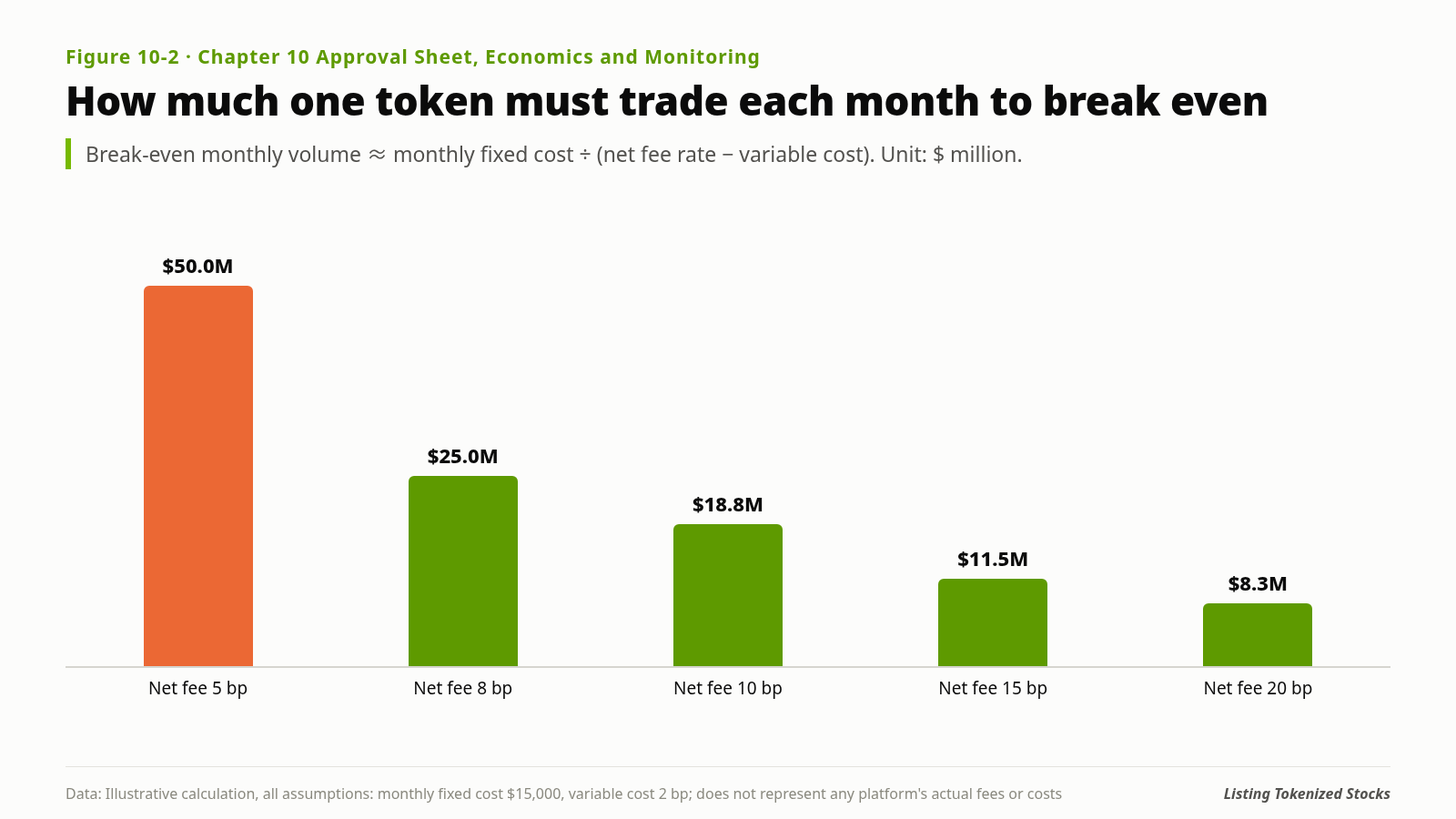
This calculation puts one fact on the table: most fixed costs are paid per issuer and per jurisdiction, not per token. For the same issuer, the legal review, custody due diligence, contract permission checks and monitoring integration cost about the same whether you list 1 token or 20. So either review once and list a batch, or don’t list. Platforms that list only one or two “to test the water” have the hardest time making the economics work.
Run two more sensitivities:
- Share of volume in off-hours. U.S. regular trading hours are 32.5 hours a week, out of 168 hours. On a platform whose users are mostly in Asia, volume will concentrate in hours when U.S. markets are closed, when market makers widen or pull their quotes, so execution costs and incident probability are both higher. Run the numbers once each at an off-hours share of 20%, 50% and 80%.
- Market-making subsidies. Market makers usually quote regular and off-hours sessions separately, with wider spread commitments for off-hours, or none at all. For each step up in subsidy, write down in the table how far the break-even volume rises.
Written material to request before listing
- Issuer: terms of the revenue share or listing incentive, the calculation base, the settlement cycle, and any exclusivity or minimum-volume requirement.
- Issuer: creation/redemption minimums, fees, settlement times and off-hours capacity, and how status changes will be communicated to you.
- Market makers: prices quoted against the term list in the piece on depth, with regular and off-hours sessions quoted separately.
- Data vendors: quotes and service levels for price, depth and corporate-action data.
- Legal: one-off fees for this batch of tokens, and the additional fee for each new jurisdiction.
4. After launch: every metric needs a threshold, an owner and an action
The listing review happens once; prices, depth, multipliers and reserves change every day. The tables below are layered by frequency. Each item comes from a trap in one of the earlier pieces and maps to the action ladder in the piece on incident playbooks (L1 Watch, L2 Reduce-only, L3 Halt trading, L4 Halt deposits, L5 Halt withdrawals, L6 Delist).
All thresholds in the tables are examples, drawn from my sample of one weekend and one trading day, not derived from long-run data. Use them by first running in shadow mode: alert and record only, with no automatic actions; collect several months of data, set thresholds from your own false-positive and false-negative rates, then connect them to actions. For the first few months after launch, every action at L2 or above is confirmed by a human.
Daily (or real time)
- Cross-issuer deviation, after dividing by the multiplier: Example threshold: Above 1% after dividing by the multiplier for 10 minutes; Owner: On-call risk officer; Action triggered: L1; above 2% or above the main pool’s fee rate, move to L2
- Last-trade time of reference pools: Example threshold: No trade for more than 30 minutes in regular hours, or more than 6 hours off-hours; Owner: On-call risk officer; Action triggered: Down-weight or drop the pool from the reference price
- Number of pools and liquidity in a data source: Example threshold: Liquidity returned by a source falls by more than half within an hour; Owner: Head of data; Action triggered: Alert; never silently average over the remaining pools
- Effective and pending multipliers: Example threshold: Not switched to the new value after the effective time; new value does not match the company’s announced ratio; chains of the same issuer still disagree after the same effective time (a pending value before its effective time is normal pre-scheduling and does not alert); Owner: On-call risk officer; Action triggered: Scheduled window: halt per the piece on incident playbooks; unscheduled: halt first, report after, straight to L3
- Issuer status and pause flags: Example threshold: Any non-normal state on the status page; on-chain pause or freeze event; Owner: On-call risk officer; Action triggered: Creation/redemption interrupted: L1, moving to L2 after 24 hours; global transfer pause: L3 + L4 + L5
- Oracle timestamp: Example threshold: Older than the price source’s stated heartbeat; Owner: On-call risk officer; Action triggered: Stop liquidations in the token; switch to the external anchor
A few notes. At 17:57 UTC on November 16, six SPY tokens deviated from the underlying by +0.29% to +1.22%; after dividing by the multiplier only +0.02% to +0.27% remained. Alerts that skip the multiplier division are mostly false alarms. On the same day, for a stretch from 03:00 to 14:30 UTC, DexScreener stopped returning Ondo’s two large pools, leaving readings from the small pools only; at the moment the pool count drops, the average price looks perfectly normal.
Weekly
- Cost to sell $10,000, $100,000 and $1 million: Example threshold: Cost at your per-order limit exceeds the target (e.g. 50 bp); Owner: Head of product; Action triggered: Lower the per-order limit or adjust routing
- Market-maker performance: Example threshold: Uptime, spread or quote size below contract; Owner: Head of product; Action triggered: Withhold rebates under the contract or replace the market maker
- Actual use of the creation/redemption door: Example threshold: Number and value of mints and burns at weekends and overnight; Owner: Head of risk; Action triggered: If it drops to zero, check the issuer’s status
- Weekend deviation and convergence at the open: Example threshold: Time taken after Monday’s open to get back within 0.1%; Owner: Head of risk; Action triggered: Build the sample; review off-hours rules quarterly
Quarterly
- Proof of reserves: Example threshold: Ratio below 100%, report overdue, change of verifier; Owner: Head of risk; Action triggered: L2; ask the issuer for a written explanation
- Custody concentration: Example threshold: The underlying shares of several listed issuers sit with the same custodian; Owner: Head of risk; Action triggered: Lower LTV and aggregate caps according to concentration
- Changes in contract permissions: Example threshold: Change of permission holder, proxy admin or multisig threshold; Owner: Head of risk; Action triggered: Rerun the permission check from the piece on custody and contract control
- Collateral parameters: Example threshold: Recalculate with the latest gap, spread and depth; Owner: Head of risk; Action triggered: Revise LTV and liquidation threshold
- Compliance checklist: Example threshold: Changes in issuers’ restricted jurisdictions, new local rules, suitability requirements; Owner: Legal & compliance; Action triggered: Update the access list and product-page disclosures
- Economics: Example threshold: Actual monthly contribution against the scenarios at listing; Owner: Head of product; Action triggered: Below break-even for two consecutive quarters: assess delisting (L6)
5. What we measure ourselves
Most of the spread, depth and multiplier data in this series comes from the author’s own on-chain monitoring: from November 15, 2026, hourly records of Tesla’s price and liquidity across the four issuers; from November 16, expanded to 10 underlyings and 50 official deployments, with every address checked against the issuer’s official list. The limits of this basis have been stated repeatedly: the last-trade price is not the executable price. So the next additions to the monitoring are exactly the items in the tables of the previous section: each pool’s last-trade time and fee rate, execution prices split by direction, cost-to-sell curves, and mint and burn events. Once enough weekends of data have accumulated, the conclusions marked “in this sample” in the pieces on price sources, depth and collateral will be updated in the second edition.
6. The last page: ten questions
If the review meeting can ask only ten questions, ask these ten, one per decision:
- Are we listing a token or a perpetual? What legal object does the user hold, whom do they have a claim on, and what secures it?
- How many shares does one token equal right now? Which field does the system read, and when is the next change?
- Who can create and redeem, and when, and on the basis of which binding terms? Did anyone actually use the door last week?
- Where do the display price, trading reference price and liquidation price each come from? What rules apply at weekends and in the first 30 minutes after the open? When did the reference pool last trade?
- What does it cost to sell $100,000? Which cost was the per-order limit derived from? Between which two lines does the market-making contract’s spread fall?
- Where do holders rank if the issuer defaults? Has the collateral been lent out? Who can freeze, pause or upgrade this contract?
- How much does the LTV assume can be sold in a liquidation, to whom, and at what slippage? Who bears the loss if the token’s transfers are paused?
- In which jurisdictions are our users? What is the token there, whom can it be sold to, and who runs the suitability test?
- On the day something goes wrong, who hits pause and who approves the restart? If the issuer’s status changes, how do we find out?
- What is the break-even volume? After launch, who watches deviation, multipliers and pool timestamps every day, and at what thresholds?
Conclusion
Listing a tokenized stock looks like adding a trading pair. In fact it is ten interlocking decisions. The most underestimated of them is not compliance but price: the same stock reads differently across issuers, across pools and during off-hours, and if you read the wrong one, the liquidation threshold, the market-making quotes and what you show users are all wrong with it. The creation/redemption door gives spreads a chance to be arbitraged flat, but an open door does not mean prices follow closely; fees and eligibility confine the arbitrage to an asymmetric band. And the economics decide that this is done in batches or not at all. On listing day you run a one-off review. What really manages the risk is the handful of numbers you watch every day after launch, and who hits which level of halt when you see them.
— Excerpted from Listing Tokenized Stocks, Chapter 10: The Listing Approval Sheet, the Economics and the Monitoring Metrics
Full book: https://pickful.ai/books/kspm
Repost this post?
Share with your followers.
Reply