
目录(6 节)

·
The Middleman Moved: 94% of tokenized US stocks clear through one 250-person broker
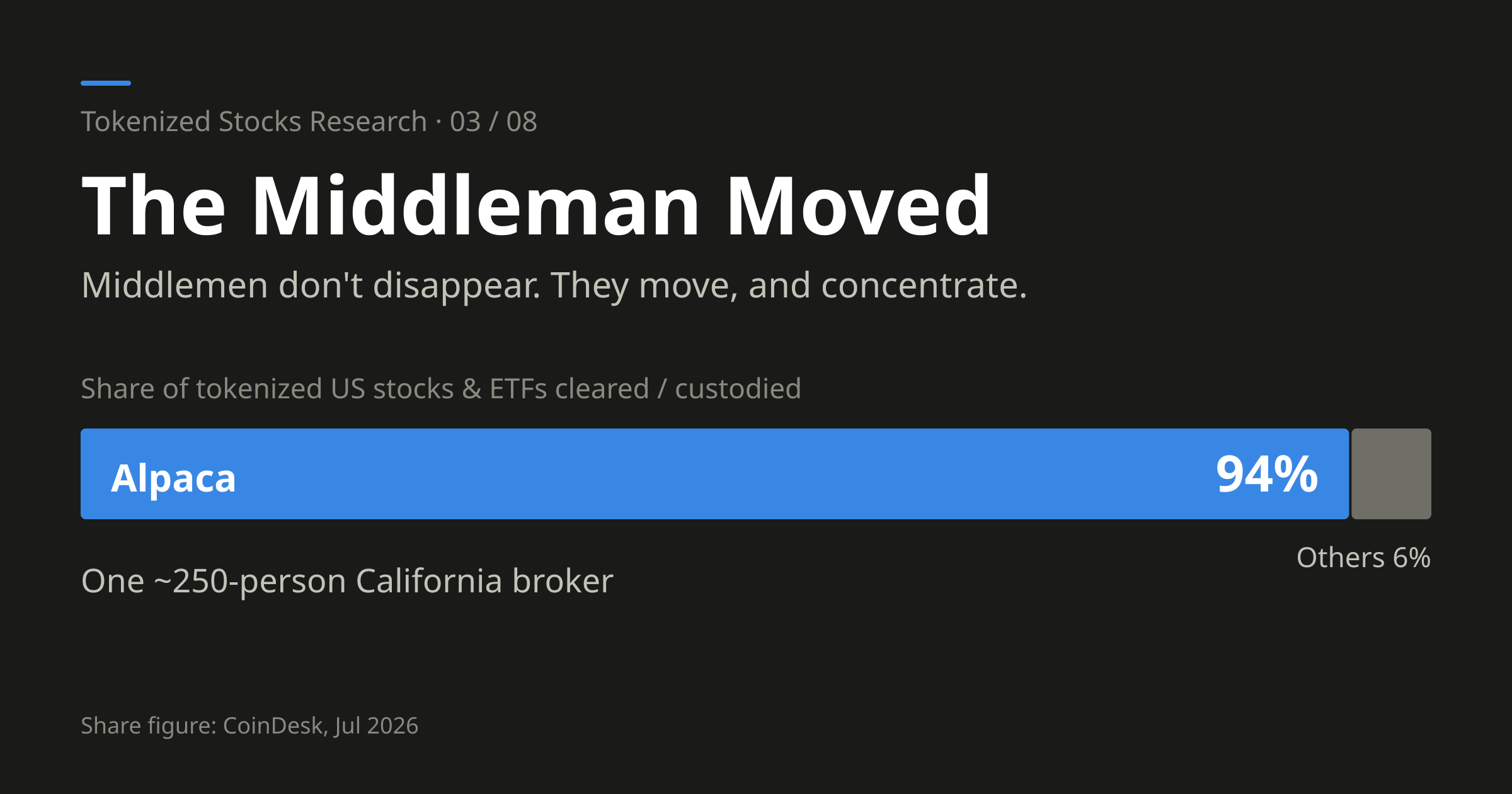
An industry built on cutting out the middleman has concentrated about 94% of tokenized US stock and ETF clearing and custody in one ~250-person California broker, Alpaca. Middlemen don't disappear. They move, and they concentrate.
If you’re assessing the risk in tokenized products, or doing due diligence for institutional clients, this is the most underrated risk in the sector.
The conclusion first.
The entire pitch for tokenized stocks is “cut out the middleman.” Eighteen months in, the industry has created a new middleman, and it’s more concentrated than any of the ones it set out to replace.
A California broker called Alpaca clears or custodies about 94% of tokenized US stocks and ETFs, and holds more than $1.5B of the underlying shares.
Its client list: Binance, Kraken, Coinbase, Ondo, Dinari.
That’s nearly the whole market.
The middleman moved
That’s my name for this.
The disintermediation story assumes middlemen get eliminated. They don’t. They move. And after they move they’re usually more concentrated, because the regulation, licensing and engineering at the new location keep competitors out.
Tokenized stocks need a very specific combination of capabilities:
- SEC-registered broker-dealer + FINRA member + self-clearing
- Holding the underlying 1:1 and processing every corporate action (dividends, splits)
- Real-time minting and redemption (Alpaca’s Instant Tokenization Network)
- Securities lending and locates
- Insured cash sweep
- Proxy voting rails (integrated with Broadridge)
Very few firms in the world can do all six. This isn’t the result of a monopoly. It’s the result of scarce capability. The outcome is the same.
How concentrated
| Metric | Value |
|---|---|
| Share of tokenized US stocks & ETFs cleared/custodied | ~94% |
| Underlying shares held | >$1.5B (only shares backing tokens in circulation; excludes ordinary brokerage assets) |
| Valuation | $1.15B (Series D, Jan 2026) |
| Employees | ~250 |
| Brokerage accounts | 10M+, in 40+ countries |
(The 94% and $1.5B figures are CoinDesk’s, from July 2026, and cover tokenized US stocks and ETFs. The $2.9B market figure below is a September whole-market number. The two can’t be divided into each other.)
A private company valued at $1.15B custodies $1.5B of underlying assets and supports a market with $2.9B in nominal size.
Its capital adequacy, business continuity plan and disaster recovery have never been publicly disclosed. Outsiders have no way to assess them.
The cap table is the most interesting part
Alpaca’s funding history:
- Apr 2025, Series C: $50M (led by Tencent, $461M post-money)
- Jan 2026, Series D: $150M (led by Drive Capital, $1.15B post-money). Investors include Citadel Securities and Kraken.
- Jul 2026, Series E: $135M (led by Peak XV), plus about $300M of debt from Payward and BMO, for a $435M total package
Put those two names next to each other:
Citadel Securities sent the SEC a 13-page letter on December 2, 2025, explicitly opposing any exemption for tokenized US stocks.
Kraken is one of the biggest players in the sector and owns xStocks.
They’re shareholders in the same company.
I don’t think this amounts to any wrongdoing. But it shows one thing: whichever way the regulatory fight over tokenization goes, Alpaca is on the winning side. That’s part of why its share is so high.
The contagion has already happened once
No hypotheticals needed. On June 12, 2026, the day SpaceX listed, Binance, Bybit, Bitget Wallet and MEXC all cancelled their tokenized IPO subscriptions and refunded users. The shared cause: their upstream supplier, xStocks, couldn’t deliver enough of the underlying shares.
That time, the link that broke was sourcing. Alpaca sits on clearing and redemption, which is much closer to where the money actually moves.
If Alpaca suffered an operational outage, a regulatory penalty, or financial distress:
- About 94% of the industry’s creation/redemption channels would fail at once
- Market makers couldn’t redeem, so the arbitrage mechanism shuts down
- With arbitrage shut, token prices decouple from the underlying
- And retail could never redeem in the first place. What they hold is, in substance, a price maintained by market makers’ goodwill.
A professional reader will push back: 94% concentration doesn’t mean custody, clearing and redemption would all be cut by the same failure at the same time. Clients may hold inventory buffers or backup brokers, and secondary market makers can hold the price up for a while. That’s fair. But no one has publicly disclosed any of those buffers. Until they can be verified from outside, 94% should be treated as a single point of failure.
Step 4 is the structural flaw in this sector: market makers can redeem, so the peg holds. Retail can’t, so the peg is borrowed.
If you’re doing due diligence
Three questions to ask any tokenized product provider:
-
Who is your clearing and custody counterparty, and is there a second one? If the answer is “Alpaca” with no backup, you’re not taking that token’s risk. You’re taking Alpaca’s.
-
Is there a publicly reviewable legal opinion on bankruptcy remoteness? “Bankruptcy-remote” appears in every piece of marketing, but no major issuer has ever published the full text of a legal opinion. Without the document, the word is just a claim.
-
Can retail redeem? If not, think of the product as “a custody-backed price tracker,” not a stock.
Three lines to close
Middlemen don’t get eliminated. They move, and they usually end up more concentrated.
The biggest single point of failure in this sector isn’t onchain. It’s a California broker you’ve probably never heard of.
When only market makers can redeem, what retail holds isn’t an asset. It’s goodwill.
Can you name the clearing counterparty behind the tokenized product you hold?
转发此帖子?
与您的关注者分享。
回复