
Contents (6)

·
More Lottery Tickets Won't Get You to 100x: The Price of Not Going to Zero (Why 100x Is Hard 3/4)
Split $10K into 100 tickets and one must go 10,000x for the whole account to go 100x. The two-stage rocket nears the math ceiling at a 94% chance of ruin; a barbell avoids ruin but cuts 100x odds to about 0.03%.
If you have done angel investing, or run a small high-risk account, you know the line: “Early-stage is about casting a wide net. One hit in a hundred is enough.”
That works in venture capital under one condition: each net is big enough. A fund that writes 30 checks of several million dollars can return the whole fund on a single 100x.
Move the same logic to $10,000 and something counterintuitive happens:
The wider you spread, the further you get from a 100x on the whole account.
Do the absolute-dollar math first
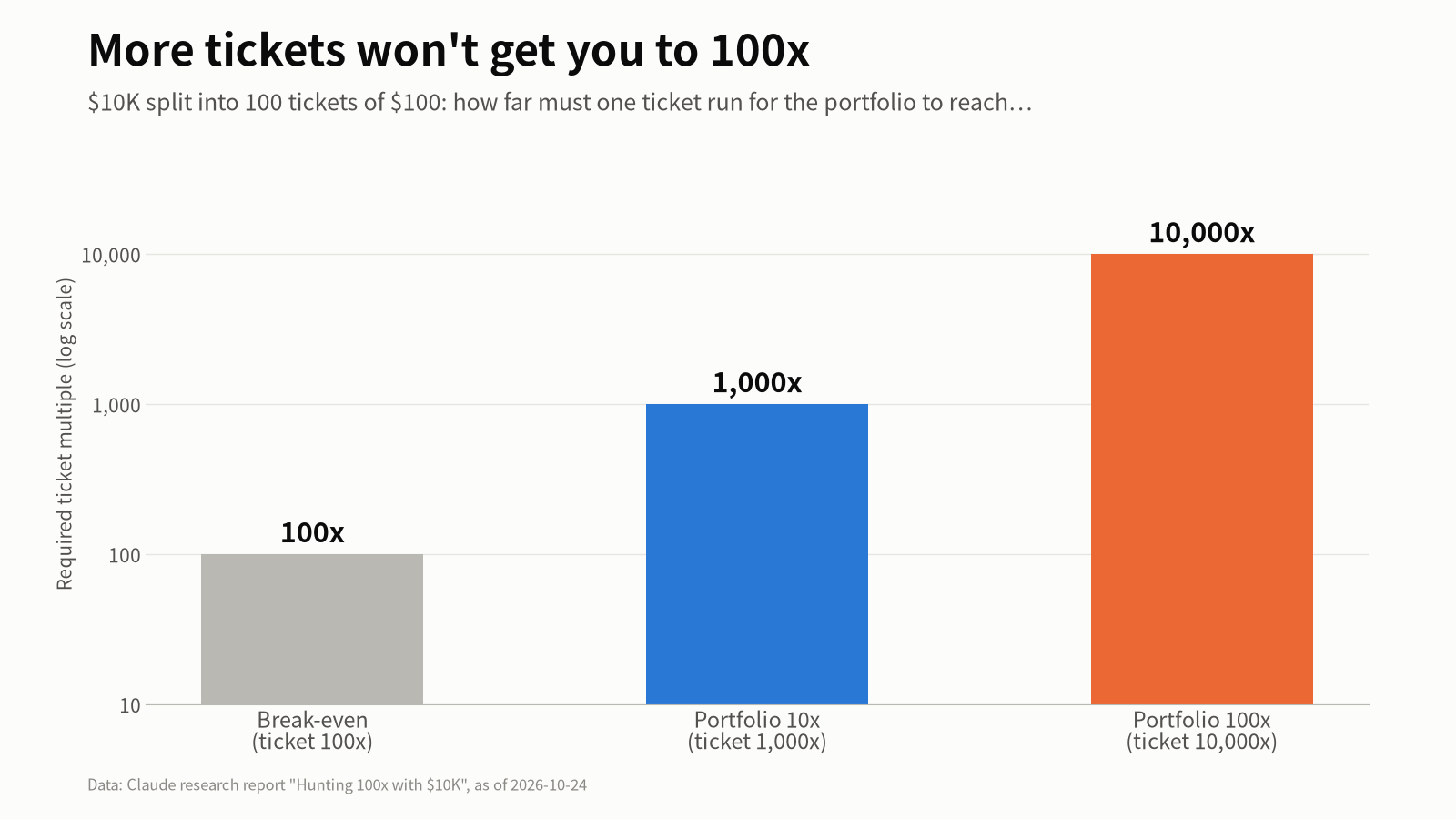
Turning $10,000 into $1,000,000 means the whole portfolio has to go 100x. Now split it into 100 tickets of $100:
- One ticket goes 100x: you get $10,000. The portfolio is back to roughly where it started.
- One ticket goes 1,000x (extremely rare): you get $100,000. The portfolio is about 10x.
- For a single $100 ticket to take the whole portfolio to 100x, it has to go 10,000x.
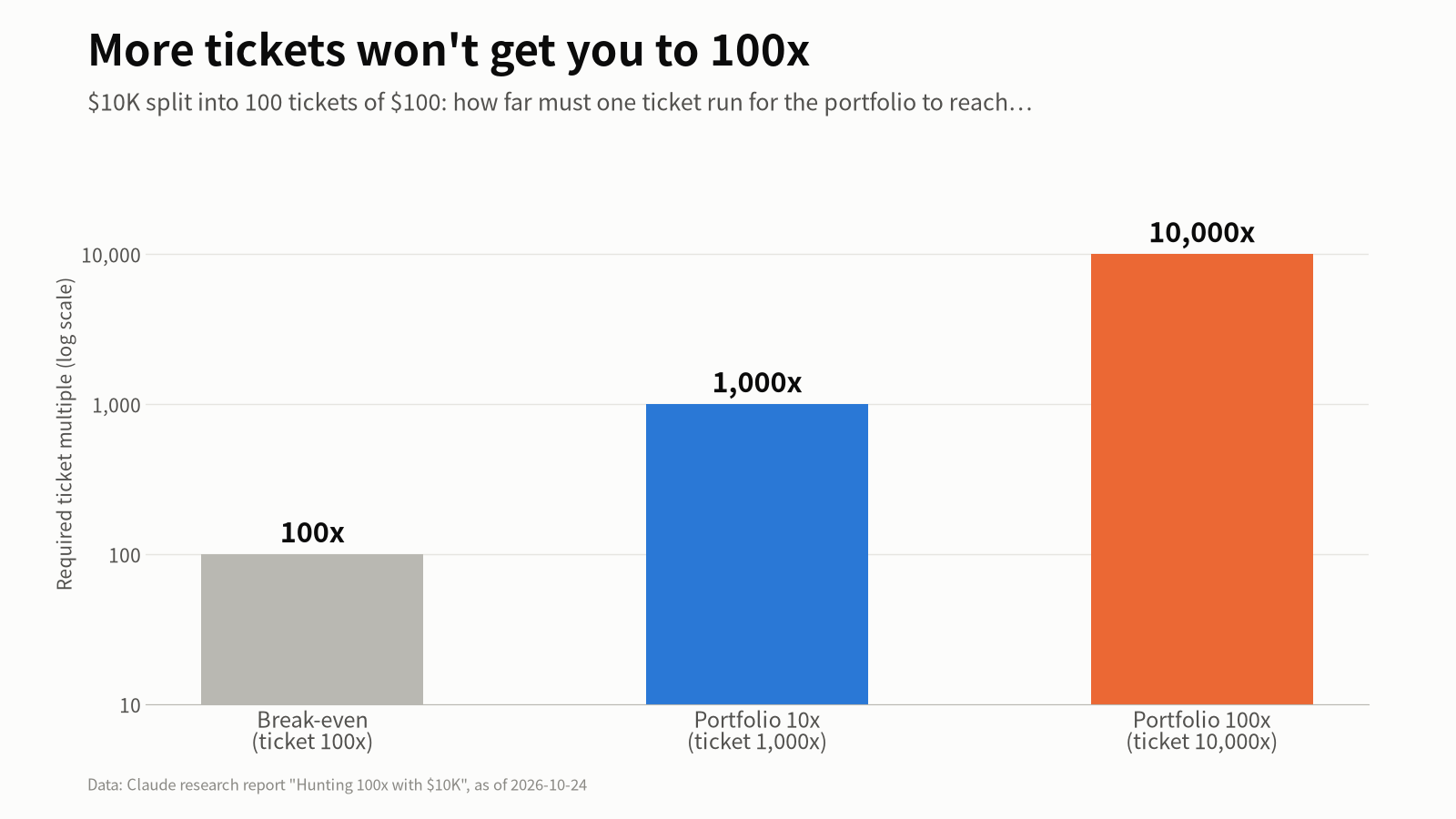
That is the problem: a 100x needs a big winner times a big position. A big winner on a small position only gets you back to break-even.
The simulation agrees. Split $10,000 into 40 tickets of $250 under fairly optimistic assumptions:
- Median outcome about $6,900
- About 12.8% odds of 2x
- About 0.22% odds of 10x
- Odds of 100x: about zero
What diversification does: it cuts the odds of being wiped out from 85% to 8%. What it does not do: make 100x possible.
The only structure that approaches the ceiling: the two-stage rocket
In the first article I showed that the mathematical ceiling on 100x odds is about 1% of the expected multiple. Only one structure gets close to it. I call it the Two-Stage Rocket:
- Stage one: put the entire account into a bet with a 10% chance of going 10x.
- If it hits, put the whole $100,000 into the next bet of the same kind.
- Both stages hit: $1,000,000.
0.1 × 0.1 = 1%. The simulation gives about 0.83%, almost on the ceiling.
The cost is just as clear: in 94% of outcomes you end up with less than $2,000.
It is not a clever strategy. It is an honest one. It puts a plain price tag on 100x: a 1% chance costs you a 90%-plus chance of ruin.
What “not going to zero” costs
Now flip the question: what if I don’t want to go to zero?
I built a barbell:
| Sleeve | Amount |
|---|---|
| Small probes in the first week of new platforms | 25 × $100 |
| Working capital for airdrops and points | $2,500 |
| Far out-of-the-money BTC calls | $1,520 |
| Early token sales | $1,500 |
| Reserve | $2,000 |
Plus one rule: the first time the account reaches $100,000, lock 30% and only send the remaining 70% into a second-stage rocket.
Results:
| Metric | Value |
|---|---|
| Expected value | ~$12,600 |
| Median | ~$8,700 |
| Odds of 10x | ~1.4% (before the second stage) |
| Odds of 100x | ~0.03% |
| Odds of ending below $5,000 | ~0 |
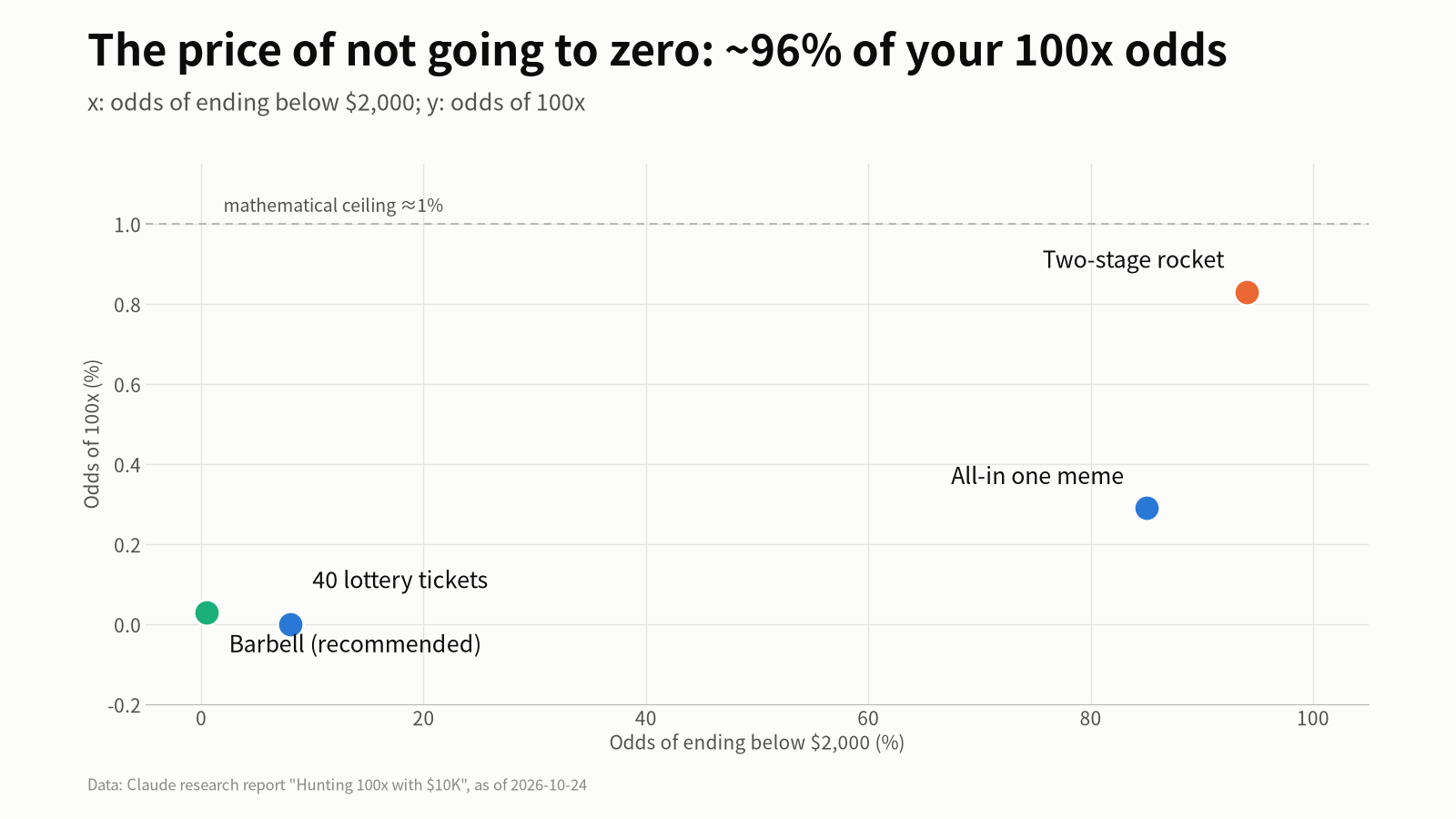
Put it next to the rocket: 100x odds drop from 0.83% to 0.03%, more than twenty times lower; odds of ruin drop from 94% to about zero.
That is the price of not going to zero: roughly 96% of your 100x odds.
The choice you actually have to make
Lay these numbers side by side and the choice is simple, just uncomfortable:
- If you want a real shot at 100x, take the rocket, write down in advance “one attempt, stop at zero,” and make sure this money truly is a lottery budget.
- If you want to stay at the table, take the barbell, accept that 100x almost never happens, and in exchange get small failures and ammunition left for the next opportunity.
The dangerous one is the third person: talking about “a 100x shot,” holding a diversified portfolio, and expecting not to lose. He gets no 100x, doubles down and chases after every small loss, and ends up walking the all-in path with a diversified book.
One rule you must write down beforehand
Whichever path you choose, one rule has to be written down before the first bet: how you concentrate after you win.
Without it, the 100x odds of any portfolio are zero. Same arithmetic: only moving a small-position winner into a large position can produce “big winner times big position.” And people make two mistakes when they are up: either they cash out everything and leave for good, or they push all the gains back in and give it all back at once.
“Lock 30%, deploy 70%” is not optimal. It is a pre-commitment that makes the decision for you at your most emotional moment.
One line
Diversification buys peace of mind; concentration buys possibility. A 100x never needs more tickets. It needs one ticket big enough, and one you can afford to lose.
What structure does your high-risk money have right now? Have you ever written down what you will do after you win?
Notes on data
- All probabilities come from Monte Carlo simulations (200,000–300,000 runs). Distribution parameters are assumptions, not measurements; the full parameters are in Appendix C of the full report. New-platform probes assume an expected multiple of about 1.19, which already credits the participant with diligence and speed and is on the optimistic side.
- The BTC option sleeve uses live Deribit quotes from 2026-10-24, priced risk-neutrally at roughly 42% implied volatility, with no pricing edge assumed.
Why 100x Is Hard, part 3 of 4.
Repost this post?
Share with your followers.
Reply