
目錄(6 節)

·
Robinhood's Customers Barely Trade Onchain. Its In-App Earn Product Became a Top Pool Anyway
Robinhood's customers are nearly invisible in onchain trading, yet Earn, embedded in the app, helped make Morpho the chain's largest protocol. The distribution switch: big-platform customers move onchain only when a product sits in the main entry point, takes one action, carries the platform's backing and offers a clear return.
If your platform has millions or tens of millions of customers and you are working out how to bring them onchain, Robinhood Earn is the best case study available today.
Start with two numbers pointing in opposite directions.
Robinhood has about 28.6 million funded customers. Yet CoinDesk Research estimated that trades identifiable as Robinhood app users made up only about 1–2% of activity on Robinhood Chain. The estimate depends on identity heuristics, the denominator and the period, but the scale is plain: Robinhood’s customers are almost invisible in onchain trading.
On the other side, by early October the chain’s largest protocol was Morpho, with about $580 million in TVL, and its largest stablecoin was USDG, at about $690 million. One important source of both was a single product: Robinhood Earn.
Public onchain data cannot tell whether depositors are existing Robinhood customers, and it cannot prove that Earn brought in every USDG on the chain. The contrast still needs explaining: customers are nearly absent from onchain trading, yet a deposit product embedded in the app became one of the chain’s biggest pools of capital.
One Button, an Entire Protocol Stack
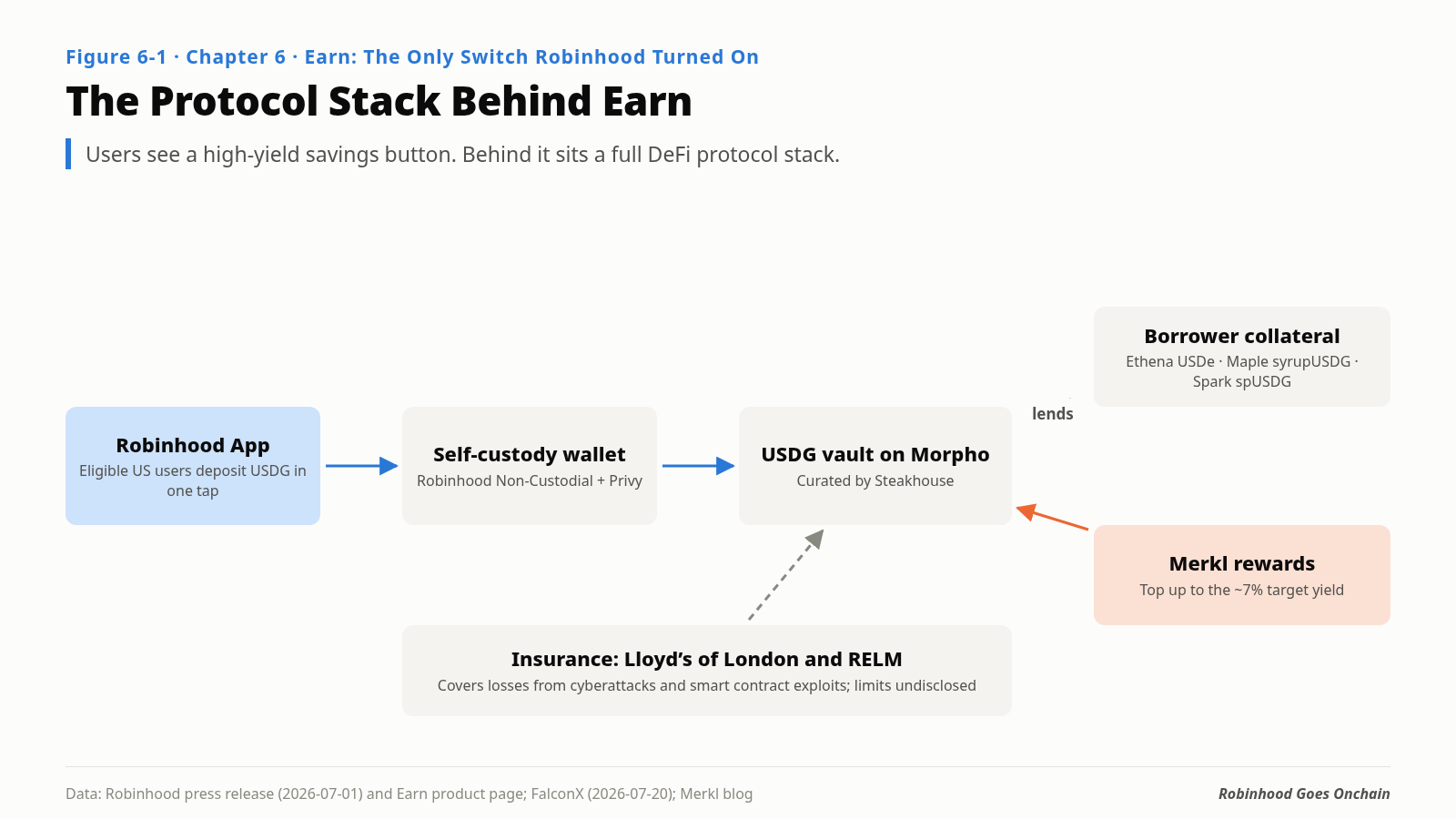
Earn launched with mainnet on July 1. It was Robinhood’s first decentralized lending product inside its main app:
- The entry point is the app. Eligible U.S. users act inside the Robinhood app, with no extra wallet to install and no DeFi to learn.
- Assets sit in a self-custody wallet. USDG goes onchain through a self-custody wallet; Robinhood does not hold the assets.
- Yield comes from onchain lending. Funds go into a Steakhouse-curated USDG vault on Morpho, where borrowers mostly post stablecoin assets from Ethena, Maple and Spark as collateral. Estimated yield: about 7%.
- It is insured. Coverage through Lloyd’s of London and RELM protects against losses from cyberattacks and smart-contract bugs; the limit was not disclosed.
The user sees a high-yield savings button. Behind it sits a whole DeFi stack.
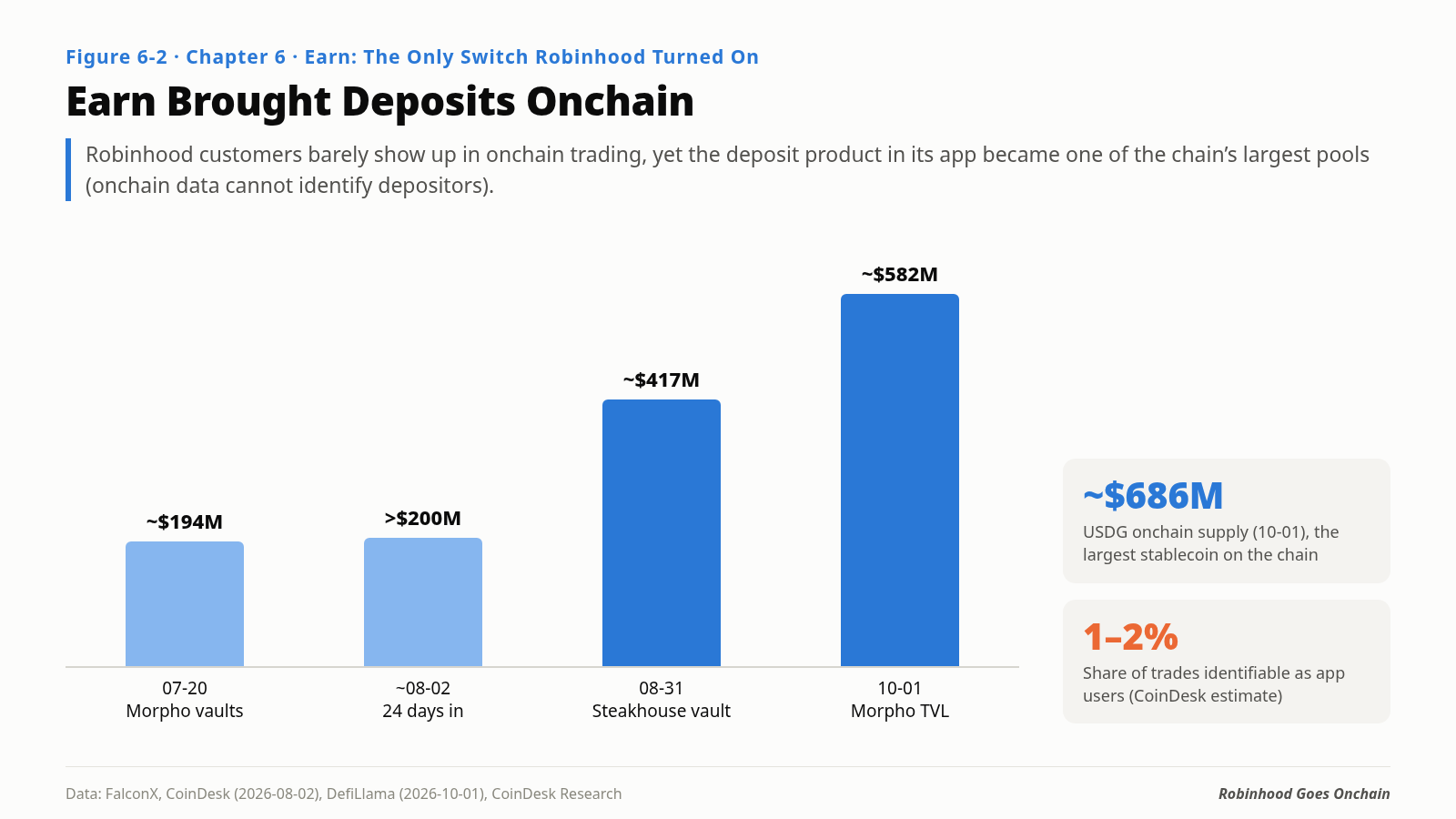
It grew fast:
| Date | Reading | Source |
|---|---|---|
| July 20 | About $194M in Morpho vault TVL on the chain | FalconX |
| Early August | More than $200M in the vault’s first 24 days | CoinDesk |
| August 31 | About $417M in the Steakhouse USDG vault, Morpho’s third largest | FalconX |
| October 1 | About $582M in Morpho TVL, the chain’s largest protocol | DefiLlama |
The 7% Includes a Subsidy
The estimated 7% does not all come from lending. FalconX’s July 20 figures put the vault’s own yield at about 1.9% and the lending market at about 2.5%; rewards paid through the incentive platform Merkl filled the gap. Analysts estimated the mechanism could sustain the 7% target up to a vault of roughly $2 billion.
That does not make the subsidy unsustainable by definition. A subsidy is a customer-acquisition cost. What Robinhood bought with it is a first group of customers willing to keep deposits onchain and comfortable with a self-custody wallet. The real test is how much capital stays after incentives taper.
The Framework: The Distribution Switch
Put Earn next to onchain trading and one framework falls out:
A large platform’s customers do not move onchain on their own. The switch turns on only when a product is embedded in the platform’s main entry point.
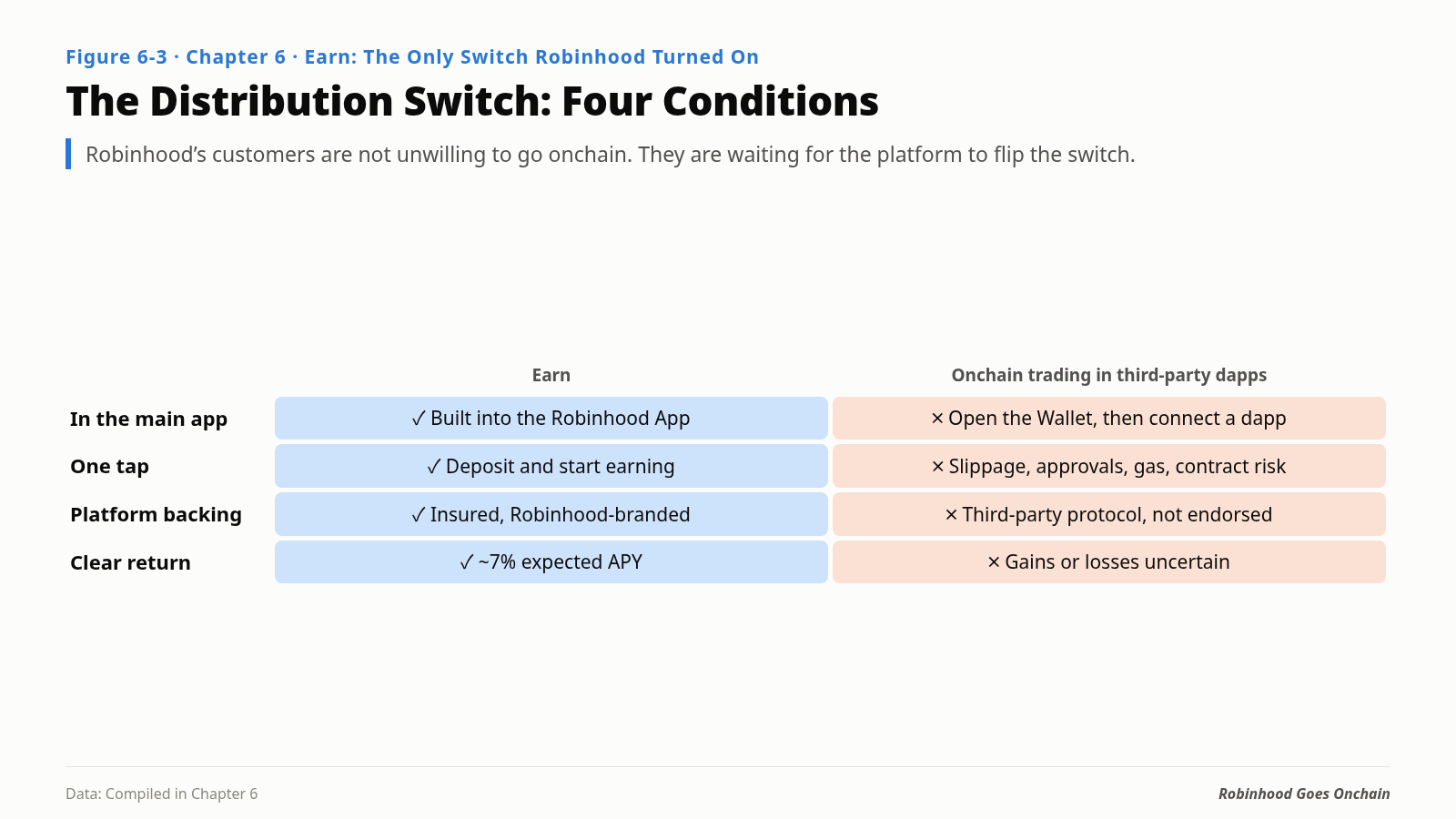
Four conditions turn the switch on. Earn meets all four; third-party dapps meet none:
| Condition | Earn | Third-party onchain dapps |
|---|---|---|
| Inside the main entry point | Directly in the Robinhood app | Open Wallet, then connect to a dapp |
| One action | Deposit and start earning | Understand slippage, approvals, gas, contract risk |
| Platform endorsement | Insurance and the Robinhood brand | Robinhood expressly does not endorse |
| A clear return | About 7% estimated yield | Uncertain profit or loss |
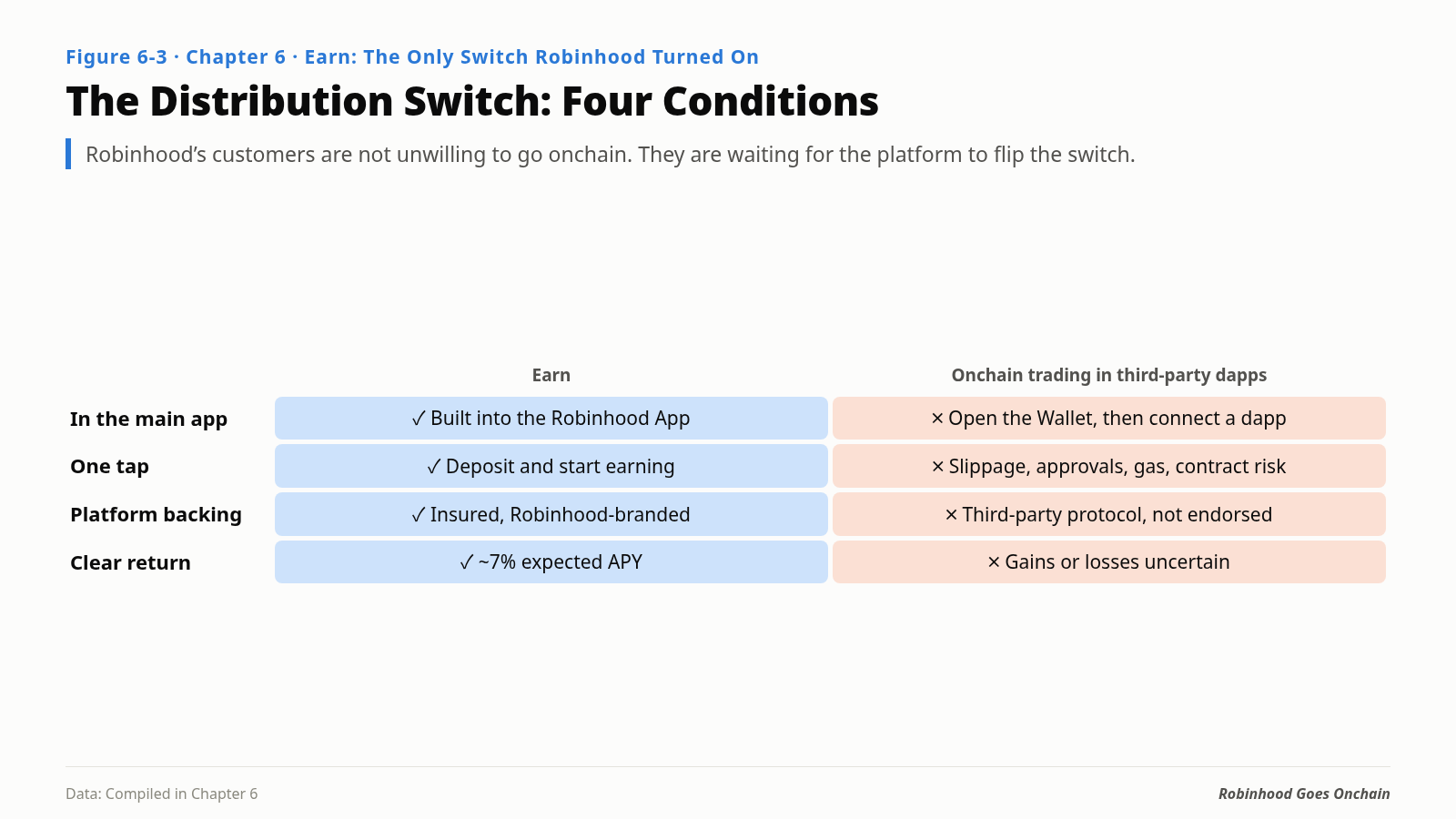
The framework lines up with the numbers. Identifiable app users supplied only about 1–2% of trading, while Earn, embedded in the app, drew substantial deposits. It does not rule out the role of subsidies, yield or other channels, but it offers a testable explanation: where the switch opened, the money came.
Where Is the Next Switch?
Use the framework to list the switches Robinhood could open next:
| Possible switch | What it requires | Signal to watch |
|---|---|---|
| Stock Tokens in the app | Rights-preserving U.S. Stock Tokens and a compliant venue | An announcement of U.S. Stock Tokens or an affiliated venue |
| Onchain perpetuals in the app | U.S. perpetuals connected to onchain settlement | Whether the U.S. perpetuals announced in September settle onchain |
| Agents trading onchain | Robinhood Agents reach onchain wallets | Whether agents can call onchain protocols |
| Social meets onchain | Robinhood Social adds onchain trading | Whether onchain assets trade directly from the feed |
| In-app Stock Tokens abroad | More countries allow distribution inside the main app | Whether apps outside the EU offer them directly |
If the switch explanation holds, each new switch brings another wave of demand from Robinhood’s own customers. That will shape the chain’s second phase more than any subsidy.
If You Build Onchain Products
- The most effective way to reach a big platform’s customers is to become the backend embedded in its app, not a frontend onchain waiting for visitors. Morpho, Steakhouse, Spark, Ethena and Maple all got their flow behind Earn this way.
- Treat one action, platform endorsement and a clear return as design requirements. Ordinary users do not go onchain for its own sake.
- Retention after incentives taper is the only real test of whether a switch opened.
The Takeaway
Robinhood’s customers are not unwilling to go onchain. They are waiting for the platform to flip the switch. Earn was the first one flipped. When the next one opens, watch whether deposits and holders stay, not the volume.
If you ran a large platform, which onchain product would you put in the main app first?
— Adapted from Robinhood Goes Onchain: A Broker’s First Year, Chapter 6, “Earn: The Only Switch Robinhood Turned On”
The full book (17 chapters, 48 figures, first 3 chapters free to read): https://pickful.ai/books/qx7q
轉發此貼文?
與您的關注者分享。
回覆