
目錄(8 節)

·
In the Crypto Winter, Coinbase Planted the Seeds That Now Hold Up Half the Company
2018–2019 Crypto winter, custody, Coinbase Ventures and USDC
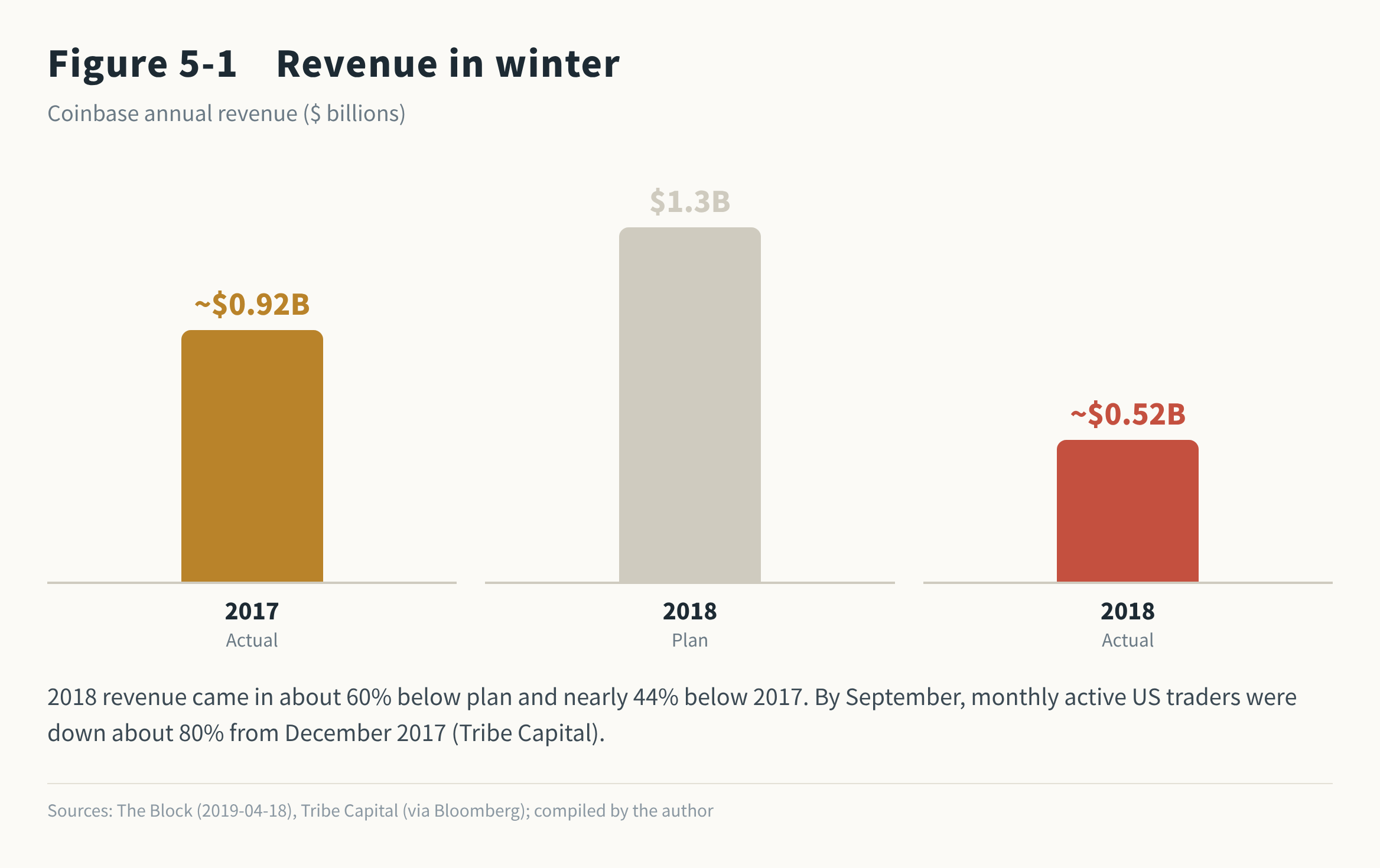
For 2018, Coinbase had planned on $1.3 billion in revenue.
The actual number was about $520 million: roughly 60 percent below plan, and down nearly 44 percent from about $923 million in 2017.
Bitcoin fell from nearly $20,000 in December 2017 to just over $3,000 by the end of 2018. According to Tribe Capital, by September 2018 the number of people buying or selling crypto on Coinbase in the US each month was down about 80 percent from December 2017.
Most of the people who had overloaded Coinbase’s servers in the winter of 2017 were gone.
This is what the crypto industry calls “winter.” For a company that earned almost all its revenue from trading fees, winter meant a harsh fact: when the market stops trading, you stop earning.
But in exactly this year, Coinbase made a string of bets that looked minor at the time: custody, venture investing, an odd paid-email company, and a dollar stablecoin called USDC.
Nobody then would have guessed that the last of these would, five years later, become one of Coinbase’s most important sources of profit.
1. The trap of a single revenue stream
By 2018, Coinbase’s problem was obvious: it depended too much on trading.
In a bull market, volume soared and the high fees paid by retail users made Coinbase a fortune. In a bear market, volume shrank and revenue went out like the tide. Worse, crypto’s cycles were extreme: up dozens of times on the way up, down 80 percent on the way down.
That revenue structure had two fatal weaknesses:
- It was unpredictable. Nobody could predict when the next bull market would come, so the company couldn’t plan long term around stable revenue.
- It was passive. How much revenue came in depended almost entirely on coin prices, which Coinbase didn’t control.
Armstrong and the leadership team knew that for Coinbase to last, it had to find revenue that didn’t depend entirely on trading volume.
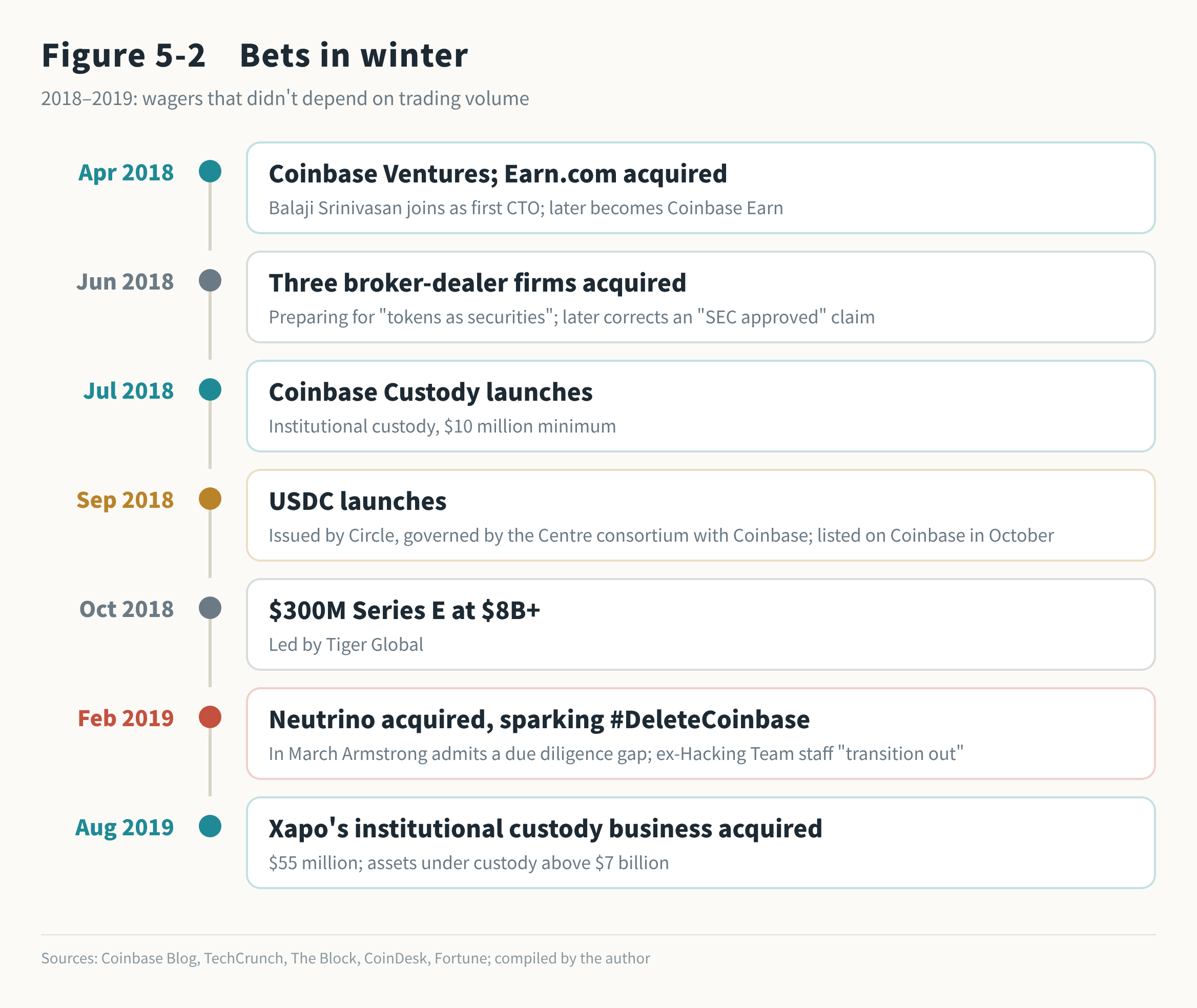
In October 2018, Coinbase raised a $300 million Series E led by Tiger Global at a valuation above $8 billion. In a year of collapsing prices and industry layoffs, that money gave Coinbase the means to place bets during the winter. According to the company at the time, the money would go toward international expansion, building the custody business, and laying the groundwork for a marketplace that could “trade thousands of assets.”
2. Four seeds
In 2018, Coinbase placed bets in several directions at once.
Seed one: custody (Coinbase Custody). On July 2, 2018, Coinbase formally launched a custody business for institutions, with a $10 million minimum deposit. By October it was a regulated “qualified custodian,” chartered in New York and bearing fiduciary duties.
The logic of custody was simple. Institutional investors that wanted to buy crypto assets could not, and would not, hold private keys themselves. They needed a custodian that met regulatory requirements, just as they need a custodian bank for stocks. In 2018 this market was small and institutional interest in crypto was limited. But Coinbase was betting that institutions would come sooner or later, and when they did, they would need a vault they could trust.
A year later Coinbase fertilized this seed with an acquisition. In August 2019, it bought the institutional custody business of the bitcoin wallet company Xapo for $55 million. According to Fortune, Coinbase beat Fidelity for the deal. Afterward, Coinbase Custody held more than $7 billion in digital assets for more than 100 clients, and called itself the largest crypto custodian in the world.
This seed would not truly bloom until 2024, when spot bitcoin ETFs were approved and Coinbase became the custodian for most of them.
Seed two: Coinbase Ventures. In April 2018, Coinbase announced its own venture arm to invest in early-stage crypto startups. The aim was not purely financial return. More important was putting Coinbase at the center of the ecosystem: knowing about the newest projects and supporting assets and applications that might one day trade on Coinbase.
Seed three: buying Earn.com. In April 2018, Coinbase acquired a company called Earn.com for a reported price of more than $100 million. Its product, “get paid in bitcoin to reply to emails,” sounded a bit strange. What Coinbase really wanted was its co-founder, Balaji Srinivasan, who became Coinbase’s first chief technology officer. Earn.com’s technology later evolved into Coinbase Earn, a “learn and earn” product: users who learned about a crypto project received a small amount of its tokens.
A try that didn’t work out: securities licenses. In June 2018, Coinbase announced it was acquiring three small companies: the broker-dealer Keystone Capital; Venovate Marketplace, which held broker-dealer and alternative trading system licenses; and Digital Wealth, a registered investment adviser. The idea was that if certain tokens were someday deemed securities, Coinbase could trade them under the oversight of the SEC and the Financial Industry Regulatory Authority (FINRA).
In July, a Coinbase spokesperson told the media that the SEC and FINRA had approved the acquisitions. A few days later the company had to correct itself: the SEC had not been involved in the approval at all; only FINRA had approved it, and the earlier statement stemmed from informal conversations with SEC staff.
The episode shows how far apart Coinbase and securities regulators still were. It wanted to prepare in advance for the day tokens were deemed securities, yet it couldn’t even get “who approved what” right. That road didn’t pan out, and the question of “which tokens are securities” was eventually put to it in 2023, in the form of an SEC lawsuit.
Seed four: USDC. This was the least noticed, and the most important.
3. USDC: a joint venture
In May 2018, the crypto finance company Circle announced it would issue a dollar stablecoin. On September 26, the stablecoin officially launched, and in October it was listed on Coinbase. It was governed by a consortium called Centre, formed jointly by Circle and Coinbase. The coin was pegged one-to-one to the US dollar: USD Coin, or USDC.
Stablecoins weren’t new. Tether (USDT) had existed since 2014 and in 2018 utterly dominated the stablecoin market. But Tether had a persistent problem: whether its reserves were really complete, and really in dollars, was never clearly answered. Its issuer was registered offshore, and audit reports were long absent.
USDC was positioned as “the compliant Tether”:
- Its issuer, Circle, was a US-regulated company;
- Every USDC was fully backed by assets such as cash and short-term US Treasuries;
- Its reserves were regularly examined by a third-party accounting firm and reported publicly.
Why would Coinbase do a stablecoin?
In the context of 2018, the main reason was the exchange’s needs. Crypto trading needs a stable unit of account. When users sold bitcoin and didn’t want to move the money back to a bank, they needed a stable “digital dollar” that could circulate on-chain to park funds. Tether played that role on many offshore exchanges, but as a US-regulated exchange, Coinbase needed a more compliant, more transparent option.
The real value of the decision, though, lay in the stablecoin business model.
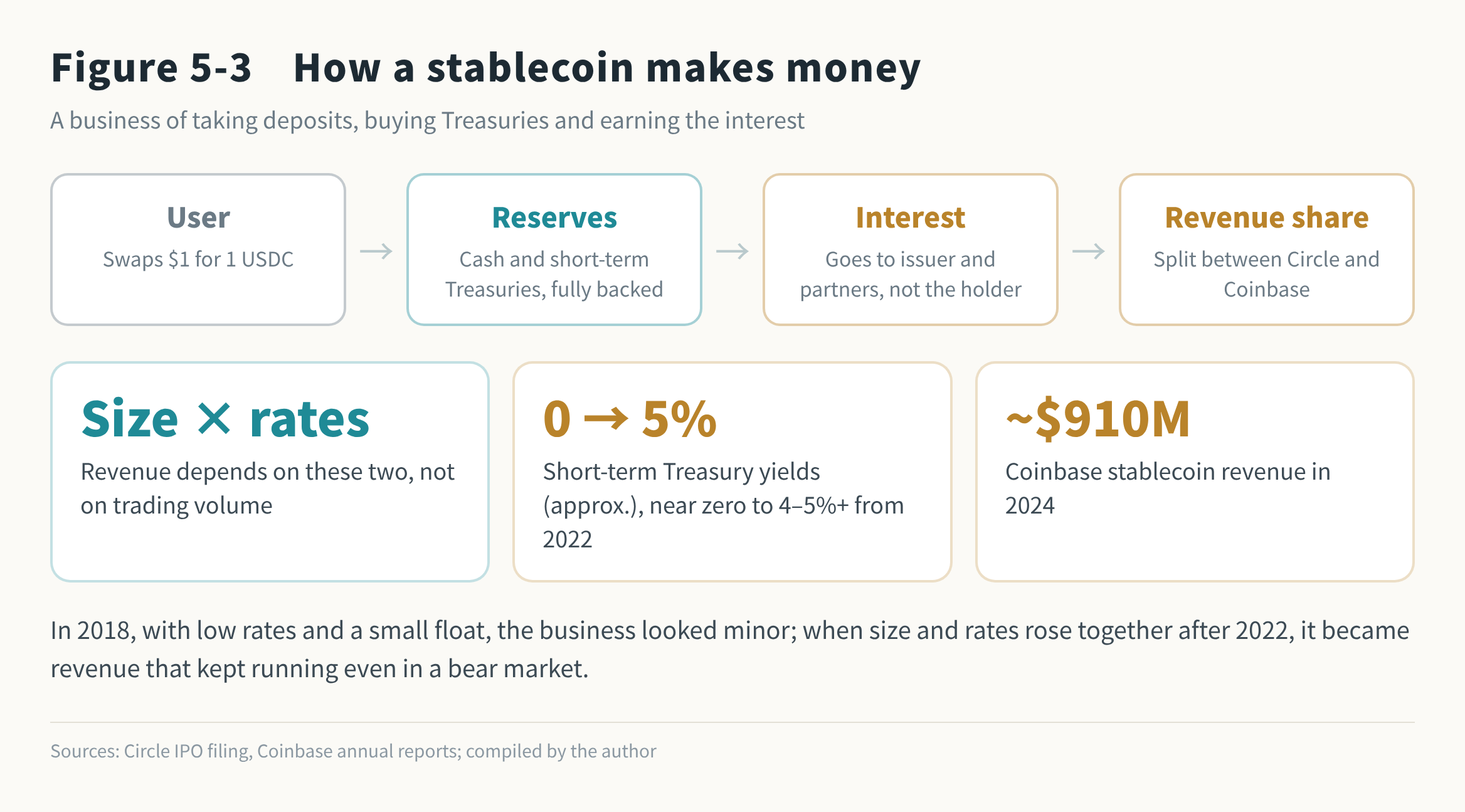
When a user swaps $1 for 1 USDC, the issuer gets $1 of reserves. Those reserves are invested in cash and short-term Treasuries, and the interest goes to the issuer and its partners. The user holding USDC earns no interest from the coin itself.
In other words, a stablecoin is a business of “taking users’ deposits, buying Treasuries and earning the interest.” In 2018, US rates were low and USDC was small, so the business looked unremarkable. But it had one key feature: its revenue had nothing to do with trading volume. It depended on two things: the total size of the stablecoin, and the level of interest rates.
That was exactly what Coinbase had been looking for: revenue that didn’t depend on trading volume.
4. An acquisition users forced it to back out of
Not every bet made in the bear market was a good one.
In February 2019, Coinbase acquired Neutrino, an Italian blockchain analytics company. According to documents seen by The Block, the price was about $13.5 million. Blockchain analytics traces where money on-chain comes from and goes, exactly the capability a regulated exchange needs for anti-money-laundering work and cooperation with law enforcement.
The problem was the people. Neutrino’s three core members had previously worked at an Italian company called Hacking Team, which sold surveillance software to a number of governments, some with serious human rights records, and which had been used to monitor journalists and dissidents.
When the news spread, the community erupted. A “#DeleteCoinbase” hashtag appeared on Twitter, and some users posted screenshots of closing their accounts. Coinbase’s first response was that it knew about the team’s past but felt the significance of the business opportunity outweighed that consideration. That made things worse.
In March 2019, Armstrong admitted on the company blog that there had been “a gap” in its due diligence process, and that the three former Hacking Team members would “transition out.” As to whether “transition out” meant being fired, and when they would leave, the company said nothing further.
Seen against the book’s main thread, the affair has a deeper meaning. From Chapter 1 on, Coinbase had walked a tightrope between “cooperating with regulators” and “protecting users.” On-chain analytics is a tool for cooperating with regulators, but when the tool is built by people who once helped governments monitor journalists, what users feel is no longer “compliance” but “being watched.” Standing on the side of the rules doesn’t mean you can ignore how users see the side you’re standing on.
5. When the seed sprouted
USDC’s growth was not smooth.
From 2018 to 2020 it lagged far behind Tether. Only when the DeFi (decentralized finance) boom took off in 2020, and on-chain lending and trading needed large amounts of reliable stablecoins, did USDC start growing fast. In 2022, the Federal Reserve began raising rates sharply to fight inflation, and short-term Treasury yields rose from near zero to 4 to 5 percent and above.
With both size and rates rising, the interest income behind USDC soared.
In August 2023, Coinbase and Circle restructured their partnership: the Centre consortium was dissolved, Coinbase received a small equity stake in Circle, and the two firms set new terms for sharing USDC reserve income. According to documents Circle later filed when it went public, Coinbase receives half of the residual USDC reserve income after certain costs, and the share is tied directly to how much USDC is held on Coinbase’s platform.
In 2024, Circle’s total revenue and reserve income came to about $1.7 billion, while Coinbase’s stablecoin revenue was about $910 million, up more than 30 percent year over year. That year, stablecoin revenue became one of the largest items in Coinbase’s subscription and services revenue.
An obscure joint venture from the 2018 bear market had, five years later, become a “money printer.”
More importantly, this money printer kept running in bear markets. When volume shrank and trading revenue fell, stablecoin revenue didn’t disappear as long as USDC’s size and interest rates held up. It gave Coinbase, for the first time, a genuinely “defensive” source of revenue.
6. Looking back: judgment or luck?
The judgment: Building non-trading businesses in the bear market was the core judgment of this chapter. Custody, venture investing, stablecoins: none showed obvious returns at the time, but they all pointed the same way, turning Coinbase from “an exchange” into “a crypto financial infrastructure company.”
The luck: USDC’s later success involved a good deal of luck. Neither the 2020 DeFi boom nor the high rates after 2022 could have been foreseen in 2018. Had US rates stayed near zero, stablecoins would never have become such a profitable business.
The mistake: The Neutrino acquisition was the most obvious misstep of these two years. What it exposed was not a problem of technical judgment but of value judgment: a company that lives on trust evaluated an acquisition on business math alone and never ran the trust math. To its credit, the correction came reasonably fast, with a public admission and adjustment within about a month.
What’s worth learning: In a highly cyclical industry, the best time to make bets is often the bear market. In a bull market, everyone is busy making trading money and nobody has the bandwidth for “slow businesses.” In a bear market, when the trading money is gone, a company is forced to think: besides trading, what else can we live on?
What if Coinbase hadn’t done USDC in 2018?
It would probably have faced a much harder 2022 bear market: trading revenue collapsing with no other revenue to offset it. It would likely have needed bigger layoffs, and its stock would have fallen further. More importantly, it would have lost one of the best positions in the later “stablecoin era” (in 2025 the US passed the GENIUS Act, bringing stablecoins formally into a regulatory framework).
The lesson of this chapter: the most important seeds are planted in the coldest season; and whether a seed is worth planting depends on whether its revenue complements your existing business.
Decision Card
- Situation: The 2018 crypto winter: revenue 60 percent below plan, active users down about 80 percent, revenue almost entirely from trading
- Options: A: cut spending and wait for the next bull market B: build new businesses unrelated to trading volume during the winter
- Choice: B: custody, Coinbase Ventures, the Earn.com acquisition, and launching USDC with Circle
- Outcome: Short term: heavy investment, unclear returns. Long term: custody underpinned the ETF era, and USDC became one of its most important non-trading revenue sources
- Lesson: The most important seeds are planted in the coldest season; new businesses should complement the existing one, not rise and fall with it
Key line: In a bull market everyone makes money from trading. Only in a bear market do you ask what else you can live on.
Sources
- 2018 revenue versus plan: The Block, 2019-04-18
- Active users down about 80 percent: Bloomberg Quint
- Series E and custody: The Block, 2018-10-30; Fortune, 2018-10-30; The Daily Hodl
- The Earn.com acquisition: FinTech Global
- USDC, the Centre consortium and revenue sharing: Decrypt: Coinbase Takes 50% Share; Coin Metrics; Decrypt: SEC probes revenue formula
- 2024 stablecoin revenue: Coinbase Q4 2024 shareholder letter; Decrypt
- Custody launch: Bitcoin Magazine; Armstrong’s blog
- Earn.com price: PYMNTS
- Acquisition of Xapo’s institutional custody business: The Block; Crowdfund Insider, 2019-08; beating Fidelity: Yahoo Finance (citing Fortune)
- The three broker-dealer acquisitions and the “SEC approval” correction: Cointelegraph; Bloomberg / BloombergQuint; Yahoo Finance
- USDC announcement and launch dates: Wikipedia: USDC; Fortune, 2023-08-21
- The Neutrino acquisition and #DeleteCoinbase: CoinDesk; Vice; price: The Block; Decrypt
From my new book Coinbase: On the Side of the Rules: https://pickful.ai/books/tqn4
轉發此貼文?
與您的關注者分享。
回覆