
目录(9 节)

·
FTX Said Its Stock Tokens Were Backed by Shares. In Bankruptcy, Holders Got Dollar Claims
The questions this piece answers: who holds the underlying shares? Where do users rank if the issuer goes bankrupt? Who on-chain can pause, freeze, take away or upgrade the token? Which proofs should you ask to see?
The questions this piece answers: who holds the underlying shares? Where do users rank if the issuer goes bankrupt? Who on-chain can pause, freeze, take away or upgrade the token? Which proofs should you ask to see?
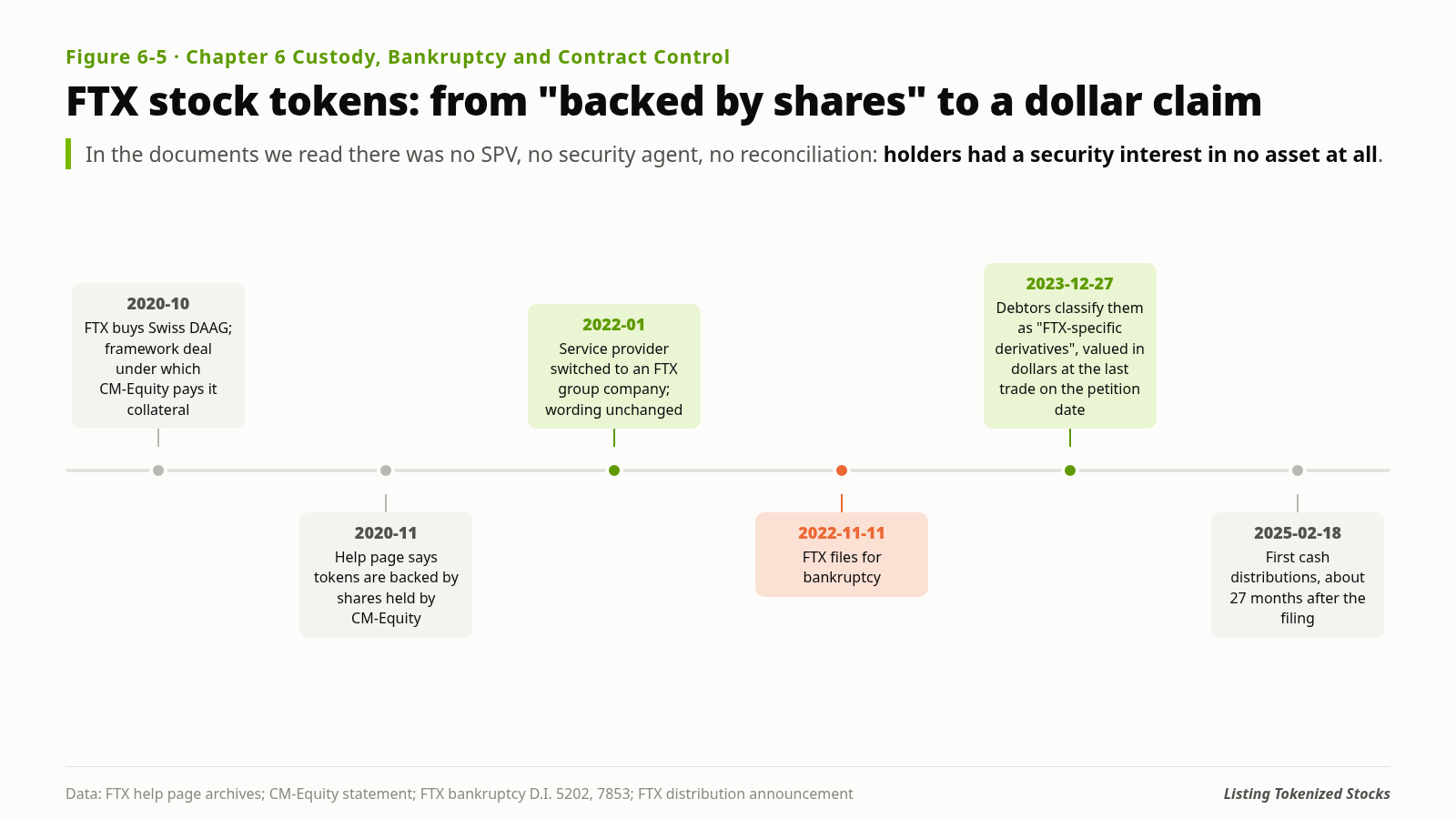
In November 2020, FTX’s help page said its spot stock tokens were “backed by Tesla shares held in custody by CM-Equity” and that “the corresponding shares can be redeemed from CM-Equity if needed.” Two years later FTX filed for bankruptcy. On December 27, 2023, the FTX debtors filed a valuation motion with the US Bankruptcy Court that characterized the same tokens this way: stock tokens, like leveraged tokens and futures, were “FTX-specific derivatives,” to be converted into dollar claims at the last-trade price on FTX’s own order book on the petition date. Under that valuation, holders received a customer claim denominated in dollars, not shares. The first cash distributions began on February 18, 2025, about 27 months after FTX filed.
“Backed by shares” did not get FTX stock-token holders any shares in the bankruptcy. Today’s tokenized stocks have, on paper, filled in the walls FTX lacked, and they have added a layer FTX never had: the on-chain contract. The contract states who can pause all transfers, who can blocklist an address, who can move or burn tokens without the holder’s signature, and who can swap the contract for a different body of code. These powers usually sit idle. When they are used, they land directly on your hot wallets, your deposit and withdrawal rails, and your lending markets.
So this piece asks you to make two decisions: before listing, which documents do you need to see before you believe that the shares behind a tokenized stock really belong to holders if the issuer fails; and which on-chain powers held by the issuer can you accept, and what must the issuer tell you in advance.
The piece on issuance structures sorted products into a four-rung “ownership ladder.” This piece is only about what happens after something goes wrong. The leading roles go to the tracker certificates on the third rung and the beneficial-interest certificates on the second, because that is where most on-chain liquidity sits and those are the two structures with the most carefully designed bankruptcy remoteness.
Three kinds of failure: first establish who failed
“The issuer has a problem” covers at least three situations, and each has a different answer:
- The issuer itself defaults or goes bankrupt. This is the case prospectuses spend the most pages on: the security agent takes over, sells the pledged assets and pays out in order.
- The custodian fails. The shares sit in an account at a broker or bank. If the custodian goes bankrupt, can those shares be separated from the custodian’s own assets?
- The group behind the issuer, a securities-lending counterparty or a distribution platform fails. The issuer may be an independent SPV, but its shares may have been borrowed from a group company, and its creations and redemptions may only be possible through the group’s exchange. This is mainly where the FTX lesson lies.
There are two more cases that do not involve bankruptcy but happen more often: the issuer (or a technology provider acting for it) using its on-chain powers, and a cross-chain bridge failing. Both are covered in the second half of this piece. Your own platform can also be the party that fails; the monitoring metrics in the piece on the approval sheet deal with that.
Four walls: entity, assets, security, proof
A fully designed structure builds four walls between holders and the three risks above.
Wall one: entity separation. The issuer is an SPV that does only this one thing, takes on no outside debt, has “limited recourse” obligations (holders can only be paid out of the pledged assets, and any shortfall is extinguished), and holders agree not to petition for its bankruptcy. Every issuer here has this wall. The RHJ prospectus states that the products are “secured, limited-recourse obligations,” that “no other assets of the issuer or of any other series will be available to cover a shortfall,” and it includes a non-petition clause. Ondo and bStocks both provide that no one may petition for the issuer’s bankruptcy until one year and one day after the last token is redeemed. Ondo says its SPV has independent directors; half of bStocks’ board is independent.
This wall has a corollary: the parent does not stand behind it. The Backed prospectus states that Payward (Kraken’s parent) does not guarantee the issuer’s obligations. A large exchange buying an issuer does not mean the exchange vouches for the tokens.
Wall two: asset segregation. The shares should sit in custody accounts in the issuer’s name, separated by product, not mixed with the custodian’s own assets and not shared across products. Backed says its pledged assets are held “asset by asset” in dedicated sub-accounts and that “collateral of different products is not commingled.” RHJ’s custody accounts are segregated by series, but its prospectus concedes that some cash accounts “may not be segregated by series.”
The weak point of this wall is securities lending, and the three issuers write about it in completely different ways:
- Ondo’s prospectus term sheet says “the issuer may not lend the collateral.”
- Backed and RHJ both allow lending to be switched on in the final terms: shares are lent to a “principal borrower” in exchange for cash collateral. The Backed prospectus states that once lending is on, the product “will to a greater extent no longer be backed or secured by the underlying shares,” and the cash collateral received goes into a shared account, allocated “pro rata and pari passu” across all products that permit lending.
- For bStocks, taking the BRKB prospectus as an example, the shares behind the first batch of certificates were themselves borrowed by Binance’s clearing company from Alpaca. The prospectus lists this as a risk factor: during this period, “1:1 backing relies on a securities-lending arrangement rather than unencumbered underlying assets in the issuer’s own custody account”; if Binance’s clearing company cannot return the shares on demand and they are recalled, there may be “a temporary shortfall in 1:1 backing,” and redemptions may be suspended.
So “there are shares” and “there are shares that belong to holders” are two different things. For every token you plan to list, check whether the lending switch in its final terms is on or off.
Wall three: security and ranking. A third-rung tracker certificate is a debt instrument. Whether holders get priority over the pledged assets depends on an independent security agent and on an account control agreement signed by the issuer, the custodian and the security agent.
- Backed: The security agent is Security Agent Services AG (Zug). The tripartite account control agreement with the US custodian Alpaca was signed in June 2025 and creates a perfected security interest under New York’s Uniform Commercial Code. Enforcement events include issuer insolvency, a regulator ordering it to cease business, under-collateralization not cured for 5 consecutive business days, and a payment or delivery default not cured for 30 business days. Once an event occurs, every investor is deemed to have automatically instructed the security agent to enforce; no vote is needed.
- RHJ: Both the security agent and the verification agent are the same Security Agent Services AG used by Backed, and the two issuers share the same registered address in Jersey. Only the security agent can enforce the security.
- Ondo: The security agent and verification agent is Ankura Trust Company, which holds a “first-priority security interest” in the underlying shares. Ondo’s letter to the SEC states that total collateral value “must be at least 100.5% of the value of outstanding products”; the prospectus provides that an asset-to-liability ratio below 100.5% at close for 30 consecutive days is an event of default. For holders to demand early redemption of all products themselves, registered holders of at least 60% of the redemption amount must consent.
- bStocks: There is no independent security agent. Instead of the “debt plus pledge” route, the issuer holds the shares for holders as a trustee; the prospectus says recourse is limited to “the underlying assets held on trust by the issuer in a segregated custody account.” Nor does it have a numbered payment waterfall like Backed’s or RHJ’s.
The security wall comes down, in the end, to a payment waterfall. The RHJ prospectus puts it most plainly: after enforcement, taxes are paid first, then the security agent (together with related fees of the administrator and authorized participants), then the payment account bank, then the custodian and broker, and only then the investors, “so investors rank fifth.” Backed and Ondo use the same structure: the fees of the security agent and service providers come first, and holders share what remains pro rata.
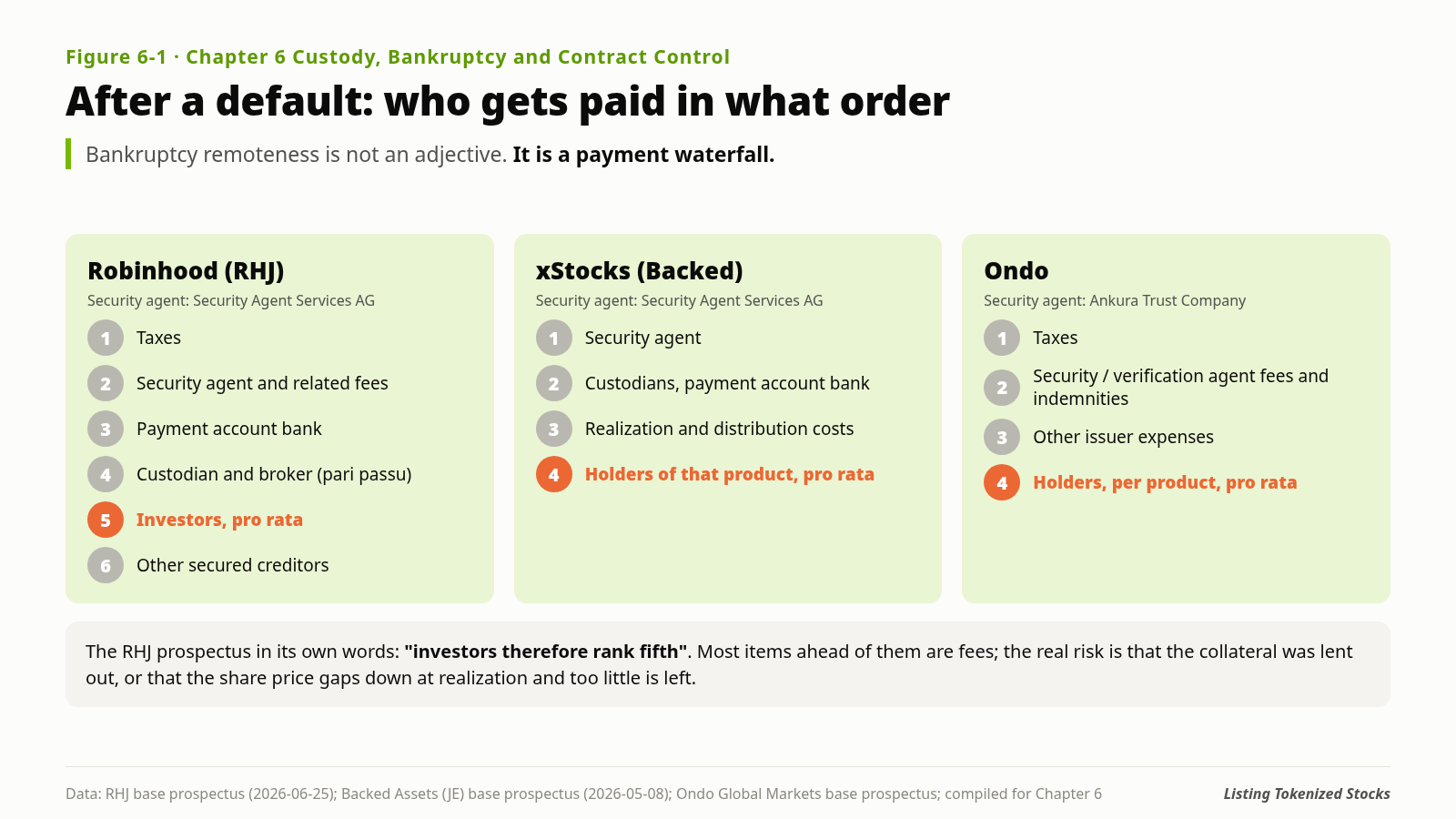
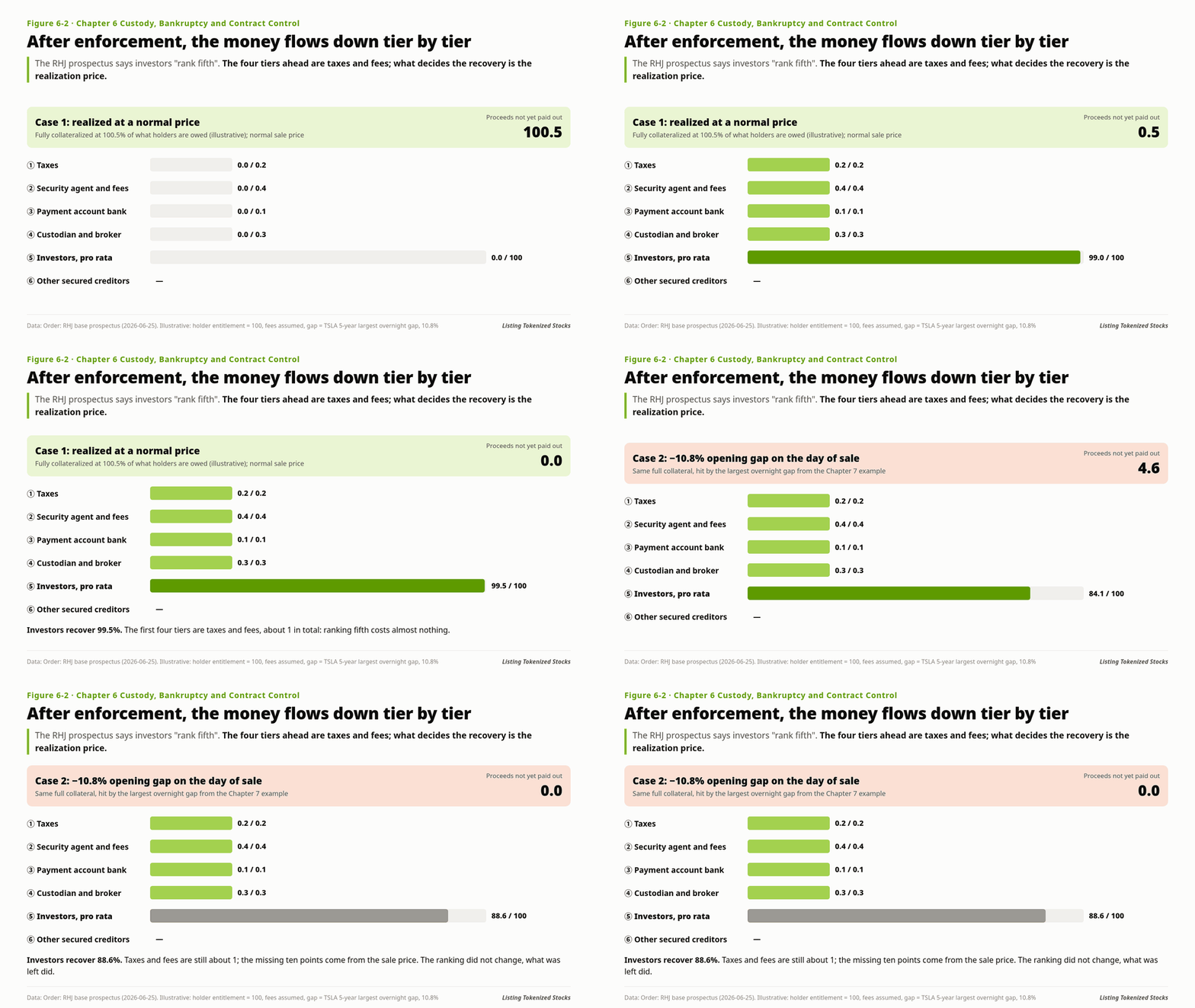
Ranking fifth is not necessarily bad. The items ahead are usually fees, far smaller than the pledged assets themselves. The real risk is how much is left between the value of the pledged assets and those fees, and that depends on two things: whether the pledged assets have been lent out (wall two), and the share price at the time of the sale. The opening gaps in the piece on price sources and the loan-to-value ratios and liquidation thresholds in the piece on collateral apply here too.
Wall four: proof. The first three walls are on paper; the fourth tells you whether the paper is true. The issuers differ widely:
- Ondo: According to Ondo’s documentation, Ankura “reviews and verifies daily” the existence and quantity of the underlying shares; daily verifications have been published online since October 1, 2025, and a monthly reconciliation report is published by the 20th of the following month. The prospectus also says the verification agent reports “daily and monthly.” This is the most specific of the group.
- xStocks: There is a public proof-of-reserves dashboard that lists supply and shares in custody for each token. On November 16, NVDAx had about 630,000 tokens outstanding against about 639,000 NVDA shares in custody, a ratio of 101.38%. The dashboard says it provides “read-only access” to the collateral accounts (the pledged assets), but does not say which third party verifies it or how often it updates. When Backed earlier connected its bTokens to Chainlink Proof of Reserve, it wrote that the accounting firm The Network Firm ran the attestation API, updated every 10 minutes, with Chainlink posting on-chain once a day (sooner if reserves moved more than 10%). Whether that arrangement applies unchanged to today’s xStocks is not stated in the documentation; confirm it with the issuer.
- RHJ: It has a verification agent whose duties include confirming that the pledged assets are “segregated” and publishing reports on the issuer’s website, but the frequency the prospectus commits to is only once a year: within three months after the end of the financial year, on the issuer’s website. The product only launched in July 2026, and we have not yet found any published report on the issuer’s documentation site.
- bStocks: Its website says it publishes a “proof of collateral” daily with “independent verification,” but does not name the verifier. In the prospectus, the reconciliation is done by Binance NCCL, Binance’s clearing company within the Binance group, which reconciles on-chain holdings against its own general ledger intraday; the prospectus calls this an “independent check.” The issuer’s statutory auditor, Crowe Mak, audits the financial statements, and the prospectus does not link that to the proof of collateral. The prospectus states that the issuer publishes the number of certificates outstanding weekly through ADGM’s disclosure platform.
- Dinari: Says its reserves are audited by an unnamed “Big Four” accounting firm, with no stated frequency; we found no published audit report.
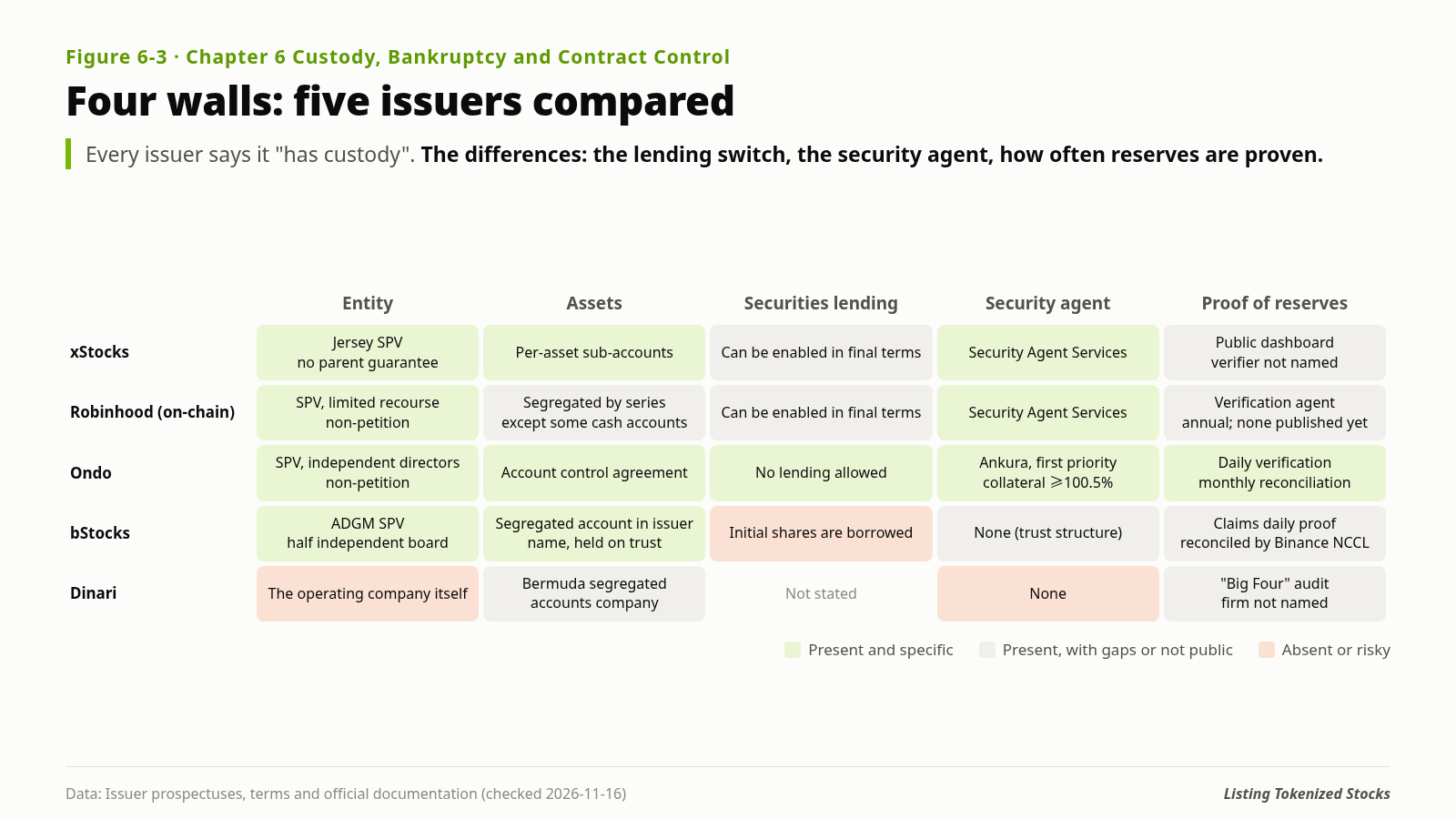
When you ask about proof, ask three things: who verifies it, how often, and whether you can check the numbers yourself. You can read on-chain token supply yourself, for example, but shares in custody can only come from a third party. A “proof of reserves” issued only by the issuer, with no frequency and no signing firm, is little more than a marketing page. Tokens deployed on several chains need one more step: add up supply across every chain before comparing it with shares in custody. The section “Cross-chain and bridges” below explains why this step cannot be skipped.
Six issuers, one custodian
Put the custodians side by side and one easily missed fact stands out: Alpaca Securities appears in nearly every structure. Alpaca is RHJ’s custodian and broker; Ondo’s underlying shares are held via Alpaca at DTC, the US securities depository; the shares behind the bStocks and Coinbase certificates sit in segregated accounts Alpaca opened in each issuer’s name; Dinari’s custody is at Alpaca; Backed has four custodians and Alpaca is one of them, the other three being InCore Bank and Maerki Baumann in Switzerland and GTN Europe in London.
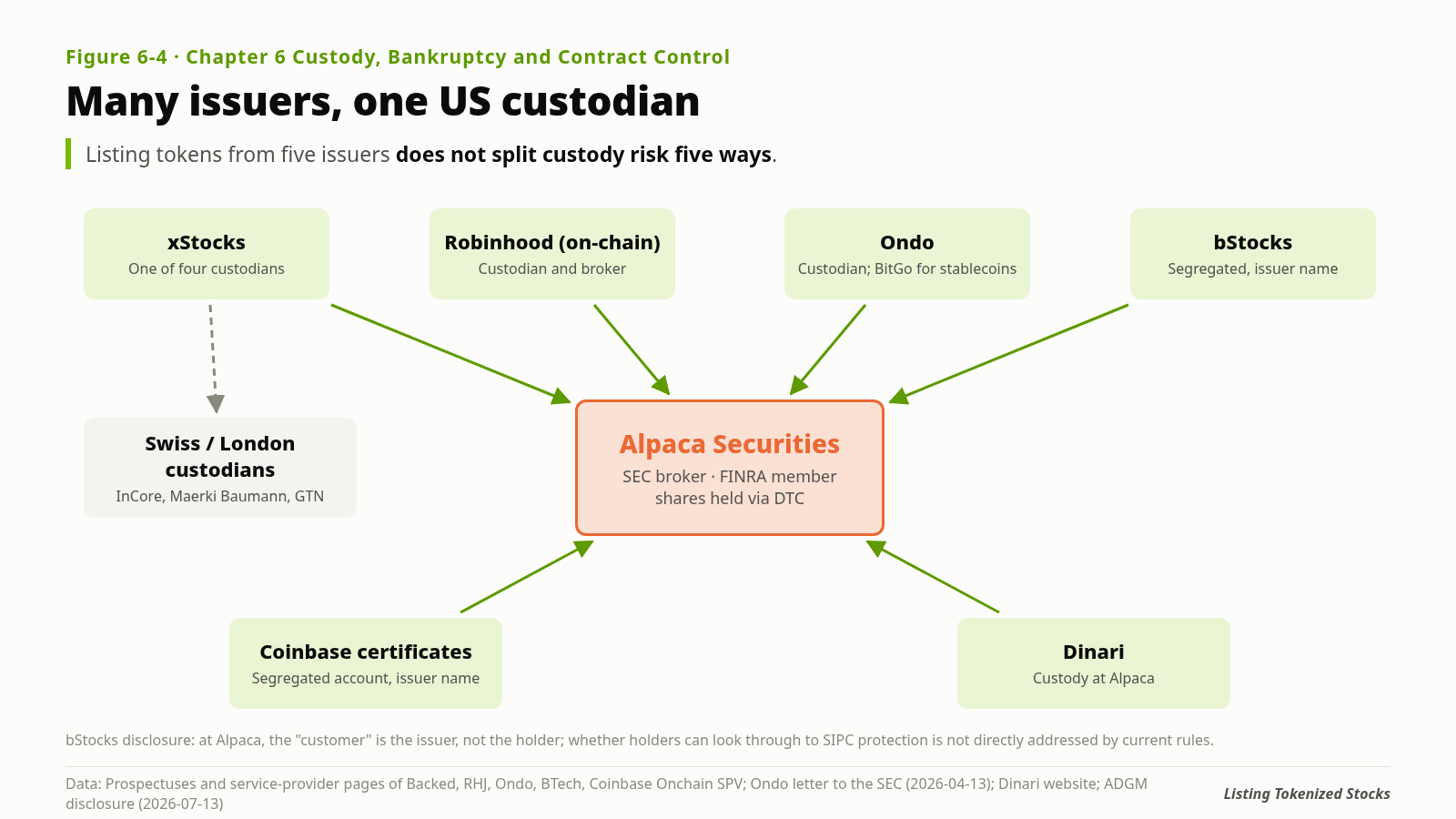
This does not mean Alpaca has a problem. It is an SEC-registered broker and FINRA member, and its customer assets are protected by US broker-dealer customer-protection rules. The issue is that custody segregation at all of these issuers ultimately depends on whether the same set of rules can be enforced at the same institution. Listing tokens from five issuers does not split custody risk into five.
There is also something untested. bStocks published a separate disclosure on how US bankruptcy and customer-protection rules apply: at Alpaca, the “customer” is the issuer, not the certificate holder, and holders have no direct contractual relationship with Alpaca; whether holders can look through to protection from the Securities Investor Protection Corporation (SIPC) is, under current rules, “not directly addressed for this new custody structure.” In the material we have read, no issuer has given a definitive answer for the case where the custodian goes bankrupt.
Post-mortem: which walls the FTX stock tokens lacked
Back to FTX. Check it against the four walls: in the documents we read, none of them can be found.
Entity: no SPV. FTX’s help page stated in 2020 that brokerage services were provided by CM-Equity, a licensed German broker, and “not FTX Trading LTD”; the tokens existed only on FTX’s internal ledger and could not be withdrawn on-chain. From January 2022 the same page named FTX’s own group company Canco GmbH (FTX Switzerland) as the provider, with the same wording: “backed by Tesla shares held in custody by FTX Switzerland.” CM-Equity later stated that its cooperation with FTX ended on December 31, 2021, and that it was “not the counterparty to these bilateral contracts.” The users’ counterparty changed; the wording on the page did not.
Assets: collateral flowed into the group. According to the FTX debtors’ filings, CM-Equity and Digital Assets AG, a Swiss company FTX acquired (later renamed FTX Europe), signed a framework agreement for collateral contracts on October 27, 2020, under which CM-Equity periodically paid FTX Europe to “provide collateral for CM-Equity clients’ stock-token trading.” The collateral was not locked up on the holders’ side; it flowed into an affiliate of the exchange.
Security: no security agent. In the documents we read there was no issuing SPV, no security trustee or agent, and no pledge for token holders. Holders had no security interest in any specific asset, and that is where everything that followed began. (A side branch of the same story: the collateral dispute over Binance’s 2021 stock tokens with CM-Equity was settled in 2024 with a general unsecured claim; see this piece’s sources.)
Proof: none. We found no reconciliation in the bankruptcy filings of how many shares were actually held. What we could find was the flow of money: under a collateral framework agreement dated October 27, 2020, CM-Equity periodically paid FTX Europe to “provide collateral for tokenized stock trading” (FTX bankruptcy D.I. 11626-6). In other words, what remains in the record is cash movements, not a list of shares held.
Put the four together and you get the outcome at the top of this piece: without an SPV, the tokens were FTX’s own contracts; without a security interest, holders fell into the pool of unsecured customer claims; without a reconciliation, there was no batch of “holders’ shares” to recover. The bankruptcy treated them as FTX-specific derivatives, converted them into dollars at FTX’s last-trade price on the petition date, and put them into the large pool of FTX.com customer claims to queue with every other customer.
For contrast, Binance’s own 2021 shutdown had no bankruptcy remoteness either, but the counterparty did not collapse: after Germany’s Federal Financial Supervisory Authority (BaFin) raised concerns, Binance gave holders 90 days to sell, and at the deadline closed all positions at the trading price after the US market opened. With the same lack of segregation, holders get the market price back while the counterparty is alive; when the counterparty goes bankrupt, they get a claim and a wait of more than two years.
Today’s tracker certificates have, on paper, filled in all of these walls: an independent SPV, per-product custody, an independent security agent, a numbered payment waterfall. Note, though, that as far as we know, none of these structures has yet been through a real default. The prospectuses say who gets paid first, but there is no precedent for how long it takes from the security agent’s takeover to money reaching holders.
Contract powers: who can pause, who can freeze, who can take, who can change the code
Bankruptcy remoteness answers “who gets paid in the end.” Contract powers answer a more everyday question: while the issuer is perfectly healthy, what can it do to the tokens in your wallet?
Every securities token comes with enforcement tools. That is a legal requirement, not a defect: prospectuses generally state that the issuer can pause, freeze and cancel in cases of sanctions, court orders or hacks. What a listing platform needs to check is not “do these powers exist” but five things: who holds each power, what it can do, under what conditions it is used, which of your wallets and business lines stop first when it is used, and whether the issuer will tell you beforehand.
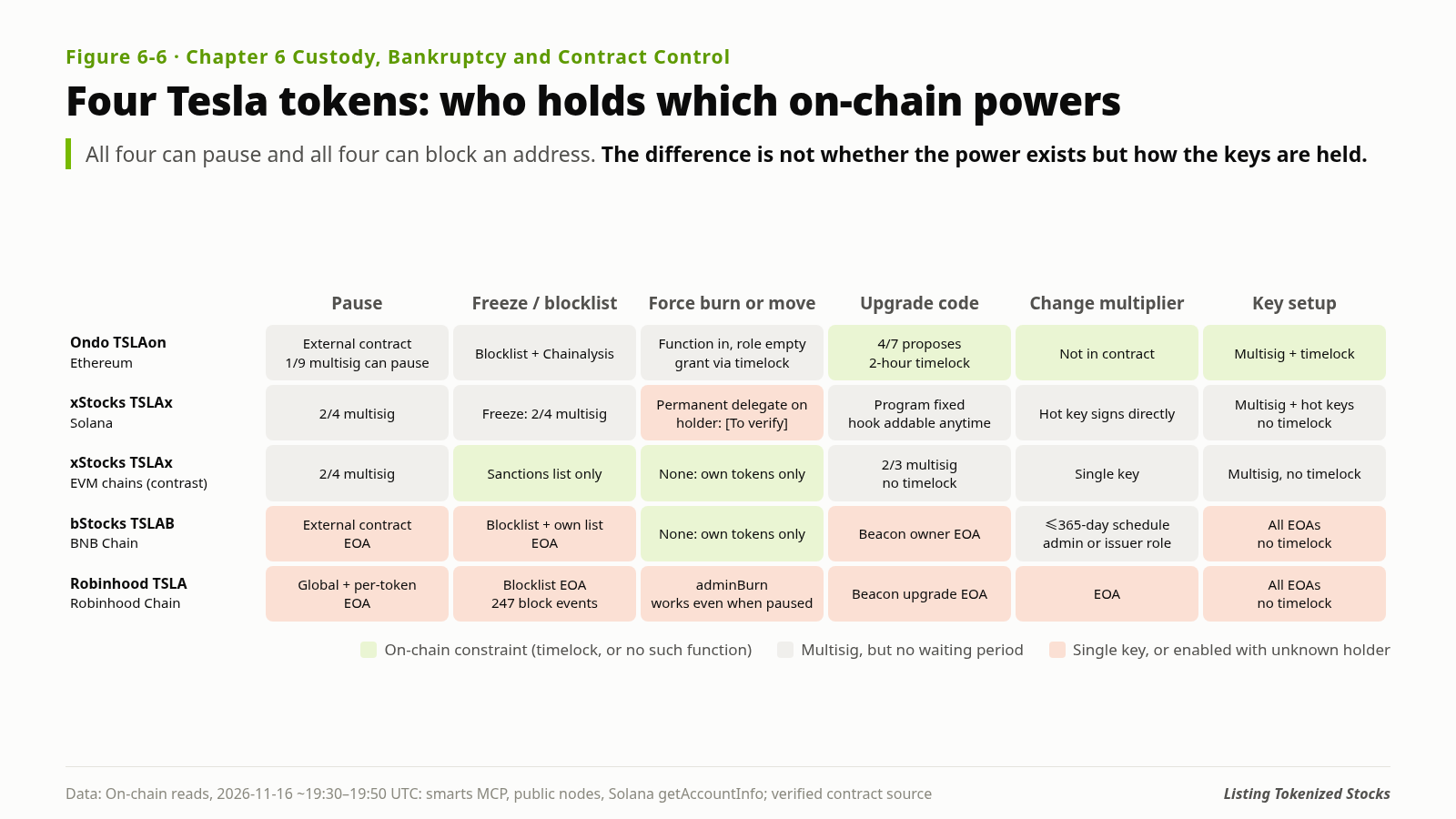
On November 16, 2026 (UTC), we read the on-chain state of four Tesla tokens: Ondo’s TSLAon (Ethereum), xStocks’ TSLAx (Solana), bStocks’ TSLAB (BNB Chain), and TSLA on Robinhood Chain. On the EVM chains we read each token contract’s source, role members, and the owners of its proxy and beacon, then checked whether those addresses were multisigs (Safe signing thresholds), timelocks (minimum delay) or plain externally owned accounts. On Solana we used public nodes to read each authority on the mint account and its Token-2022 extensions, then checked whether recent transactions from each authority address were signed directly or invoked through a multisig program. Here is what we found.
Ondo TSLAon (Ethereum): fast to pause, slow to resume, a 2-hour window on upgrades
TSLAon is a beacon proxy: its code is pointed to by a single beacon contract, and changing the beacon changes every Ondo stock token that uses it at once. The token contract itself is thin; pause and blocklist live in external contracts:
- Pause: Holder (as read): External pause-manager contract; the pause role is a 1/9 Safe multisig, the unpause role a 4/7 Safe; What it can do: Pause a single token, or all Ondo stock tokens at once; while paused, every transfer, mint and burn fails; Conditions (prospectus): Hacks, technical changes, discovered bugs; “limited to the time reasonably necessary,” and must “apply equally to all affected purchasers”
- Blocklist: Holder (as read): External compliance contract: an Ondo-managed blocklist (owner a 1/2 Safe) plus the Chainalysis sanctions oracle; What it can do: Listed addresses cannot send or receive; Conditions (prospectus): Breaches of anti-money-laundering rules, sanctions or transfer restrictions
-
Forced burn: Holder (as read):
burn(any address, amount), requires the burner role; no address currently holds this role; What it can do: Burn tokens directly from any address; Conditions (prospectus): Where a transfer is later found to breach restrictions, the issuer may “reverse the transfer and cancel the tokens, with or without payment” - Upgrades and configuration: Holder (as read): Admin and beacon owner is a timelock contract with a minimum delay of 7,200 seconds; proposer is a 4/7 Safe, executor and canceller a 1/9 Safe; What it can do: Change the code, swap the compliance contract or the pause contract, grant the burner role; Conditions (prospectus): The prospectus allows ledger updates for technical, legal or corporate-structure reasons
- Mint: Holder (as read): 3 contracts: a token-manager contract, an issuance-manager contract, a LayerZero cross-chain contract; What it can do: Increase supply; Conditions (prospectus): Subscriptions and cross-chain transfers
Two features of this design are worth remembering. First, one person can pause; four are needed to resume. Any one of the 9 signers can stop every Ondo stock token. That is right for defending against hacks, but for you it means a pause can arrive with no warning at all. Second, upgrades and grants of the burner role must first queue in the timelock for at least 2 hours. The timelock emits an event when an operation is queued, and you can listen for it: when you see a queued operation targeting the token, the beacon or the compliance contract, you have at least 2 hours to decide whether to halt deposits and withdrawals or lending first. This is the only on-chain enforced advance-notice window among the four.
One note for technical teams: the automated scanning tool we used flagged TSLAon only as “upgradeable, mintable, has roles.” It did not flag “pausable” or “has blocklist,” because those two live in external contracts. If you rely on the scan report alone, you will miss the two powers Ondo uses most.
xStocks TSLAx (Solana): more on-chain capability than the prospectus describes
TSLAx on Solana uses the Token-2022 standard, with eight extensions enabled on the mint account. The authorities we read are:
- Freeze: Holder (as read): Vault 0 of a Squads multisig (2/4, timelock 0); What it can do: Freeze any holder’s token account; frozen accounts cannot transfer out
- Pause (pausable extension): Holder (as read): The same Squads vault; What it can do: Pause all transfers of this token; not currently paused
- Permanent delegate: Holder (as read): An ordinary system account; it did not sign any of the 15 most recent related transactions; whether it is a multisig and who controls it has not been confirmed; What it can do: Move or burn tokens from any account without the holder’s signature
- Transfer hook: Holder (as read): Same as above; What it can do: No hook program attached at present; the authority can attach one at any time, after which every transfer must be approved by that program
- Display multiplier (scaled UI amount): Holder (as read): A hot key that signs directly; What it can do: Change the multiple wallets use to display balances, for dividend reinvestment and stock splits; currently 1
- Mint: Holder (as read): Another hot key that signs directly; What it can do: Increase supply
- Confidential transfers: Holder (as read): Same address as the permanent delegate; new accounts not auto-approved; What it can do: Not usable in practice at present
Compare Backed’s base prospectus (May 8, 2026). Its list of contract functions is: mint, burn (only tokens held by the issuer itself), transfer on behalf, pause, and update. On freezing it says “future contract updates may introduce a freeze function and extend the burn function,” usable only when required by a court, a regulator or law. xStocks’ TSLAx contract on Ethereum and other EVM chains matches that list: mint, a burn limited to the issuer’s own tokens, pause, and the Chainalysis sanctions oracle; no freeze, and no function to burn from someone else’s address. On Solana, the same product already has a freeze authority and a permanent delegate switched on.
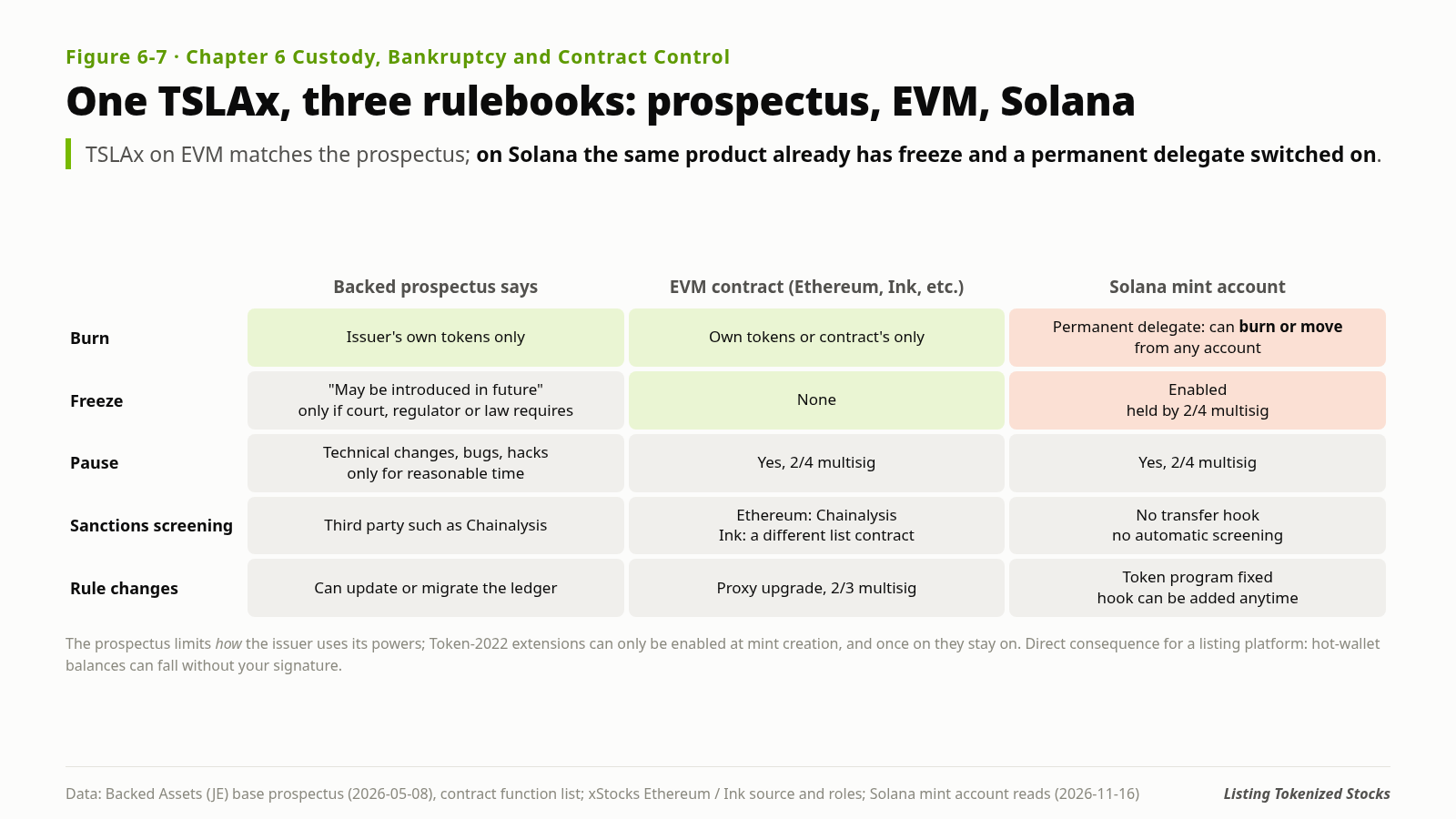
This is not necessarily a breach: the prospectus limits how the issuer uses its powers, and Token-2022 extensions can only be enabled when a mint is created; if they are not enabled then, they never can be. The issuer very likely set up the tools in advance. For a listing platform, though, there are two direct consequences. First, your reconciliation must accept “the balance went down by itself”: the permanent delegate can move or burn TSLAx from your hot-wallet token accounts without your signature, and your internal ledger must recognize this kind of change rather than treat it as theft. Second, the transfer hook is Solana’s “upgrade switch”: the token program is a shared Solana program that the issuer cannot change, but it can attach a hook program to TSLAx at any time, after which every transfer must carry extra accounts and be approved by that program. Your deposit, withdrawal and market-making programs could fail on the spot. This belongs in your notification clause.
bStocks TSLAB (BNB Chain): restrained functions, single-signature keys
The TSLAB contract states that it is a securities certificate recognized by the ADGM Financial Services Regulatory Authority, with ISIN AE000A4AU295. Its function list is more restrained than the other three: there is no function to burn or move tokens from someone else’s address; the issuer and the issuer role can only burn certificates they hold themselves. Freezing works through a per-token blocklist plus a global sanctions list (maintained by bStocks itself, not Chainalysis), and pausing through an external pause contract. The multiplier is set by the admin or the issuer role; the contract bounds it between 0.000000001x and 1,000,000,000x and allows it to be scheduled at most 365 days ahead.
How the powers are held is another matter:
- The token admin, the admin and operator roles of the compliance contract, and the admin and operator roles of the pause contract are all plain externally owned accounts (EOAs), not multisig contracts, and there is no timelock. The token-admin address has already sent 242 transactions; it is a key in active use.
- The owner of the beacon contract (which decides which code every bStocks token runs) is also an EOA, with 0 transactions sent.
- There are 3 issuer roles: two operations-wallet contracts and one EOA.
An EOA may be backed by multi-party computation (MPC) custody, where several parties jointly produce one signature, which is invisible on-chain; how BTech manages its keys has to be confirmed with the issuer. What can be confirmed on-chain is that changing the code, blocklisting and pausing have no on-chain enforced waiting period; one signature is enough.
The prospectus and the contract match on functions. The BRKB prospectus states that the contract has “blocklist, freeze and pause functions,” operated by the technology provider BTech Services on the instructions of the central securities depository (CSD), “without the cooperation of the counterparty”; if certificates are transferred to an ineligible on-chain address, the CSD can instruct a freeze, “causing the holder to lose all economic interest”; upgrades are managed by the technology provider and require the issuer’s prior consent. In other words, bStocks’ freeze exists for “leaving the compliant environment”: if certificates are withdrawn from Binance to an external wallet and passed to someone who should not hold them, they get frozen; to move them back to Binance they must pass deposit screening, and if they fail they become “permanently untradeable and unredeemable.”
TSLA on Robinhood Chain: the fullest set of powers, all single-signature
Robinhood’s stock tokens concentrate their powers in one access-control registry contract, which also serves as the beacon for every stock token. The powers readable from the token contract are:
- Global pause: Holder (as read): Pause role on the registry contract, EOA; What it can do: Pause every stock token on Robinhood Chain at once
- Single-token pause: Holder (as read): Single-token pause role, EOA; What it can do: Pause this one token; while paused, even the multiplier cannot be changed
- Blocklist: Holder (as read): Blocklist role, EOA, 252 transactions sent; What it can do: Blocklisted addresses cannot send, receive or approve
- Admin burn (adminBurn): Holder (as read): Admin-burn role, EOA; What it can do: Burn tokens from any address, even while paused or blocklisted
- Upgrade: Holder (as read): Beacon-upgrade role, EOA; What it can do: Replace the code of every stock token
- Multiplier: Holder (as read): Multiplier-update role, EOA; What it can do: Change the display multiplier, with a specified effective time
- Oracle-paused flag: Holder (as read): Oracle-pause role, EOA; What it can do: Mark the price source as paused (as the piece on price sources explained, this flag is only advisory)
The prospectus and contract broadly agree. The RHJ base prospectus lists the functions as: create, burn (limited to tokens the issuer holds, redeems or cancels), freeze, transfer on behalf, pause, update, blocklist, and seizure “transferring products to the competent authority”; blocklisting, freezing, pausing and seizure are used when a “sanctions event” occurs or a court or regulator requires it. There is no “transfer to the competent authority” function in the contract, so seizure can technically only be “burn, then re-mint to the other party” [Inference; not stated by the issuer].
The on-chain record also shows how often these powers have been used. The registry contract has emitted 247 blocklist events in total: 244 executed together on June 8, 2026, 2 on test addresses (later lifted), and 1 in November. We randomly sampled 20 blocklisted addresses and checked them against the Chainalysis sanctions oracle on Ethereum; 13 were also on that list, which suggests the batch was mainly a preload of sanctions lists. Separately, on November 2, 2026 at 21:03 (UTC), one address was blocklisted and then unblocked 72 minutes later. A global pause occurred once, on June 30, 2026, and was lifted about 1 minute later; the chain does not show why. Events like these exist only in the on-chain record, with no announcement; if you are not listening, you will not know.
The four side by side: what to accept, what to put in the contract
Line the four up and “does the power exist” barely distinguishes them: all four can pause, and all four can stop a given address from transferring. Three can make tokens disappear without the holder’s consent (Ondo must first queue a grant of the burner role; Robinhood has it ready; xStocks has it ready on Solana); only bStocks’ current contract lacks this. The real difference is in how the powers are held:
- Ondo: Multisig plus a 2-hour timelock, with an on-chain advance window.
- xStocks (Solana): Freeze and pause held by a 2/4 multisig; how the permanent delegate and transfer hook are held could not be read and needs confirming with the issuer; multiplier and mint are hot keys.
- bStocks, Robinhood: All EOAs, no timelock.
As for what to accept, we suggest this split: the existence of a power is not in itself a veto; the veto is when four things are all true: a single key, no waiting period, no documented conditions for use, and no commitment from the issuer to notify you. On this reading, the first two are true for both bStocks and Robinhood; the last two depend on what you can negotiate.
When these powers reach your platform, the impact falls in four areas:
- Pause (single token or global): Wallets and business affected first: All deposits and withdrawals fail; your positions in DEX pools cannot be swapped out; liquidations and repayments in lending markets fail; What you need to prepare: Wire the pause signal into on-call alerts; freeze new borrowing in lending markets in step; a user-notice template
- Blocklist or freeze an address: Wallets and business affected first: User withdrawals to a blocklisted address fail; if your hot wallet or pool address is blocklisted, all withdrawals of this token are stuck; What you need to prepare: Register your hot wallets, cold wallets and contract addresses with the issuer; agree a deadline for lifting wrongful blocks
- Forced burn or transfer: Wallets and business affected first: Your platform account balance falls without your signature; users’ balances on your platform no longer match the chain; What you need to prepare: Reconciliation recognizes issuer actions and books them separately; the agreement states who bears the loss
- Upgrade, attach a hook, change the compliance contract: Wallets and business affected first: The transfer interface changes, deposit, withdrawal and market-making programs may fail; new rules may block your addresses; What you need to prepare: Listen for upgrade and configuration events; require advance notice
Multiplier changes are also a contract power, but they are handled in the piece on multipliers: require the issuer to publish the new multiplier and its effective time in advance, and make sure your system does not price on the old multiplier around the moment it takes effect.
Notification requirements: we suggest the listing agreement contain at least these. Upgrades, replacing the compliance or pause contract, attaching a transfer hook to a Solana token, and changing a power’s holder or a multisig threshold: notice in advance, with a lead time no shorter than the on-chain timelock (where there is no timelock, negotiate one). Multiplier changes published in advance as the piece on multipliers requires. If a pause happens: immediate notice, with the reason and expected duration. Where a freeze, blocklisting or burn involves your platform’s addresses or your users’ addresses: notice the same day, with the basis (sanctions, court order, transfer violation). Whatever the issuer will not commit to, record on the approval sheet and reflect in collateral haircuts and supply caps.
Cross-chain and bridges: the same token does not follow the same rules on every chain
Tokenized stocks seldom live on just one chain. According to xStocks’ public API, TSLAx is deployed on 12 networks: Ethereum, BNB Chain, Arbitrum, Solana, Tron, TON, Mantle, HyperEVM, Ink, X Layer, Optimism and Monad. According to Ondo’s token registry, TSLAon is natively deployed on Ethereum, BNB Chain and Solana, while the versions on HyperEVM and Robinhood Chain are “bridged tokens.” For bStocks and Robinhood, this piece read only one chain each.
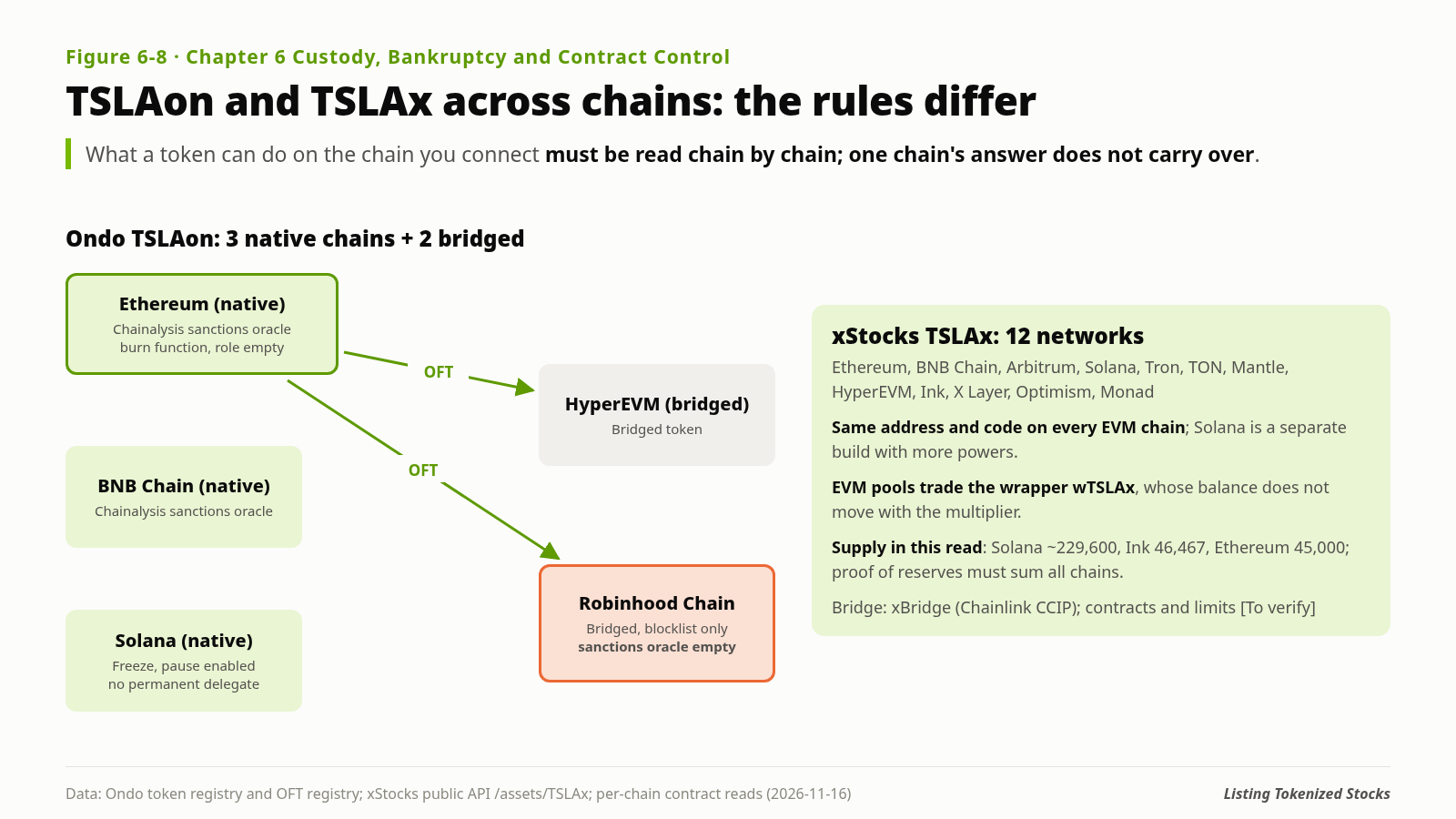
Comparing chain by chain, there are at least three inconsistencies, and all of them affect a platform:
One: control powers differ. As the previous section showed, TSLAx has no freeze and no burn-on-behalf on EVM chains, but has both on Solana. Ondo is the reverse: the TSLAon contract on Ethereum has a “burn from any address” function (the role is currently empty), while the TSLAon mint account on Solana has freeze, pause and display multiplier enabled and no permanent delegate. For the same issuer and the same stock, what can be done on the chain you connect must be read chain by chain; one chain’s conclusion cannot be applied to another.
Two: sanctions screening differs. Ondo’s compliance contract is connected to the Chainalysis sanctions oracle on both Ethereum and BNB Chain; the Ondo bridged token on Robinhood Chain has only a blocklist, and its sanctions-oracle address is empty. xStocks uses the Chainalysis oracle on Ethereum, and on Ink a list contract at a different address; we have not confirmed where that list comes from. An address that would be rejected on Ethereum may receive tokens without trouble after bridging to another chain. For the issuer this is a compliance gap; for you it means “the same user’s deposits get different screening results on different chains.”
Three: the bridge itself can mint. Ondo bridges with LayerZero’s OFT standard: TSLAon on both Ethereum and Robinhood Chain gives the minter role to an Ondo OFT contract, which burns on the source chain and mints on the destination chain. This means that if the cross-chain messaging layer errs or is compromised, tokens can appear out of thin air on the destination chain, with no shares behind them. xStocks has announced Chainlink CCIP for cross-chain transfers (xBridge); this piece did not check the details chain by chain, and xBridge’s contract addresses and limits are not yet verified. This is also why proof of reserves must add up supply on every chain before comparing it with shares in custody: in this read, TSLAx had 45,000 tokens outstanding on Ethereum, 46,467 on Ink and about 229,600 on Solana; any excess on any chain has to show up in the total.
One more easy trap: wrapped tokens. The DEX pools for xStocks on EVM chains do not trade TSLAx itself but “Wrapped Tesla xStock” (wTSLAx), a wrapper contract built on the ERC-4626 standard that takes TSLAx deposits and issues shares. Its balance does not change with the multiplier; the contract converts how much TSLAx one wTSLAx represents. In this read, about 1,084 wTSLAx were outstanding on Ink. If a user deposits wTSLAx as if it were TSLAx, or your price source quotes TSLAx while the pool trades wTSLAx, your books will be wrong.
On deposits and withdrawals, these are the situations a platform will run into, and how to handle them:
- Deposits rejected by the contract. If the sending address or your deposit address is on a blocklist or sanctions list, the on-chain transaction simply fails and the user sees “transfer failed.” State on the deposit page that this token has transfer restrictions, and make sure customer support can look up the reason for a failure.
- Withdrawals to “the wrong place.” The bStocks prospectus states that if certificates are withdrawn to an external wallet and passed to an ineligible holder, they may be frozen; to move them back into the CSD environment they must pass deposit screening. If your platform is not part of bStocks’ compliant environment, a user who withdraws from you and later wants to go back to Binance may not be able to.
- Enable only the chains and contracts the issuer supports. The same stock is a different contract with different powers on different chains, so deposit addresses must be enabled one by one by “chain + contract address,” and bridged tokens assessed separately. Ondo labels its tokens on HyperEVM and Robinhood Chain as bridged; whether they can be created and redeemed directly on those chains is a question for the issuer.
- Treat an upgrade or a newly attached hook on any chain as a change to the token. The monitoring scope is every chain you have enabled, not just the “main chain.”
What this means for your platform
First, put “where holders rank if things go wrong” into your internal listing assessment, not just “is there custody.” Every issuer says it has custody. The differences are who the security agent is, how the ranking works, and whether the lending switch is on.
Second, monitor proof of reserves the way you monitor prices. Pull the proofs you can read (Ondo’s daily verification, xStocks’ dashboard) once a day and reconcile them against total supply across chains. A ratio below 100%, or a proof that stops updating beyond the agreed frequency, should be one of your alert thresholds.
Third, treat a single custodian as concentration risk. If several of the issuers you list all use Alpaca, your risk disclosures cannot say “multiple issuers diversify the risk.”
Fourth, read powers chain by chain, and read how they are held. For every token on every chain you enable, list the holders of five powers: pause, freeze, forced burn, upgrade and multiplier. State whether each is a multisig, a timelock or a single key; whenever a holder changes, run it again.
Fifth, have a halt plan ready. Once a security agent takes over, the on-chain tokens can probably still be transferred, but their price has already decoupled from the stock; once an issuer pauses, the tokens freeze everywhere at once. Decide in advance which signals trigger halting buys, halting use as collateral, and how to notify users.
Custody and contract questions to ask the issuer before listing
- Which custodians hold the underlying shares? In whose name are the accounts opened, and is there a separate account per product (or series)?
- Does the custody agreement state clearly that these shares are not the custodian’s own assets? Which country’s law governs it?
- Is there an independent security agent or trustee? Who? Is there a tripartite account control agreement with the custodian, and on what date was it signed?
- Is the security interest first priority? In which jurisdiction has it been perfected (for example, under New York’s Uniform Commercial Code)?
- What is the payment waterfall after enforcement? Where do holders rank? Are the fees ranked ahead of them capped?
- Which events trigger enforcement of the security? Is it automatic, or does it need a holder vote? What is the voting threshold?
- Do this token’s final terms allow the underlying shares to be lent? How much is on loan now? Who is the borrower, and is it an affiliate of the issuer?
- Does any part of the backing come from borrowed shares or arrangements with affiliates (such as bStocks’ initial liquidity)? When does that end?
- Does the parent or group guarantee the issuer’s obligations? If not, what do the documents say?
- Who verifies the proof of reserves? How often? Is supply listed separately for each chain? Can you pull it automatically through an API?
- If the custodian goes bankrupt, can holders get SIPC or equivalent protection? Has the issuer obtained a legal opinion on this?
- After an issuer default, how long is it expected to take from the security agent’s takeover to holders receiving payment? Can the on-chain tokens be transferred during that time?
- On each chain we plan to enable, which address holds pause, freeze (or blocklist), forced burn or transfer, upgrade, and multiplier changes? Is it a multisig (what threshold), a timelock (how long a delay), or a single key? Is there MPC or hardware custody behind it?
- Under what conditions are these powers used? Do they match the function list in the prospectus? For powers that are enabled on-chain but not described in the documents (for example, the permanent delegate on Solana), where are their purpose and limits written down?
- How much notice will we get before upgrades, changes to compliance or pause contracts, attaching transfer hooks, or changes to who holds a power? When a pause, freeze or burn involves our addresses, how soon will we be told, and will you give the basis?
- Can our hot wallets, cold wallets and contract addresses be registered? If they are blocked by mistake, who lifts the block, and how fast?
- Is sanctions screening consistent across chains? Which chains have no sanctions list connected?
- Which bridge is used for cross-chain transfers? Does the bridge contract have minting power, and are there per-transaction and daily limits? If the bridge fails, how are excess tokens dealt with?
- What is the relationship between wrapped tokens and native tokens? On which chains can tokens be created and redeemed directly, and on which must they be bridged back first?
- Is there a list, with reasons, of past pauses, blocklistings and burns?
Conclusion
Bankruptcy remoteness has to come down to a payment waterfall; contract control has to come down to a table of powers. The waterfall tells you what users get back after the issuer fails; the table of powers tells you, while the issuer is healthy, where a single signature can stop your hot wallets, deposits and withdrawals, and lending markets. Both can be read before you list. FTX’s holders had neither.
Sources
All items checked on 2026-11-16. On-chain reads were taken on 2026-11-16 at about 19:30–19:50 (UTC): Ethereum block ~26,429,716, Robinhood Chain block ~116,010,624, Solana slot ~470,250,210.
Custody, bankruptcy and FTX
- FTX help page (stock token description): archived 2020-11-01 https://web.archive.org/web/20201101084115/https://help.ftx.com/hc/en-us/articles/360051229472-Equities ; archived 2022-01-09 https://web.archive.org/web/20220109132323/https://help.ftx.com/hc/en-us/articles/360051229472-Tokenized-Stocks ; archived 2022-10-27 https://web.archive.org/web/20221027042145/https://help.ftx.com/hc/en-us/articles/360051229472-Tokenized-Stocks
- CM-Equity statement (2022-11-11 version and later expanded version): https://web.archive.org/web/20230331095138/https://cm-equity.de/en/rectification-to-the-publication-alameda-research-llc/
- FTX debtors’ motion on the valuation of digital-asset claims (D.I. 5202, 2023-12-27): https://archive.org/download/gov.uscourts.deb.188450/gov.uscourts.deb.188450.5202.0.pdf
- FTX debtors’ 9019 settlement motion (D.I. 7853, 2024-02-22; the DAAG acquisition and the sale of the FTX Europe subsidiaries): Kroll case site https://restructuring.ra.kroll.com/FTX/ExternalCall-DownloadPDF?id1=MzA3MjMyNg%3D%3D&id2=0&cid=0
- Side branch: FTX Europe restructuring motion and collateral claim settlement agreement (D.I. 11626, 2024-04-10; settlement agreement dated 2024-04-07; the dispute over about $65 million of collateral Binance transferred to CM-Equity, settled with Binance (Switzerland) AG receiving a $50 million general unsecured claim and CM-Equity receiving $1 million in cash): https://restructuring.ra.kroll.com/FTX/ExternalCall-DownloadPDF?id1=MzEwNzUzMQ%3D%3D&id2=0&cid=0 ; Coverick declaration (D.I. 11626-6, read via an OCR version attached to an SEC public comment) https://www.sec.gov/comments/s7-2024-01/s7202401-464091-1228634.pdf
- FTX initial distributions (2025-02-18): https://www.prnewswire.com/news-releases/ftx-commences-initial-distributions-to-convenience-class-and-sets-next-distribution-302379212.html
- BaFin notice on Binance Germany’s stock tokens (2021-04-28): https://www.bafin.de/SharedDocs/Veroeffentlichungen/DE/Verbrauchermitteilung/weitere/2021/meldung_210428_binance_deutschland.html ; Binance announcement ending support for stock tokens (2021-07-16): https://www.binance.com/en/support/announcement/3a0304f3ee1c43668959c1b01f610d59
- Backed Assets (JE) Limited base prospectus (2026-05-08): security agent, account control agreement, enforcement events, payment waterfall, securities-lending terms, no Payward guarantee; contract function list (mint, burn limited to own holdings, transfer on behalf, pause, update), “a freeze may be introduced in future,” Chainalysis sanctions oracle. Link in the piece on issuance structures.
- RHJ base prospectus (2026-06-25): limited recourse, non-petition, payment waterfall (investors rank fifth), verification agent, securities-lending terms; Q&A 3.8 and the tokenization function list (create, burn, freeze, transfer on behalf, pause, update, blocklist, seizure). Service providers https://docs.robinhood.com/rhj/service-providers
- Ondo: letter to the SEC Crypto Task Force (2026-04-13; Alpaca, DTC, Ankura, 100.5%) https://www.sec.gov/files/ctf-written-input-ondo-finance-041326.pdf ; base prospectus (events of default, 60% vote, no lending, verification reports; freeze, transfer reversal, token cancellation and pause terms), link in the piece on issuance structures; Trust and Transparency https://docs.ondo.finance/ondo-stocks/trust-and-transparency
- bStocks: BRKB prospectus (2026-10-20; held on trust, securities-lending risk factor, non-petition, weekly publication of outstanding amount; blocklist, freeze and pause operated by BTech Services on CSD instructions; freezes for ineligible addresses, deposit screening; upgrades require the issuer’s prior consent), link in the piece on issuance structures; disclosure on the application of US insolvency and customer-protection rules https://www.adgm.com/globalassets/market-disclosure/content/disclosure/disclosure-on-application-of-us-insolvency-and-customer-protection-rules_07_13_2026_16-03-36.pdf ; transparency page https://www.bstocks.finance/transparency
- xStocks proof-of-reserves dashboard (NVDAx figures as seen on 11-16; they change): https://defi.xstocks.fi/proof-of-reserves ; service providers and custodians https://assets.backed.fi/legal-documentation/service-providers
- Coinbase Onchain SPV, Dinari: see the piece on issuance structures sources; Dinari reserve description https://dinari.com/dshares
Contract powers (on-chain reads)
- Ondo TSLAon (Ethereum)
0xf6b1117ec07684D3958caD8BEb1b302bfD21103f: contract GMToken (verified source); beacon0x985462c9aa4d6c3ad59ae6e1e9c0c11347ed1598, whose owner is also the admin0x3715B2154d2FF4C5B027C7a1f734B53F27bc34f1(TimelockController, getMinDelay = 7200; proposer0x71A4d411b5f7941Dee020417fca30413712f1646is a 4/7 Safe, executor and canceller0x2e55b738F5969Eea10fB67e326BEE5e2fA15A2CCis a 1/9 Safe); 3 MINTER_ROLE holders (GMTokenManager0x2c15…5C8c, OndoOFT0xDe1c…7431, GMIssuerManager0xec8b…1f4E); BURNER_ROLE and CONFIGURER_ROLE have 0 members; pause contract TokenPauseManager0xfd48112e448417ca79305a518c4186df4b0a200a(pause role a 1/9 Safe, unpause and admin a 4/7 Safe); compliance contract0x54a8757c2fef8649830b158a8c19d3a670e80318→ OndoCompliance0x156F73fc73197555e950743Cb2B23F411c751002: blocklist0xd8c8174691d936E2C80114EC449037b13421B0a8(owner a 1/2 Safe), sanctions list0x40C57923924B5c5c5455c48D93317139ADDaC8fb(Chainalysis oracle). Read via smarts MCP (get_admin_risk, get_contract_source) and eth_call on public Ethereum nodes. - xStocks TSLAx (Solana)
XsDoVfqeBukxuZHWhdvWHBhgEHjGNst4MLodqsJHzoB: Solana public node getAccountInfo (jsonParsed). Token-2022; freeze and pause authorityJDq14BWvqCRFNu1krb12bcRpbGtJZ1FLEakMw6FdxJNs, derived as vault 0 of Squads v4 multisig8gep9m2BmCqz4qCQMcqZoqnaGedXgRWehFYhKaPuiu8X(threshold 2, 4 members, timelock 0); permanent delegate, transfer hook, metadata and confidential-transfer authority5aMNNLQJwAEeoemTEMkv5NVjqKwvvefRYCQ5Z67HFvEq; display-multiplier authorityS7vYFFWH6BjJyEsdrPQpqpYTqLTrPRK6KW3VwsJuRaSand mint authority7pt9tkctJPK7PPNQJ77GKg8ZffSF6QxoMiCFYHxrtaCj(recent transactions all signed directly); supply 22,963,344,682,519 (8 decimals). - xStocks TSLAx (EVM)
0x8ad3c73f833d3f9a523ab01476625f269aeb7cf0(same address on Ethereum and Ink): BackedTokenImplementation (verified source; burn limited to own holdings or the contract itself); owner and proxy-admin owner0x4975…3a65is a 2/3 Safe; pauser0x8768…FC50is a 2/4 Safe; the sanctions list is the Chainalysis oracle on Ethereum and0x262fbC0FAF42d2c2c1A5278Bdbcf56a37EcAf07fon Ink. Wrapper contract wTSLAx0xc3fdbe3a68ee5de461d30415a8165cf9aefe1171(WrappedBackedTokenImplementation, ERC-4626). Deployment network list: xStocks public API https://api.xstocks.fi/api/v2/public/assets/TSLAx - bStocks TSLAB (BNB Chain)
0x5b1910eaad6450e50f816082aa078c41f10c292f: SecuritiesToken (verified source); beacon0x156d6dce9a4f6139a3406f1f021f1a4880de93a3, owner0x4333DAf4481F281F3D3d2B8735cE80bc00028d0C(EOA, nonce 0); DEFAULT_ADMIN_ROLE0x45e35Fe982F3869221b222Abea372fA97AA7679d(EOA, nonce 242); 3 ISSUER_ROLE holders; compliance contract0x53dBa7AaBDe774787A1F57236B235567dA8e14F4and pause contract0x9fc74Be63f3589485B2423984a7a0557e0CF700a, whose admin and operator roles are all EOAs; identifier = AE000A4AU295. Read via public BNB Chain nodes. - Robinhood Chain TSLA
0x322F0929c4625eD5bAd873c95208D54E1c003b2d: Stock (verified source); access-control registry and beacon0xe10b6f6b275de231345c20d14ab812db62151b00; role holders reconstructed from the registry’s RoleGranted/RoleRevoked events and rechecked with hasRole, all EOAs; 247 Blocked events (244 in blocks 43,543–49,999 on 2026-06-08; 2 on 0xdead-style test addresses; 1 on 2026-11-02), 5 Unblocked events (4 on test addresses); the address blocklisted at 21:03 and unblocked at 22:15 on 2026-11-02 is0xb397711c21f1a117c3c48c4443b178089bffaf94; global Unpaused / Paused / Unpaused events at 16:57, 17:01 and 17:02 (UTC) on 2026-06-30. A sample of 20 blocklisted addresses was checked with isSanctioned on the Ethereum Chainalysis oracle; 13 returned true. Robinhood Chain public node https://rpc.mainnet.chain.robinhood.com - Ondo multichain: token registry https://docs.ondo.finance/partner-docs/tokens (TSLAon: Ethereum, BSC
0x2494b603319d4d9f9715c9f4496d9e0364b59d93, SolanaKeGv7bsfR4MheC1CkmnAVceoApjrkvBhHYjWb67ondo; HyperEVM0x417883b1709545f1211A25b00ad13455fC7F1bc5and Robinhood Chain0xb197f36c25ba9b66960688882a4dc595c6b04309are bridged tokens); OFT registry https://docs.ondo.finance/partner-docs/ofts . On Robinhood Chain, TSLAon’s admin is a 2-hour timelock, MINTER_ROLE is OndoOFT0xcF70…29eD, and the sanctions-list address is zero; on BSC, TSLAon is connected to the Chainalysis oracle; on Solana, TSLAon has no permanent-delegate extension. - xBridge (Chainlink CCIP): official Chainlink partnership coverage https://chainlinktoday.com/backed-partners-with-chainlink-to-launch-ccip-powered-xbridge-for-xstocks/
Not yet confirmed (questions for issuers):
- The third-party verifier and update frequency of xStocks’ proof of reserves: not stated on the dashboard; Backed earlier wrote, for its bTokens, that The Network Firm updates the attestation every 10 minutes and Chainlink posts it on-chain daily; whether this still applies to xStocks is unconfirmed.
- RHJ’s verification reports: the prospectus commits to one a year (within three months of financial year-end); no published report found yet.
- bStocks’ “daily proof of collateral”: in the prospectus the reconciliation is done by Binance NCCL; no verifier outside the Binance group was found.
- Dinari’s reserve auditor and audit frequency: the website says only “Big Four”; no published report found.
- Which xStocks / RHJ products have securities lending switched on in their final terms: final terms not checked one by one.
- The number of shares actually held behind the FTX stock tokens: no reconciliation found in the bankruptcy filings, only CM-Equity’s collateral payments to FTX Europe.
- The date of the court order approving the CM-Equity / Binance settlement: only a proposed order filed on 2024-05-28 was found.
- How the permanent-delegate and transfer-hook authority address of TSLAx (Solana) is controlled: it is a system account that has not signed directly in recent transactions, and whether it is a multisig could not be confirmed; no xStocks terms specifically covering the Solana permanent delegate were found.
- Whether the EOAs at bStocks and Robinhood are backed by MPC or hardware custody: cannot be determined on-chain.
- How Robinhood’s “seizure” would be carried out: the contract has no function to transfer to an authority; “burn then re-mint” is an inference.
- The source of the sanctions-list contract used by the xStocks deployment on Ink; xBridge contract addresses and limits: not checked chain by chain.
- Whether Ondo’s bridged tokens on HyperEVM and Robinhood Chain can be created and redeemed directly: the registry only labels them as bridged.
- The power readings in this piece cover only one stock (TSLA) and one or two chains per issuer; other stocks and chains need to be checked individually. Tokens under the same beacon share code, but their roles and configuration may differ.
— Excerpted from Listing Tokenized Stocks, Chapter 6: Custody, Bankruptcy and Contract Control
Full book: https://pickful.ai/books/kspm
转发此帖子?
与您的关注者分享。
回复