
Contents (8)

·
2022: The Strongest Rival, FTX, Destroyed Itself
2022 The Super Bowl, a chain of collapses, two rounds of layoffs and the fall of FTX
On November 2, 2022, the crypto news site CoinDesk published a story with an unremarkable headline and contents like a time bomb.
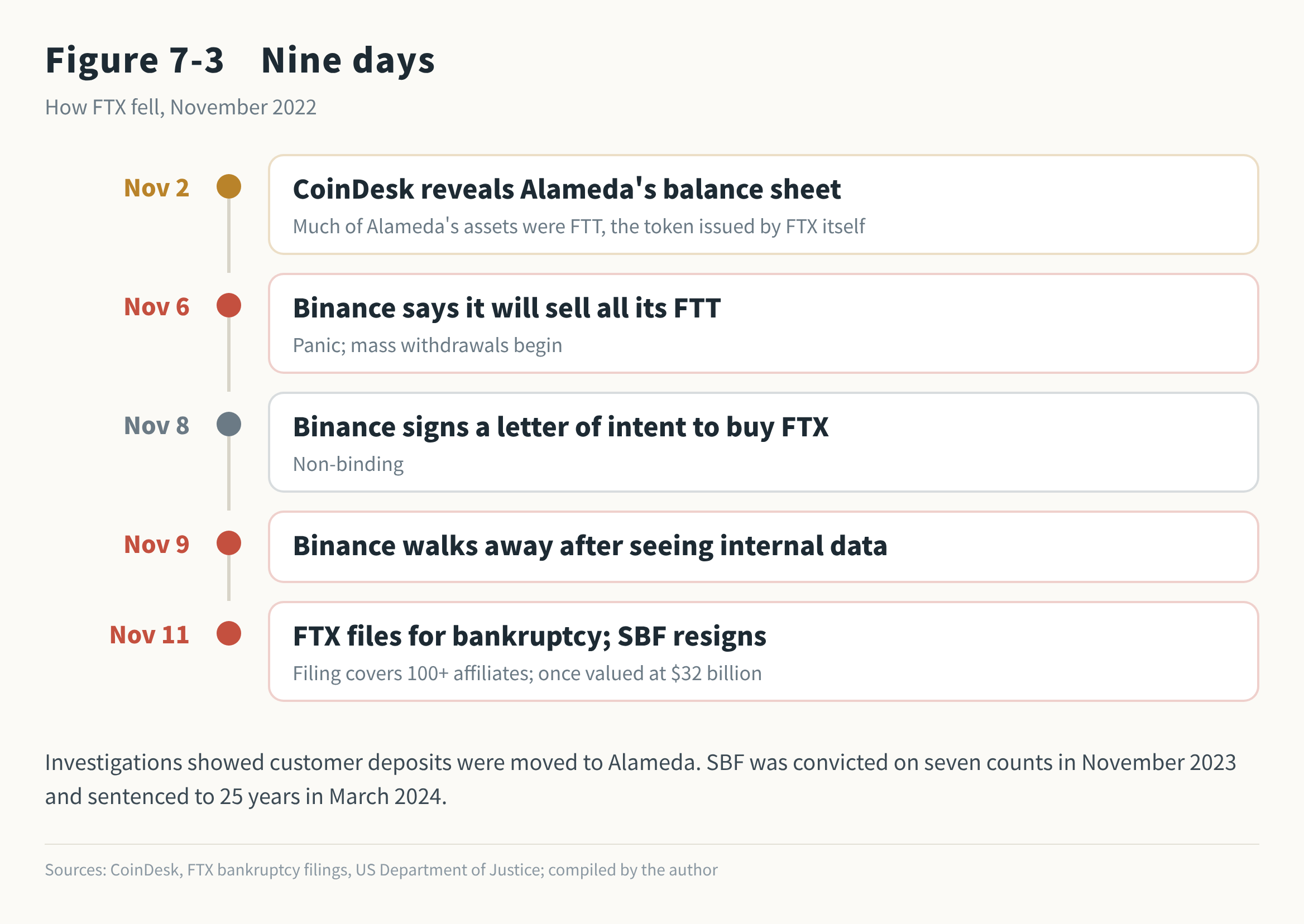
It revealed a leaked balance sheet: a large share of the assets of the trading firm Alameda Research was FTT, the token issued by the crypto exchange FTX itself. Alameda and FTX both belonged to the same person: Sam Bankman-Fried, or SBF.
Four days later, Binance announced it would sell all the FTT it held. Panic spread and users began withdrawing from FTX en masse.
On November 8, Binance signed a non-binding letter of intent to acquire FTX. Just one day later, after looking at FTX’s internal data, it walked away.
On November 11, FTX filed for bankruptcy and SBF resigned as CEO. The filing covered more than 100 affiliated companies.
In nine days, an exchange once valued at $32 billion and seen as one of Coinbase’s strongest competitors fell from the summit to the abyss.
It was the crypto industry’s “Lehman moment.” And at the center of the storm, Coinbase lived this story for the third time: the rival died first.
1. A QR code at the Super Bowl
The story starts at the beginning of that year.
February 2022, the Super Bowl: the highest-rated broadcast in America, with 30-second ad slots costing millions of dollars. That year’s game was dubbed the “Crypto Bowl”: FTX, Crypto.com, eToro and Coinbase all ran ads.
FTX hired the comedian Larry David for a spot about skeptics throughout history who missed great inventions. Crypto.com hired LeBron James.
Coinbase’s ad was the simplest and the most unexpected: just a colorful QR code bouncing around a black screen, like an old DVD player’s screensaver. No dialogue, no celebrities, no product pitch.
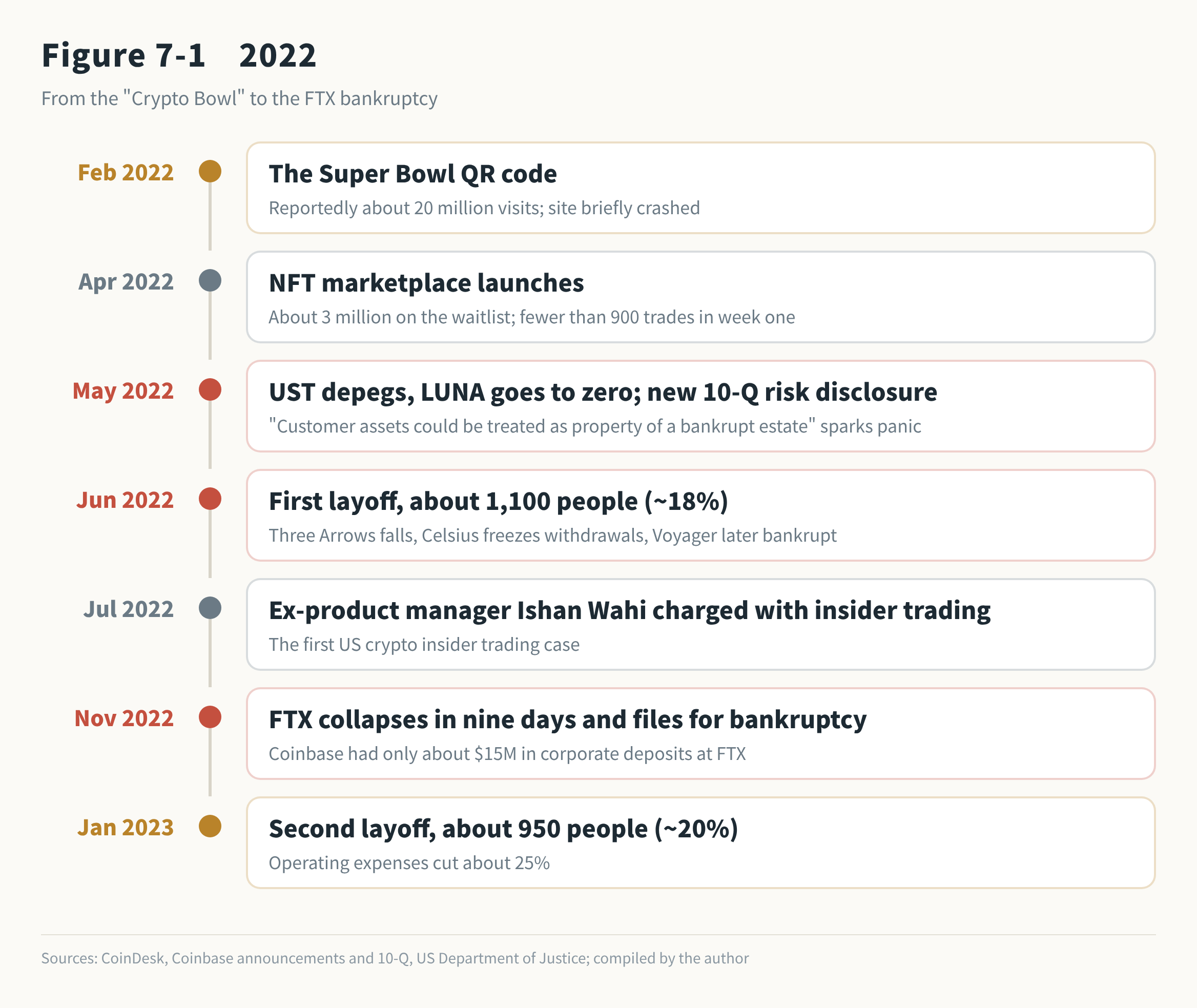
Curious viewers pulled out their phones to scan it. According to reports, the site got about 20 million visits and briefly crashed under the load. New users who scanned it could claim $15 in bitcoin.
The ad was widely discussed in marketing circles as an extremely successful piece of creative. But looking back now, it reads more like the end of an era: it was the crypto industry’s last party in front of a national audience. Shortly after the Super Bowl, the market began a collapse that lasted all year.
Coinbase itself also bet wrong at the peak. On April 20, 2022, it launched a long-planned NFT marketplace; according to CoinDesk, about 3 million people had signed up for the waitlist. Yet in the first week, the platform saw fewer than 900 transactions in total from about 650 users. In the two weeks after it opened to everyone in early May, only a little over 1,200 users completed a transaction. Over the same period, OpenSea, the leader in NFTs, did thousands of times its volume.
Many people lined up; very few came to trade. It was the exact reverse of what Coinbase faced in 2013 and 2017: back then, users overwhelmed the systems; this time, the systems were ready and the users didn’t come.
2. A chain of collapses
The 2022 crypto bear market was nothing like 2018. In 2018 a bubble burst and prices fell. In 2022 it was a credit collapse, with one institution after another going under.
- May: the algorithmic stablecoin TerraUSD (UST) lost its peg, and its sister token LUNA went to zero within days, wiping out tens of billions of dollars in market value.
- June to July: the crypto hedge fund Three Arrows Capital went down because of LUNA’s collapse; the crypto lender Celsius froze withdrawals; another lender, Voyager, filed for bankruptcy. They had lent to and guaranteed one another, so one falling dragged down the next in a chain reaction.
- November: FTX collapsed.
In this chain of collapses, Coinbase had a trust crisis of its own.
In May 2022, just as LUNA was collapsing, Coinbase added a new risk disclosure to its quarterly report (10-Q): if Coinbase went bankrupt, crypto assets customers held on the platform might be treated as part of the bankruptcy estate, and customers might be treated as general unsecured creditors of the company.
In a panicking market, that sentence was instantly amplified: could keeping your coins at Coinbase also mean losing everything?
Armstrong quickly stepped in to explain. The new risk disclosure was added because of a new SEC accounting requirement (SAB 121) that applied to all public companies holding crypto assets for third parties; Coinbase had no risk of bankruptcy; the language was reasonable because the legal protection of crypto assets in bankruptcy proceedings had not yet been tested in court. Armstrong also apologized: the company should have updated its retail terms earlier, and it had not communicated proactively with users when it added the disclosure, and said Coinbase would give retail users legal protections similar to those of institutional clients.
A month later, Coinbase disclosed that as of June 30, 2022, it held about $95.5 billion in fiat and crypto assets for customers.
This episode shows one thing: in a panicking market, trust is extremely fragile. Even one line of compliance-required text can spark fears of a run.
There was something else that summer that brought Coinbase back to an old problem left over from Chapter 4: could news of upcoming listings be exploited?
In July 2022, the US Department of Justice and the SEC both charged former Coinbase product manager Ishan Wahi, whose job gave advance knowledge of which tokens were about to be listed on Coinbase. Prosecutors alleged that from June 2021 to April 2022 Wahi passed this information to a brother and a friend, who bought ahead of the announcements and made about $1.5 million. Prosecutors called it the first cryptocurrency insider trading case in the United States. In May 2023, Wahi was sentenced to two years in prison.
This time Coinbase was in a different position from 2017. It cooperated with law enforcement in the internal investigation, and by the time the suspects were caught, the company had a full set of employee trading restrictions and information barriers in place. But in its parallel civil complaint, the SEC characterized some of the tokens as securities. Coinbase’s chief legal officer Paul Grewal responded with a post whose gist was: Coinbase does not list securities.
An insider trading case was being used by the SEC to signal “which tokens are securities.” It was the prelude to the head-on lawsuit a year later.
3. Two rounds of layoffs
Alongside the market’s collapse came Coinbase’s own contraction.
During the 2021 bull market, Coinbase hired furiously and its headcount ballooned. In June 2022, it announced it would lay off about 1,100 people, about 18 percent of staff. In a letter to employees, Armstrong admitted the company had “grown too quickly.”
In January 2023, Coinbase announced a second round of layoffs, about 950 people or about 20 percent of staff, and cut operating expenses by about 25 percent.
For full-year 2022, Coinbase’s net revenue fell from about $7.4 billion in 2021 to about $3.1 billion, nearly halved. It posted a net loss of about $2.6 billion for the year, after earning about $3.6 billion in 2021.
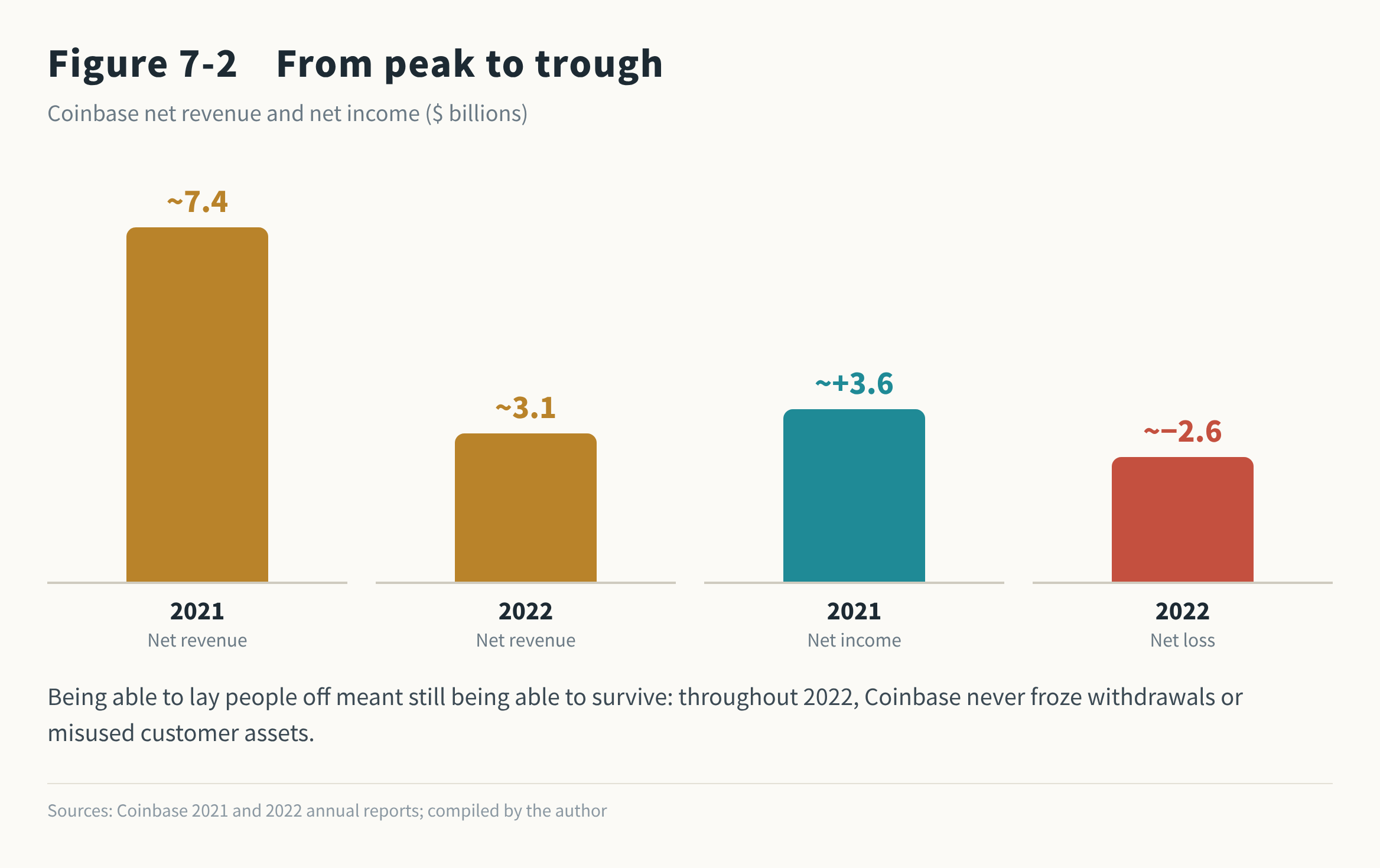
These two layoffs were among the most painful decisions in Coinbase’s history. But compared with its peers they meant something entirely different: Coinbase was laying people off; FTX, Celsius and Voyager were going bankrupt. Layoffs were about staying alive, and being able to lay people off meant it was still able to stay alive.
More importantly, throughout the 2022 collapses, Coinbase never froze user withdrawals, never misused customer assets, and suffered no major losses from exposure to failed institutions. After FTX collapsed, Coinbase said publicly that it had only about $15 million in corporate deposits at FTX and no exposure to FTT or Alameda. Its only loss was an earlier equity investment in FTX by Coinbase Ventures, which had to be written off in full.
4. FTX: the other answer
To understand what FTX’s collapse meant for Coinbase, look at what FTX was before it fell.
SBF founded FTX in 2019. An MIT graduate and former Wall Street quant trader, SBF showed up everywhere in shorts and a T-shirt with a mop of unruly hair, and the media cast SBF as “the J.P. Morgan of crypto.”
FTX’s rise was breathtaking. By early 2022 it was valued at $32 billion. It bought the naming rights to the Miami Heat’s arena, sponsored a Formula One team and top athletes, and advertised at the Super Bowl.
More importantly, SBF was extremely active in Washington, donating heavily to both parties, appeared frequently at congressional hearings and took part in drafting crypto regulation. To many, FTX was the model citizen that “worked with regulators,” even savvier than Coinbase at dealing with Washington.
That was the landscape before November 2022: on the compliance track, Coinbase faced a younger rival that told a better story and understood politics better.
Then it all collapsed.
Investigations later revealed that FTX had moved customer deposits to its affiliated trading firm Alameda Research and used them for investments, loan repayments, real estate and political donations. “Compliance” and “working with regulators” had been an elaborately designed costume. In November 2023, a jury found SBF guilty on all seven counts, including fraud; in March 2024 SBF was sentenced to 25 years in prison.
FTX’s collapse was almost a textbook counterexample to Coinbase’s path:
- Domicile: FTX: The Bahamas (main entity); Coinbase: United States
- Financial transparency: FTX: Opaque, private company; Coinbase: Public company, audited quarterly reports
- Customer assets: FTX: Diverted to an affiliate; Coinbase: Held separately from company assets
- Governance: FTX: Dominated by its founder, little board oversight; Coinbase: Public-company governance
- Relationship with regulators: FTX: Heavy lobbying, cooperation on the surface; Coinbase: Open confrontation and cooperation side by side
Before FTX collapsed, many of Coinbase’s practices were seen as clumsy and expensive: registering in the US meant more taxes; going public meant disclosing all its finances; strict asset segregation limited chances to make money with customer assets. After FTX collapsed, those “clumsy” things became Coinbase’s biggest selling points.
5. Trust gets redistributed
After FTX collapsed, the crypto industry went through a large-scale redistribution of trust.
Users began asking every exchange the same question: can you prove my money is still there? Many exchanges rushed out “proof of reserves,” trying to show that their assets covered user deposits.
Coinbase’s answer was the simplest: look at our financial statements. As a public company, it had to publish an audited balance sheet every quarter; the size of customer custodial assets and the state of the company’s own funds were all in public SEC filings.
FTX’s fall also fundamentally changed the competitive landscape:
- In the US, FTX.US exited the market, and Coinbase’s position among compliant US exchanges grew more secure.
- Globally, Binance didn’t fall, but it came under growing regulatory pressure.
- In the institutional market, “exchange and custody must be separated” and “customer assets must be segregated” became the new industry consensus, and that was exactly the system Coinbase had long since built.
This was the third time Coinbase saw “the rival died first”: Mt. Gox in 2014, FTX in 2022, and countless smaller exchanges and lenders in between. Each time, it didn’t beat its rival. It was still standing when the rival destroyed itself.
6. Looking back: judgment or luck?
The luck: FTX’s collapse was caused by SBF’s own fraud and had nothing to do with Coinbase. Coinbase did nothing to bring FTX down. Without the fraud, FTX might well have become one of Coinbase’s most powerful competitors in the US market, and its political influence might have given it the upper hand in later regulatory battles.
Long-term choices paying off: Coinbase stayed standing through the storm because of a decade of “clumsy” choices: US registration, going public, asset segregation, accepting regulation. Their value only fully shows in a crisis.
Quick corrections: The two rounds of layoffs were painful but timely. Armstrong publicly admitted the mistake of hiring too fast in 2021 and cut costs quickly. That let Coinbase preserve cash through the winters of 2022 and 2023 and leave room for the turn that followed.
The shortcomings: The NFT marketplace was an obvious misjudgment, a bet at the top of the cycle on a craze already receding. The May 2022 risk disclosure episode exposed weaknesses in Coinbase’s crisis communication. A compliance-required sentence, without advance explanation, set off needless panic.
What if FTX hadn’t collapsed?
Coinbase would likely have faced a tougher rival than Binance: one that also claimed to be compliant, also targeted the US market, and was better at political lobbying and marketing. There would have been two players on the compliance track fighting for the same users and the same regulators’ trust. When Coinbase was sued by the SEC in 2023, it would probably have been even more isolated.
The lesson of this chapter: the real moat is the things that look like burdens in good times.
Decision Card
- Situation: 2022: a chain of collapses in crypto, a spreading credit crisis, Coinbase’s revenue halved and losses mounting
- Options: A: keep its size and wait for the market to recover B: cut staff and costs fast to preserve cash and the core business
- Choice: B: two rounds of layoffs of about 18 percent and about 20 percent, while keeping assets segregated and never freezing withdrawals
- Outcome: Short term: revenue halved, heavy losses, stock collapse. Long term: FTX and other rivals fell, and trust concentrated on Coinbase
- Lesson: The real moat is the things that look like burdens in good times
Key line: It didn’t beat its rivals. It was still standing when they destroyed themselves.
Sources
- The May 2022 risk disclosure and SAB 121: CoinDesk, 2022-05-11; Coinbase 10-Q, Q2 2022
- Layoffs and 2022 financials: Blockworks; The Motley Fool; Yahoo Finance; SiliconANGLE
- FTX collapse timeline: The Block; ABC7
- Super Bowl ad: NBC; Decrypt
- Armstrong’s apology: Protos; Cointelegraph
- 2022 net loss: Coinbase 2022 10-K
- June 2022 layoffs: The Block
- FTX exposure: CoinDesk, 2022-11-08; Investing.com
- The NFT marketplace’s quiet start: CoinDesk, 2022-04-28; TechCrunch, 2022-05-06; Bloomberg / BQ Prime
- The Ishan Wahi insider trading case: US Attorney’s Office, Southern District of New York; Decrypt; Blockworks; about $1.5 million in profits: The Star (Reuters)
From my new book Coinbase: On the Side of the Rules: https://pickful.ai/books/tqn4
Repost this post?
Share with your followers.
Reply