
目录(7 节)

·
The 2017 Bull Run Broke Coinbase. Halfway Around the World, Binance Rose
2017 The great bull market, outages, the Bitcoin Cash affair and the rise of Binance
On a Thursday in December 2017, a finance app reached number one on the US Apple App Store’s free chart, pushing aside YouTube, Instagram and Snapchat.
It was Coinbase. According to Sensor Tower, it was installed more than 700,000 times in a single week on iOS alone.
The same day, a Bloomberg report carried another line: Coinbase’s trading platform had crashed at one point and continued to suffer service delays.
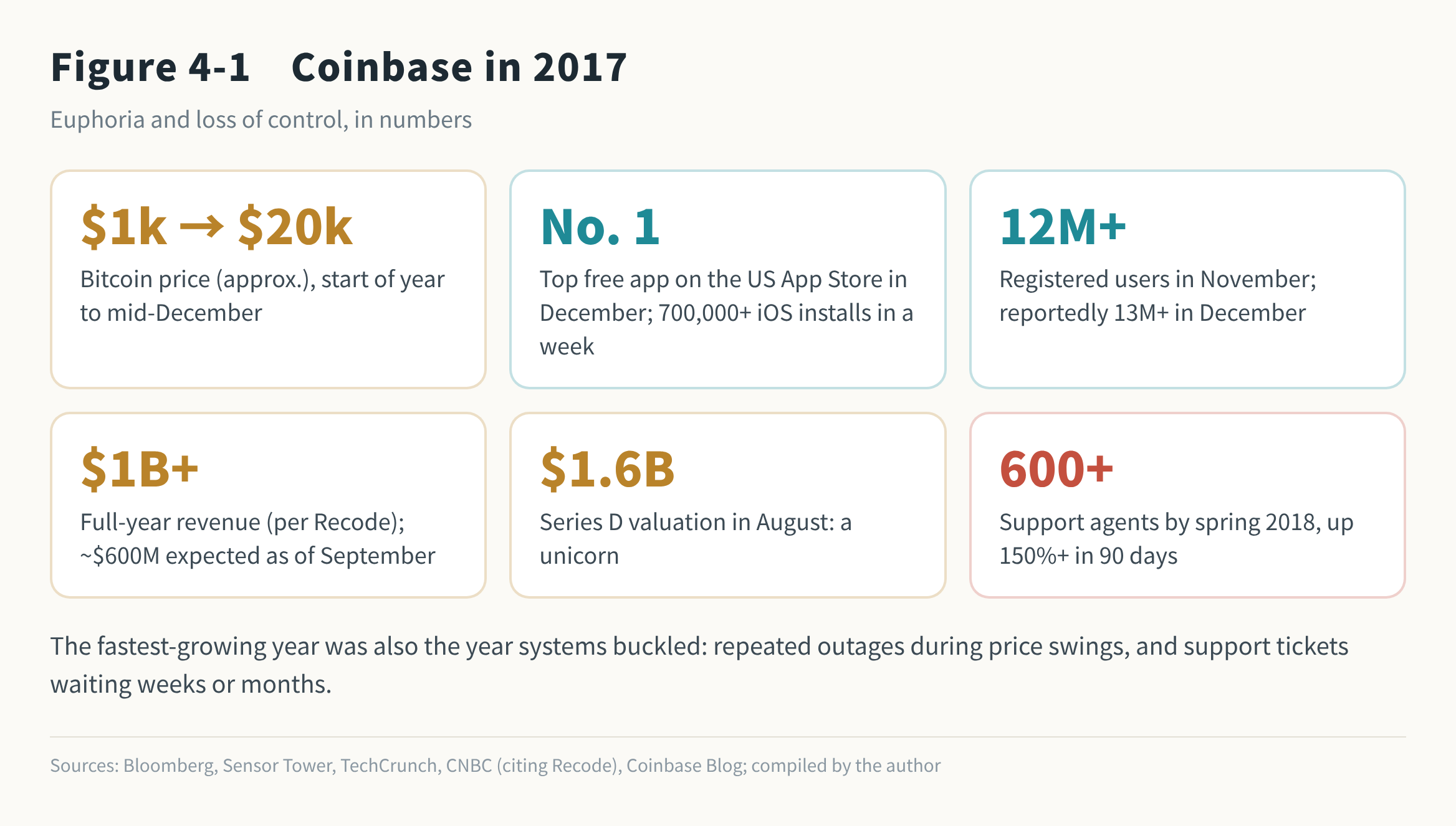
That was Coinbase’s 2017: growth beyond anyone’s dreams on one side, and systems crushed by that growth on the other. That year bitcoin’s price rose from about $1,000 at the start of the year to nearly $20,000 by mid-December, and Coinbase became, for the first time, “a name all of America knew.”
But two things that year quietly set up what came later. One was a listing controversy over Bitcoin Cash that raised questions about Coinbase’s internal governance. The other happened on the other side of the world: an exchange called Binance was founded, and a little over six months later it was the largest exchange in the world by trading volume.
1. A bull market it wasn’t ready for
The 2017 bull market was on a different scale from 2013.
That year the ICO (initial coin offering) craze swept the world. New tokens launched on Ethereum every week, sometimes raising tens of millions of dollars in minutes. Bitcoin kept setting new highs, and at one point Google searches for “bitcoin” outnumbered searches for “Trump.” Taxi drivers, college students and retirees were all talking about how to buy crypto.
For these new users, Coinbase was almost the only choice: the best-known, most legitimate and easiest platform in the United States. In August 2017, Coinbase raised a $100 million Series D led by IVP at a valuation of about $1.6 billion, officially becoming a “unicorn.” By November it had more than 12 million registered users; by December, according to reports, more than 13 million, more than the number of client accounts at the established brokerage Charles Schwab.
The money came in faster than expected too. According to Recode, citing people familiar with the figures, Coinbase expected about $600 million in revenue for the year as of the end of September 2017. The run between Thanksgiving and Christmas pushed full-year revenue above $1 billion.
Growth far outran what the systems could handle.
Whenever prices swung sharply and huge numbers of users rushed in at once, Coinbase’s website and app slowed down, froze or went down entirely. Users watched prices rise or fall and couldn’t place orders, and their anger is easy to imagine. Support tickets piled up; some users complained that account problems had gone unanswered for weeks or even months.
Coinbase’s chief product officer, Jeremy Henrickson, later admitted publicly: “There have been some well-publicized occasions this year where we haven’t kept up with the volume. We are not yet where we should be.”
The biggest hole was customer support. Millions of new users arrived within a few months, and every locked account, missing transfer and stuck identity check became a ticket. In January 2018, Coinbase hired Tina Bhatnagar from Twitter to run support, with the goal of giving all customers 24/7 phone support by the second quarter. Bhatnagar published a “90-day plan” to bring on about 500 support agents within three months. By spring 2018, Coinbase said it had more than 600 agents across three locations, offered round-the-clock phone support, and was opening an office in Portland dedicated to support.
By the company’s own account, it grew its support team by more than 150 percent in 90 days. That was the price, at the scale of more than ten million users, of the promise from Chapter 1, when the CEO personally answered complaint emails.
At an exchange, an outage is not just a user-experience problem. It means users’ money can be hurt, and trust can be hurt with it.
There was also a close call that year. In June 2017, after a sell order of about $12.5 million on GDAX, ether’s price flash-crashed from about $317.81 to $0.10, triggering a wave of forced liquidations in margin accounts. Afterward, GDAX said it had found no wrongdoing or compromised accounts, and announced that it would use company funds to compensate users who had been liquidated or had stop orders triggered during the crash. It did not reverse any trades; those who bought ether at the low price kept their gains. It was a real-money delivery on its image of “someone takes responsibility when something goes wrong.”
2. Bitcoin Cash: a governance crisis
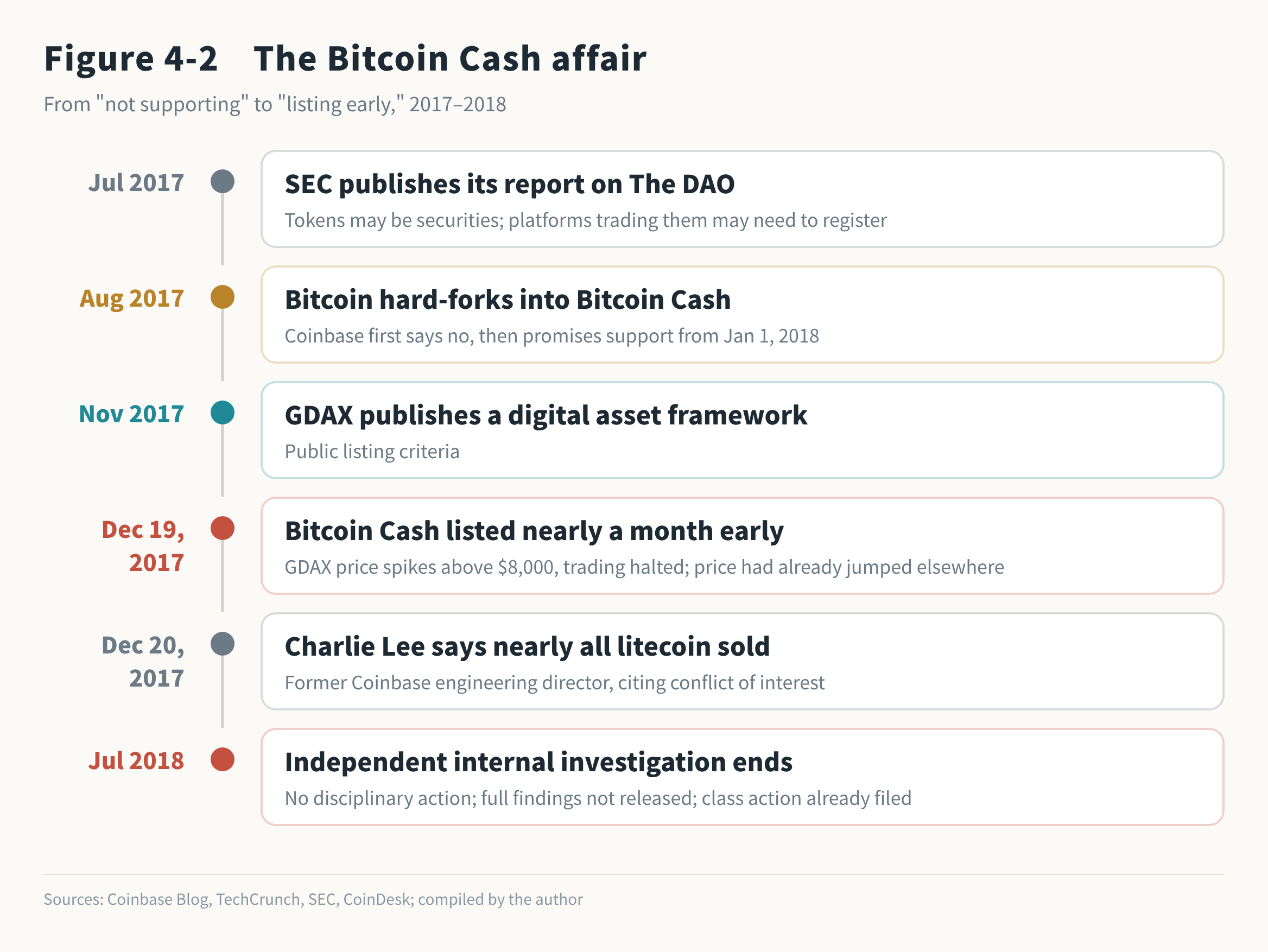
In August 2017, bitcoin hard-forked over the scaling debate, producing a new chain: Bitcoin Cash (BCH). At the moment of the fork, everyone holding bitcoin received an equal amount of Bitcoin Cash “out of thin air.”
Coinbase initially said it would not support Bitcoin Cash. That angered many users: their bitcoin was held at Coinbase, so the Bitcoin Cash from the fork should be theirs. In early August, under pressure from users threatening to move their assets or even take legal action, Coinbase reversed itself and promised to support Bitcoin Cash from January 1, 2018: first allowing withdrawals, then deciding whether to open trading.
On December 19, 2017, nearly a month early, Coinbase suddenly announced that Bitcoin Cash trading was live.
Just before the announcement, Bitcoin Cash’s price had already started rising sharply on other exchanges. After launch the market was chaotic. On GDAX, Bitcoin Cash briefly traded above $8,000, far above prices elsewhere, and trading was halted.
Accusations followed immediately: someone had known in advance that Coinbase would list Bitcoin Cash and bought ahead of time.
Armstrong responded on the company blog. All Coinbase employees and contractors had been explicitly prohibited from trading Bitcoin Cash; given the price rise before the announcement, the company would investigate; anyone found to have broken the rules would be fired immediately, and appropriate legal action taken.
Soon after, a group of users filed a class-action suit against Coinbase, alleging negligence and insider trading in the listing.
Another event that same week made the phrase “conflict of interest” even more glaring.
Charlie Lee, creator of Litecoin, had been a director of engineering at Coinbase. Lee was still at the company when Coinbase listed litecoin, and left only in June 2017 to work on Litecoin full time. On December 20, the day after the Bitcoin Cash chaos, Lee announced on Reddit having sold or donated nearly all of their litecoin. The reason given: Lee had too much influence, and holding litecoin while tweeting about it was itself a conflict of interest.
Lee denied having anything to do with the Bitcoin Cash listing mess. But together, the two events made the outside world see a question nobody had seriously asked before: when an exchange’s employees and former employees have all kinds of ties to the coins it lists, who guarantees that listings are fair?
In July 2018, Coinbase announced that an independent internal investigation by two national law firms had concluded and that the company would take no disciplinary action. It did not release the full findings or name the firms.
Legally, no law at the time clearly prohibited “insider trading” by crypto company employees. But in terms of trust, the episode exposed a problem: Coinbase had become big enough that every listing decision could move the market, yet its internal governance and information controls were still at startup level.
The direct product of that lesson was the set of listing procedures, employee trading restrictions and information barriers Coinbase gradually built afterward. But in December 2017, the price it paid was its reputation.
3. The other side of the world
While Coinbase was being knocked around by traffic, another story was unfolding.
In July 2017, Changpeng Zhao (CZ), a Chinese-born Canadian who had been chief technology officer at OKCoin, founded an exchange called Binance. It raised about $15 million in an ICO, issuing its own platform token, BNB.
Binance took a road almost exactly opposite to Coinbase’s:
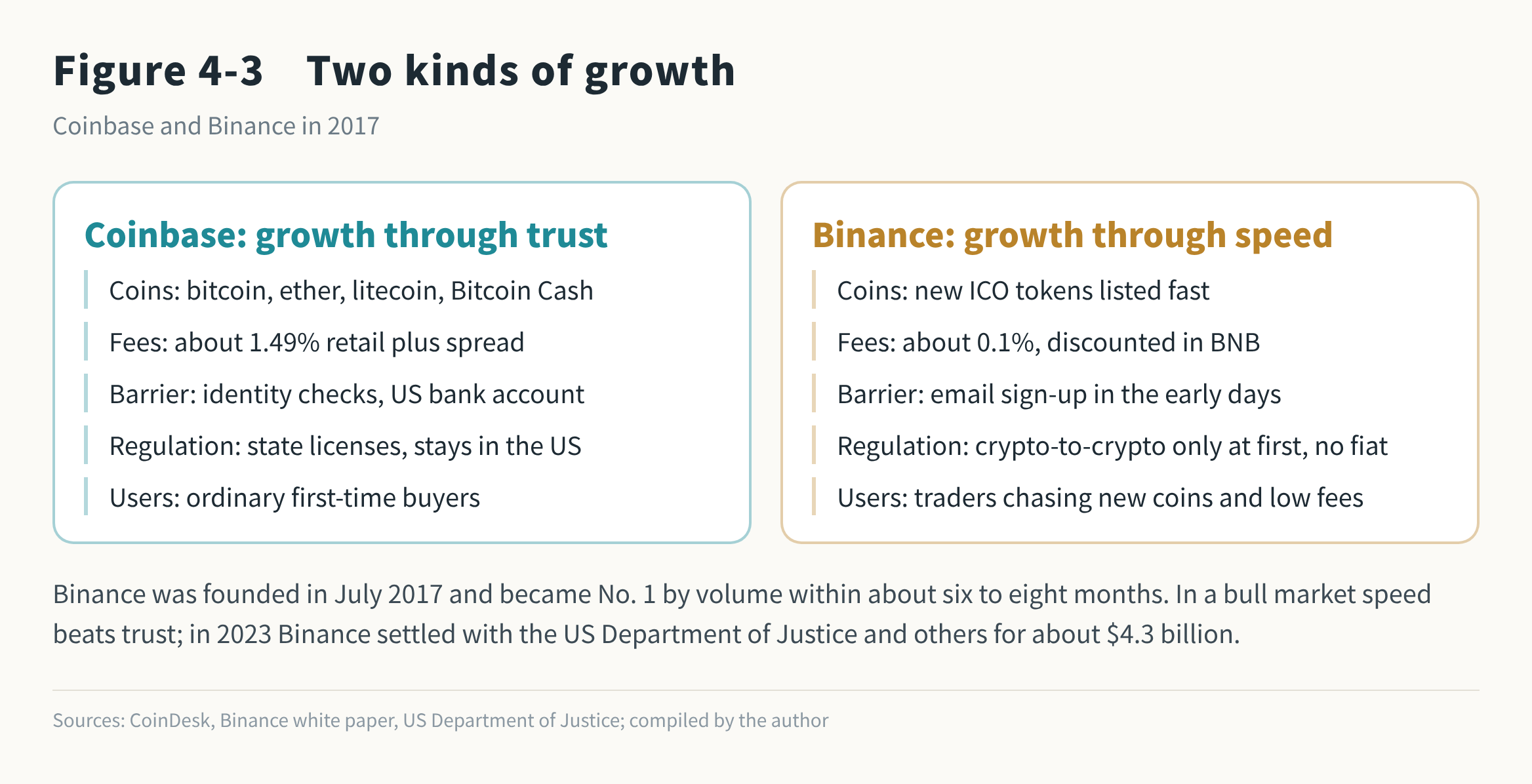
- Fast listings: the flood of new tokens born in the ICO boom could trade on Binance quickly, while Coinbase supported only bitcoin, ether, litecoin and Bitcoin Cash.
- Low fees: trading fees of about 0.1 percent, with a discount if paid in BNB, far below Coinbase’s retail fees.
- Low barriers: in the early days, an email address was enough to register and trade, without strict identity verification.
- No banks: early on it mainly did crypto-to-crypto trading and didn’t handle fiat directly, which let it largely avoid countries’ rules on fiat exchange.
- Global by design: no fixed headquarters, with a team spread around the world, going wherever policy was friendly.
The results were astonishing. Sources differ slightly, but all point to the same conclusion: within about six to eight months of its founding, Binance had become the world’s largest crypto exchange by trading volume.
Inside Coinbase, outages and the Bitcoin Cash affair had people scrambling. In the global market, a faster, cheaper rival with more coins was drawing away professional traders and global users in droves.
This was the “cost of compliance” mentioned at the end of Chapter 2: compliance won Coinbase ordinary American users, but in global markets it handed the advantages of speed and coin selection to Binance.
4. Two kinds of growth
Put the Coinbase and Binance of 2017 side by side and you see two completely different ways of growing.
Coinbase grew on trust. Most of its users were ordinary Americans buying crypto for the first time. They chose Coinbase because it “looked the safest and most legitimate.” They were willing to pay higher fees for that, but they also expected more of it on outages, support and fair listings.
Binance grew on speed. Most of its users were traders chasing new coins and low fees. They chose Binance because it was the fastest place to buy the newest tokens at the lowest cost. They didn’t care much about regulation or compliance, at least not in 2017.
In a bull market, growth through speed almost always beats growth through trust.
In a bear market, in a crisis, when regulators come down, it is the other way around. Binance would not really face that reversal until 2023: that year it and its founder settled with the US Department of Justice and other agencies, pleaded guilty and paid about $4.3 billion, and Changpeng Zhao stepped down as CEO.
But at the end of 2017, nobody knew that. At the time, Coinbase looked more like a clumsy, expensive, behind-the-times “old” exchange.
5. Looking back: judgment or luck?
Where it wasn’t prepared: The 2017 outages showed that Coinbase underestimated the size of the bull market. In a market where prices can rise twentyfold in a year, system capacity has to be built for extremes, not for normal conditions. Coinbase spent heavily on engineering over the following years to catch up. The irony is that the year its systems were most overwhelmed was also the year its revenue first passed $1 billion: the money from growth took longer to absorb than the problems from growth.
Where it corrected quickly: After the Bitcoin Cash affair, Coinbase quickly put in place more formal listing procedures and employee trading rules. In fact, a month before the affair (November 2017), GDAX had published a “digital asset framework” explaining its listing criteria; after the affair, those rules were enforced more strictly.
The real question: Conservative listing was the most debatable decision of the year. Judged by results, Coinbase missed a great deal of volume and fee income from the ICO boom and gave Binance the chance to become number one globally. But also judged by results, the vast majority of tokens issued in 2017 ICOs went to zero in the bear market that followed, and many projects were later found by the US SEC to be unregistered securities. Had Coinbase listed these tokens en masse, it would likely have faced serious legal consequences in the regulatory storm that followed.
In fact, the warning had already been issued in the summer of 2017. On July 25, the SEC released its investigative report on The DAO, concluding that the tokens issued by this Ethereum project were securities, and that platforms trading them should register as securities exchanges or qualify for an alternative trading system exemption. The SEC did not say all tokens were securities, and it brought no charges, but the signal was clear: what you list could decide whether an exchange has to answer to securities law. Binance could ignore that signal. A company that wanted to stay in the United States and go public could not.
What if Coinbase had taken Binance’s road in 2017?
It would probably have won back a lot of volume in the short run and kept the “world’s number one” spot. But it would also have lost its banking partners, US regulators’ tolerance, and its later eligibility to go public and become an ETF custodian. More importantly, it would have ended up in the same dock as Binance.
The lesson of this chapter: in a bull market, growth hides every problem; a company’s real foundation shows at the moment traffic overwhelms it.
Decision Card
- Situation: The 2017 bull market: explosive user growth, a flood of ICO tokens, and Binance rising on low fees and fast listings
- Options: A: list fast and lower barriers to compete with Binance on speed B: stay conservative on listings and put compliance and system stability first
- Choice: B, but neither systems nor governance were ready, leading to outages and the Bitcoin Cash listing affair
- Outcome: Short term: users and revenue exploded, but Binance overtook it in global volume and its reputation suffered. Long term: it avoided the regulatory risk of most ICO tokens
- Lesson: In a bull market, growth hides every problem; a company’s real foundation shows at the moment traffic overwhelms it
Key line: In a bull market, speed beats trust. In a crisis, trust beats speed.
Sources
- Reaching the top of the App Store and outages: Bloomberg, 2017-12-08; Bitcoinist; Sensor Tower
- User numbers and 2017 performance estimates: Finance Magnates
- The Bitcoin Cash listing affair: Fortune, 2017-12-20; CoinDesk: Coinbase Hit by Lawsuit; Cointelegraph; Finance Magnates
- Binance’s founding and rise: CoinDesk: Binance; Cointelegraph interview with Changpeng Zhao; CoinTracker
- Series D: TechCrunch, 2017-08-10
- Ether flash crash and compensation: TechCrunch, 2017-06-24; SiliconANGLE
- Change of position on Bitcoin Cash: CNBC, 2017-08-04; Fortune
- GDAX digital asset framework: CoinDesk, 2017-11-02
- 2017 revenue above $1 billion; about $600 million expected as of end-September: CNBC, 2018-01-22 (citing Recode); Finance Magnates
- More than 13 million users in December, more than Charles Schwab: Business Insider India
- Tina Bhatnagar’s hiring and the 24/7 phone support goal: CNBC, 2018-01-22; the 90-day plan: Coinbase Blog: Customer Support Update — Our 90 Day Plan; more than 600 agents, three locations, the Portland office: Coinbase Blog: Update: Our Commitment to Supporting Coinbase Customers; GeekWire, 2018
- Charlie Lee’s departure and litecoin sale: TechCrunch, 2017-12-20; Gizmodo; Cointelegraph
- The SEC’s DAO report: SEC press release 2017-131; Morgan Lewis
From my new book Coinbase: On the Side of the Rules: https://pickful.ai/books/tqn4
转发此帖子?
与您的关注者分享。
回复