
目錄(7 節)

·
America Opened a Door for Tokenized Stocks. Robinhood's Current Tokens Can't Walk Through It
In one week of September 2026 the CLARITY Act stalled and the SEC issued a five-year innovation exemption for tokenized U.S. stocks. Robinhood's current Stock Tokens don't qualify. Four things it must do to enter: change the asset, build a venue, manage issuers and choose a ledger.
If you work at a U.S. broker, exchange, market maker or tokenization firm, mid-September 2026 is a week worth remembering: Congress’s road closed and the SEC’s door opened.
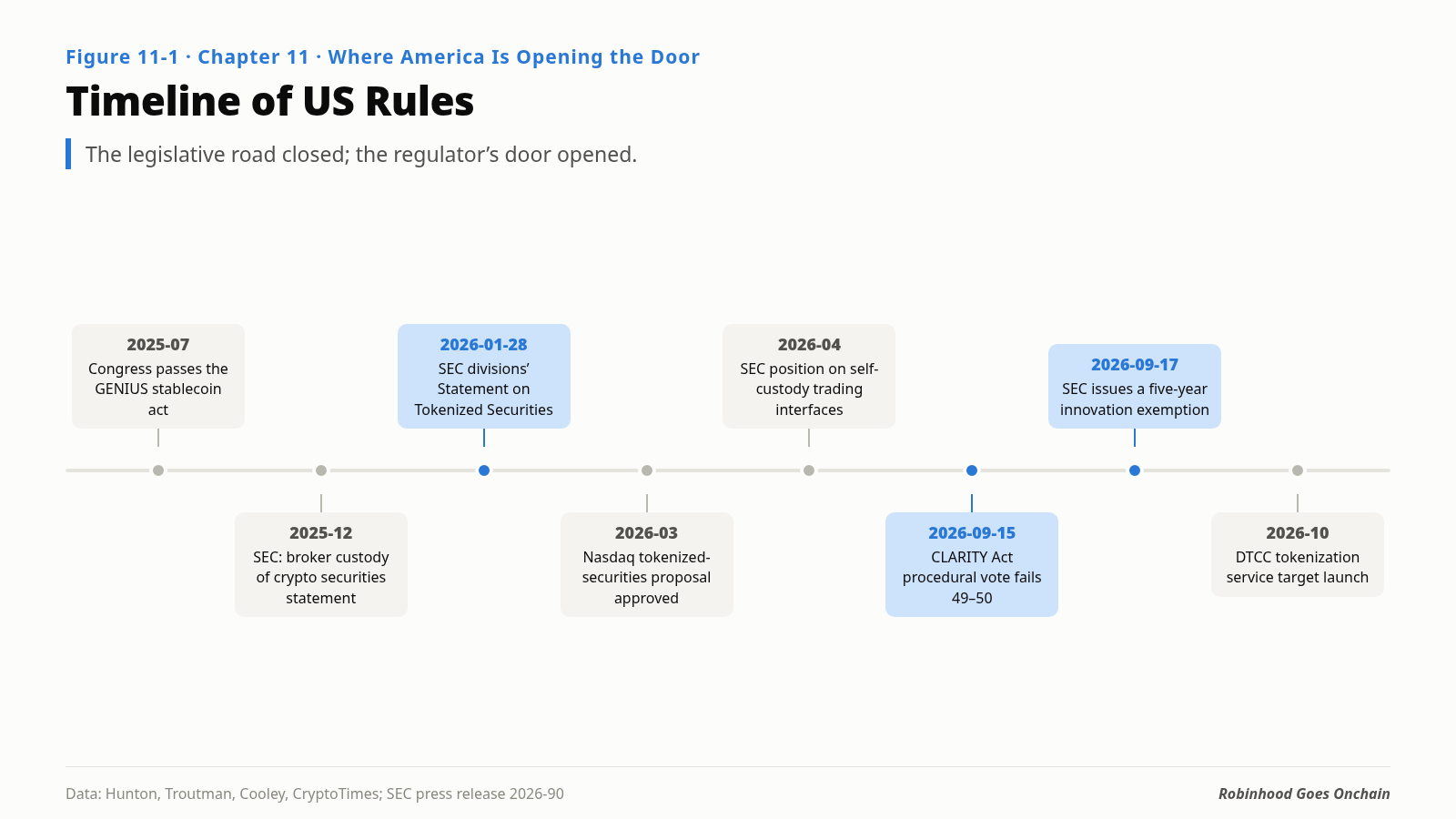
- September 15: a procedural Senate vote on the CLARITY market-structure bill failed 49–50, far short of the 60 votes needed to end debate. Several law firms concluded it had little chance in this Congress.
- September 17: the SEC issued a five-year innovation exemption allowing tokenized versions of U.S. listed stocks to trade onchain.
For some time to come, U.S. tokenization rules will be shaped mainly by regulators’ orders, statements and rules, not by acts of Congress.
What the Exemption Actually Allows
Two kinds of firm, two exemptions. A Tokenized Securities Venue (TSV) is not treated as an exchange, so it need not register as a national securities exchange or an alternative trading system. A firm supplying its own capital as liquidity to a TSV’s AMM pools is not treated as a dealer.
It is a five-year, conditional definitional exemption that covers only activity meeting its conditions strictly. Obligations around brokers, transfer agents, clearing agencies, securities registration and the Investment Company Act are not resolved by the order.
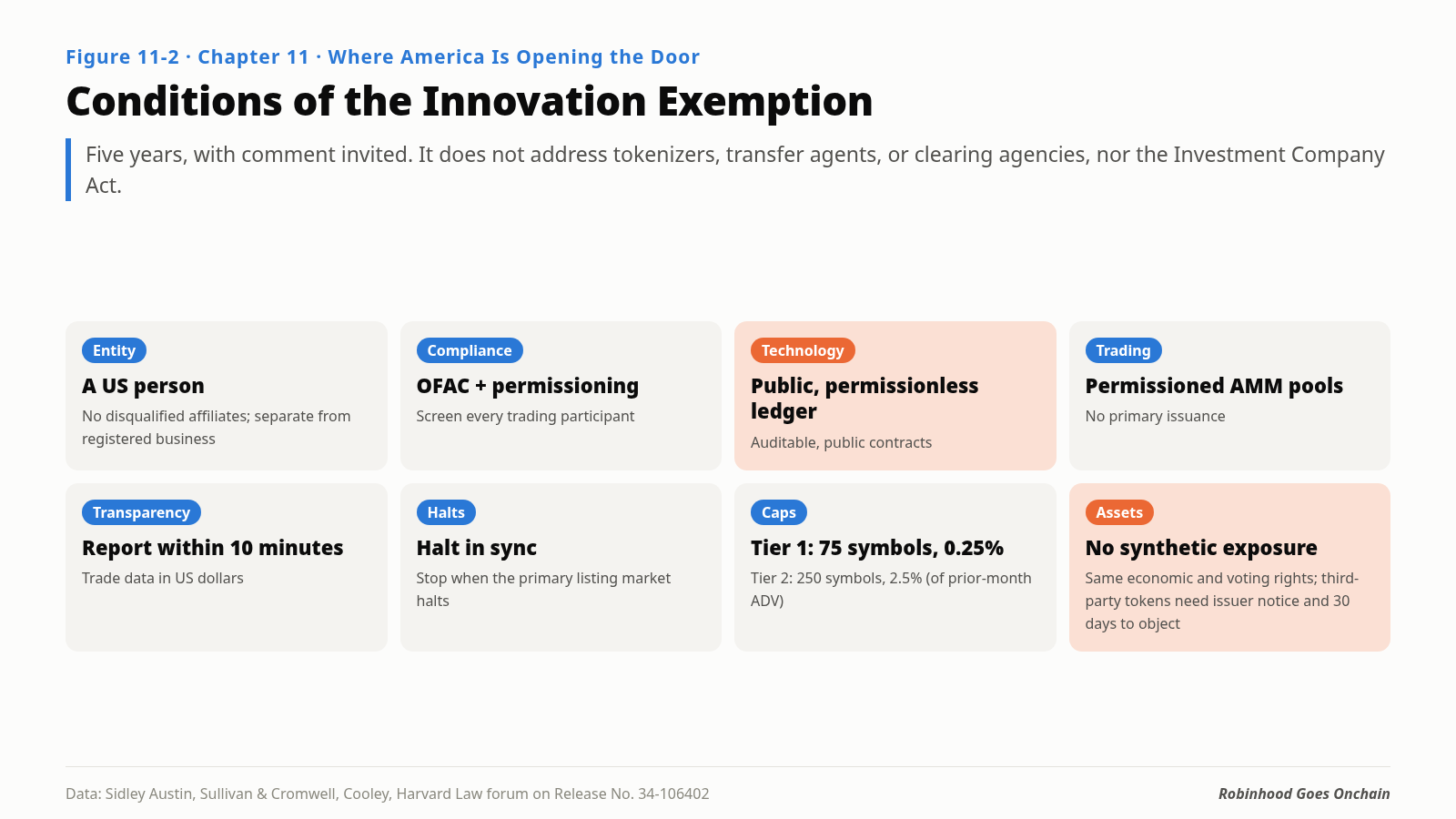
There are many conditions. The ones that matter most:
| Condition | Requirement |
|---|---|
| Operator | The TSV must be a U.S. person; a registered firm’s affiliate may run it, kept separate from registered business |
| Compliance | OFAC sanctions compliance and permission screening of every participant |
| Technology | Auditable, public contracts on a public, permissionless ledger |
| Trading | Through permissioned AMM pools; no primary issuance |
| Transparency and halts | Trades published within 10 minutes; trading halts when the stock halts on its primary exchange |
| Limits | Tier 1: up to 75 tickers, each under 0.25% of prior-month average daily share volume; Tier 2: up to 250 tickers, 2.5% |
| Assets | Tokenized by the issuer or an unaffiliated third party, with the same economic and voting rights; no synthetic third-party securities |
| Issuer | For third-party tokenization, written notice to the issuer and a 30-day objection period |
Commissioner Hester Peirce added the same day that the order is not about decentralized finance.
Why Robinhood Can’t Get In
Check the list and Robinhood’s current Stock Tokens miss on at least three counts. They are debt securities from a Jersey subsidiary giving synthetic exposure with no rights in the underlying share. They carry no votes today; in-kind redemption and voting are “coming soon,” with no date. And the existing product was issued offshore with no issuer-notice and 30-day objection process.
So on the day of the exemption, Tenev said “tokenization is coming to America,” while researchers broadly noted that the existing synthetic products from Robinhood, Kraken and Ondo all fall outside the framework. The door is open; Robinhood needs a different product to walk through it.
The Framework: Four Things to Do Before Entering
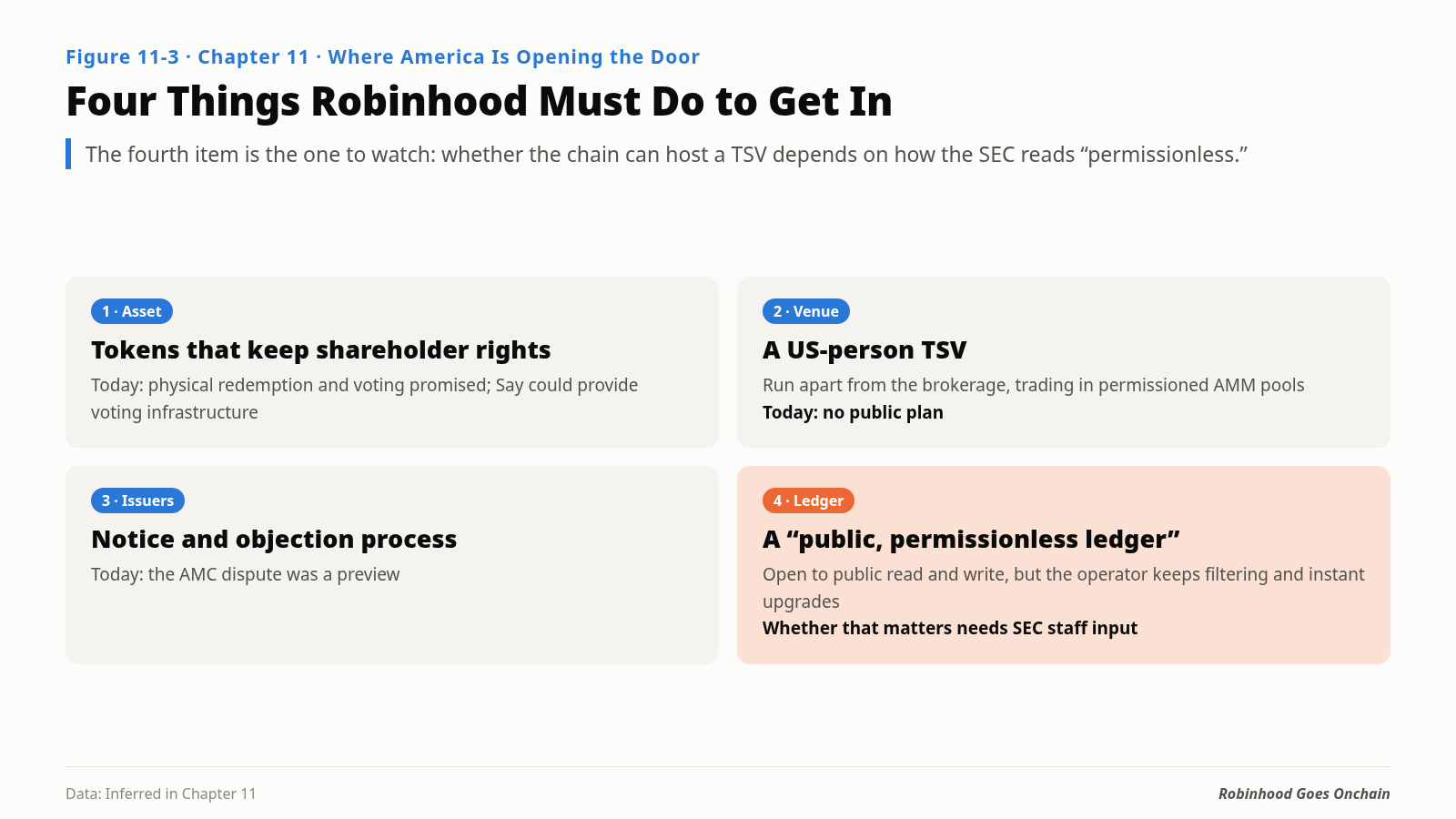
Work through the conditions and Robinhood has at least four things to do before U.S. customers can trade stock tokens onchain:
| Step | What it takes | Existing foundation |
|---|---|---|
| 1. Change the asset | Tokens that preserve shareholder rights | Redemption and voting promised; a feature promise is not a change in legal classification |
| 2. Build the venue | A U.S.-person TSV, separate from the brokerage | No public plan yet |
| 3. Manage issuers | A notice and objection process | The AMC fight was a rehearsal |
| 4. Choose the ledger | A public, permissionless ledger | See below |
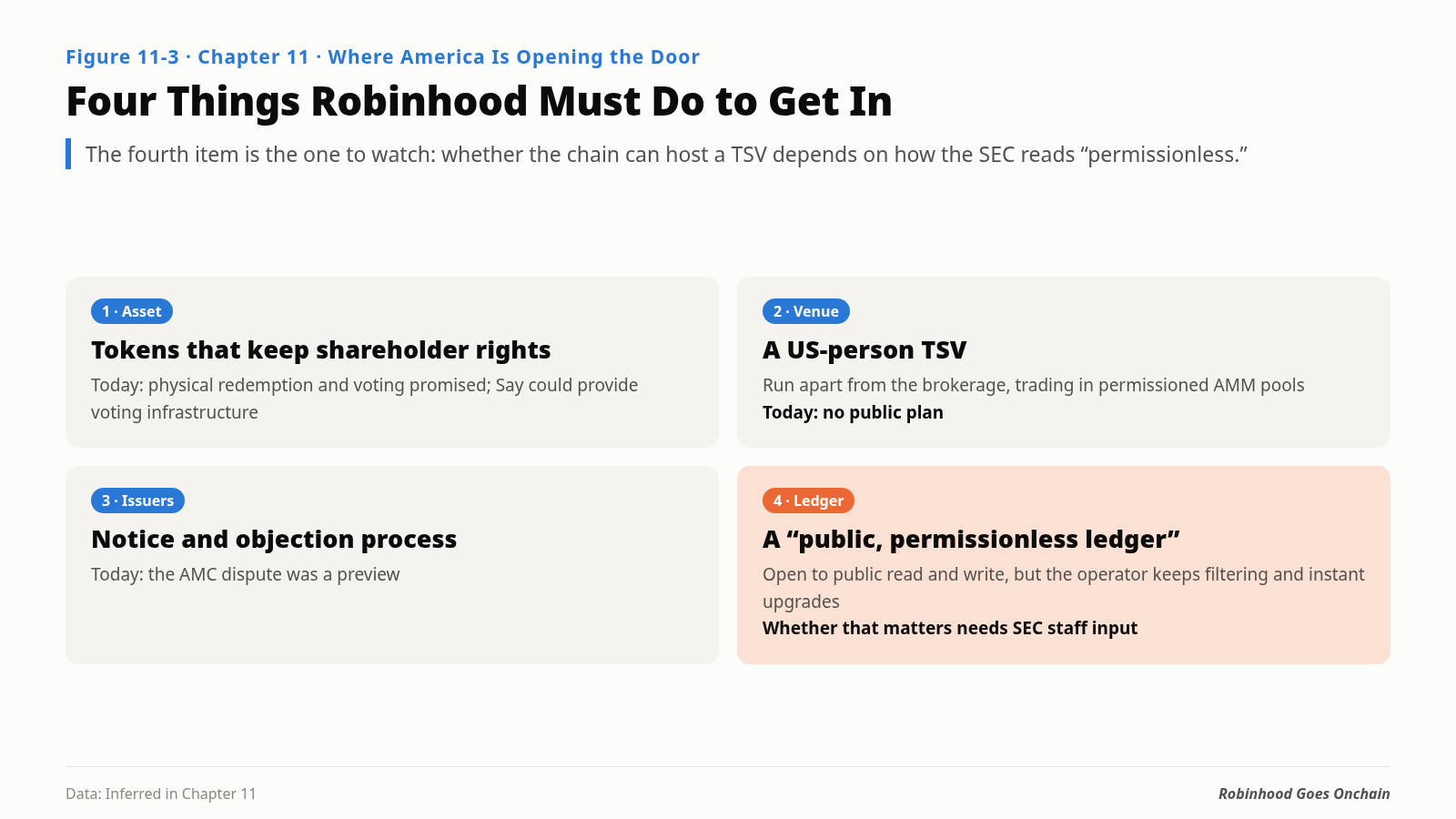
The fourth is the one to watch. The order generally reads “permissionless” as anyone being able to read and write the ledger without authorization. Robinhood Chain is open for public reads and writes, but the operator keeps transaction filtering and instant upgrades. Whether those powers affect the assessment has to be settled with SEC staff, and the order invites market participants to ask. Whether the chain can host a TSV directly depends on how the SEC reads “permissionless,” and perhaps on whether Robinhood is willing to adjust its controls.
“Thousands” Is Mainly an International Strategy
On October 1, according to press accounts, Tenev said the goal was to expand Stock Tokens from about 200 to thousands, and that private-equity tokenization had a path to implementation.
Inside the U.S. framework, thousands will not fit: any single venue relying on the exemption is capped at 75 tickers in Tier 1 and 250 in Tier 2. That does not cap every U.S. tokenization path forever, but for the foreseeable future, thousands is mainly an international strategy.
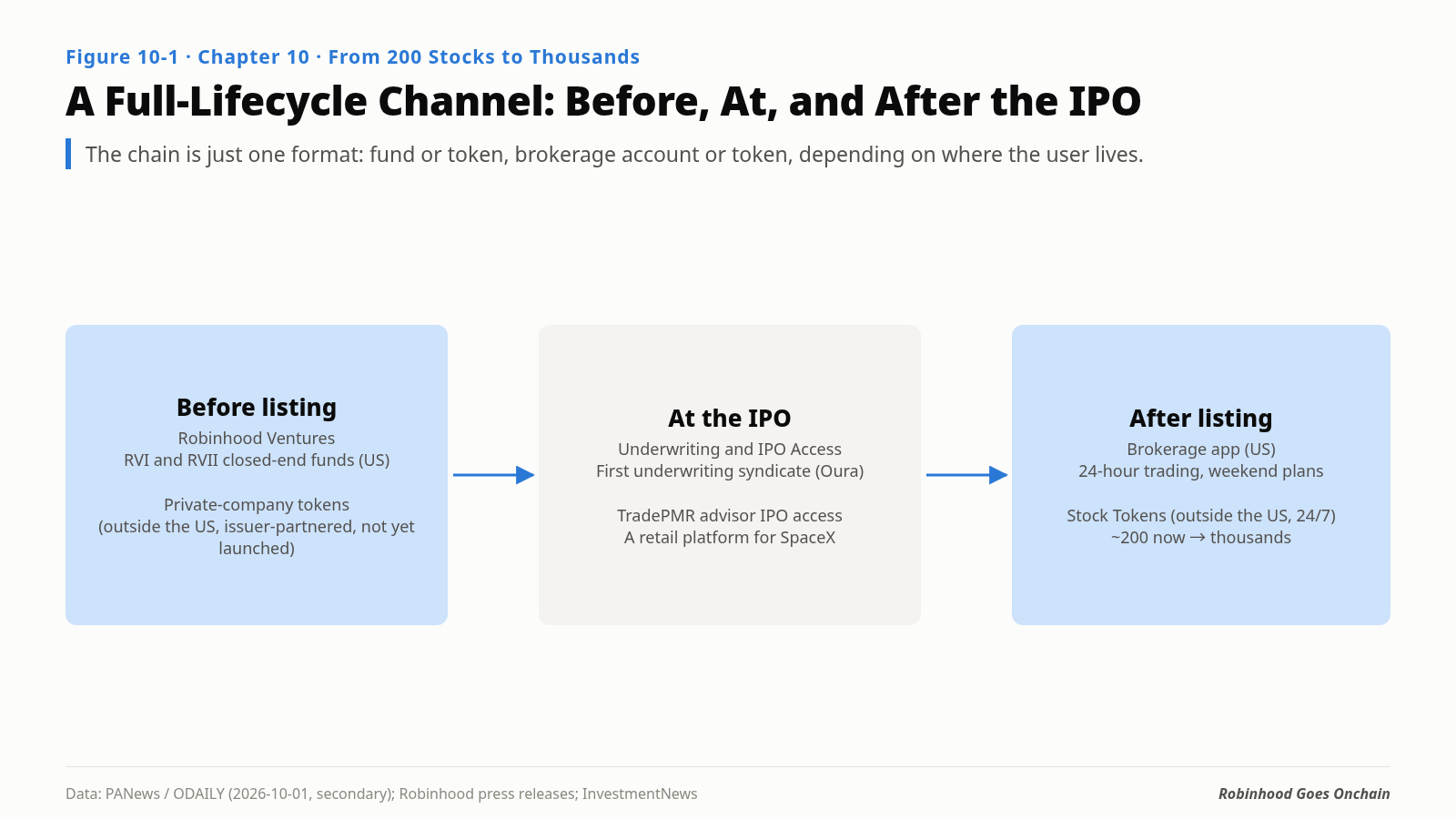
Private companies are harder, and the difficulty is legal. Share transfers usually need the company’s consent, and the SEC’s January statement explicitly assumes the tokenized securities carry no issuer-imposed transfer restrictions. So private-company tokenization most likely runs through issuer partnerships, and Robinhood Ventures’ relationships with private companies are the natural way to get that consent. That is my inference; the actual plan will be in Robinhood’s announcements.
Who Is Already Inside
Nasdaq’s tokenized-securities proposal was approved in March, with settlement through DTC. DTCC completed a production transaction with tokenized assets in July. Uniswap v4 launched permissioned pools for regulated assets with Superstate and Securitize in July. Most of these sit on the rights-preserving side.
America opened the door for real shares. Robinhood’s advantage is distribution: tens of millions of U.S. customers already onboarded and KYC’d. What it has to fix is the form of the asset.
If You Work in This Business in the U.S.
- Exchanges and market makers: TSV and liquidity provider are new compliance identities. The ticker and volume caps say that, for five years, this is a controlled experiment, not a replacement for existing markets.
- Tokenizers: the exemption does not protect the tokenizer itself. Rights-preserving structures get the widest path.
- Software and data firms: the conditions are a requirements list: permission screening, 10-minute trade reporting, halt synchronization, cap monitoring, issuer notices. Every TSV needs them.
The Takeaway
The U.S. door opened at venues and liquidity providers, and it opened for real shares. Robinhood has the customers; to get in, it first has to change the asset. Whichever of the four steps lands first will be the chain’s first U.S. signal.
Of the four steps, which do you think Robinhood takes first?
— Adapted from Robinhood Goes Onchain: A Broker’s First Year, Chapter 10, “From 200 Stocks to Thousands—and from Public to Private,” and Chapter 11, “Where America Is Opening the Door”
The full book (17 chapters, 48 figures, first 3 chapters free to read): https://pickful.ai/books/qx7q
轉發此貼文?
與您的關注者分享。
回覆