
目錄(6 節)

·
The Pool Says 0% Fee, Every Trade Pays 1%: Three Technical Forks Behind a Launchpad
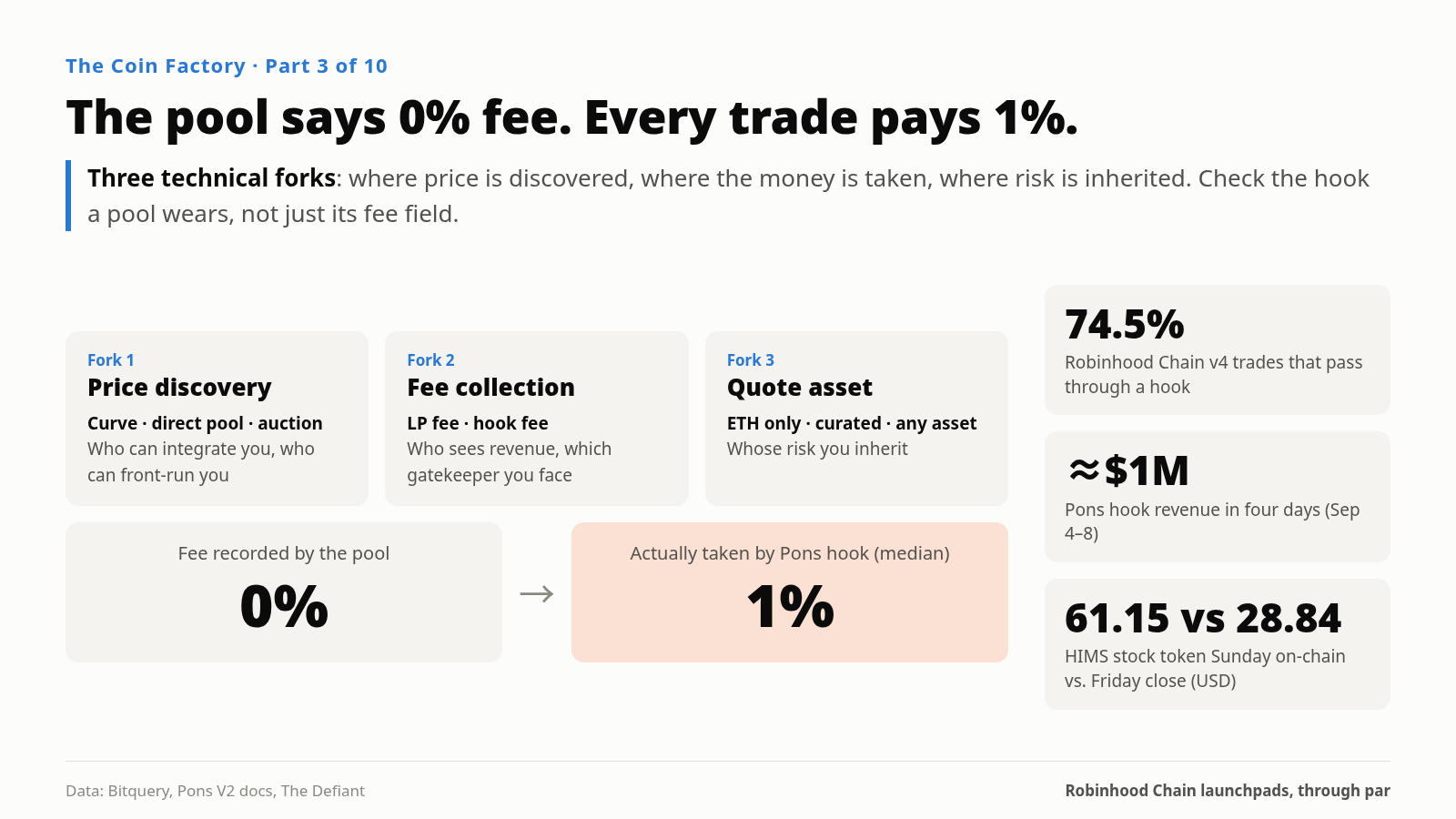
Pons pools on Robinhood Chain record a 0% fee, but its hook takes a median 1% per trade. How three technical forks (price discovery, fee collection, quote asset) decide who can integrate a launchpad, who can front-run it and who can see its revenue.
If you need to tell two similar-looking launchpads apart, or you’re designing a launch mechanism of your own, start with a pool’s fee field.
Trade a memecoin that graduated from Pons on Robinhood Chain, and the Uniswap pool records a fee of zero.
The money still gets collected. Bitquery read on-chain logs from September 4 to 8: 74.5% of Uniswap v4 trades on this chain went through a hook, and one contract handled nearly three-quarters of those hook trades. That contract is Pons’s PonsV2MemeHook. After the pool finishes its math, the hook takes a slice out of the trader’s output. In a one-day sample of 94,053 trades, the median take was 1% per trade, while the pool’s own record shows the trade paid nothing. Bitquery estimated the hook earned about $1 million in four days.
Pons’s V2 docs are upfront about it: zero fee is not a bug; the pool charges nothing, and the hook collects the swap fee and splits it under the same rules. So nothing is hidden. But it does mean any dashboard that only reads a pool’s fee field will show Pons as “zero fee.”
The biggest differences between launchpads usually aren’t on the interface. They’re in a few low-level choices.
Three technical forks: how price is discovered, how fees are collected, and what asset tokens are quoted in. Each fork decides three things at once: who can integrate you, who can front-run you, and who can see your revenue.
The sample is four launchpads on this chain: Pons, pools.trade, PAIR and par.
Fork one: price discovery
Three approaches:
- Bonding curve (Pons; pools.trade’s instant mode): the token first trades on the launchpad’s own curve contract, with price rising as people buy. On Pons, once 4.2 ETH comes in, it “graduates” into a Uniswap v4 pool.
- Direct pool (par, PAIR): at launch, the entire supply goes into a Uniswap v4 pool as single-sided liquidity. No curve, no graduation.
- Auction (pools.trade’s Crowd Launch): for four hours everyone submits a budget, fills are time-weighted so earlier bids get better prices, and if it doesn’t reach a $10,000 valuation everyone gets a full refund.
Three consequences.
First, who can integrate you. During the curve phase, trades happen inside the launchpad’s own contract, so terminals have to build specific support to show and trade pre-graduation tokens. Pons got that: Axiom gave it three dedicated columns for new, about-to-graduate and graduated tokens. A directly pooled token is a standard v4 pool from its first block, so any terminal can trade it with no adaptation. But no terminal needs a relationship with you either.
Second, who can front-run you. This chain’s sequencer processes transactions in arrival order and doesn’t accept priority bids, so front-running comes down to network latency. par, with direct pools, uses the simplest atomic protection: the creator bundles a dev buy into the launch transaction, guaranteeing they’re the first fill. That holds regardless of how ordering rules change. Pons uses a sniper tax that starts at 99% on buys and decays exponentially to zero over five seconds (Pons V2 docs). pools.trade uses its four-hour auction. PAIR caps per-trade and per-wallet size for the first five blocks after launch.
Third, graduation is itself a tradable event. Terminals display “about to graduate” separately, and traders bet on it specifically. Direct pools have no such event, so they lose a natural point of attention.
Fork two: fee collection
Two approaches. Standard LP fees (par and PAIR at 1%, pools.trade at 0.25%) are written into the pool’s parameters where anyone can see them. Hook fees (Pons) set the pool fee to zero and let a hook with afterSwapReturnsDelta permission take a slice at the end of the trade.
Three consequences here too.
Whether revenue is visible. LP fees are a public field. Hook fees don’t appear in the fee field of the trade record.
Whether you need a gatekeeper’s approval. Uniswap Labs’s published rule: hooks with returnsDelta or dynamic-fee permissions must be submitted for review before they can get into Uniswap’s router, and Uniswap Labs retains sole discretion to refuse or later remove them. Pools without those permissions get in automatically. The more powerful way to collect fees has to pass through a gate someone else controls.
Whether you have to sell what you collect. LP fees are charged by direction: on buys you collect the quote asset, on sells you collect the token being traded. So a launchpad ends up holding half its fees in memecoins it launched, which it has to sell or burn. A hook can collect only the quote asset. That’s exactly what par’s developer says V2 will change, but it requires a hook with returnsDelta permission, which means passing through that gate.
Then there’s gas. Bitquery measured that post-swap hook calls cost a median of about 40,000 gas, making a swap roughly a third more expensive. Hooks that run before the swap will reject trades over 1% outright. In older Uniswap versions, a trade would always fill as long as the pool had liquidity.
Fork three: quote asset
pools.trade mainly uses ETH. Pons uses a curated list (ETH, USDG, cbBTC, stock tokens and ETFs). PAIR uses only stock tokens. par lets any token serve as the quote asset as long as it can be priced hop by hop back to ETH with at least 5 ETH of depth at each hop, including memecoins from other launchpads.
Any-asset quoting lets a platform create new uses for existing tokens. But whatever a token is quoted in, it inherits that asset’s risk. par’s docs say so plainly: if you quote in another launchpad’s token and that token goes to zero, yours is worthless too.
Stock token quoting carries two special risks. One is issuer power: the contracts can pause, blacklist, and let an admin burn from any address (more on that in the next piece). The other is the weekend minting window. Stock tokens can’t be newly minted on weekends, so supply is fixed and on-chain prices can drift far from the last close.
August 30 is a real case. A memecoin called BONER was quoted in the HIMS stock token, and its pool soaked up 31,198 of the 58,714 HIMS stock tokens then in existence, about 53%. That Sunday, the HIMS stock token traded at $61.15 in the main USD pool, while the stock had closed Friday at $28.84. At midnight UTC Monday the issuer resumed minting; the first 1,000 newly minted tokens came in, and within 12 minutes the premium fell from 93% to 12% (per The Defiant and CryptoBriefing). Any memecoin quoted in an asset like that passively inherits the distortion.
Oracles are another dependency. PAIR has to combine prices from several stock token pools into a market cap, which relies on an admin-controlled off-chain oracle pulling from Yahoo Finance. If the price hasn’t updated in two hours, new launches fail. par doesn’t depend on an external oracle; it computes hop by hop from current pool prices. Its docs also spell out the limit of that design: a launcher can move the reference pool price within the same transaction, a trade-off made to avoid a half-hour wait. Writing the trade-off into the docs is itself a form of transparency.
Technical profiles of the four
| Technical profile | Best fit | Biggest technical cost | |
|---|---|---|---|
| Pons | Curve + hook fees + curated quote assets | High-frequency speculation, deep terminal integration | Opaque fees; depends on Uniswap router access |
| pools.trade | Auction or curve + standard pools + low fees | Fair launches with brand backing | Barely earns at the launchpad layer; relies on Uniswap’s other layers |
| PAIR | Direct pool + stock token baskets + oracle | RWA narrative | Depends on a centralized oracle; inherits issuer risk |
| par | Direct pool + standard pools + any-asset quoting | Creating uses for existing tokens, open integration | Anti-sniping is only the dev buy; V2’s quote-asset-only fees wait on hook approval |
When comparing two launchpads
Look at the pool’s hook field, not just the fee field. Uniswap v4 encodes a hook’s permissions in the last bits of its address; decode Pons’s hook ending in e044 and you’ll find afterSwapReturnsDelta.
Ask whether terminals need custom integration. If they do, distribution depends on relationships with terminals. If they don’t, anyone can trade you, but no one will go out of their way to recommend you.
Ask about quote asset risk. Especially for memecoins quoted in stock tokens, factor in issuer powers and the weekend minting window.
Closing
Launchpad interfaces all look about the same.
The real differences hide in three choices you can’t see: where price is discovered, where the money gets taken, and where the risk is inherited from.
Next time you see “0% fee,” go check what hook the pool is wearing.
When you compare launchpads, what do you look at first: fees, liquidity or the mechanism underneath?
— Excerpted from Chapter 3 of The Coin Factory, “Three Technical Forks”
轉發此貼文?
與您的關注者分享。
回覆