

·
Stripe Press: Why Does a Payments Company Publish Books?

Stripe started Stripe Press in 2018 and its catalog now lists 21 books. The site's reason: businesses are built from many inputs, and perhaps the most important is ideas. A look at where the books come from, key titles, and the films, websites and magazine beyond print.
Open Stripe Press and you find a shelf of books about technology, business and society. Engineering management, open-source software, the history of personal computing, scientific research, artificial intelligence: the topics look scattered, but they keep returning to one question. How does a new idea turn into something that keeps working for a long time?
Stripe Press is the publishing project Stripe started in 2018. As of November 2026 its catalog lists 21 books. The site sums up its focus as economic and technological progress. Stripe Press
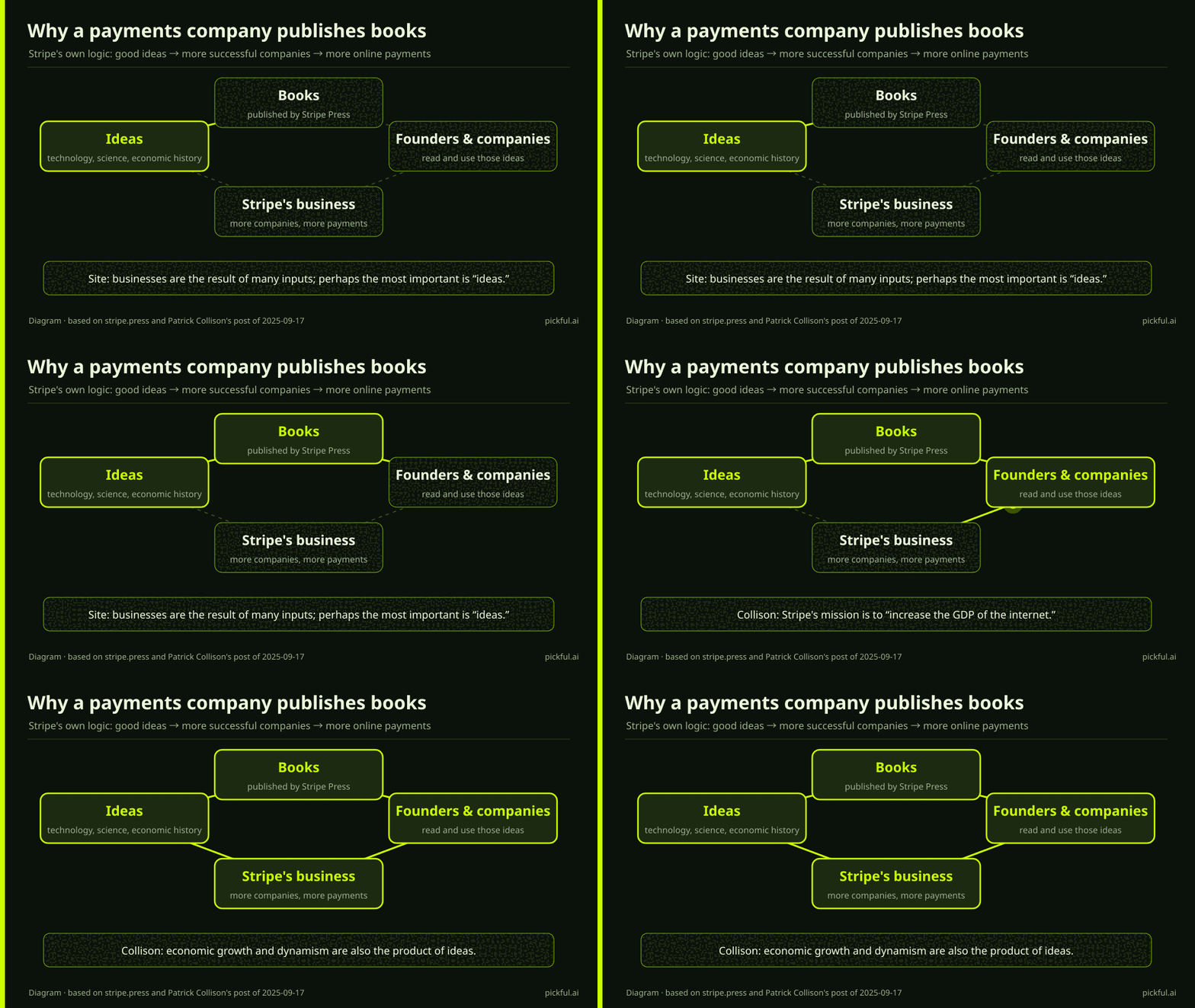
Stripe’s reason sits in the footer of every page on the site: the millions of businesses Stripe works with are the result of many different inputs, and perhaps the most important ingredient is “ideas.” CEO Patrick Collison put it more directly in September 2025. Stripe’s mission is to “increase the GDP of the internet.” It does that mainly by building financial infrastructure, but economic growth and dynamism are also the product of ideas, and Stripe subscribes to economic historian Joel Mokyr’s explanation of the industrial revolution (Mokyr shared the 2025 Nobel Prize in economics). Follow that logic: good ideas help more companies succeed, and companies that succeed process more payments through Stripe. Patrick Collison’s post
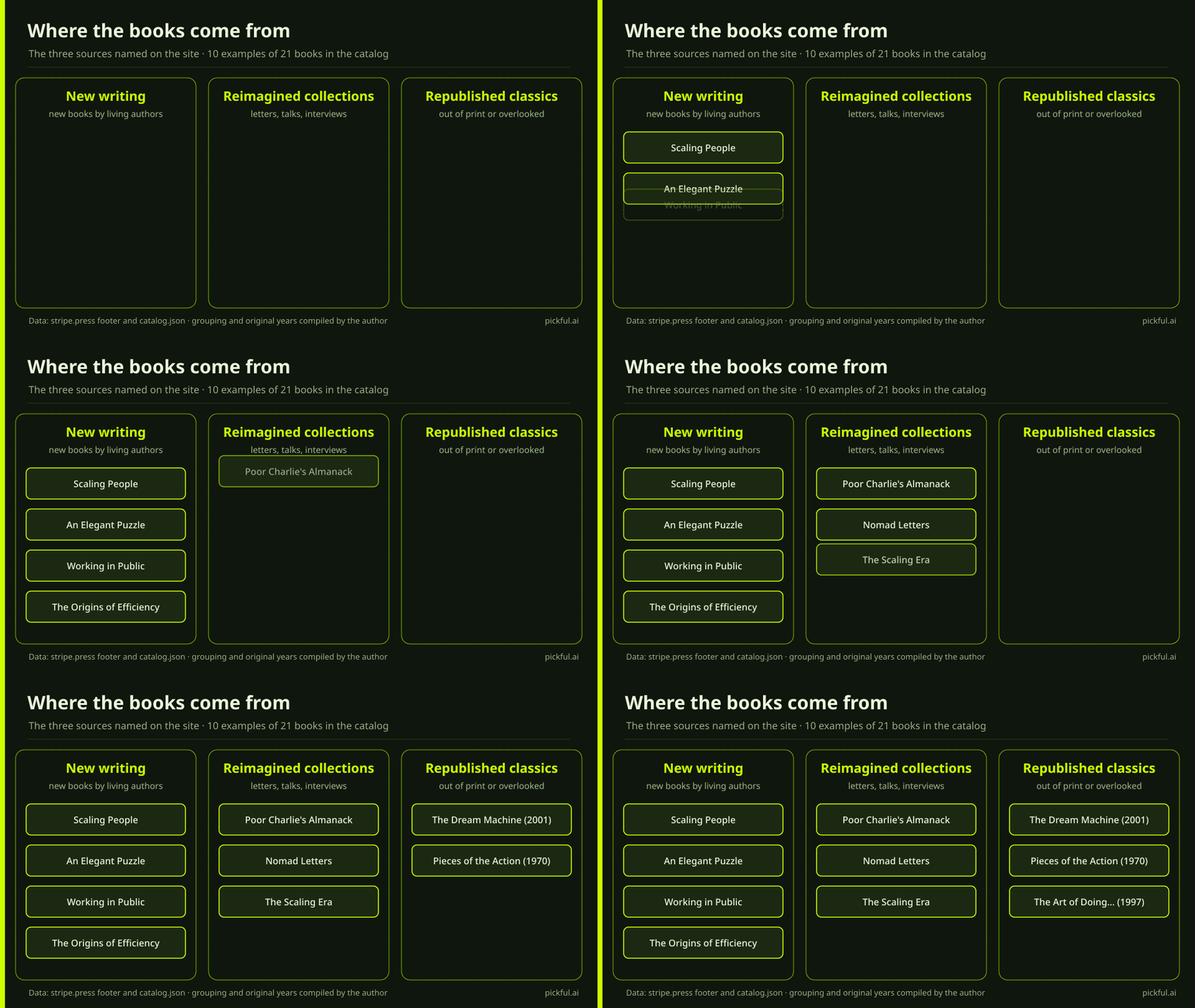
The site also explains where the books come from. Some contain entirely new material, some are collections of existing work reimagined, and others are older books that stayed relevant or became relevant again. Claire Hughes Johnson’s Scaling People and Will Larson’s An Elegant Puzzle are new work. Poor Charlie’s Almanack collects Charlie Munger’s talks, The Scaling Era is drawn from Dwarkesh Patel’s AI interviews, and Nomad Letters, out December 1, is the first print collection of Nick Sleep’s 2001–2014 letters to partners. The Dream Machine (2001), Vannevar Bush’s Pieces of the Action (1970) and Richard Hamming’s The Art of Doing Science and Engineering (1997) are new editions of older books. Stripe Press catalog
The list mixes practical guides that answer “how do I do this” with history and ideas that explain “why things are the way they are.” Scaling People covers the management problems of a growing company; An Elegant Puzzle is about how engineering teams organize and decide. On the other side, M. Mitchell Waldrop’s The Dream Machine tells the story of J. C. R. Licklider to revisit the early visions of personal computing and the internet, and Nadia Eghbal’s Working in Public looks at open-source software and the people who keep those projects running.
Read together, the books show a clear editorial view: progress does not only happen in flashes of insight. It also depends on organization, collaboration, maintenance and slow accumulation. Stewart Brand’s Maintenance: Of Everything, Part One makes the point most directly, moving “maintenance” out of the category of chores and into a discussion of technology and civilization.
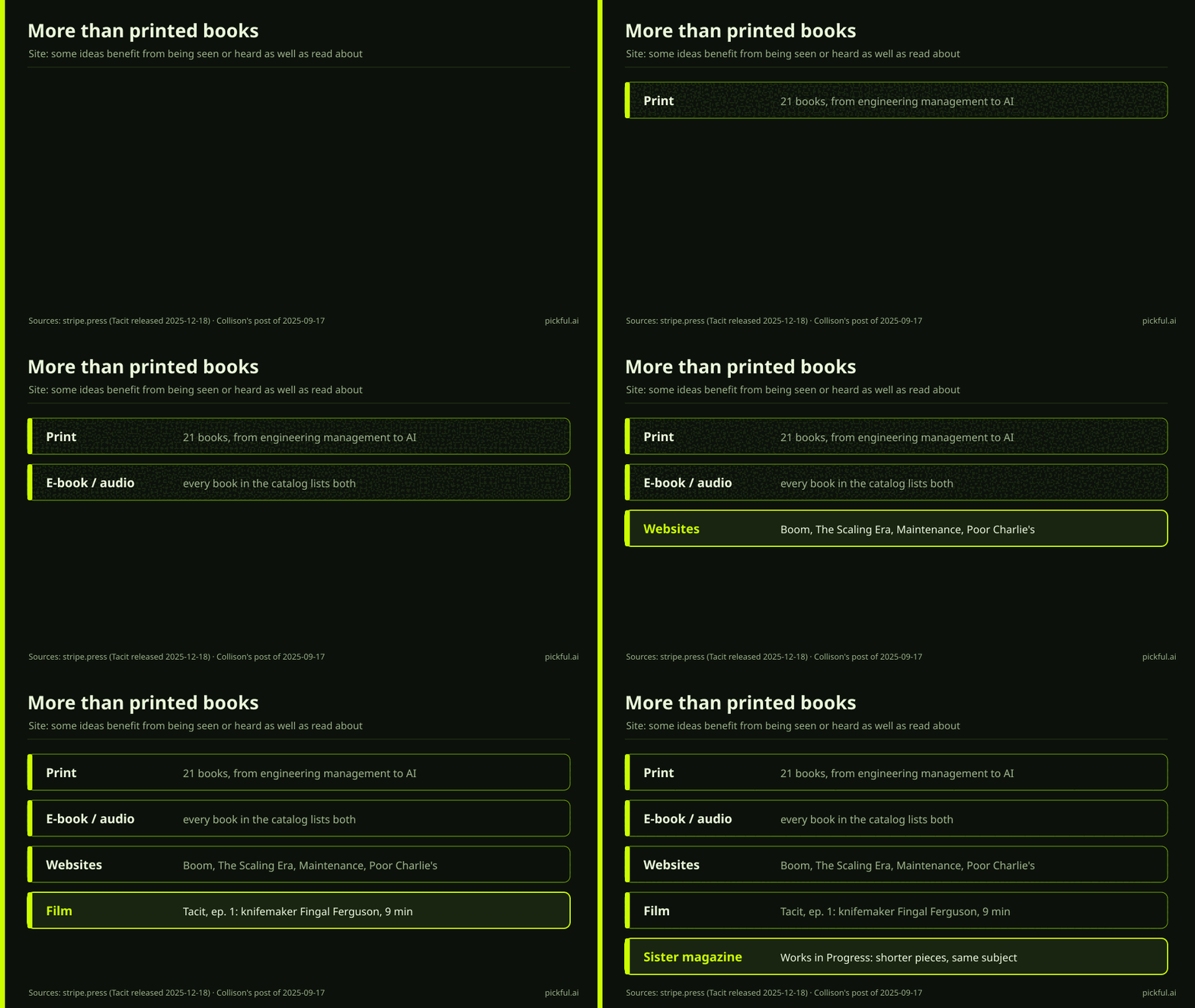
Stripe Press is also taking its work off the page. In the site’s words, some ideas benefit from being seen or heard as well as read about. Every book in the catalog has an e-book and an audiobook. Boom, The Scaling Era, Maintenance and Poor Charlie’s Almanack each have their own website; the Munger one is a complete digital edition. The first episode of the film series Tacit, released in December 2025, runs nine minutes and follows Fingal Ferguson, a fifth-generation farmer and knifemaker in West Cork, Ireland, and the kind of craft knowledge that is hard to write down. Collison also calls the magazine Works in Progress a sister initiative to Stripe Press; it publishes shorter pieces on the same subject.
If you want a place to start, go in through your own question. Leading a team: An Elegant Puzzle. Curious how the internet was imagined: The Dream Machine. Want to understand the labor behind open source: Working in Public. Want to know how AI got here over the past few years: The Scaling Era. That is the appeal of Stripe Press. It does not hand you a set of standard answers. It gives you a shelf of ideas you can keep coming back to.
Repost this post?
Share with your followers.
Reply