
Contents (9)

·
Robinhood Chain's Next Step: Stock Tokens, Developers, and a Global Asset Network
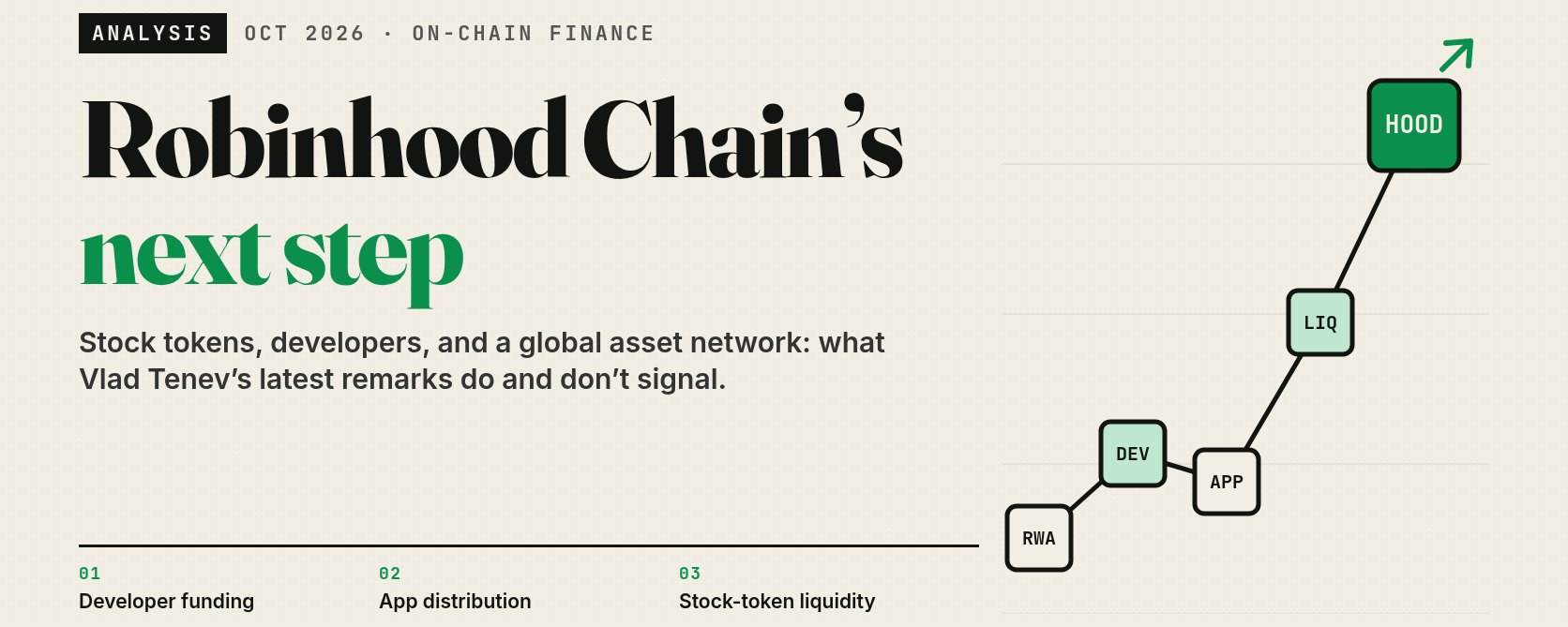
Vlad Tenev's AMA remarks are clearly positive for Robinhood Chain and directionally positive for developers, but not an endorsement of any token. What matters next: developer funding, app distribution, and stock-token liquidity.
On October 12, 2026, Robinhood CEO Vlad Tenev addressed questions about Robinhood Chain in an AMA. He stressed that the company has not abandoned the chain, that early builders matter to the ecosystem, and that Robinhood is investing resources to attract strong developers, with more details to come. Vlad Tenev’s original AMA post
The remarks drew attention because HOOD Summit ‘26 barely discussed Robinhood Chain, leaving some in the community worried that the company had quietly deprioritized it. Against that backdrop, Tenev’s response reads as a strategic reaffirmation, and partly as an effort to steady developer expectations.
But it cannot be stretched into a claim that Robinhood will buy any ecosystem token, support its price, or list a particular project in the Robinhood app.
The Core Takeaway
Tenev’s statement is clearly positive for Robinhood Chain itself and directionally positive for its developer ecosystem, but it is not a direct endorsement of any specific token on the chain.
The signal that really matters: Robinhood is treating this chain as infrastructure for its internationalization, institutional business, and asset tokenization strategy, not as a short-term product experiment.
What the market should watch next is not which projects the CEO mentions, but whether Robinhood actually delivers on three capabilities: developer funding, distribution through its main app, and stock-token liquidity.
Why Does Robinhood Need Its Own Chain?
The claim that “Robinhood Chain is an important priority” is fairly credible, because this direction did not first appear in the AMA.
Tenev has previously told investors that Robinhood Chain can help users in more than 120 countries and regions access U.S. markets; that stock tokens are its core primitive; and that the chain could help Robinhood reach its long-term goal of “50% of revenue from outside the U.S. and 50% from institutional business.” The company also plans to add more stock tokens, expand into other asset classes, improve liquidity, and bring in more institutional participation. Transcript of Robinhood’s September 2026 investor event
That suggests Robinhood Chain may serve three purposes:
- Distributing U.S. financial assets to more overseas users;
- Extending Robinhood from a trading front end into asset issuance and settlement infrastructure;
- Letting outside developers build products around these assets that Robinhood could not design in advance.
As long as Robinhood still believes in asset tokenization, owning its own chain has a long-term strategic rationale.
Does the Summit’s Silence on the Chain Signal a Strategic Downgrade?
HOOD Summit ‘26’s official storyline centered on new tools for active U.S. traders, including AI Agents, weekend U.S. stock trading, perpetual futures, earnings contracts, extended options trading hours, OCO orders, and higher intraday buying power. HOOD Summit ‘26 official product announcement
Robinhood Chain’s main audience, by contrast, is overseas users, on-chain developers, and DeFi markets. The two may need some separation in marketing and regulatory messaging, so that everyday users don’t mistake third-party on-chain projects, meme coins, or DeFi protocols for products Robinhood has vetted or endorsed.
So the summit’s lack of emphasis on the chain is not enough to show that the company has lowered its strategic priority.
That said, the community’s concern is not baseless. For a new chain, if the team goes a long time without publishing a roadmap, a funding plan, and distribution channels, developer expectations will fade. Tenev’s follow-up sent a positive signal, but until the funding size, timeline, and project selection criteria are published, it remains a directional commitment.
How Is “Investing in Great Developers” Most Likely to Play Out?
Publicly confirmed information is limited: Robinhood wants to attract strong developers, is committing resources to that end, invites good projects to reach out, and will announce specific measures later. Report on Robinhood Chain’s developer investment remarks
Based on management’s wording, Robinhood’s existing capabilities, and how other chains typically build ecosystems, the possible next moves can be ranked subjectively as follows. This is not a roadmap the company has published.
| Potential move | Relative likelihood | Rationale |
|---|---|---|
| Developer grants, an accelerator, or an ecosystem fund | High | Best matches the language about “committing resources” and soliciting projects |
| Technical support, liquidity, and market-making resources | High | Liquidity and developer tooling are baseline conditions for a new chain’s ecosystem |
| Robinhood Ventures investing in some teams | Medium-high | Attracts projects while building long-term economic interest |
| Driving traffic via the app, Wallet, or social products | Medium | This is Robinhood’s main edge over an ordinary L2 |
| Listing top projects’ tokens in the Robinhood app | Medium-low | Would still require separate compliance, liquidity, and risk review |
| Buying back or supporting existing ecosystem token prices | Low | No public evidence currently supports this |
The misreading most worth avoiding is automatically translating “investing in developers” into “buying ecosystem tokens” or “leading ecosystem tokens are about to be listed.” There is no necessary link between these things.
Stock Tokens Are the Main Line; Memes Are the Experimental Layer
Robinhood Chain’s official core is not memes but real-world assets (RWA), especially stock tokens.
When Tenev discussed what would make the chain succeed, he pointed straight to stock tokens. His vision is not simply putting stocks into a closed app, but letting these assets enter DeFi and combine with smart contracts, liquidity pools, lending, yield products, and derivatives. Transcript of Robinhood’s Q2 2026 earnings call
He also acknowledged that developers may combine RWA with crypto-native assets such as memes, creating products Robinhood did not anticipate. The more accurate reading: Robinhood supplies real-world assets and infrastructure, and developers experiment freely in a permissionless environment.
Memes function more as a traffic and experimentation layer than as a long-term moat. The advantages Robinhood Chain could genuinely build include:
- Supply of scarce assets such as stock tokens;
- Distribution power from Robinhood’s existing user base;
- Compliance, custody, and institutional relationships;
- Connections among the app, Wallet, and the chain;
- A more mature liquidity foundation.
If the chain ends up with only meme trading, while RWA lending, payments, composite assets, and institutional liquidity fail to grow, then even high trading volume would not prove that its core strategy has succeeded.
The Key Tension: “Open Deployment, Centralized Distribution”
If Robinhood wants to build a sustainable on-chain ecosystem, its ideal flywheel might look like this:
Issue more stock and real-world asset tokens
            ↓
Developers build trading, lending, index, yield, and agent apps
            ↓
More users, volume, liquidity, and fees
            ↓
Attract market makers, institutions, and new developers
            ↓
Robinhood app and Wallet bring in more users
            ↓
Further strengthen asset liquidity and app distribution
Robinhood’s advantage over an ordinary L2 is that it doesn’t have to rely on airdrops to acquire users. It already has brokerage customers, a wallet, a brand, asset-issuance capability, and regulatory relationships.
But this also creates a key tension: Robinhood emphasizes permissionlessness on one hand, while on the other it controls the most valuable asset supply, the main app’s front door, and the potential listing channel. The ecosystem may therefore end up with an “open deployment, centralized distribution” structure: anyone can build, but whether you reach users at scale may still depend on Robinhood’s choices.
Six Risks to Watch
- Regulatory risk: Cross-border distribution of stock tokens, DeFi composability, and tokenization of private assets may face different restrictions in different jurisdictions.
- Liquidity quality risk: High DEX volume may be concentrated in a few assets or include incentivized trading or wash trading, and cannot be equated directly with real demand.
- Ecosystem concentration risk: If traffic revolves mainly around a few launchpads and meme coins, the developer economy may lack staying power.
- Distribution delivery risk: Robinhood has powerful app distribution, but whether it will open that to third-party on-chain apps remains unproven.
- Value capture risk: Robinhood Chain’s success does not mean any given ecosystem token can capture value. Especially without an official native token, the market can easily project the narrative onto unofficial assets.
- Vague commitment risk: “More news coming soon” still lacks a funding size, timeline, and selection criteria, and for now can only be treated as a directional signal.
Final Verdict: Watch Execution, Not Token Associations
Tenev’s statement strengthens Robinhood Chain’s long-term strategic standing and raises the odds that developers get more resources. RWA and stock tokens remain the clearest official direction; memes can be part of an active ecosystem, but they are not a long-term moat Robinhood has confirmed.
Evidence for expectations about existing ecosystem tokens’ prices, investment, or listings remains insufficient.
The three verifiable things truly worth watching next:
- Whether Robinhood announces a developer program with a clear size, duration, and selection criteria;
- Whether Robinhood provides real distribution for third-party on-chain apps through the app or Wallet;
- Whether the variety, use cases, and on-chain liquidity of stock tokens keep growing.
Only if all three materialize can Robinhood Chain graduate from a passing trading hotspot to a global asset chain with durable network effects.
Sources
- Vlad Tenev’s original AMA post
- Transcript of Robinhood’s September 2026 investor event
- Transcript of Robinhood’s Q2 2026 earnings call
- HOOD Summit ‘26 official product announcement
- Report on Robinhood Chain’s developer investment remarks
This article is based on public information. Judgments about Robinhood’s future measures and strategic motives are inferences, do not constitute investment advice, and do not represent Robinhood’s endorsement of any third-party project or token.
Repost this post?
Share with your followers.
Reply