
目录(8 节)

·
Binance Lost $6.3 Billion and Survived. Can Coinbase Survive the Next Winter?

2026 The everything exchange, Base’s trial and error, tokenized stocks and another cold October
On October 29, 2026, two pieces of news hit crypto screens almost at the same time.
The first: Coinbase reported its third-quarter 2026 results. Total revenue was about $1.22 billion, down about 35 percent from about $1.87 billion a year earlier. Reported net income was about $719 million, which looked impressive. But a closer look showed that about $715 million of it came from unrealized gains on crypto assets the company held: paper profits. Excluding those, adjusted net income was only about $78 million.
The second: Binance, the world’s largest crypto exchange, was hacked. According to the blockchain analytics firm TRM Labs, attackers moved about $6.3 billion in assets out of Binance wallets across ten blockchains in roughly 20 minutes. It was the largest theft in the crypto industry’s recorded history. Both TRM Labs and Chainalysis believed the attackers were most likely from North Korea. Binance suspended withdrawals.
The next day, October 30, Coinbase’s stock fell 10.6 percent to close at $143.54, touching a 52-week low during the session. Its high over the previous year had been $361.40.
The scene seemed to replay a plot this book has seen again and again: a huge rival in trouble, the market in a panic.
But this time, the plot didn’t follow the old script.
1. The rival didn’t die
After Mt. Gox in 2014 and FTX in 2022, people naturally asked: would Binance be next?
The answer, at least so far: no.
Binance announced that it had set aside more than $6.34 billion of company funds to cover the stolen assets, and had worked with blockchain partners to freeze about $3 billion of affected assets. User deposits were unaffected. From November 1, Binance resumed withdrawals in phases, and net outflows over the following days came to about $3.64 billion, about 2.1 percent of its total assets; the FBI attributed the attack to North Korea. Binance’s preliminary finding was that the attackers may have entered through the compromised laptop of an operations engineer; as of early November, a full incident report had still not been published. Analysts judged that the attack did not pose a significant threat to Binance’s solvency.
That is fundamentally different from Mt. Gox and FTX. Mt. Gox lost coins and couldn’t pay them back; FTX misused customer assets and couldn’t fill the hole. Binance had $6.3 billion stolen, and could cover it with its own money.
This shows two things:
First, the crypto industry has changed. In 2014, the largest exchange went bankrupt after losing 850,000 bitcoin; in 2026, the largest exchange had $6.3 billion stolen and kept operating. The industry’s leading players had built up enough capital to absorb enormous shocks.
Second, the “rival dies first” script may not easily play out again. In the first half of this book, Coinbase won again and again as its rivals destroyed themselves. In a more mature market, rivals don’t fall so easily, and Coinbase has to win through its own growth, not its rivals’ failures.
Even more notable: when Binance was hacked, Coinbase’s stock plunged too. In investors’ eyes, any risk in the crypto industry spreads to every crypto company, however compliant.
2. The everything exchange
Coinbase’s answer to this environment in 2026 was a strategy it called the “everything exchange.”
According to Coinbase’s quarterly reports in 2026, the company’s three product priorities for the year were: grow the everything exchange, scale stablecoins and payments, and drive on-chain adoption.
The logic of the everything exchange is simple: if Coinbase sells only bitcoin, its revenue will always be tied to bitcoin’s price; if it sells everything, users have more reasons to stay and revenue becomes more diversified.
On December 17, 2025, at a launch event called “System Update,” Coinbase announced a series of new businesses and said the Base App was live in 140 countries:
- Stock trading: US users could trade stocks and ETFs directly on Coinbase, starting with a selection of top stocks and planned to expand to thousands.
- Prediction markets: through a partnership with Kalshi, a prediction market platform regulated by the US Commodity Futures Trading Commission (CFTC), users could trade on the outcomes of sporting events, economic data, political events and more. The service later covered all 50 US states. To expand the business, Coinbase also acquired the prediction market company The Clearing Company in December 2025.
- Stock perpetual futures and other derivatives were also planned.
By the third quarter of 2026, these new businesses had begun contributing revenue: prediction markets passed $200 million in annualized revenue, and, according to the company’s earnings materials, paid Coinbase One subscribers hit an all-time high.
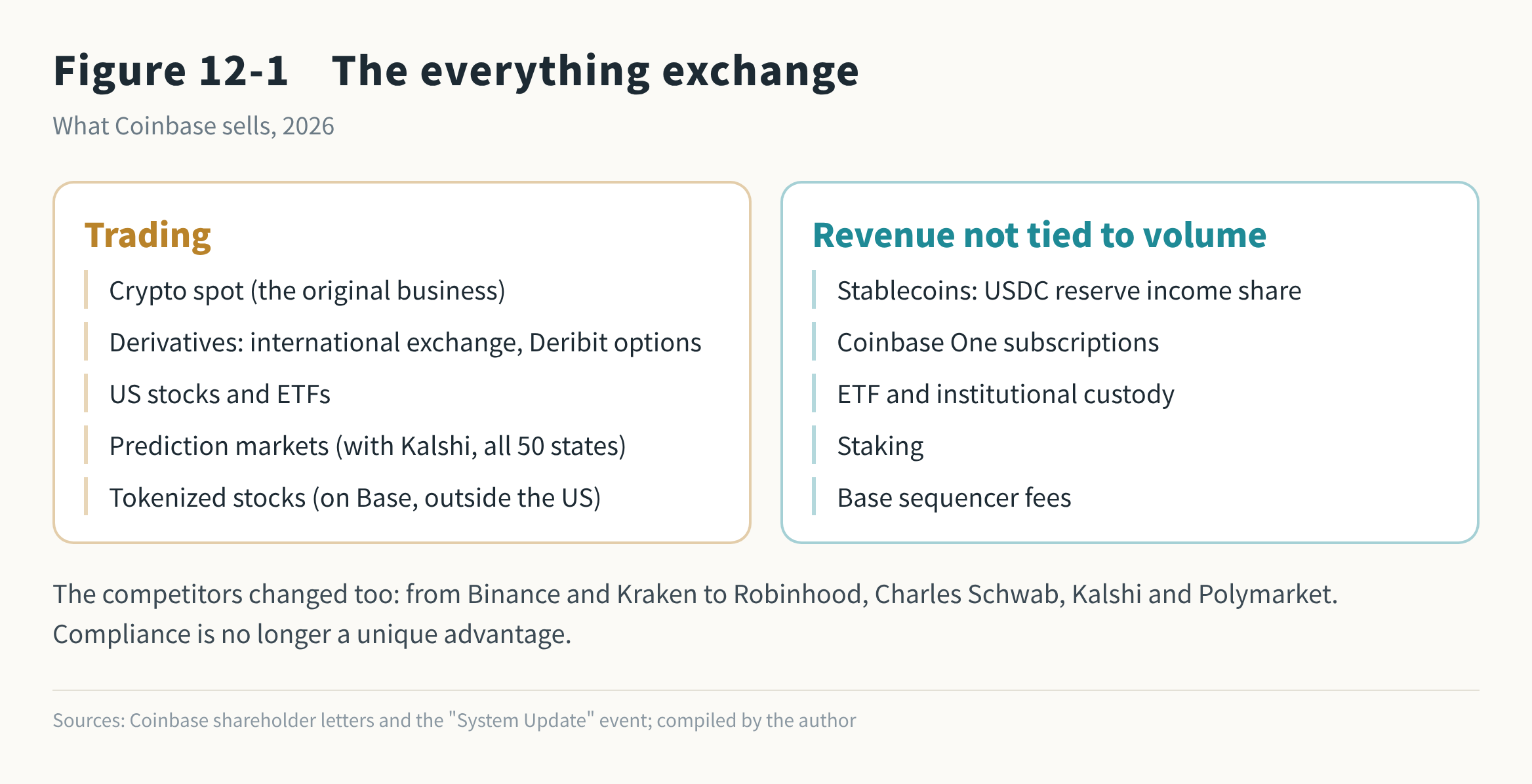
Coinbase was turning from “a crypto exchange” into “a financial platform where you can trade anything.” Its competitors were widening too, from Binance and Kraken to Robinhood, Charles Schwab, and even prediction market platforms like Kalshi and Polymarket.
3. Base: a turn that admitted failure
Beyond the everything exchange, Coinbase’s other main thread was Base.
Base, launched in 2023, had by 2026 become one of the most important layer 2 networks on Ethereum: first among layer 2s in both spot crypto trading volume and DeFi total value locked.
But Base’s development wasn’t smooth. In 2025, Coinbase turned the old Coinbase Wallet into the “Base App” and positioned it as an on-chain “everything app,” with one major direction being on-chain social: letting users post, follow and tip on-chain, turning every piece of content into a tradable token.
That bet didn’t work.
In July 2026, Base creator Jesse Pollak publicly admitted that the bet on on-chain social had been “definitively wrong,” and handed leadership of the Base App to Jordan Fish (known in crypto as Cobie). Pollak said the Base App would become “less Base-centric” and turn into a trading app focused on trading tokenized assets, global stablecoin payments and AI agents.
This is another example in this book of “wrong, but corrected quickly.” A founder publicly admitting that their core bet failed, and quickly handing the product to someone better suited, is not easy at any company.
After the turn, Base made fast progress. In August 2026, tokenized stocks launched on Base: each token backed one-to-one by a real share, tradable on-chain around the clock, but issued only to users outside the US. Within four days of launch, on-chain trading volume passed $120 million; by September 19, 30-day rolling volume passed $1 billion, with single-day volume reaching about $100 million at one point, most of it on Aerodrome, the leading decentralized exchange on Base. Coinbase’s chief financial officer said on the earnings call that sequencer fees on Base were the direct way Coinbase currently earned revenue from tokenized stocks.
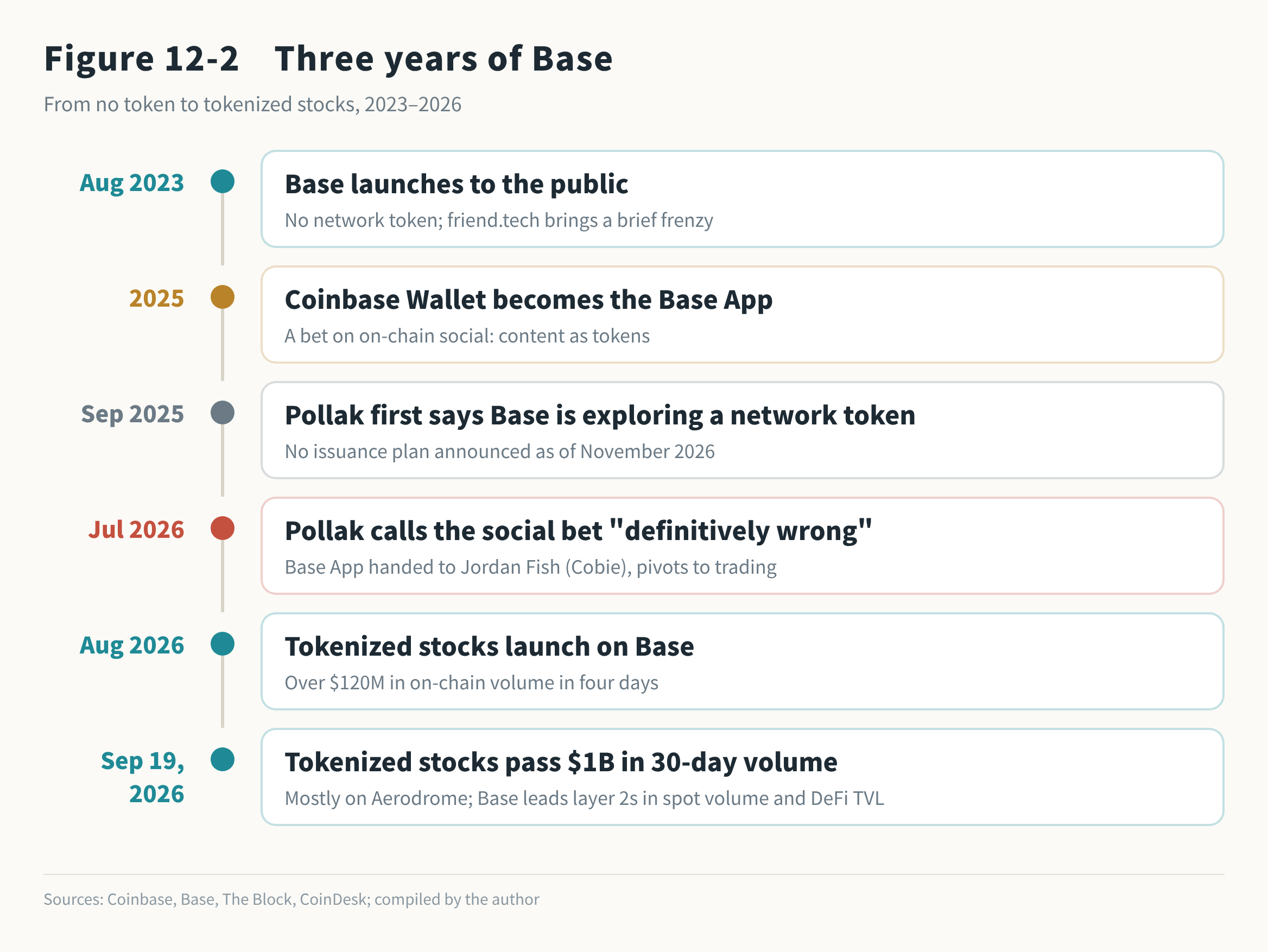
Pollak believes tokenized stocks and non-dollar stablecoins will lead a coming “tokenization supercycle.”
Whether Base will issue its own network token remains an open question. In September 2025, Pollak said for the first time that Base was exploring a network token for governance and incentives; but as of November 2026, Coinbase had not announced any plan to issue one. In 2023, Base chose “no token” as a compliance decision; in the friendlier regulatory environment of 2026, that choice was being reconsidered.
4. Stablecoins and payments
The third main thread was stablecoins and payments.
From USDC planted in the 2018 bear market, to the revenue-sharing restructuring in 2023, to the passage of the GENIUS Act in 2025, stablecoins had become Coinbase’s most important non-trading source of revenue.
In 2026, Coinbase widened its stablecoin bets further:
- It launched a service letting businesses issue custom stablecoins backed by USDC and other assets;
- It pushed USDC as the main payment and settlement instrument on Base;
- It launched x402, a payment protocol for AI agents (open-sourced in May 2025 and donated in April 2026 to the x402 Foundation under the Linux Foundation), letting AI programs pay for services directly in stablecoins over the internet’s HTTP protocol. By mid-2026, x402 had processed hundreds of millions of transactions in total, but some analyses found that about half were wash activity and that real payment value was still tiny; by August, transactions on Solana made up about 70 percent, overtaking Base.
The judgment behind this: if the future internet has huge numbers of AI agents transacting with one another, they will need a currency that programs can call directly and that settles around the clock. Stablecoins are the best candidate for that currency, and Coinbase wants to be the infrastructure for this new payments network.
It’s too early to say whether that judgment is right. But it continues a pattern that runs through this book: planting seeds, beyond the current business, for a future that hasn’t arrived yet.
5. Can it survive this winter?
Back to the October at the start of this chapter.
Bitcoin fell about 7 percent in October, dropping below $80,000 on the 22nd and hovering around $77,000 at month’s end. Trading volume fell, ETFs saw outflows, and the Binance hack dealt another blow to market confidence.
Coinbase’s third-quarter results showed clearly the pressure it faced:
- Falling trading revenue: total revenue was down about 35 percent year over year, showing that Coinbase’s revenue still depended heavily on how active the market was.
- Questionable earnings quality: most of the $719 million in net income came from paper gains on crypto it held; if prices kept falling, those gains could turn into losses.
- Non-trading revenue near half: third-quarter subscription and services revenue was about $570 million, up about 3 percent from the previous quarter and about 49 percent of net revenue; stablecoin revenue within it was about $307 million. In a quarter when trading revenue fell sharply, this part essentially held steady.
- New businesses still early: prediction markets passed $200 million in annualized revenue, and tokenized stocks traded around $100 million a day, still small next to Coinbase’s overall revenue.
Meanwhile, Coinbase’s board raised its share buyback authorization from $2 billion to $4 billion in January 2026; but in the third quarter, the company bought back only about $5.3 million of stock, all in August, leaving about $1.96 billion of the authorization unused as of the end of September.
There was one more easily missed detail. Starting in the second quarter of 2026, Coinbase stopped reporting “trading volume” as a key operating metric; second-quarter monthly transacting users were about 7.6 million, a third fewer than the 11.4 million at the end of 2021. An exchange that chooses to stop emphasizing trading volume is telling you how it wants to be seen.
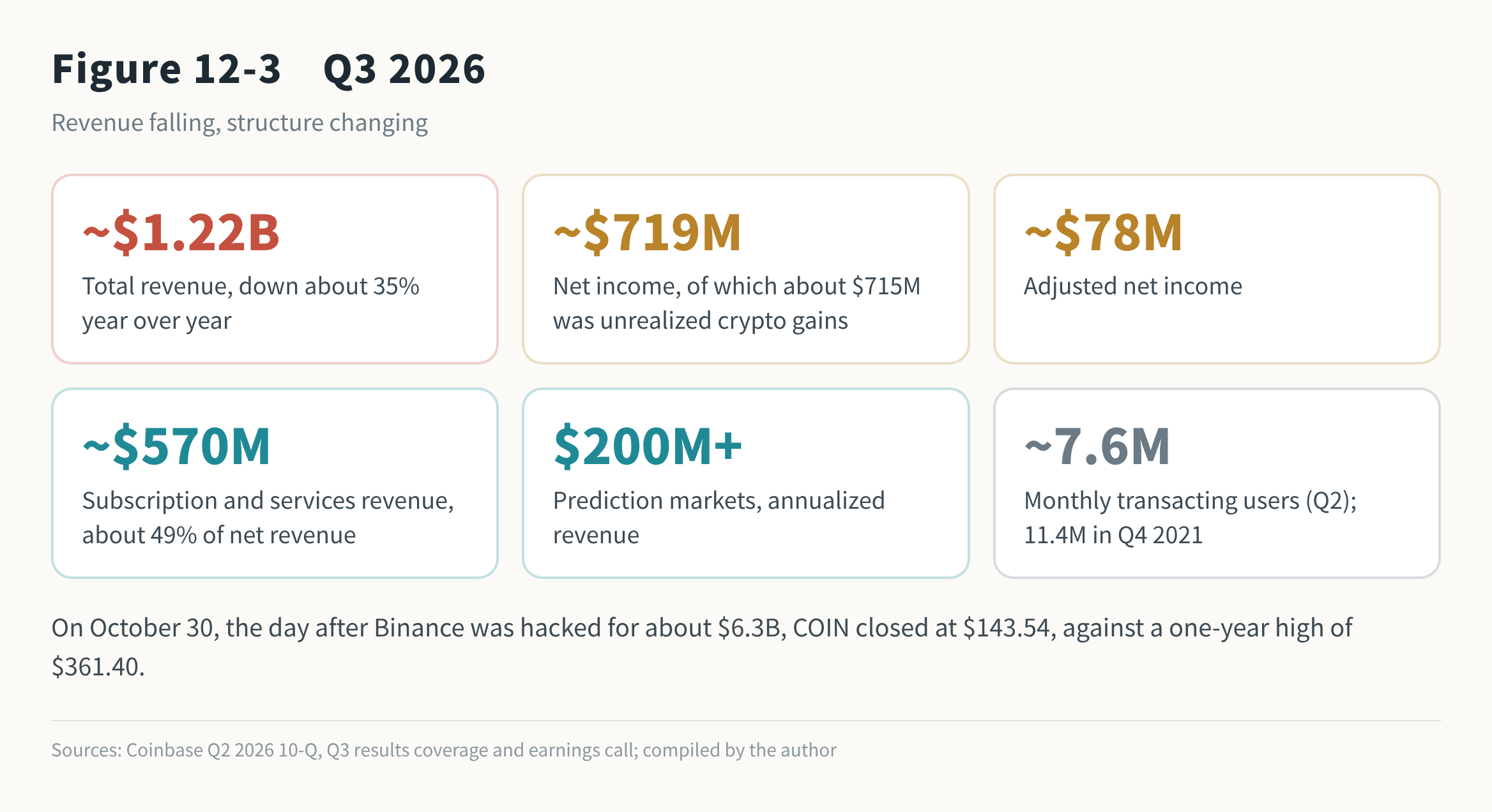
This is the Coinbase of 2026: unprecedented scale, standing and diversity of business on one side, and a cyclicality it still hasn’t escaped on the other.
Can it survive this winter?
Based on this book’s history, the answer is probably yes. Coinbase survived the Mt. Gox collapse of 2014, the winter of 2018 and the chain of collapses of 2022. Each time, it lived on the capital built up in bull markets, the seeds planted in bear markets, and those “clumsy” choices that looked like burdens in good times.
But the real question isn’t “can it survive,” it’s: can diversification really change Coinbase’s fate?
There are three tests:
- In the next bear market, can non-trading revenue (stablecoins, subscriptions, custody, prediction markets, Base) carry most of the company’s profit? In the third quarter of 2026 it was already about half of net revenue; but stablecoin revenue depends on interest rates, and if rates fall, that pillar will thin. If it can still hold up in a low-rate bear market, Coinbase will truly have escaped the fate of “the coin price decides everything.”
- In the everything exchange battle, can Coinbase beat Robinhood and traditional brokers? This time its competitors aren’t non-compliant offshore exchanges but financial companies that are equally compliant, equally public, and equally focused on ordinary people. Compliance is no longer its differentiator.
- Can Base and stablecoins turn Coinbase from “an exchange” into “infrastructure for the on-chain economy”? That is the story Armstrong has been telling for more than a decade. In 2026 it finally had some visible numbers, but it is still a long way from being realized.
This book can’t answer these questions, because their answers lie in the future.
6. Looking back: still too early to see
This is the only chapter in the book where we can’t look back.
All we can do is place the Coinbase of 2026 within the arc of this book and see what has continued and what has changed:
What continued: planting seeds in bear markets; accepting self-cannibalization; correcting mistakes quickly; opening new fronts in a crisis.
What changed: For the first time, Coinbase faces a market where “rivals don’t fall easily.” For more than a decade, compliance was its biggest differentiator; now that the regulatory environment has improved and traditional finance has poured in, compliance is becoming standard for everyone. Coinbase needs to find a new advantage that others can’t easily copy.
The answer it is betting on: on-chain. Traditional brokers can sell stocks and ETFs, prediction market platforms can sell event contracts, but only Coinbase has a regulated exchange, a leading layer 2 network, a leading compliant stablecoin, and more than a hundred million users all at once. If the future of finance really moves on-chain, Coinbase is in the best position.
And if it doesn’t?
Then Coinbase will face a situation exactly opposite to 2012: back then, it was the minority that chose rules in an industry without them; now, it is an ordinary player competing in a market with clear rules, against countless rivals who follow them just as well.
Decision Card
- Situation: 2026: a better regulatory environment, but compliance no longer a unique advantage; a cooling market, with revenue down about 35 percent year over year; Binance hacked for $6.3 billion but still standing
- Options: A: focus on the core crypto trading business, cut costs and wait out the cycle B: expand into an “everything exchange,” betting on on-chain, stablecoins and tokenized assets
- Choice: B: launched stock trading, prediction markets and tokenized stocks; after the Base App’s social bet failed, quickly pivoted to a trading app
- Outcome: (Still unfolding) Prediction markets above $200 million in annualized revenue, tokenized stocks at about $100 million a day, but still far too small to offset the fall in trading revenue
- Lesson: When your differentiator becomes industry standard, you must find the next hard-to-copy advantage before the old one disappears
Key line: Compliance was once Coinbase’s moat. Now that everyone follows the rules, it needs to dig a new one.
Sources
- Q3 2026 subscription and services revenue ($570 million; Q2: $555 million), stablecoin revenue ($307 million), adjusted net income ($77.7 million), prediction markets annualized revenue and the paid Coinbase One high: Coinbase Q3 2026 10-Q; Coinbase Q3 2026 earnings materials (8-K)
- Q3 2026 results: Coinbase Q3 2026 earnings materials (8-K); KuCoin News; MarketScreener; Investing.com call transcript; Cointribune
- 2026 strategic priorities: Coinbase Q3 2026 10-Q
- Buyback analysis: Panabee
- Binance resuming withdrawals, net outflows and the FBI attribution: CNN, 2026-11-01; TechCrunch, 2026-11-01; CNBC, 2026-11-02
- The Binance hack: CNBC, 2026-10-29; CNBC, 2026-10-30; TechCrunch; PBS; Wikipedia: 2026 Binance hack
- COIN stock and markets: Money365; TradingView
- The everything exchange, stock trading and prediction markets: Coinbase Blog: System Update; The Block; Cointelegraph; CryptoNinjas
- The Base App pivot and tokenized stocks: The Defiant; The Block, 2026-08-06; The Block, 2026-10-09; BeInCrypto
- The System Update event: Fortune, 2025-12-17
- Tokenized stock volume: Crypto Briefing: $124 million in four days; Crypto Briefing: past $1 billion in the first month; Crypto Briefing: $100 million in a day
- x402: Forkast; Glenbrook; Crypto Briefing
- Buybacks: Coinbase Q3 2026 10-Q
- Binance hack developments: Crypto Briefing; Dexerto
- Q3 2026 subscription and services revenue, its share and stablecoin revenue estimates: Investing.com, 2026-10-29; Motley Fool call transcript, 2026-10-30; sec-api.io
- Q2 monthly transacting users and dropping trading volume as a metric: Coinbase Q2 2026 10-Q
From my new book Coinbase: On the Side of the Rules: https://pickful.ai/books/tqn4
转发此帖子?
与您的关注者分享。
回复