Chapter 4: July 1: One Chain, Four Products
What did Robinhood actually deliver when its chain went live? This chapter unpacks the July 1, 2026 launch: the network itself and the four products introduced with it.
The Second Launch, in London
On July 1, 2026—exactly one year after Cannes—Robinhood held a second onchain event at the Old Royal Naval College in Greenwich. Its theme was “The World Is Flat.”
The company announced the public mainnet of Robinhood Chain, describing it as an institution-grade Layer 2 built on Arbitrum, natively connected to Robinhood’s onchain users, “AI-native,” and designed for real-world assets. Launch partners included Uniswap, with a dedicated AMM intended to provide the principal source of public liquidity; Pleiades, with Robinhood’s own AMM; Alchemy; BitGo; and Chainlink.
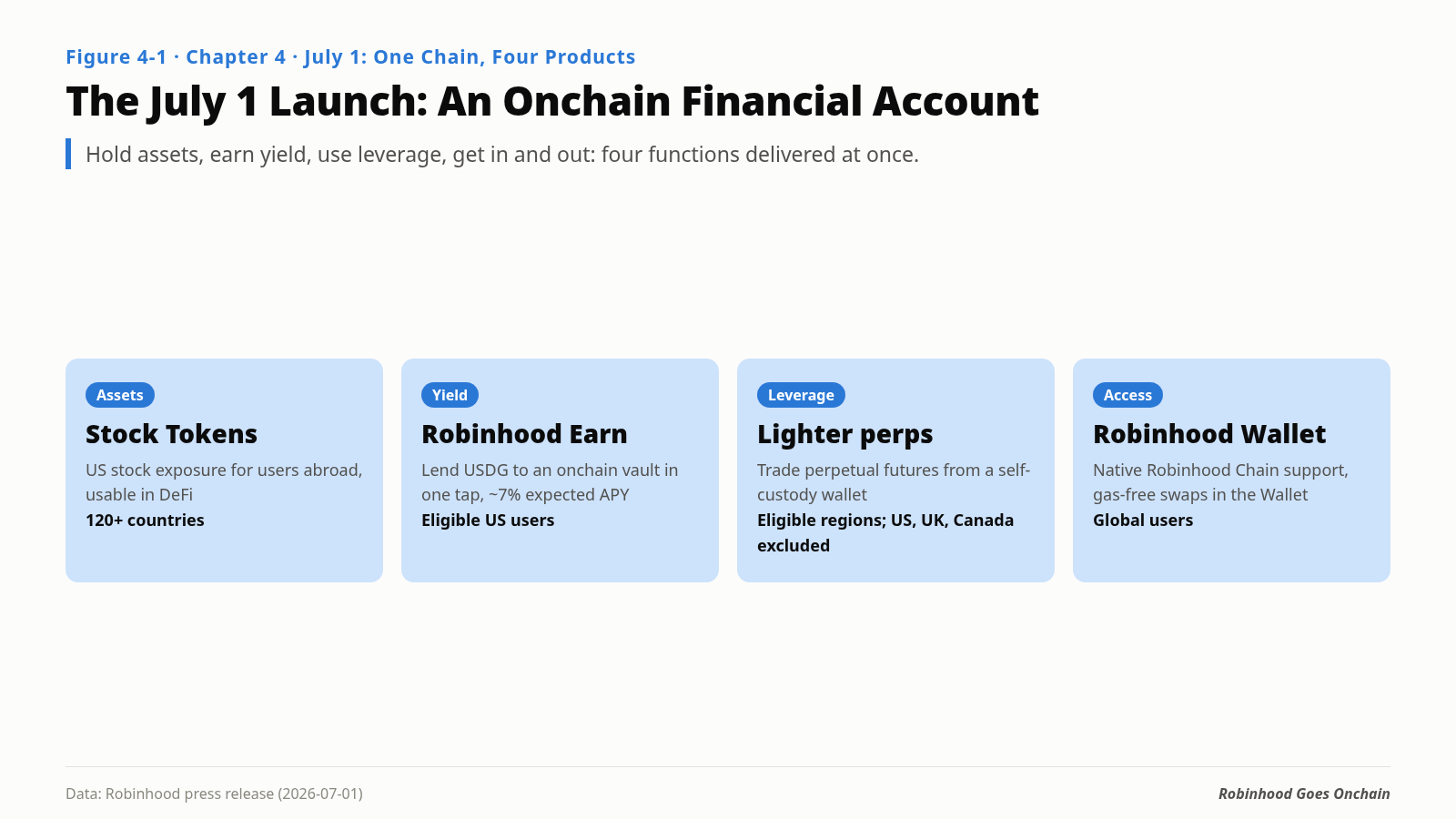
Four products arrived with the chain. This book calls them the four-piece stack:
| Function | Product | Problem addressed | Intended users |
|---|---|---|---|
| Assets | Next-generation Stock Tokens | International users can hold U.S. equity exposure without a U.S. brokerage account and use it in DeFi | Eligible users in 120-plus countries, excluding the U.S. and others |
| Yield | Robinhood Earn | Lend USDG to an onchain vault from the app in one action, at an estimated yield of about 7% | Eligible U.S. users |
| Leverage | Lighter perpetuals in Robinhood Wallet | Trade perpetual futures from a self-custody wallet | Eligible jurisdictions, excluding the U.S., U.K., Canada, and others |
| Access | Robinhood Wallet | A self-custody wallet with native Robinhood Chain support and gas-free in-wallet swaps | Global users |
Together, the four products covered the basic functions of an onchain financial account: hold assets, earn yield, obtain leverage, and move in and out. Robinhood was launching a usable account, not an empty chain.
What Kind of Chain?
| Parameter | Robinhood Chain | What it means for users |
|---|---|---|
| Technology | Arbitrum Nitro, using Orbit / Dedicated Blockchains | Ethereum tools work with little migration, but the technology itself is not a moat |
| Chain ID | 4663; testnet 46630 | — |
| Gas token | ETH; no native token | There is no chain coin through which network value is captured |
| Block time | Approximately 100 milliseconds, with preconfirmations | Suited to high-frequency and agent-based trading |
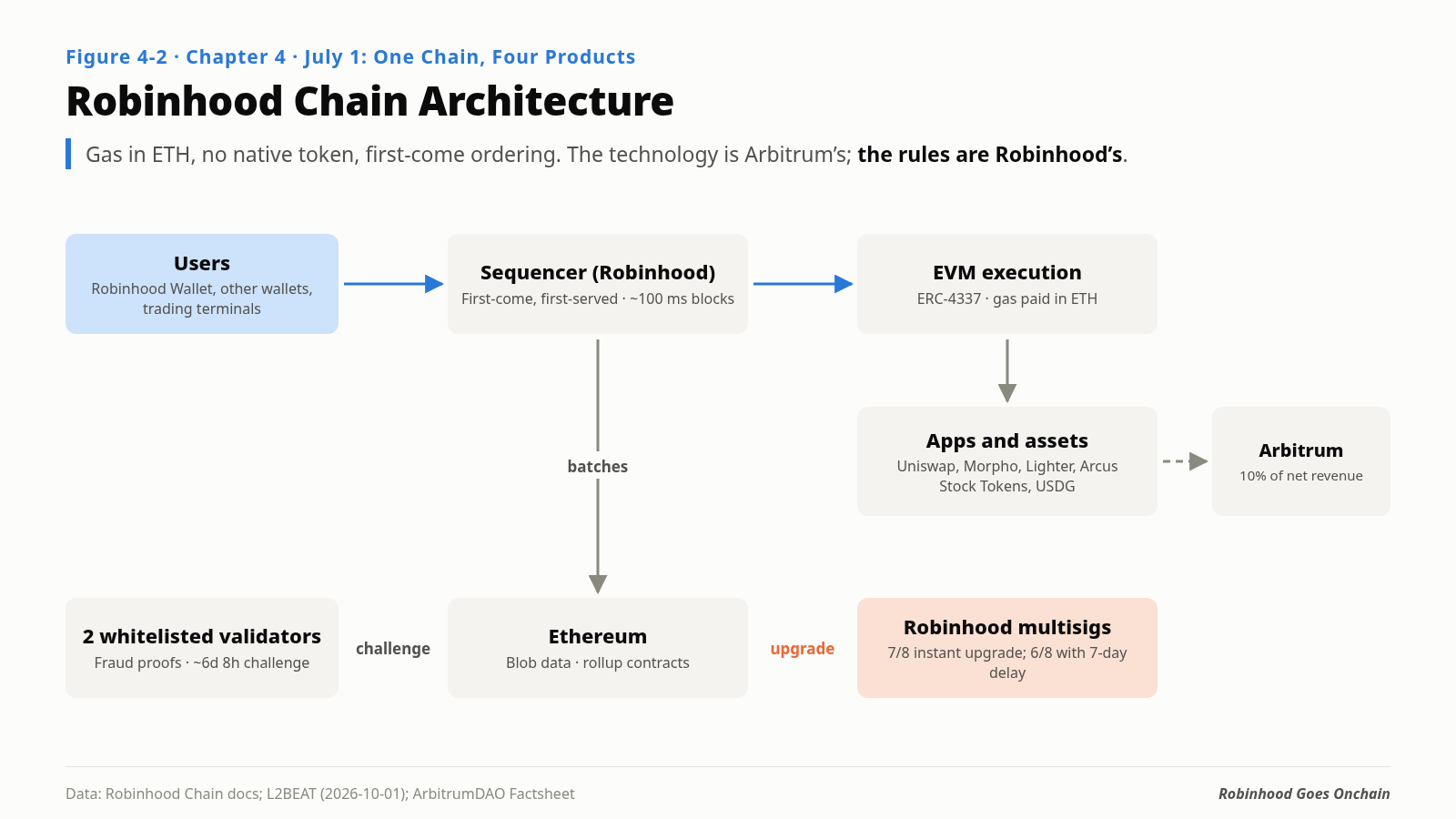
| Ordering | Centralized sequencer; documented as first come, first served | No public mempool, limiting conventional sandwich attacks |
| Data availability | Posted to Ethereum as blobs | Inherits Ethereum data availability |
| Account abstraction | Native ERC-4337 support | Sponsored gas, batched transactions, and session keys |
| Withdrawals | Approximately seven days through the canonical bridge to Ethereum | Creates demand for third-party fast bridges |
| Arbitrum relationship | 10% of net protocol revenue goes to Arbitrum: 8% to the DAO treasury and 2% to the Developer Guild; the DAO has no operational control | A licensing and revenue-sharing relationship, not a governance relationship |
Two choices reveal Robinhood’s approach particularly clearly.
- Use ETH for gas and issue no native token. Robinhood avoided the securities-law, market-structure, and conflict-of-interest questions that another token would create. This narrows product risk; it is not a regulatory exemption. For a broker regulated by the SEC, it was close to the only practical choice.
- First-come, first-served ordering. The policy can make prices more predictable, although outsiders cannot fully verify arrival order. As Chapter 3 noted, Robinhood was evaluating paid priority—potentially the most consequential rule change since launch.
The public testnet had launched on February 10, 2026, alongside a $1 million commitment to Arbitrum developer programs. According to ArbitrumDAO, it processed more than 200 million transactions before mainnet went live.
The Four Products after One Hundred Days
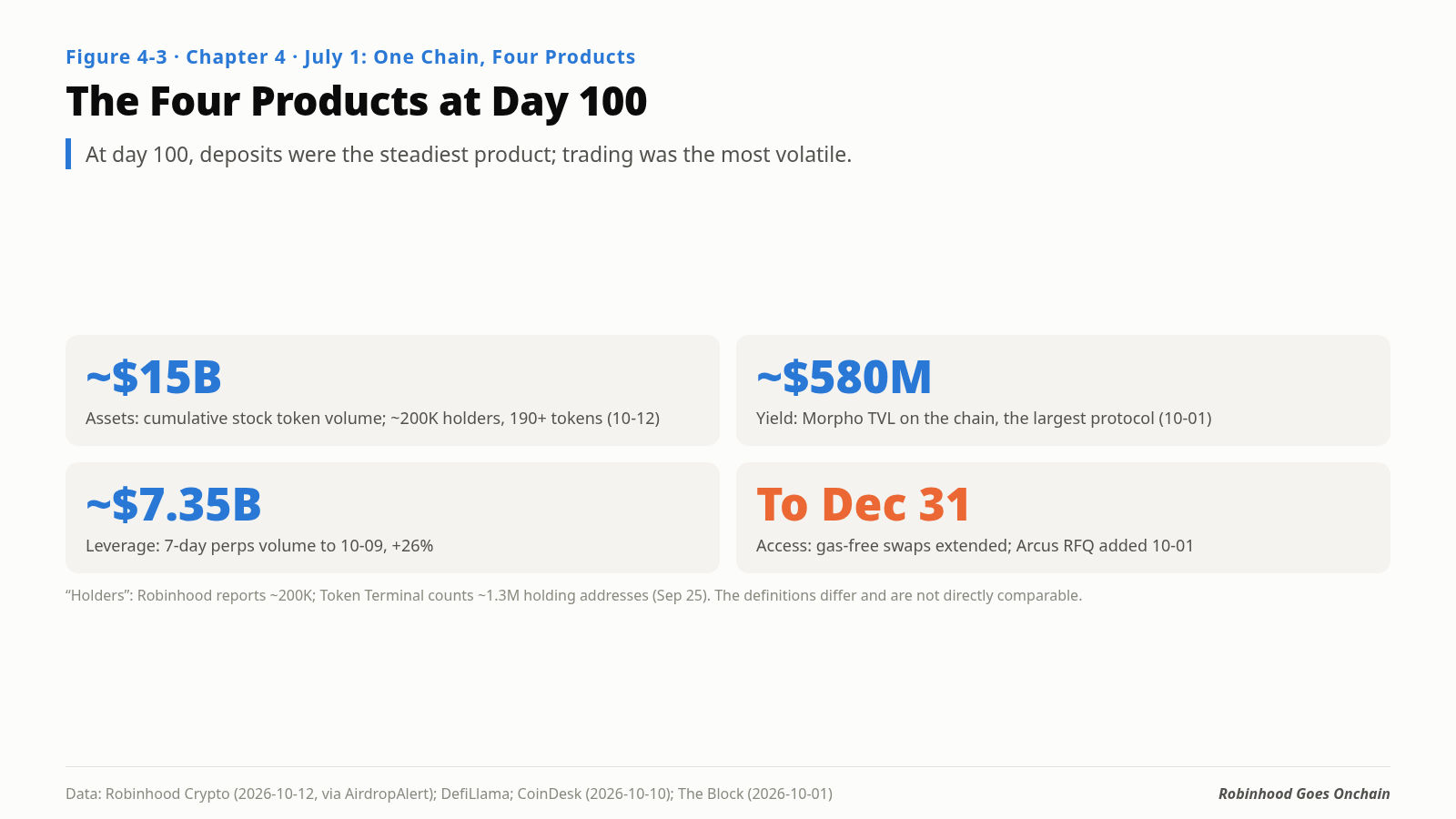
Assets: Stock Tokens. On October 12, Robinhood Crypto published its hundred-day figures: approximately $15 billion in cumulative volume, about 200,000 holders, and more than 190 U.S. stocks and funds, according to AirdropAlert’s summary. September alone contributed roughly $6.57 billion, or about 42% of all onchain stock-token volume that month.
Yield: Earn. Deposits in the underlying Steakhouse USDG vault reached approximately $420 million by the end of August. By early October, Morpho’s TVL on the chain was about $580 million, making it the largest protocol there. Chapter 6 examines Earn in detail.
Leverage: perpetual futures. Perpetual volume rose against the broader October decline. CoinDesk calculated rolling seven-day volume of about $7.35 billion as of October 9, up 26%. Lighter held approximately $108 million on the chain, while Arcus, built by the dYdX team, also introduced spot and perpetual markets for stock tokens.
Access: Wallet. The gas-free promotion, originally due to expire on September 29, was extended through December 31 for in-wallet swaps worth at least $0.50. On October 1, Wallet integrated Arcus’s request-for-quote system, adding another execution path for more than 190 stock tokens.
| Function | Hundred-day reading | Source |
|---|---|---|
| Assets | About $15B cumulative volume, 200,000 holders, and 190-plus instruments | Robinhood Crypto, Oct. 12, 2026; summarized by AirdropAlert |
| Yield | About $580M in Morpho TVL | DefiLlama, Oct. 1, 2026 |
| Leverage | About $7.35B in seven-day perpetual volume, up 26% | CoinDesk, Oct. 10, 2026 |
| Access | Gas-free swaps extended through Dec. 31; Arcus RFQ integrated | CoinDesk; The Block, Oct. 1, 2026 |
A Methodological Difference That Matters
At least two figures circulated for stock-token “holders”: Robinhood’s approximately 200,000 and Token Terminal’s approximately 1.3 million addresses as of September 25, cited secondhand by Cryptopolitan.
The published definitions are not detailed enough to reconcile them. Robinhood’s number refers to holders. The secondhand address count may double-count addresses across tokens or include contracts and other non-unique categories. This book does not compare the figures directly. It uses Robinhood’s disclosure when discussing users and states the methodological limits when citing onchain addresses. On a new chain, the same word can describe very different populations.
What This Means for Onchain Product Design
- Use the four-piece stack as a checklist: can users hold assets, earn yield, obtain leverage, and enter or exit in one place?
- Issuing no chain token is a structural choice, not timidity. It separates regulation of the chain from regulation of the assets.
- Transaction ordering is part of the product. First-come, first-served and paid priority distribute value differently among market makers, arbitrageurs, and ordinary users.
The Takeaway
July 1 did not produce an empty chain. It delivered an onchain financial account: assets, yield, leverage, and access all at once.
Sources for This Chapter
- Robinhood, “Robinhood Accelerates Global Expansion with Robinhood Chain Mainnet…,” July 1, 2026: event, positioning, partners, and products
- Robinhood Chain documentation: network parameters, ordering, account abstraction, and ecosystem partners
- ArbitrumDAO Factsheet: revenue share and testnet transaction count
- Robinhood, February 10, 2026: public testnet and $1 million commitment
- Robinhood Crypto hundred-day figures on X, October 12, 2026, summarized by AirdropAlert on October 14
- FalconX, September 2026: Steakhouse USDG vault deposits
- DefiLlama protocol data, accessed October 1, 2026: Morpho and Lighter TVL
- CoinDesk, October 10, 2026, as relayed by crypto.news: perpetual volume and gas-free extension
- The Block, October 1, 2026: Arcus integration
- Cryptopolitan citing Token Terminal, September 25, 2026: approximately 1.3 million holding addresses; see Chapter 1 of The Token Factory