
Chapter 1: From Zero Commissions to “Everyone an Owner”
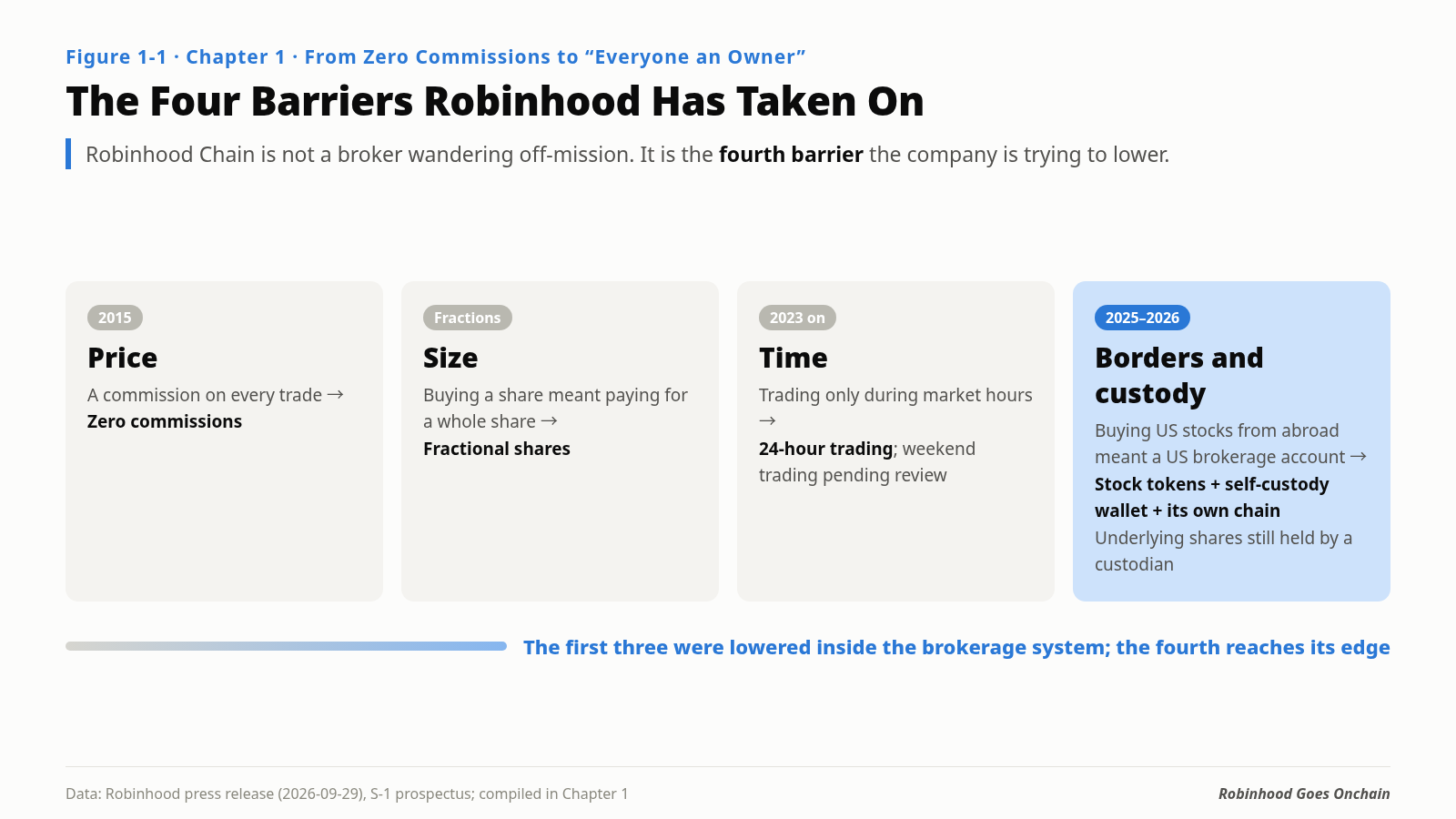
To understand why Robinhood built its own blockchain, begin with the one thing the company has spent more than a decade doing: removing barriers. This chapter traces Robinhood’s path and introduces a perspective that runs throughout the book. Going onchain is the fourth barrier the company has tried to dismantle.
A Company That Turned Barriers into Products
Vladimir Tenev and Baiju Bhatt founded Robinhood in 2013. The Stanford classmates had previously built trading software for hedge funds in New York. They saw a striking discrepancy: executing a trade cost a large brokerage firm almost nothing, yet the firm still charged its customer a commission on every transaction.
Robinhood’s first product removed that commission. In March 2015, it formally launched a mobile app offering commission-free trading. Within a few years, what began as one startup’s defining feature had become the standard across the U.S. retail-brokerage industry.
In retrospect, nearly every major Robinhood product can be understood as an attempt to remove a barrier:
| Barrier | The old model | Robinhood’s approach |
|---|---|---|
| Price | Pay a commission on every trade | Commission-free trading, launched in 2015 |
| Minimum investment | Buying an expensive stock required enough money for a whole share | Fractional shares |
| Time | Trade only while the exchange was open | 24-hour trading beginning in 2023; weekend trading announced in September 2026, subject to regulatory review |
| Borders and custody | International users needed a U.S. brokerage account to buy U.S. stocks; assets remained inside the brokerage system | Stock Tokens, a self-custody wallet, and Robinhood’s own chain, introduced in 2025–2026; the underlying shares still remain with a custodian |
The first argument of this book is that Robinhood Chain is not a broker’s excursion into an unrelated industry. It is the fourth barrier Robinhood has attempted to remove. The first three were dismantled within the U.S. brokerage system. The fourth is the boundary of that system itself.
The Price of Zero Commissions: Payment for Order Flow
Zero commissions did not eliminate the cost of trading. They changed who paid it. Payment for order flow, or PFOF, became an important source of revenue for Robinhood: the broker routed customer orders to market makers for execution, and those market makers paid Robinhood for the flow. The company’s revenue now also includes net interest income, subscriptions, and other transaction-based revenue.
The model helped Robinhood grow quickly. It also kept the company at the center of recurring regulatory controversy. In December 2020, the SEC found that Robinhood had failed in its earlier years to disclose fully its reliance on payment for order flow and had failed to satisfy its duty of best execution. Robinhood agreed to pay $65 million to settle the case. In June 2021, the Financial Industry Regulatory Authority fined the company $57 million over system outages, misleading communications with customers, and other issues, and ordered it to pay approximately $12.6 million in restitution. At roughly $70 million in total, it was the largest financial penalty FINRA had imposed at the time.
This history matters to the story of Robinhood Chain. Much of Robinhood’s economics depends on customers trading inside its app and leaving their assets there. If those customers move assets into self-custody wallets and trade through decentralized exchanges, revenue streams such as payment for order flow may no longer accrue to Robinhood. That tension helps explain the company’s onchain strategy: begin with international customers and prioritize products embedded inside Robinhood’s own interfaces. Chapters 3 and 6 return to this point.
January 28, 2021
The most consequential day in Robinhood’s history was January 28, 2021.
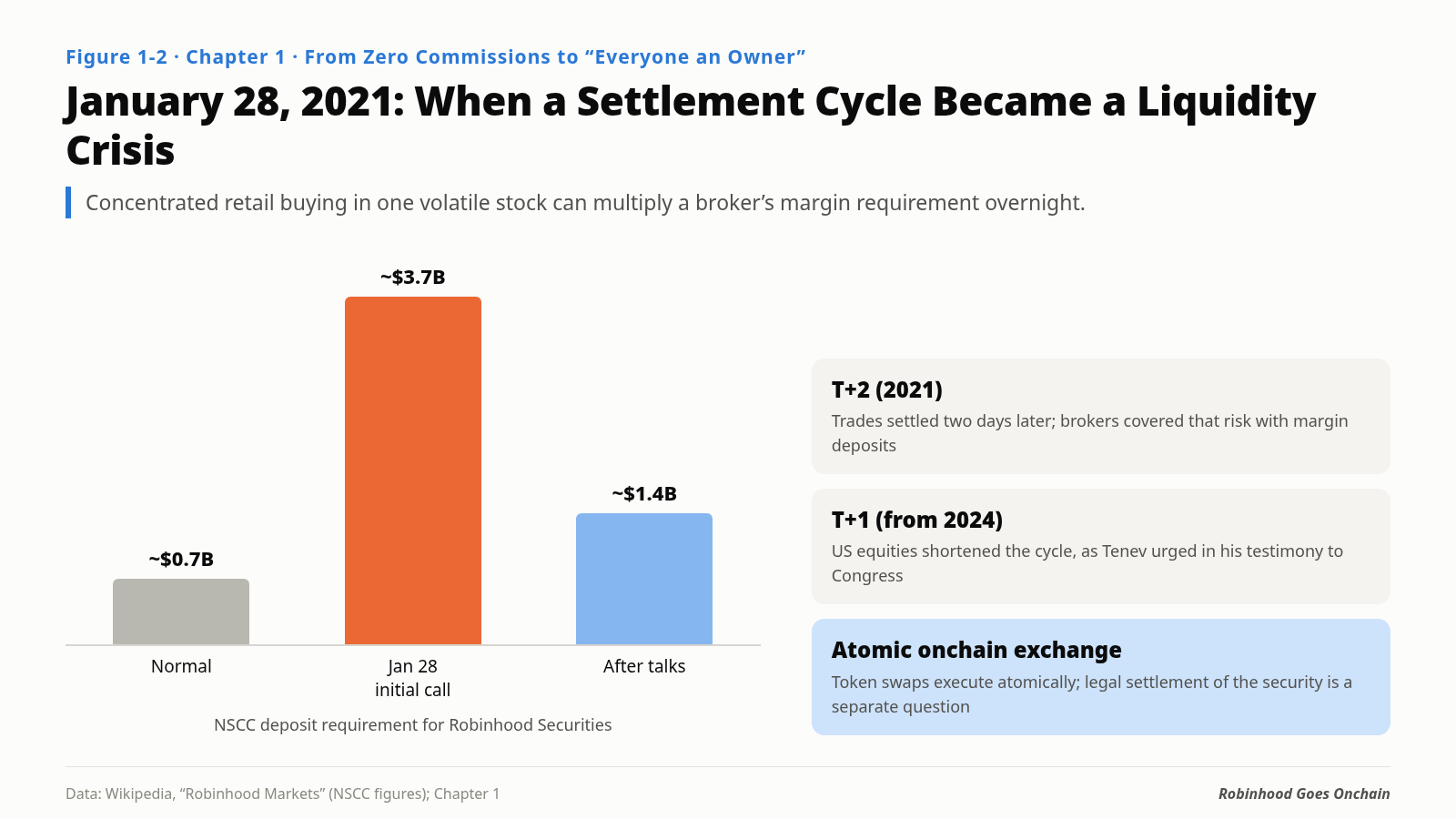
That week, retail traders congregating in Reddit’s r/wallstreetbets forum piled into GameStop, AMC, and other stocks, sending their prices sharply higher. On January 28, Robinhood and several other brokerages restricted purchases of those stocks. The immediate reason lay deep in the post-trade system. The National Securities Clearing Corporation, or NSCC, raised Robinhood Securities’ required deposit from approximately $700 million to roughly $3.7 billion before later reducing it to about $1.4 billion. Robinhood did not have enough capital to support its customers’ buying at the initial requirement.
In the public memory, January 28 became the day Robinhood sided with Wall Street. In the history of market infrastructure, it was also a public lesson in the consequences of the settlement cycle. U.S. equities then settled on a T+2 basis: cash and securities changed hands two business days after a trade. Brokers had to post collateral to cover the risk during that interval. A burst of concentrated retail trading in one volatile stock could therefore multiply a broker’s collateral requirement overnight.
On February 2, 2021, Tenev published an article titled “It’s Time for Real-Time Settlement,” arguing that the market should move beyond T+2. On February 18, he faced questions before the U.S. House Committee on Financial Services. The U.S. equity market eventually moved to T+1 in 2024.
Blockchain systems can make exchanges between tokens atomic and reduce some reconciliation work and capital tied up in settlement. But fast onchain execution does not necessarily produce T+0 settlement in the legal sense. That depends on whether a token represents the underlying share, how transfer and custody are arranged, the finality properties of the chain, and the mechanisms for exiting it. Robinhood’s direct experience of settlement-driven liquidity pressure is one reason tokenization holds such strategic appeal for the company.
From Trading App to Financial Platform
Robinhood went public on Nasdaq on July 29, 2021, at an offering price of $38 per share and a valuation of approximately $32 billion. Over the next several years, the company made three moves that laid the groundwork for its onchain strategy.
- It expanded its crypto business. Robinhood Crypto operates under a virtual-currency license from the New York State Department of Financial Services. In June 2025, Robinhood completed its acquisition of the long-established crypto exchange Bitstamp for approximately $224 million in cash, according to its second-quarter 2026 Form 10-Q.
- It expanded beyond the United States. Robinhood established a licensed presence in Lithuania covering 30 countries in the European Union and European Economic Area, entered the United Kingdom, acquired WonderFi in Canada, and obtained a capital-markets-services license from the Monetary Authority of Singapore. In the second quarter of 2026, its international funded-customer count surpassed 1 million for the first time.
- It expanded from trading into ownership. New products included the Robinhood Gold subscription, retirement accounts, prediction markets through event contracts, Robinhood Ventures—designed to give retail investors access to private companies through publicly traded funds—and “Trump Accounts” for U.S. newborns.
By the second quarter of 2026, Robinhood’s business looked like this:
| Metric, Q2 2026 | Value | Year-over-year change |
|---|---|---|
| Total net revenues | $1.31 billion | +32% |
| Options transaction-based revenue | $342 million | +29% |
| Event-contract revenue | $156 million | More than 10× |
| Equities transaction-based revenue | $129 million | +95% |
| Crypto transaction-based revenue | $100 million | −38% |
| Net interest revenue | $389 million | +9% |
| Funded customers | 28.4 million | +7% |
| Platform assets | $369 billion | +32% |
| Robinhood Gold subscribers | 4.8 million | +39% |
Source: Robinhood’s second-quarter 2026 results, released July 29, 2026.
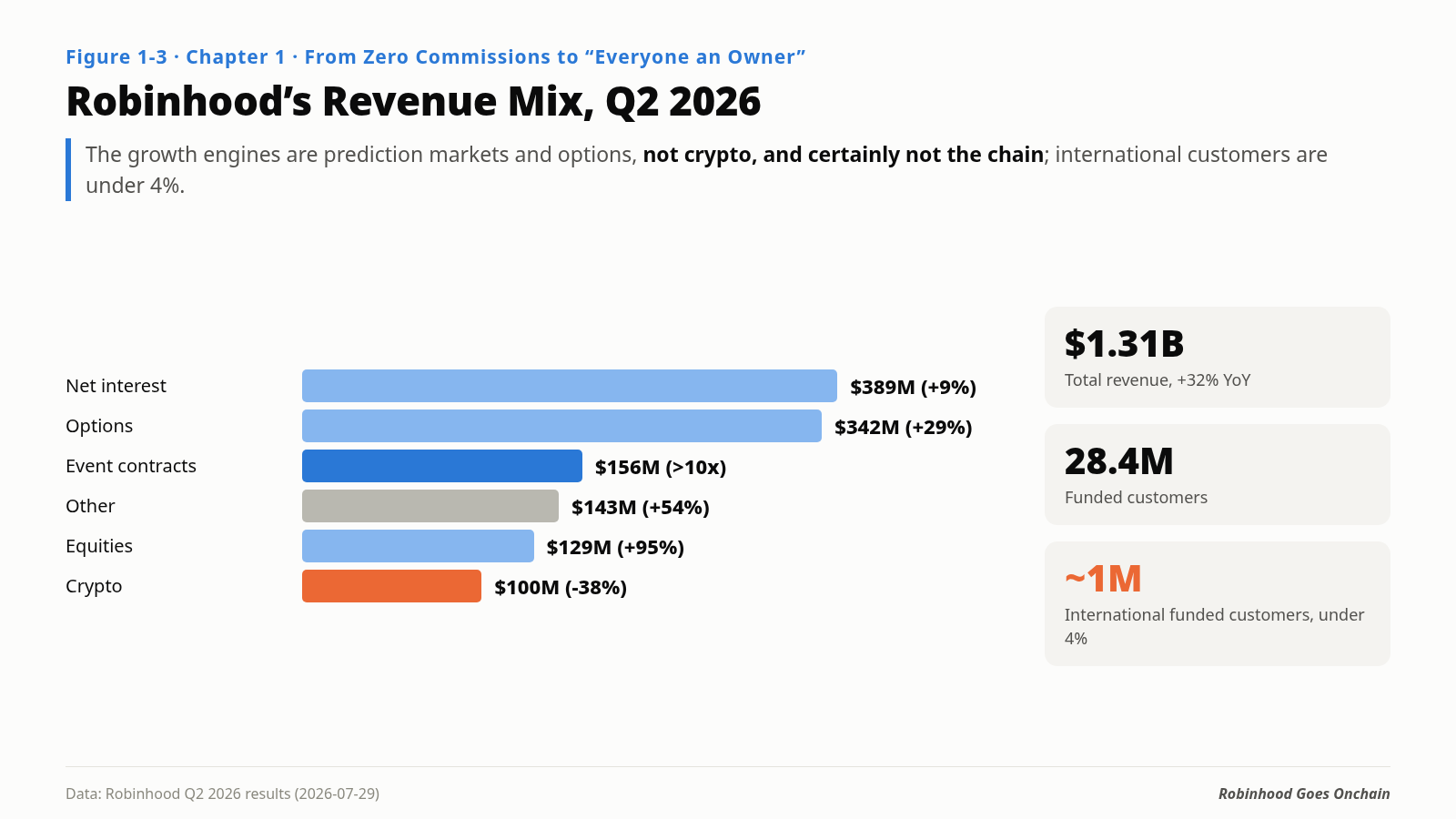
Two details stand out. First, crypto transaction revenue was falling while prediction markets were growing rapidly. Crypto—and certainly Robinhood Chain—was not the company’s primary growth engine at that moment. Second, Robinhood had only about 1 million international funded customers, less than 4% of its total. Together, these figures clarify the chain’s strategic role. It was not built to replace Robinhood’s U.S. brokerage business. It was designed to open markets beyond the United States and prepare infrastructure for a new generation of financial products.
“Everyone an Owner”
In recent years, Tenev has repeatedly described Robinhood’s mission as “making everyone an owner.” In the company’s second-quarter 2026 results, he placed Robinhood Chain, Robinhood Ventures, and Trump Accounts side by side as three new expressions of that objective.
The phrase connects three otherwise different businesses:
- Trump Accounts are intended to give children in the United States ownership of an index fund from birth.
- Robinhood Ventures gives retail investors exposure, through publicly traded funds, to private companies such as OpenAI and Databricks.
- Robinhood Chain and Stock Tokens give users in more than 120 countries economic exposure to U.S. stocks without requiring a U.S. brokerage account.
All three attempt to separate “ownership” from the traditional brokerage account. That is the best starting point for understanding Robinhood’s onchain strategy. The company is not merely trying to build a faster blockchain. It is trying to create a larger market of owners.
What This Means for Brokerage and Fintech
- Place Robinhood Chain in the sequence of barriers the company has tried to remove, not simply in a ranking of competing blockchains. Its competition with Base or Solana is primarily about assets and distribution, not raw performance.
- Watch the tension between payment for order flow and onchain trading. Any product that moves a customer’s transactions from the Robinhood app onto a public blockchain can change the broker’s revenue model.
- Shorter settlement cycles are among tokenization’s most concrete potential benefits. They address collateral pressure that brokers have experienced firsthand. But faster onchain execution does not, by itself, mean faster legal settlement of a security.
The Takeaway
Zero commissions removed the price barrier. Fractional shares lowered the minimum-investment barrier. Around-the-clock trading weakened the time barrier. Robinhood Chain is intended to lower the barriers of geography and account-based custody. The underlying shares still remain with a custodian; what changes is the form in which users hold a claim tied to them.
Sources for This Chapter
- Robinhood’s 2021 S-1 registration statement filed with the SEC: founding date and founders
- Wikipedia, “Robinhood Markets”: the January 28, 2021 NSCC deposit figures of $700 million, $3.7 billion, and $1.4 billion; 2025 revenue of $4.47 billion
- ABC News, July 29, 2021: IPO price and valuation
- SEC Release 2020-321, December 17, 2020: PFOF disclosure and best-execution findings; $65 million civil penalty
- FINRA release, June 30, 2021, as reported by CNBC and Bloomberg: $57 million fine and approximately $12.6 million in restitution
- Robinhood, “It’s Time for Real-Time Settlement,” February 2, 2021: Tenev’s argument for real-time settlement
- Wikipedia, citing CNN on March 12, 2015: launch of the app in March 2015; House hearing on February 18, 2021
- Robinhood’s second-quarter 2026 results and Form 10-Q: revenue mix, customers, platform assets, and consideration paid for Bitstamp
- Robinhood investor-relations website: 28.6 million funded customers and $384 billion in platform assets as of August 31, 2026
- Robinhood releases dated July 1 and September 29, 2026: expansion in the EU, Canada, and Singapore; weekend-trading plans
- Summary of Episode 292 of the Moonshots podcast published by BigGo Finance: Trump Accounts and the ownership narrative