
The First Failure: Bitcoin Payments, 2014–2018
The questions this chapter answers: Why did Stripe add bitcoin and then switch it off? What did it learn from joining Libra and then walking away? What did the failure leave behind?
A Post Written Too Early
On July 21, 2014, a long essay appeared on the Stripe blog under the title “Bitcoin: the Stripe perspective.” The author was Greg Brockman, then Stripe’s head of engineering. A year later, Brockman left Stripe and co-founded OpenAI.
Read today, the essay feels strangely familiar.
Brockman began by breaking money down into three functions: a store of value, a unit of account, and a medium of exchange. In countries with stable inflation, he argued, bitcoin would struggle to become something ordinary people saved in or priced things in; but when it came to “moving value,” its potential was enormous. Paying for something online was almost the only experience on the internet that had barely changed in twenty years, and once money had to cross a border, moving it got even harder. Information flows across countries on the internet without anyone caring who runs the other country’s network; money does not. The traditional payment system, he wrote, “looks a lot like computer networks before the Internet.”
The solution he sketched was a layer of “gateways” in every country. Users would sign up with the gateway in their own country, link a local bank account, and give instructions in the currency they knew: “send £10 to this person, send $20 to that one.” Behind the scenes, the gateways would settle with each other in bitcoin. Bitcoin would become the “IP layer” of payments: users would see payment addresses that looked like email addresses, while the systems underneath talked to each other in bitcoin addresses.
The essay made one more prediction. Even if the underlying network was open, consumers would still need someone to guarantee that “if something goes wrong, you can get your money back,” just as Visa does today. So the bitcoin world would eventually produce a small number of centralized “trust providers,” responsible for arbitrating refunds, vetting merchants and setting the rules.
Put that essay next to the Stripe of twelve years later. Bridge is precisely the “gateway” between national fiat currencies and onchain dollars; Tempo and OUSD are the settlement network in the back; and Stripe itself, together with Visa, which Stripe invited onto Tempo as a validator, plays exactly the role of “trust provider.”
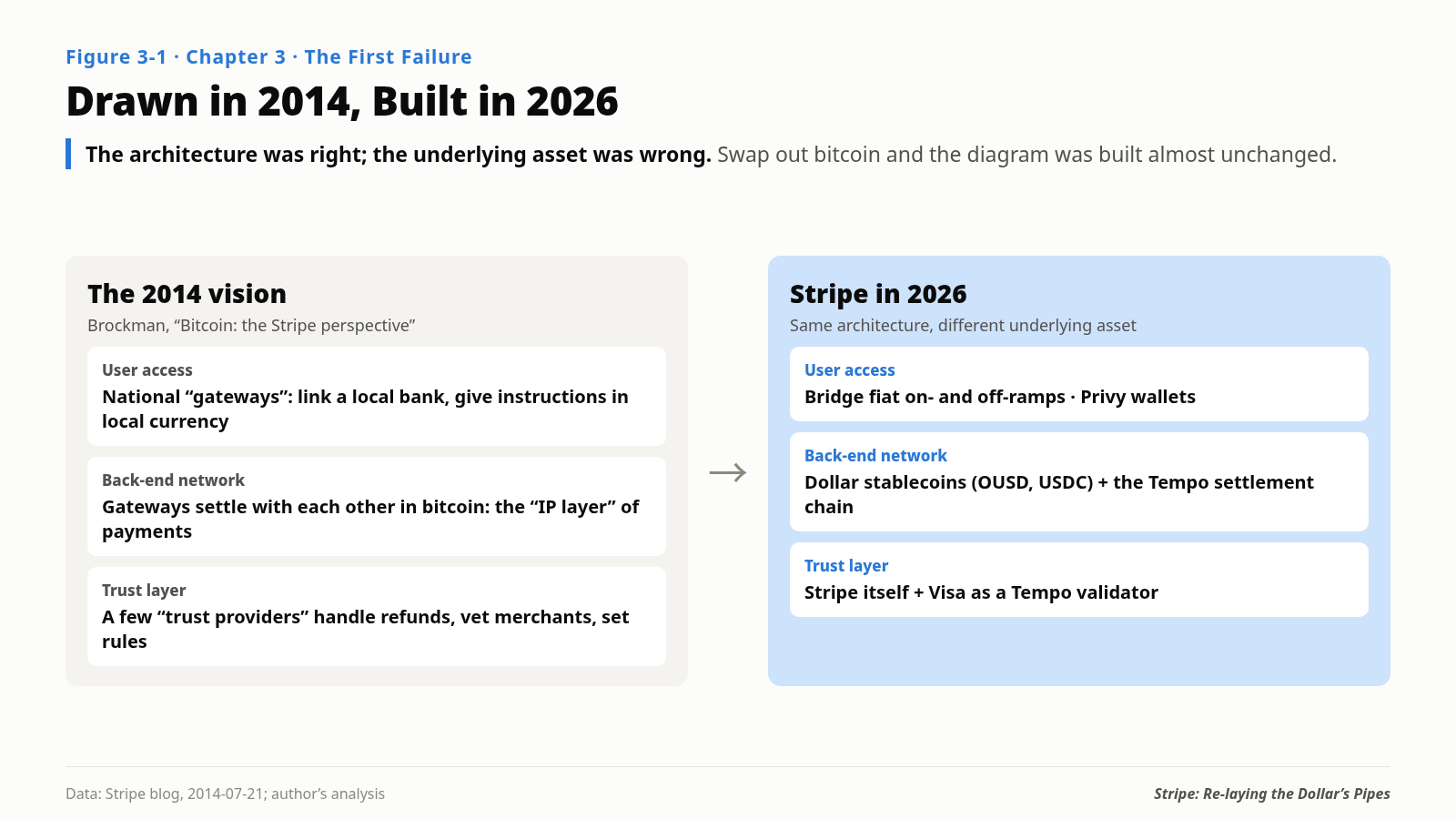
In 2014, Stripe drew the architecture correctly; it just picked the wrong underlying asset. This chapter is about how that mistake was discovered and how it was corrected.
Switching It On, Then Off
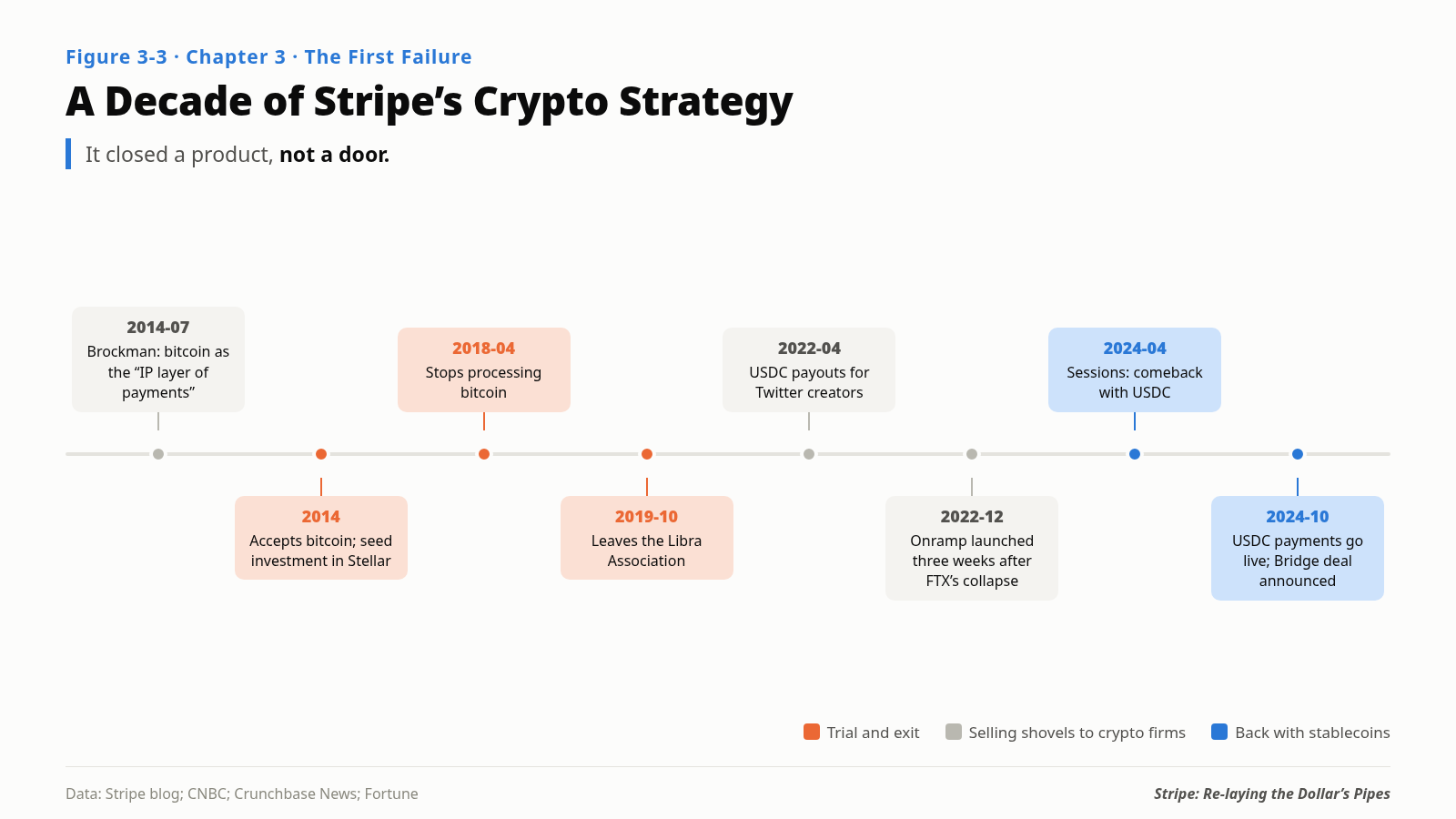
In 2014, Stripe became the first major payments company to support bitcoin payments. The same year, it provided seed funding to a new blockchain project, Stellar, whose goal was exactly the cross-border gateway network Brockman’s essay described.
Over the next three years, the price of bitcoin rose dozens of times over, but bitcoin payments on Stripe followed a very different curve. In January 2018, Stripe published a post announcing that it would stop supporting bitcoin; the Introduction already quoted this farewell letter. Its reasons are worth taking apart one more time:
- Confirmation times got longer. Once blocks filled up, a transaction could wait a long time to be confirmed.
- The price moved while you waited. By the time a payment confirmed, the price of bitcoin had changed, so orders priced in dollars arrived as “the wrong amount,” and failure rates rose accordingly.
- Fees soared. An ordinary transfer could easily cost tens of dollars in fees, as much as a bank wire.
- Demand shrank. Fewer and fewer merchants wanted to accept bitcoin, and for those that did, the revenue it brought in was falling sharply.
The letter’s final verdict was that bitcoin had become “more suitable to be an asset than a means of exchange.” That was the exact opposite of the 2014 essay’s premise. The original idea was that bitcoin didn’t need to be a good savings vehicle, as long as it was a good way to move money. Four years later, it had turned into a decent vehicle for saving (or speculating), and was no longer a good way to move money.
Stripe was also careful about how it shut the product down. It didn’t quietly pull it. It spelled out its reasons, gave a three-month transition period, and named several directions it still believed in: the Lightning Network, Ethereum, Stellar, and “other proposals that may emerge that could keep fees low and settlement fast.” It closed a product, not a door.
The Three Tests for a Payment Currency
Why did bitcoin fail where stablecoins later passed? Put the 2018 farewell letter next to the 2024 comeback, and you can distill three tests that any currency must pass to become an everyday payment tool:
Test one: a stable price. Merchants price in dollars or euros, and they keep their books, pay salaries and file taxes in their home currency. If the currency used to pay rises or falls a few percent during the minutes it takes to confirm, the merchant is carrying exchange-rate risk it never wanted. That is what Stripe meant by “the wrong amount.”
Test two: cheap and fast. Fees have to be lower than a card payment, and settlement has to be measured in seconds. Bitcoin at the end of 2017, at tens of dollars and tens of minutes per payment, failed on both counts.
Test three: easy in and out, with someone accountable when things go wrong. Merchants ultimately need to convert the money back into local currency and deposit it in a bank; consumers need to be able to get refunds; regulators require anti-money-laundering and sanctions screening. This test isn’t a technical problem. It’s a question of licenses, compliance and trust.
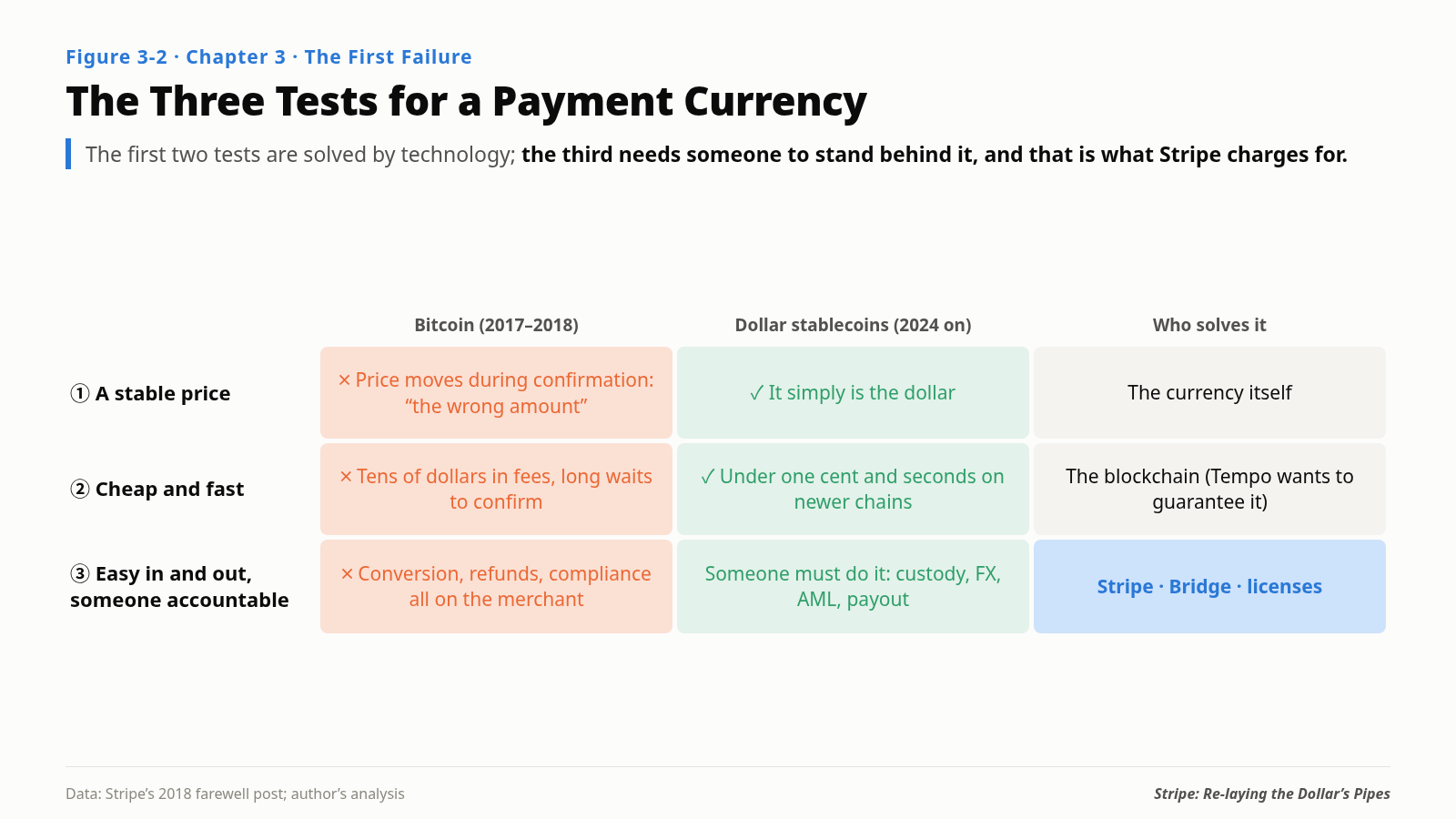
In 2018, bitcoin failed both the first and second tests. In 2024, dollar stablecoins passed the first test by definition: they are dollars. As for the second, on newer public chains such as Solana and Base, transfer costs had fallen below one cent, with funds arriving in seconds.
The remaining third test happens to be Stripe’s own business. When a merchant receives USDC, Stripe handles custody, converts it into dollars, deposits it in the merchant’s bank account, and runs the anti-money-laundering screening. The controversy raised in the Introduction, that Stripe charges 1.5% to accept stablecoins (later cut to a 0.8% promotional rate) while the onchain cost is under one cent, is answered right here: the first two tests are solved by technology; the third needs someone to stand behind it, and what Stripe charges for is the third test.
This framework also explains everything Stripe built afterwards. Bridge, Privy and the OCC license all reinforce the third test; Tempo takes the second test one step further, turning cost and speed into something that can be guaranteed rather than something that depends on someone else’s chain.
The Libra Interlude: Don’t Be the One Challenging the Rules
Between “switching off bitcoin” and “embracing stablecoins,” Stripe took one detour.
In June 2019, Facebook unveiled Libra, its plan for a global digital currency, and set up an association of more than twenty companies to govern it. The founding members included Visa, Mastercard, PayPal and eBay, and also Stripe. Libra’s ambition was bold: backed by a basket of currencies and government bonds, and aimed at Facebook’s billions of users, it would become a digital currency used around the world.
Regulators reacted ferociously. A private technology company issuing a global currency that might bypass national central banks touched the nerve of monetary sovereignty. In October 2019, U.S. Senators Sherrod Brown and Brian Schatz wrote to Visa, Mastercard and Stripe, warning them of the risks of taking part in Libra. A few days later, on October 11, eBay, Stripe, Mastercard, Visa and Mercado Pago all announced on the same day that they were leaving; PayPal had already left a week earlier. Libra was later renamed Diem and was wound down in early 2022.
The interlude was short, but its effect on Stripe ran deep. The lesson it took away: when it comes to money, don’t be the one challenging the rules. Money is the business of the state. Private companies can build better pipes, but they cannot try to create a new kind of money.
Look at the choices Stripe made afterwards, and this lesson is engraved on nearly every step. It bet on dollar stablecoins, not a new currency. It had Bridge apply for a federal trust bank charter, stepping into regulation of its own accord. OUSD is issued by a regulated U.S. company, with reserves held at institutions like BlackRock and BNY. Libra tried to get around the rules; Stripe chose to get inside them.
The First Step Back: Selling Shovels to Crypto Companies
In 2021, with the crypto market heating up again, Stripe rebuilt its crypto team. This time its posture was different: rather than accepting coins itself, it would provide services to crypto companies.
In March 2022, Stripe added the first update to its farewell letter, saying it would “connect crypto businesses to today’s global financial infrastructure.” In April, Stripe announced a partnership with Twitter: creators on Twitter could choose to receive their earnings in USDC, paid out to their own crypto wallets over the Polygon network. Stripe handled all of the crypto-related complexity, and Twitter didn’t have to change a single line of its own code.
On December 1, 2022, Stripe launched a fiat-to-crypto onramp that any crypto wallet or app could embed in its own product. Users could buy crypto with a card, while Stripe handled identity verification, fraud and compliance. Early users included the NFT marketplace Magic Eden, the wallet Argent and the music platform Audius.
The timing was delicate. Three weeks earlier, the crypto exchange FTX had gone bankrupt, and the entire industry was in a panic. Stripe’s launch blog post included the line: “The past few weeks have been tough for the crypto ecosystem. Despite that, we remain excited about the underlying innovation.”
While others were fleeing, Stripe was building roads. It was selling shovels: no exposure to coin prices, no involvement in trading, just the one piece crypto companies found most painful, the gateway between fiat and crypto. This was exactly the Stripe of 2011: not competing with anyone for their business, just taking the most troublesome part off their hands.
2024: Coming Back With a Different Currency
In April 2024, at Sessions, Stripe’s annual conference, John Collison announced that Stripe would support crypto payments again, this time accepting the dollar stablecoin USDC, with transactions that “settle instantly on-chain and are automatically converted to fiat.” That same month, one more update line appeared at the top of the 2018 farewell letter.
In October 2024, the product went live. U.S. merchants could accept payments from customers in USDC on Ethereum, Solana and Polygon, receive dollars, and pay a 1.5% fee. This time, the stablecoin payments infrastructure behind it was provided by Paxos, a licensed trust company, and Stripe was its first customer.
Demand looked nothing like 2018. In March 2025, in written testimony to the U.S. House Financial Services Committee, Patrick Collison wrote that in the first week after Stripe launched stablecoin payments, stablecoin payment volume exceeded the total bitcoin payment volume Stripe had seen over a year and a half back then. Collison also made a point of stressing that Stripe’s interest in stablecoins was “not to replace existing payments infrastructure, but to complement it.”
That same October, Stripe announced it was acquiring Bridge. This time, it was no longer just “supporting” a cryptocurrency; it was starting to buy the pipes themselves.
What the Failure Left Behind
Looking back, the bitcoin payments of 2014 to 2018 were a failed product. But the failure left Stripe with three things that later proved extremely valuable.
First, the right question. From 2014 on, what Stripe was looking for was always “money that can flow across the internet the way information does.” Bitcoin wasn’t the answer, but the question itself was right. And because the question never changed, when stablecoins appeared, Stripe recognized them almost immediately.
Second, a yardstick. “Is it more suitable to be an asset, or a means of exchange?” That line became Stripe’s touchstone for evaluating every crypto asset. It is why Stripe later stuck almost exclusively to dollar stablecoins and stayed away from other crypto assets.
Third, a reputation. Shutting down the product cleanly, publicly stating its reasons, and leaving Libra in good time made Stripe, in the eyes of regulators and large merchants, a player that “knows where the lines are.” When the OCC approved Bridge to set up a trust bank in 2026, and when Visa and Mastercard were willing to launch OUSD alongside it, that reputation was part of the reason.
Lessons for Other Companies
1. If the vision is right and the vehicle is wrong, change the vehicle, not the vision. Stripe’s 2014 architecture diagram was built almost unchanged by 2026; bitcoin was simply swapped out for dollar stablecoins. Many companies throw out the vision along with the failure and miss their second chance.
2. Let the data shut the product down, and leave the door open. When Stripe dropped bitcoin, it spelled out why and named the directions it still believed in. Exiting gracefully does more to preserve your right to come back than propping up a product that isn’t working.
3. In a regulated industry, don’t be the one challenging the rules. The lesson of Libra is that however elegant a design that goes around the rules may be, it will not get past regulators. Every step Stripe took afterwards went inside the rules: using the dollar, applying for licenses, finding regulated reserve custodians.
4. A bear market is a good time to build roads. Launching an onramp three weeks after FTX collapsed looked badly timed. In reality, competition was at its thinnest and partners were most willing to talk. By the next cycle, the road was already built.
5. Be a service provider first, a participant later. From USDC payouts for Twitter creators, to the onramp, to stablecoin payments, Stripe always stood in the position of “handling the complicated part for others.” Only after it had built up enough experience and relationships did it start owning pipes of its own.
The bottom line: Stripe drew the right map in 2014; it just had to wait ten years for the right vehicle.
Data and Sources
Verified:
- “Bitcoin: the Stripe perspective” (2014-07-21, Greg Brockman): the three functions of money, “gateways,” the “IP layer of payments,” “trust providers,” three improvements: original post on the Stripe blog.
- First major payments company to support bitcoin in 2014; the reasons for ending support in 2018, the transition period, and the directions it still favored (the Lightning Network, Ethereum, Stellar, and “Stripe provided seed funding”); the two updates of 2022-03-10 and 2024-04-25: original Stripe blog post “Ending Bitcoin support.”
- Stellar’s seed round of about $3 million in 2014-08, with Stripe as an investor: company database records (consistent with the Stripe blog’s “provided seed funding”).
- Libra: Stripe as a founding member; on 2019-10-11 eBay, Stripe, Mastercard, Visa and Mercado Pago withdrew, PayPal having withdrawn a week earlier; Senators Brown and Schatz’s letter to Visa, Mastercard and Stripe: CNBC 2019-10-11, Yahoo Finance, Business Insider.
- USDC earnings payouts for Twitter creators (Polygon, Stripe Connect): Crunchbase News 2022-04.
- Onramp launched 2022-12-01, early users Audius, Magic Eden and Argent, the blog line “The past few weeks have been tough for the crypto ecosystem”: Fortune 2022-12-01, TechCrunch.
- USDC support announced at Sessions 2024, “settle instantly on-chain and are automatically converted to fiat”: CoinMarketCap, citing John Collison’s post on X.
- Launch in 2024-10, USDC on Ethereum, Solana and Polygon, 1.5% fee: insights4vc compilation and multiple media reports. Paxos as the underlying provider and Stripe as its first customer: Paxos announcement of 2024-10-15, Eco compilation.
- First-week stablecoin payment volume exceeding a year and a half of bitcoin volume; “not to replace existing payments infrastructure, but to complement it”: Patrick Collison’s written testimony to the U.S. House Financial Services Committee, 2025-03-11 (docs.house.gov).
Media reports (not confirmed by Stripe):
- Stripe rebuilt its crypto team in 2021: LinkedIn profile of a former lead (leading Stripe Crypto from 2021-08).