
Seven Lines of Code: Two Brothers and a Problem Nobody Wanted to Fix
The questions this chapter answers: Why was it so hard to get paid online in 2010? And what let two young Irishmen break into a market held by the banks and PayPal?
Two Programmers from the Countryside
Patrick and John Collison grew up in a village on the banks of the River Shannon in County Limerick, Ireland. In later interviews, they described it as a place with “nothing but cows.” To get online, their parents installed a satellite connection. Both brothers taught themselves to program before they were ten.
At 16, Patrick, the elder, built an artificial intelligence project in a self-written dialect of Lisp and won Ireland’s Young Scientist award in 2005. Patrick went on to MIT, and John to Harvard. Neither finished.
Their first company was Auctomatic, which made management tools for big sellers on eBay. In 2007 it went through the Silicon Valley startup accelerator Y Combinator (YC). In March 2008, the company was sold to a Canadian company for about $5 million. That year, Patrick was 19 and John was 17.
What the experience left the brothers with was more than money. Building Auctomatic, they ran into the problem of getting paid online firsthand for the first time, and discovered for the first time how absurdly hard it was.
How Hard It Was to Get Paid Online in 2010
Readers today can hardly imagine what an American startup had to go through in 2010 to accept a single credit card payment online.
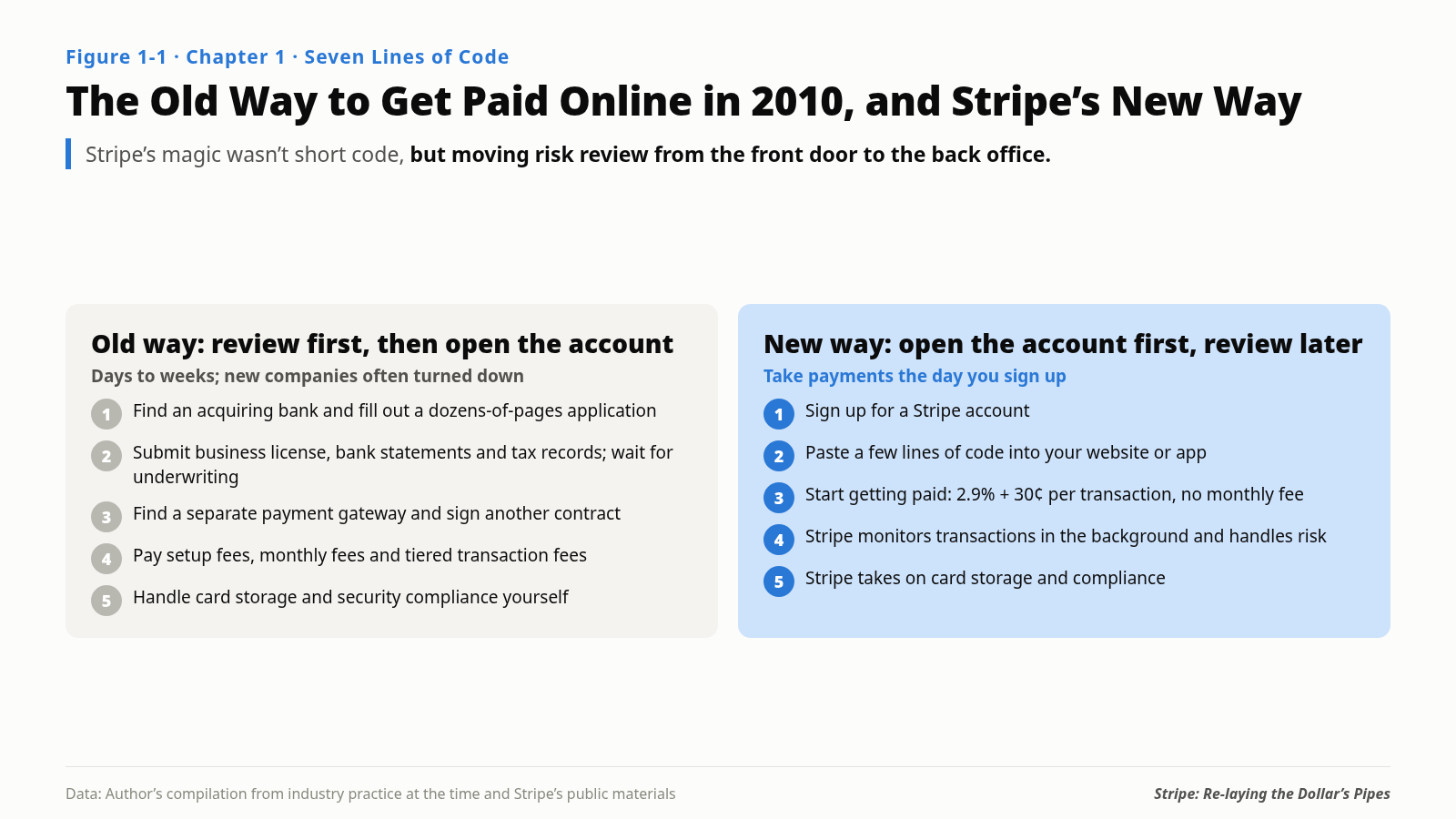
Step one: open a merchant account. You had to find an acquiring bank, fill out an application dozens of pages long, hand over your business license, bank statements and tax records, and then wait for the bank to “underwrite” you, that is, assess whether you were likely to vanish or rack up chargebacks. It took days if you were lucky and weeks if you weren’t. Newly founded companies with no transaction history were often simply turned down.
Step two: hook up a payment gateway as well. A merchant account only settled where the money went. You also needed a gateway company to pass card numbers securely from your website to the bank. Gateway and bank were two companies, two contracts and two sets of fees: setup fees, monthly fees, per-transaction fees, plus a tiered rate sheet nobody could understand.
Step three: handle compliance yourself. How you stored and encrypted card numbers had to meet the card networks’ security standards. If there was a data breach, it was on you.
The other option was PayPal. It spared you the hassle of opening an account, but customers were redirected to a PayPal page to pay, which made for a disjointed experience. Merchants’ accounts could also be frozen without warning by risk controls, leaving their money stuck for months. In startup circles, “PayPal froze my money” was practically a standing complaint.
These headaches had one thing in common: the whole process was designed for the bank’s risk department, not for the people writing code. To a bank, a new merchant was first a risk and only second a customer. So review came first, the bar was set high, and the pricing was made complicated.
And in 2010 something was happening on the internet that the banks hadn’t noticed: the people making the decisions had changed. The iPhone and the App Store meant one person with one computer could build a product. Cloud computing meant a company could launch without buying servers. More and more businesses left it to programmers to decide which tools to use. They didn’t want to fill out forms or make phone calls. They wanted to read the docs, write the code and get it running right away.
The banks treated getting paid as a financial problem. The Collison brothers treated it as a software problem. Everything Stripe started from lies in that difference in perspective.
/dev/payments
In early 2010, the brothers started building a payments tool, originally called /dev/payments. The name said who it was for: /dev is a system directory every programmer knows. The company was later renamed Stripe.
They wrote the first prototype while spending the winter in Buenos Aires. The first real user was another YC company, 280 North, and its founder Ross Boucher. By later accounts, when the product first went live, many back-end steps were still handled by hand by the brothers themselves: users saw a clean interface up front, while behind it two people were holding things together. Delighted with the product, Boucher eventually joined Stripe and became one of its earliest employees.
The product’s core selling point was later summed up as “seven lines of code”: a developer pasted a few lines of code into their website and could start accepting credit cards. The phrase is a bit of an exaggeration, but it gets at the heart of it. Compared with the old way, Stripe packaged all four jobs (opening an account, the gateway, storing cards and compliance) into a single API.
The real magic wasn’t how short the code was. It was that it moved risk review from the front to the back.
The old way was “review first, then open the account.” Stripe’s approach: Stripe itself, as one large merchant, opened accounts with acquiring banks; new merchants were placed under Stripe’s umbrella and could take payments the moment they signed up, while Stripe continuously monitored transactions in the background and dealt with anything unusual. This is what the industry later called the “payment facilitator” model. The risk didn’t disappear. It moved from a form at the bank’s front door to round-the-clock data monitoring inside Stripe’s systems.
That choice came at a high price. Stripe had to absorb chargeback and fraud losses on behalf of thousands of small merchants, so it had to spot bad actors faster and more accurately than the banks. That’s why Stripe later invested so heavily in risk: Radar, the anti-fraud product it launched around 2016, essentially turned that early “after-the-fact review” capability into a business of its own.
“Give Me Your Laptop”
A good product still needs users. How did early Stripe win customers?
In 2013, YC founder Paul Graham wrote a famous essay, “Do Things That Don’t Scale,” that singled out Stripe:
At YC we use the term “Collison installation” for the technique they invented. More diffident founders ask “Will you try our beta?” … But the Collison brothers weren’t going to wait. When anyone agreed to try Stripe they’d say “Right then, give me your laptop” and set them up on the spot.
The scene shows two things. First, early users were “grabbed” one at a time, not won through advertising. Second, Stripe’s target users were right next door: YC batchmates and Silicon Valley startups. These people were programmers themselves; if the tool worked well for them, they recommended it to the next founder, and as their companies grew, Stripe grew along with them.
Around May 2011, Stripe raised a seed round of about $2 million. The investor list was interesting: Peter Thiel, Elon Musk and another PayPal co-founder, Max Levchin, plus Sequoia, Andreessen Horowitz and SV Angel. Three PayPal founders all invested in a company that looked set to compete with PayPal. They knew better than anyone that PayPal had come in from the consumer side and gone around the banks; Stripe was coming in from the developer side, which no one had done before.
In September 2011, after more than a year in private beta, Stripe officially launched to the public. The pricing was a single line: 2.9% plus 30 cents per successful transaction, with no setup fees, no monthly fees and no hidden fees. That price wasn’t cheap; large merchants negotiating with banks could get lower rates. But for a company just getting started, it was clear, predictable and ready to use right away. Fifteen years later, it is still Stripe’s standard online price in the US.
Why Them, and Why Then
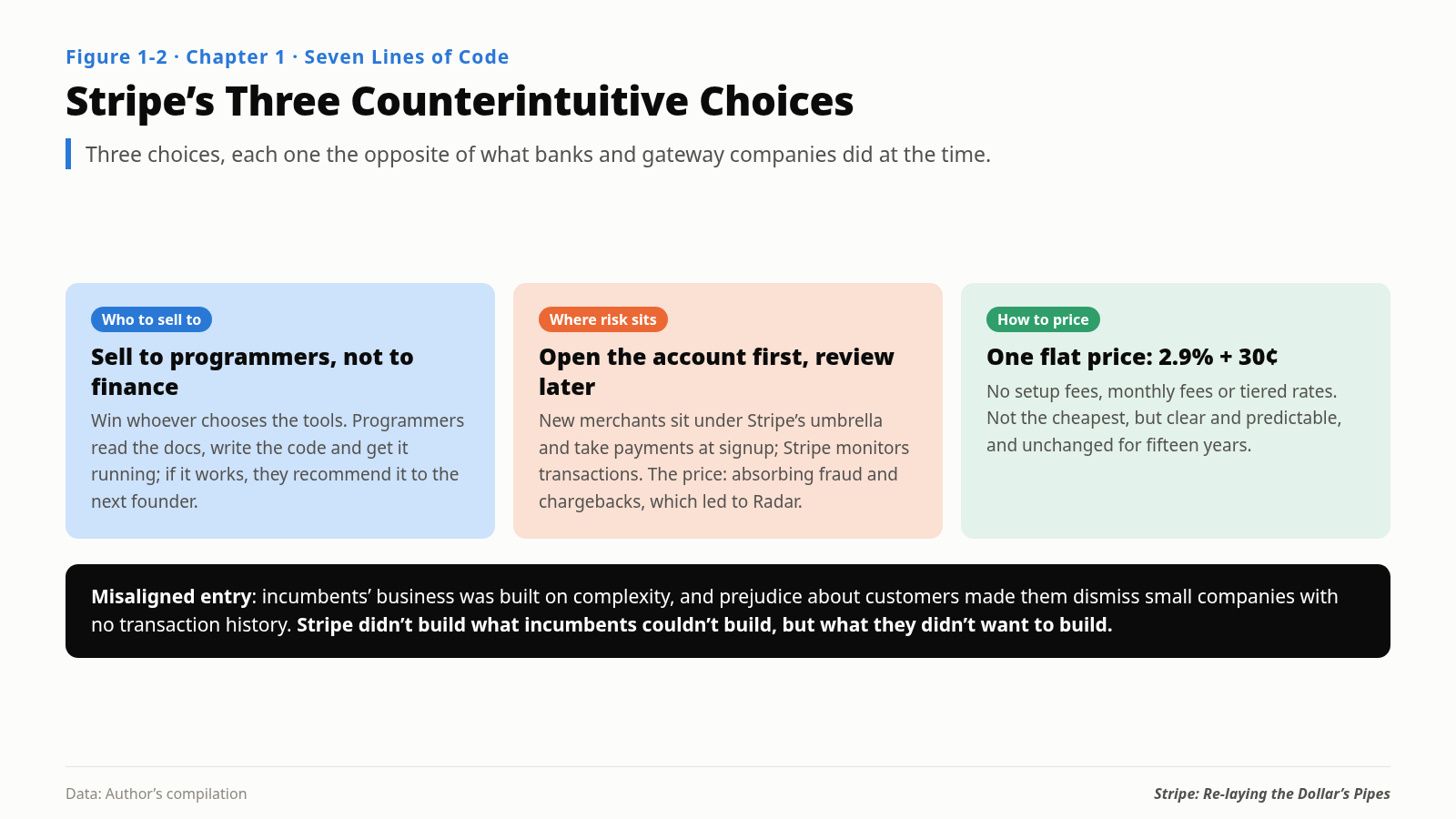
Looking back, Stripe’s way in was no mystery at all: developers hate filling out forms, so don’t make them. Why didn’t the banks, the gateway companies or PayPal do it?
First, the incumbents’ business was built on complexity. Tiered rates, monthly fees and setup fees were sources of revenue in themselves, and the more complicated the process, the more valuable the sales team. Cutting all that would mean cutting away part of their own profits and their own organization.
Second, the incumbents misjudged the customer. To a bank, a startup with no transaction history was a high-risk, low-value customer not worth serving. Stripe bet on exactly the opposite: that today’s small companies would grow into tomorrow’s big ones. The bet proved right. Stripe charges by transaction volume, so the more its customers sell, the more Stripe takes in; when a startup grows from a few hundred dollars a month to hundreds of millions of dollars a year, Stripe doesn’t spend a cent in extra sales costs. Later, platforms such as Lyft and Shopify used Stripe Connect to handle payments among multiple parties.
Third, the timing was right. Around 2010, mobile apps, subscription software, crowdfunding platforms and the sharing economy all took off at once. These new businesses all needed to get paid online, and what they needed was a set of tools they could combine freely in code, not a standardized checkout counter. By 2015, Stripe had about 200 employees and could already process transactions in 139 currencies. Its customers included Kickstarter and Salesforce, and it had integrated the newly launched Apple Pay.
Put these three points together and you get a pattern this book will see in Stripe again and again. I call it the “misaligned entry”: coming in where incumbents are unwilling to go because of their profit structure, organizational inertia or prejudice about customers. Stripe didn’t build something the incumbents couldn’t build. It built something the incumbents didn’t want to build.
The Economics Behind Seven Lines of Code
Stripe’s early “simplicity” came at a cost. Understanding those economics is the key to understanding why it later moved into crypto.
On a $100 US credit card transaction, the merchant pays Stripe $3.20 (2.9% plus 30 cents). But most of that $3.20 doesn’t stay with Stripe. It goes to the issuing bank as interchange, part goes to Visa or Mastercard as a network fee, and the acquiring bank takes a share too. What Stripe keeps is just a thin margin in the middle.
According to media reports, Stripe’s revenue in 2025 was about $6.8 billion, against payment volume of $1.9 trillion that year. Divide one by the other and Stripe kept only about 0.36% of transaction value. Stripe hasn’t confirmed this number, and the definitions may not line up perfectly with total payment volume, but the order of magnitude is clear: most of what merchants pay goes to the owners of the pipes, and Stripe gets only a small slice.
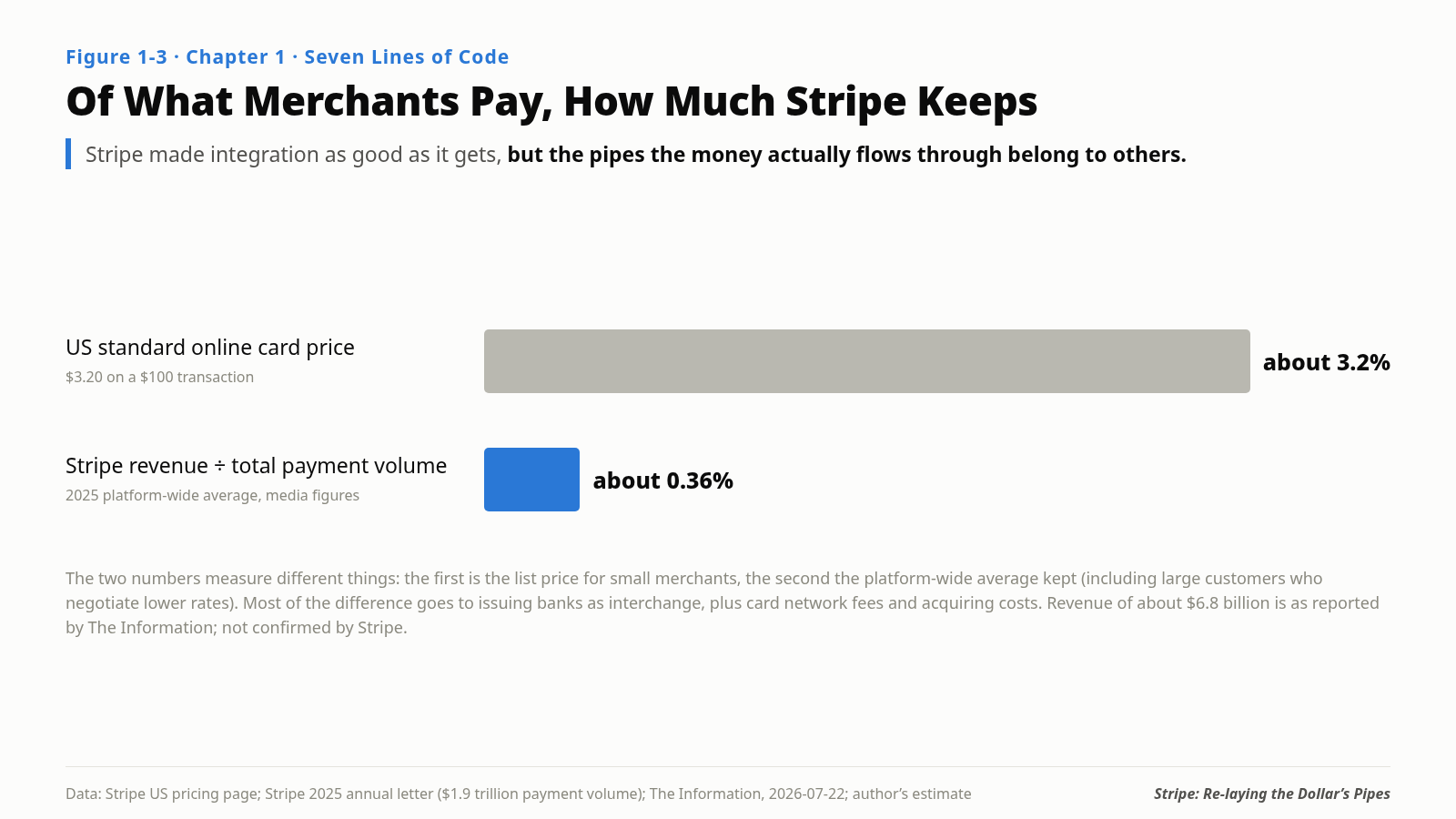
That’s the other side of “seven lines of code.” Stripe used software to take the complexity onto itself, but it stood on other people’s pipes. It could make integration as good as it gets, but it couldn’t change the rules or prices of the pipes. This structural constraint has been with it from 2011 to today, and it’s the source of the argument in the Introduction: stablecoins are Stripe’s first chance in fifteen years to own the whole pipeline.
One more detail is worth remembering. When Stripe resumed accepting crypto in 2024, it charged 1.5% on stablecoins, even though an onchain transfer costs less than a cent. Critics called it rent-seeking; supporters said it was the price of “abstracting away the complexity.” By November 2026, the stablecoin rate on the pricing page had come down to a promotional 0.8%. It’s almost exactly the same argument as in 2011: back then, too, people said 2.9% was too expensive, but founders were willing to pay for “works right away.” What Stripe has always sold isn’t the pipes. It’s not having to worry about the pipes.
Lessons for Other Companies
Stripe’s beginnings left founders four lessons that still hold.
1. Look for processes “designed for the wrong people.” In 2010, the payment process was designed for banks’ risk departments, but the people using it were programmers. Any industry where the people who use something and the people it was designed for don’t match hides a Stripe-style opportunity: tax filing, customs declarations, opening accounts across borders, corporate procurement… Today, stablecoin on- and off-ramps are still like this in many countries.
2. Risk can come later, but it can’t disappear. Stripe’s real innovation wasn’t short code; it was moving review from the front door to the back office. That made the user experience ten times better, at the cost of the company having to build risk capabilities better than a bank’s. Any company that wants to copy “use first, review later” should first ask itself: can you cover the bad debt and the fraud?
3. Win the person who chooses the tools first. Before Stripe, payments were sold to finance departments and bosses; Stripe sold to programmers. Whoever really decides which tools to use, win them first, even if they aren’t the one signing the check. Today, Stripe is repeating this playbook with payments for AI agents (see Chapter 9).
4. Do things that don’t scale, until they do. “Give me your laptop” doesn’t sound like something an infrastructure company should do. But every early user is a sample, and only by installing it yourself do you find out where people get stuck. Scale is the outcome, not the starting point.
The bottom line: Stripe didn’t understand payments better than the banks. It understood the people who use payments better than the banks did.
Data and Sources
Verified:
- The Collison brothers’ upbringing, teaching themselves to program, Patrick’s 2005 Young Scientist award, dropping out of MIT and Harvard: CNBC, 2017-03-20; Wikipedia entry “Patrick Collison.”
- Auctomatic joined YC in 2007 and was sold to Live Current Media for about $5 million in March 2008: CNBC, 2017-03-20; Startup Grind (Medium).
- Began building /dev/payments in 2010; first user was Ross Boucher of 280 North, who later joined Stripe: Startup Grind (Medium); Patrick Collison interview at Startup Grind.
- Seed round of about $2 million in 2011, investors including Thiel, Musk, Sequoia, Andreessen Horowitz and SV Angel; all three PayPal co-founders invested in Stripe: Wikipedia entry “Stripe, Inc.”; Business Insider, 2013-03.
- Public launch in September 2011: Wikipedia; multiple media outlets.
- Original text on the “Collison installation”: Paul Graham, “Do Things That Don’t Scale” (2013-07), republished by Business Insider.
- 2.9% plus 30 cents pricing; about 200 employees in 2015, 139 currencies, customers including Kickstarter and Salesforce, Apple Pay integration: CNBC, 2015-05-07; Stripe US pricing page.
- 2025 payment volume of $1.9 trillion: Stripe 2025 annual letter.
Media reports (not confirmed by Stripe):
- 2025 revenue of about $6.8 billion and free cash flow of about $3.2 billion: The Information, 2026-07-22, as cited by SaaStr and others. The 0.36% derived from this is the author’s estimate; whether revenue is reported gross or net has not been confirmed.
- Writing the prototype in Buenos Aires and handling early back-end steps by hand: Patrick Collison’s recollections in interviews, compiled from secondary sources.