
Chapter 1 A Chain's First Hundred Days
If you’re evaluating apps on a new chain, or trying to figure out how to read a new chain’s early numbers, start here. This chapter covers where Robinhood Chain began: what it was built to do, what actually happened in its first phase, and why the swings of that first phase say little about where it’s headed.
A broker built the chain. Memes got there first.
On July 1, 2026, Robinhood took the stage in London and switched on Robinhood Chain’s mainnet. It’s an Ethereum L2 built on the Arbitrum stack, with blocks roughly every 100 milliseconds and gas paid in ETH. Robinhood pitched it as “an AI-native blockchain built to bring real-world assets onchain.” The keynote was all about stock tokens, onchain lending and AI-agent trading, and the day-one partner list included Uniswap, Chainlink, Alchemy and BitGo.
But the first apps to hit scale on a new chain are rarely the ones it was built for, and Robinhood Chain was no exception. What took off first were token launchpads, which let anyone mint a new token and start trading it in under a minute.
New chains usually start this way. A chain needs its first users, its first liquidity and its first developers, and nothing has a lower barrier than launching and trading tokens. pump.fun played that role on Solana; a wave of launchpads played it on Base. Robinhood’s CEO said as much. “While we’re building Robinhood Chain to be the best chain for RWA,” Vlad Tenev posted on X a week after launch, “it works great for memes too.”
This chapter offers one rule for reading early data:
Phase-one activity comes from the easiest use case. Phase-two growth comes from what the chain was built to do. To read a new chain, track those two curves separately.
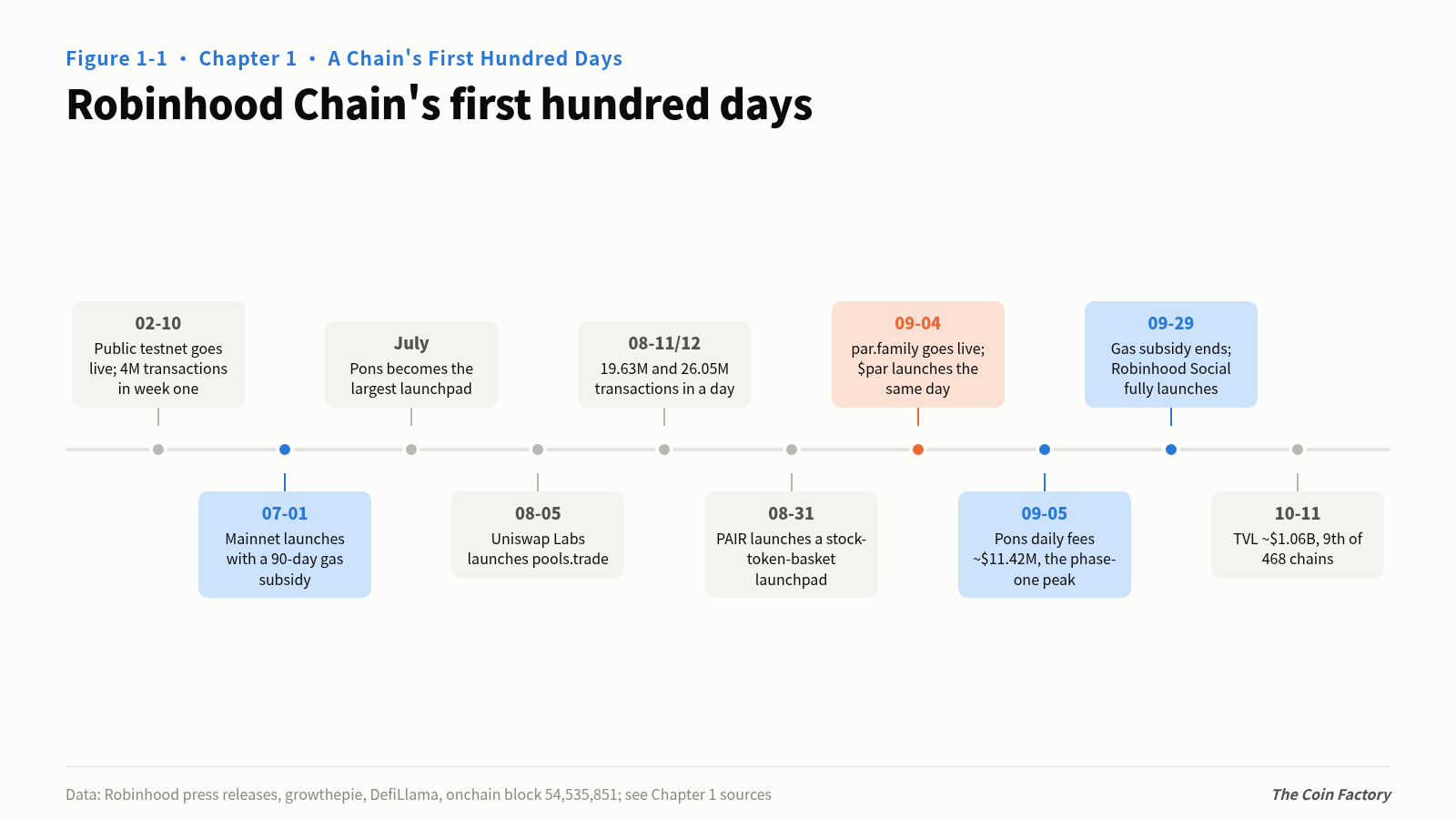
The first hundred days
| Date | Event | Data (source) |
|---|---|---|
| 2026-02-10 | Public testnet goes live | 4 million transactions in week one (Robinhood / The Block) |
| 2026-07-01 | Mainnet launches, along with a 90-day gas subsidy covering swaps made from Robinhood Wallet | Robinhood press release; subsidy scope per multiple reports |
| Mid-July | ~6 million daily transactions and 250,000+ daily active users, topping Base on some days | FalconX (2026-07-20, citing Artemis) |
| July | Pons becomes the chain’s largest launchpad | Early totals of ~$117 million in volume, 1.68 million transactions and nearly 98,000 wallets (CryptoRank, via Dune) |
| From July 2 | Virtuals adds support for launching AI-agent tokens on the chain; Bankr’s chat- and social-based token launches deploy here by default | Virtuals announcement; Bankr docs |
| July 21 | Robinhood extends AI-agent trading to crypto | Per a TrustSwap roundup |
| August | Daily average of ~11.06 million transactions for Aug 3–9; 19.63 million on Aug 11 and 26.05 million on Aug 12 | growthepie |
| 08-05 | Uniswap Labs launches its own launchpad, pools.trade | Per Decrypt / Yahoo Finance |
| 08-31 | PAIR launches a launchpad that pairs new tokens with baskets of stock tokens | GlobeNewswire |
| 09-04 | par.family goes live; its platform token, $par, launches the same day | Onchain, block 54,535,851 |
| 09-05 | Pons daily fees hit ~$11.42 million, the high-water mark of phase one | DefiLlama |
| September | The chain passes 30 launchpads | Per Yahoo Finance |
| 09-29 | Gas subsidy ends | Consistent across multiple reports |
| 09-29 | HOOD Summit 2026: Robinhood Social, the in-app trading community, exits beta (it had been in beta since March); Robinhood also unveils Robinhood Agents, plans for 24/7 stock trading and 15+ other products | Robinhood press release; Investing.com event transcript |
| 10-07 | PONS lists on Coinbase spot | Per AirdropAlert |
| 10-11 | Daily average of ~6.21 million transactions for Oct 2–8 (growthepie); TVL ~$1.06 billion, 9th of 468 chains; stablecoins ~$1.1 billion, up from ~$241 million on July 7 | DefiLlama |
Two curves
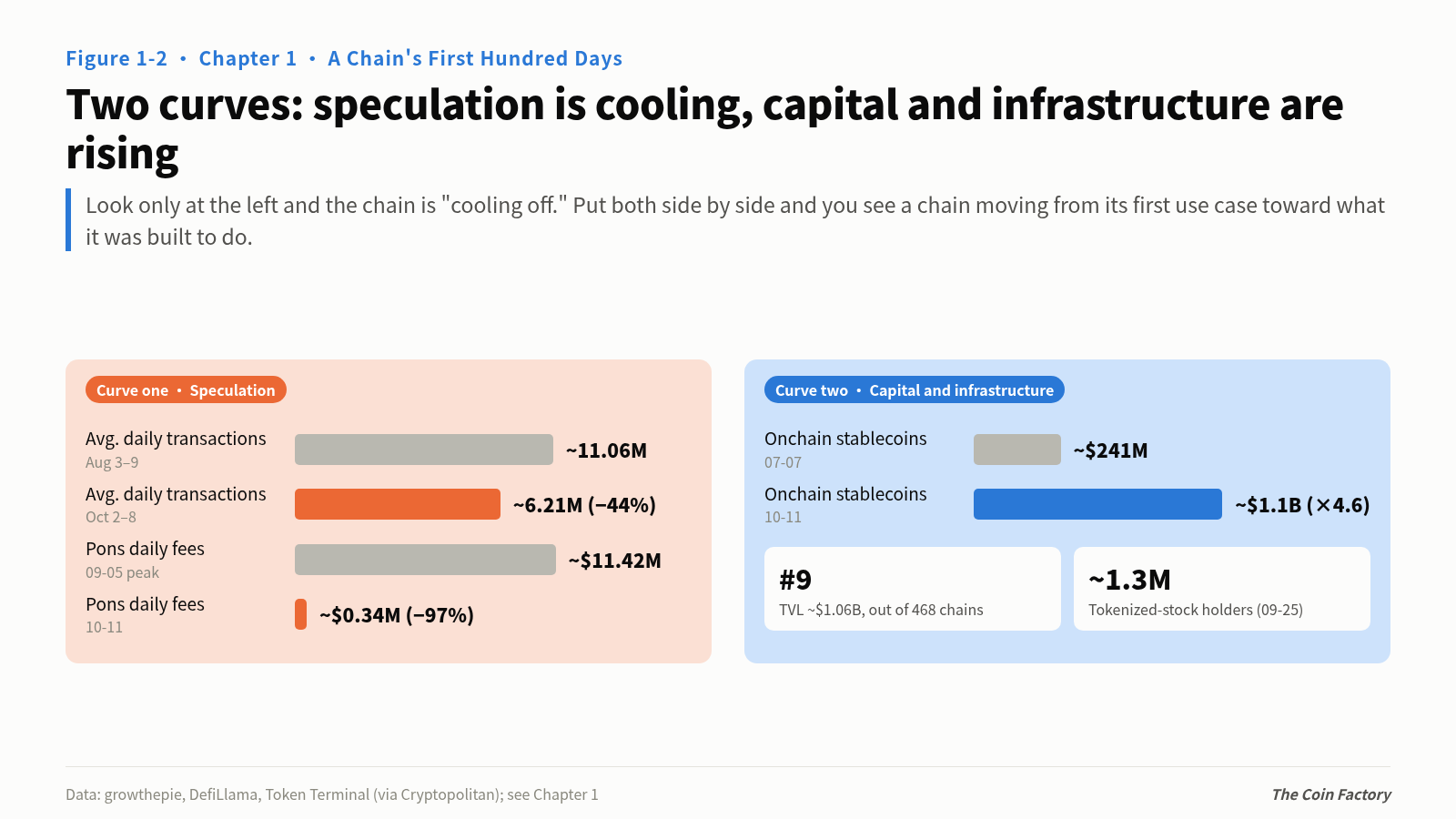
Sort these hundred days of data by what they measure, and you get two curves heading in opposite directions.
Curve one: speculation. Average daily transactions fell from about 11.06 million in the week of August 3–9 to about 6.21 million in the week of October 2–8, down 44%. Pons’s daily fees fell from a peak of about $11.42 million on September 5 to about $340,000 on October 11, down 97%. The curve has two peaks, one in mid-August and one in early September, and took another leg down around the end of the gas subsidy.
Curve two: capital and infrastructure. TVL broke into the top ten, stablecoins grew about 4.6x, and perpetuals volume rose 26% in a month (0xzx). Onchain RWA holders passed 420,000 about six weeks after launch (CryptoBriefing, 2026-08-10), and by September 25 the chain had about 1.3 million tokenized-stock holders, second only to BNB Chain (Token Terminal, via Cryptopolitan). AI-agent trading, lending and perps all landed inside Robinhood Wallet, and the infrastructure (Uniswap, 0x, Morpho, Lighter) is already in place.
Look only at the first curve and you’d say the chain is cooling off. Read the two together and you see a chain moving from its phase-one use case toward the job it was built for.
The gas subsidy: an amplifier, not fuel
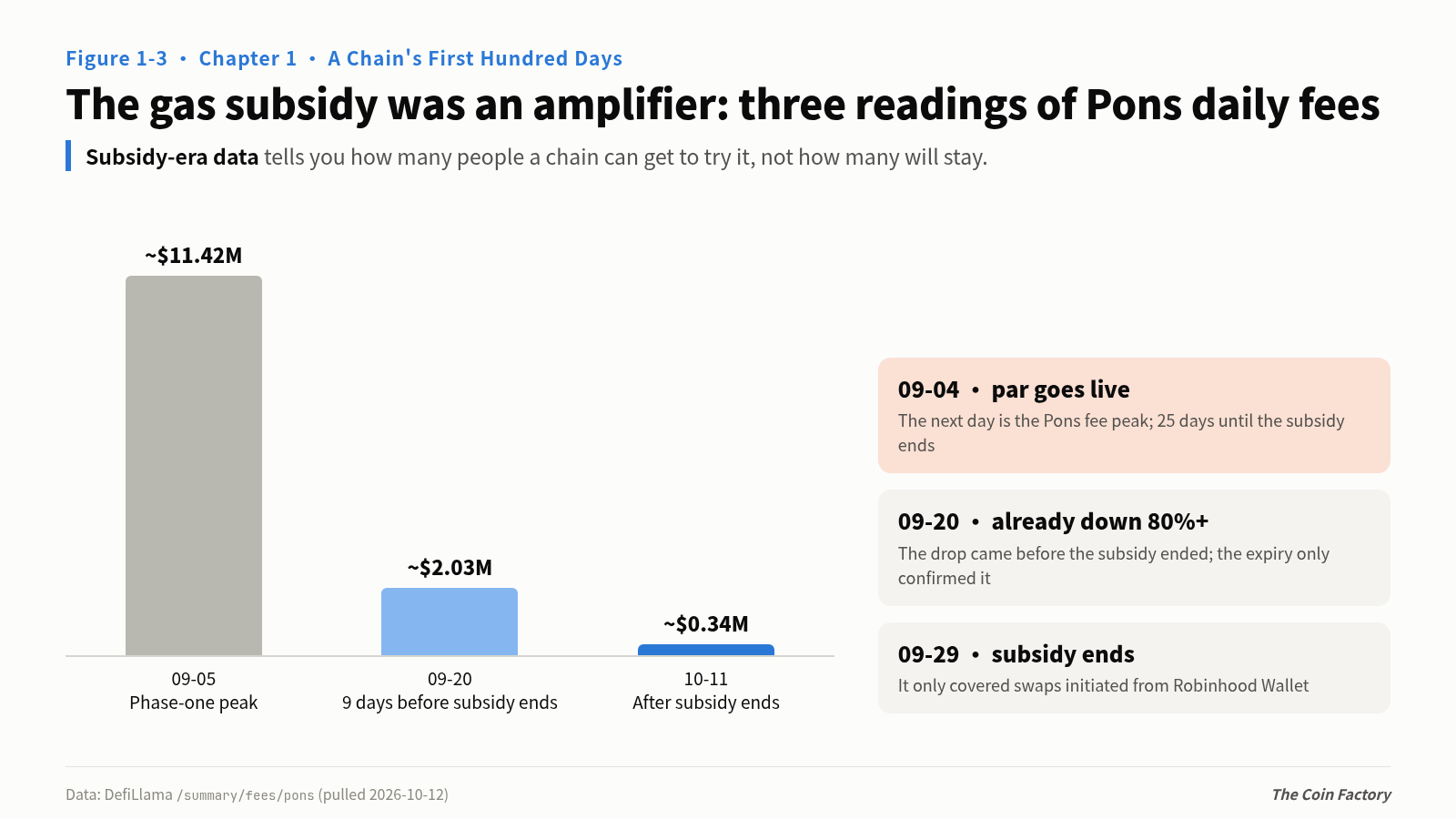
The 90-day gas subsidy only covered swaps made from Robinhood Wallet. Third-party wallets paid gas the whole time. Even so, it was enough to rewrite a launchpad’s unit economics: launching tokens and wash trading cost next to nothing, while the platform took a cut of every trade. Hence some extreme numbers from these hundred days: Noxa launched about 60,000 tokens in its first ten days, Pons topped 10,000 in a single day, and par launched 1,327 on September 26 (UTC) alone (par’s official indexer).
Once the subsidy ended, numbers like these were always going to come down, and that drop says more about the subsidy than about demand. DefiLlama data shows Pons’s fees had already fallen to about $2.03 million by September 20, more than 80% off the peak. The end of the subsidy just confirmed the trend. Subsidy-era data is a decent gauge of how many people a chain can get to try it, and a poor guide to how many will stay.
Where par fits on the timeline
par went live on September 4. The very next day, Pons’s daily fees peaked, and the gas subsidy ran out 25 days after that. By the time par arrived, the chain already had about 30 launchpads. It landed almost exactly at the crest of phase one, right before the ebb.
So par’s first-month numbers (Chapter 8) capture an unusual window: the tail end of phase one. They don’t show what par can do in the next phase, any more than Pons’s peak shows what normal looks like for Pons. This book uses par’s first month to understand how a launchpad makes money, and uses the technology and product analysis in Chapters 2–5 to judge whether par, and its rivals, can make the jump to the next phase.
Four rules for reading a new chain’s early data
Rule one: track the speculation curve and the infrastructure curve separately. Transactions, tokens launched and launchpad fees belong to the first. TVL, stablecoin supply, RWA holders and integrations by major protocols belong to the second.
Rule two: discount the data by the subsidy’s scope and length. You won’t see real activity levels until the first full quarter after a subsidy ends.
Rule three: watch what the chain itself is pushing. Robinhood is putting its resources into stock tokens, AI agents, and lending and perps inside the wallet. Where a chain keeps investing is usually where phase-two growth comes from.
Rule four: judge early apps by capability, not volume. The app with the most volume in phase one isn’t necessarily the best fit for phase two. Chapter 5 lays out a way to score launchpads against what the chain will need next.
The bottom line
A new chain’s first hundred days show you how many people it can draw in. What it was built to do decides how many stay.
Sources for this chapter
- Robinhood press release (2026-07-01): mainnet launch, positioning, day-one partners, Robinhood Wallet and agent trading
- @RobinhoodCrypto on X (2026-07-01): “An AI-native blockchain built to bring real-world assets onchain”
- Vlad Tenev on X (2026-07-08), as quoted by Fortune (2026-07-13) and Benzinga: “it works great for memes too”
- ArbitrumDAO Factsheet: mainnet date, testnet transaction count
- FalconX, Robinhood Chain Primer (2026-07-20, citing Artemis): onchain activity in mid-July
- CryptoRank (via Dune): early Pons data
- Virtuals Protocol announcement, Bankr docs: AI-agent token launches
- TrustSwap, Robinhood Chain Roadmap: date of the agent-trading expansion, RWA holders (citing CryptoBriefing). Secondary roundup, to be verified
- Crypto University, KuCoin News, Cabal Desk: gas subsidy length and scope
- growthepie (
v1/export/txcount.json, pulled 2026-10-12): daily transactions - DefiLlama API (pulled 2026-10-12): Pons fees, stablecoins, TVL and ranking
- Fomo Trading Guides (2026-09-11): Noxa token count. Affiliate site
- Decrypt / Yahoo Finance: pools.trade launch; GlobeNewswire: PAIR launch
- Robinhood press releases “Robinhood Social is Now in Beta” (2026-03-18) and “A Look Back on HOOD Summit: Engines of Creation” (2026-10-07); Investing.com transcript of HOOD Summit 2026: Robinhood Social’s full launch
- AirdropAlert (2026-10-08): PONS listing on Coinbase
- 0xzx (2026-10-11, citing DefiLlama, Bernstein): October onchain transactions, TVL, stablecoins, perps volume
- Onchain: par launch block and transaction (tx
0xd9981ad2…1532d)